



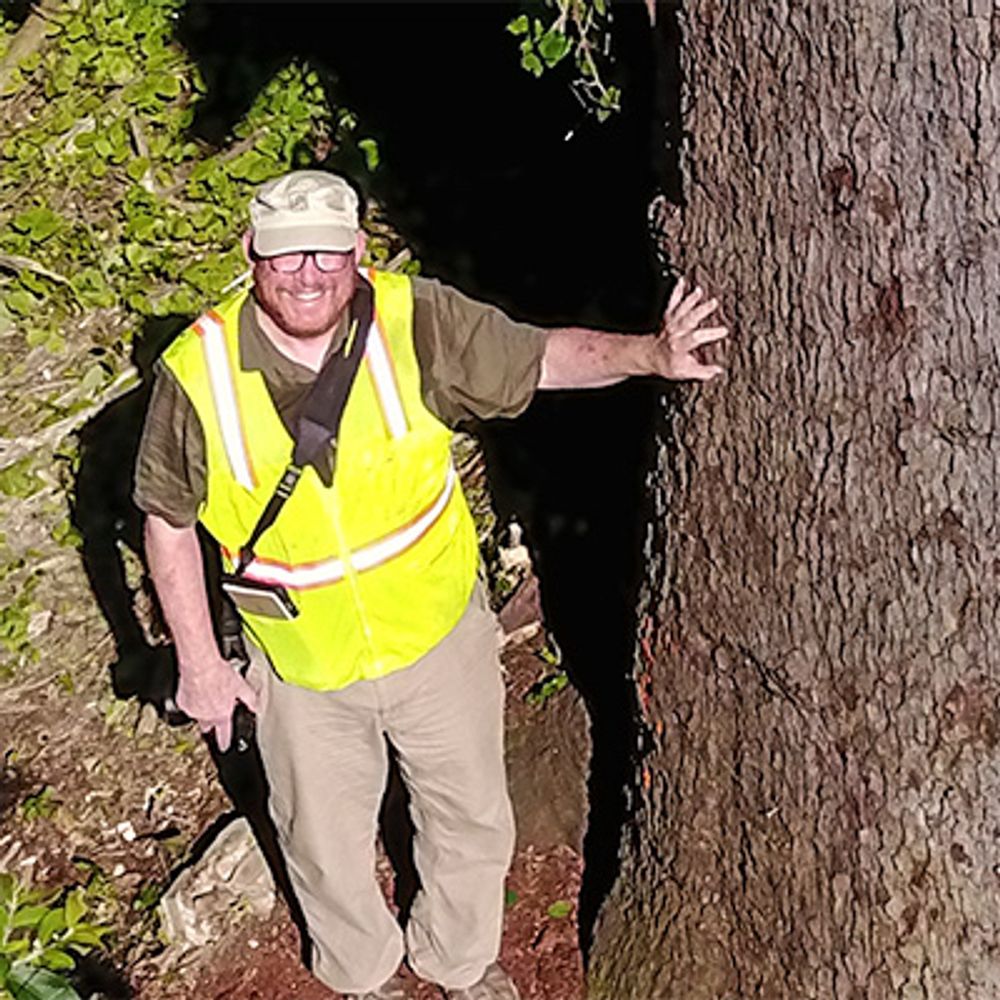
Tom Kimmerer, PhD
@tomkimmerer.bsky.social
I am a tree scientist and botanist writing about relationships between trees and humans including climate change. A Fulbright Scholar, Author of Venerable Trees and more books in progress. Read about trees here: https://ourtrees.substack.com.
Our Trees is now offering an opportunity for you to ask about trees now that Spring is arriving. Become a paid subscriber to Our Trees at our reduced rate, and join the conversation. It will be fun!

Spring is a good time to chat
Have questions about trees? Our chat is now open
open.substack.com
February 4, 2026 at 7:56 PM
Our Trees is now offering an opportunity for you to ask about trees now that Spring is arriving. Become a paid subscriber to Our Trees at our reduced rate, and join the conversation. It will be fun!
Don't you think it is more important to stay safe on the water before drowning?

February 3, 2026 at 4:20 PM
Don't you think it is more important to stay safe on the water before drowning?
A story about the amazing viola and two of its most notable performers. Some thoughts after watching Rebecca Albers perform a new work for viola and orchestra.

The amazing viola
Thoughts after a Minnesota Orchestra concert
substack.com
January 31, 2026 at 9:52 PM
A story about the amazing viola and two of its most notable performers. Some thoughts after watching Rebecca Albers perform a new work for viola and orchestra.
Technology is taking away our connections to each other and to the natural (i.e. real) world. @rebeccasolnit.bsky.social offers an insightful look into what is wrong and how to fix it. I hope everyone reads this.

What technology takes from us – and how to take it back | Rebecca Solnit
The long read: Decisions outsourced, chatbots for friends, the natural world an afterthought: Silicon Valley is giving us life void of connection. There is a way out – but it’s going to take collectiv...
www.theguardian.com
January 30, 2026 at 2:34 PM
Technology is taking away our connections to each other and to the natural (i.e. real) world. @rebeccasolnit.bsky.social offers an insightful look into what is wrong and how to fix it. I hope everyone reads this.
I just got a delivery that has taken more than two weeks to arrive. I suppose the weather is to blame. The order was for what in my family is known as Vitamin M and for which there is no substitute. The package arrived just in time to prevent serious consequences. Now for some vegan pancakes.

January 28, 2026 at 8:36 PM
I just got a delivery that has taken more than two weeks to arrive. I suppose the weather is to blame. The order was for what in my family is known as Vitamin M and for which there is no substitute. The package arrived just in time to prevent serious consequences. Now for some vegan pancakes.
Here is an ancient bur oak next to a young loblolly pine, on left in midwinter, and on right in summer. Today is a deeply cold winter day but the oak and pine are no longer dormant. A cold period has eliminated the inhibitors that prevent growth. The trees are ready to grow when it is warm enough.

Tom Kimmerer (@tomkimmerer)
Here is an ancient bur oak next to a young loblolly pine, on left in midwinter, and on right in summer. Today is a deeply cold winter day but the oak and pine are no longer dormant. Dormancy is the i...
substack.com
January 27, 2026 at 8:43 PM
Here is an ancient bur oak next to a young loblolly pine, on left in midwinter, and on right in summer. Today is a deeply cold winter day but the oak and pine are no longer dormant. A cold period has eliminated the inhibitors that prevent growth. The trees are ready to grow when it is warm enough.
Many of us are about to be visited by complex weather, possibly including ice storm. Ice can do major damage to trees, even kill them, but an ice-covered tree is hazardous to you. These trees should not be touched. Here are some simple suggestions for managing ice-covered trees.

Tom Kimmerer (@tomkimmerer)
Many of us are about to be visited by complex weather, perhaps including ice more than snow. Ice accumulation on trees is hazardous to you, your structures, and your trees. Here are a few suggestions ...
substack.com
January 24, 2026 at 4:49 PM
Many of us are about to be visited by complex weather, possibly including ice storm. Ice can do major damage to trees, even kill them, but an ice-covered tree is hazardous to you. These trees should not be touched. Here are some simple suggestions for managing ice-covered trees.
This free book is an excellent introduction to climate science for everyone.

Check out the new version of my climate science textbook. Free, accessible and online. Let me know what you think. open.oregonstate.education/climatescien...

Introduction to Climate Science
Introduction to climate science is for college students of both science and non-science majors and for everybody interested in the topic.
open.oregonstate.education
January 23, 2026 at 12:31 PM
This free book is an excellent introduction to climate science for everyone.
If you are an undergrad studying science, here is a great opportunity to spend the summer at Johns Hopkins doing molecular and cellular research in neuroscience. This could be the launch of your career, so check it out.

Applications for our summer internship program are open. This is a paid, 9 week experience designed to provide research experience to undergraduates interested in the neurosciences, especially as related to the molecular and cellular basis of neuropsychiatric disorders
www.libd.org/summer-inter...
www.libd.org/summer-inter...

Summer Internship
Summer internship
www.libd.org
January 21, 2026 at 2:02 PM
If you are an undergrad studying science, here is a great opportunity to spend the summer at Johns Hopkins doing molecular and cellular research in neuroscience. This could be the launch of your career, so check it out.
I begin my days with 4 cups of very good coffee. There is no doubt any more that coffee is a health drink. The challenge is to find ethically produced coffee. There are coffee roasters who buy directly from the producers, who are assured of a fair price. I like Little Waves, but there are others.

January 20, 2026 at 4:20 PM
I begin my days with 4 cups of very good coffee. There is no doubt any more that coffee is a health drink. The challenge is to find ethically produced coffee. There are coffee roasters who buy directly from the producers, who are assured of a fair price. I like Little Waves, but there are others.
While we wait for the trees to start their spring burst of growth, it is worth looking at winter details. The intricacy of the bark of this Kentucky coffeetree, Gymnocladus dioicus, is worthy of study, as is the bark of most trees. The coffeetree twig, stout with tiny buds, is very unusual.


January 19, 2026 at 9:52 PM
While we wait for the trees to start their spring burst of growth, it is worth looking at winter details. The intricacy of the bark of this Kentucky coffeetree, Gymnocladus dioicus, is worthy of study, as is the bark of most trees. The coffeetree twig, stout with tiny buds, is very unusual.
A stand of young chinkapin oak, Quercus muehlenbergii, basking in the winter sun. These trees are no longer dormant and are prepared to burst into growth on warm days.

Tom Kimmerer (@tomkimmerer)
This stand, possibly a clone, of chinkapin oak, Quercus muehelnbergii, is slowly getting ready for spring growth. Dormancy is finished, and we can begin to see signs of growth several months in advanc...
substack.com
January 17, 2026 at 10:07 PM
A stand of young chinkapin oak, Quercus muehlenbergii, basking in the winter sun. These trees are no longer dormant and are prepared to burst into growth on warm days.
In winter, when deciduous trees are bare, we can really appreciate the form of a tree. Here is a chinkapin oak, Quercus muehlenbergii, on a ridgetop in Nashville. It is now surrounded by young forest, but you can tell by its branch pattern that it grew in an open woodland pasture.

January 16, 2026 at 1:50 PM
In winter, when deciduous trees are bare, we can really appreciate the form of a tree. Here is a chinkapin oak, Quercus muehlenbergii, on a ridgetop in Nashville. It is now surrounded by young forest, but you can tell by its branch pattern that it grew in an open woodland pasture.
Like many of you, I like to give my favorite trees names. This is Eileen.
This oak is stable, but in karst topography, the underlying rock is not. As the rock shifts and sinkholes open, an old tree has to adjust it roots. You can see by the changing branch angles that this is a slow change.
This oak is stable, but in karst topography, the underlying rock is not. As the rock shifts and sinkholes open, an old tree has to adjust it roots. You can see by the changing branch angles that this is a slow change.

January 15, 2026 at 3:51 PM
Like many of you, I like to give my favorite trees names. This is Eileen.
This oak is stable, but in karst topography, the underlying rock is not. As the rock shifts and sinkholes open, an old tree has to adjust it roots. You can see by the changing branch angles that this is a slow change.
This oak is stable, but in karst topography, the underlying rock is not. As the rock shifts and sinkholes open, an old tree has to adjust it roots. You can see by the changing branch angles that this is a slow change.
I'm not pining for Spring. Yet. I do want to hang out with my bison friends soon. American bison, Bos bison bison, were abundant in the Bluegrass in ancient times. They, helped by drought, created the woodland pasture habitat that makes the Bluegrass landscape distinct.

January 14, 2026 at 4:10 PM
I'm not pining for Spring. Yet. I do want to hang out with my bison friends soon. American bison, Bos bison bison, were abundant in the Bluegrass in ancient times. They, helped by drought, created the woodland pasture habitat that makes the Bluegrass landscape distinct.
This is a great opportunity for a forest ecology PhD.
Apply for this fully funded PhD studentship in Tropical mountain forest ecology! Join us at University of Liverpool to carry out research on plant range shifts in the cloud forests. With: @fdraper.bsky.social @funkyant.bsky.social @jhomeier.bsky.social. Applications due Jan 21. tinyurl.com/23ary845

January 13, 2026 at 9:05 PM
This is a great opportunity for a forest ecology PhD.
We mostly talk about real trees here and at Our Trees. Here is a brief discussion of the Tree of Life and its first use in 1837 by Charles Darwin to describe evolutionary relationships. Have a look.

Tom Kimmerer (@tomkimmerer)
Trees are used as imagery for many purposes. A Tree of Life shows organisms and their evolutionary relationships.
In July 1837, Charles Darwin sketched the first tree to show evolutionary relationsh...
substack.com
January 13, 2026 at 5:02 PM
We mostly talk about real trees here and at Our Trees. Here is a brief discussion of the Tree of Life and its first use in 1837 by Charles Darwin to describe evolutionary relationships. Have a look.
It is still winter but many trees have already had their dormancy requirements met. On slightly warm sunny days, trees can absorb enough heat to stimulate sap flow. This cut maple branch dripped a lot of very sweet sap. Delicious. More to come on this important topic.

January 12, 2026 at 3:15 PM
It is still winter but many trees have already had their dormancy requirements met. On slightly warm sunny days, trees can absorb enough heat to stimulate sap flow. This cut maple branch dripped a lot of very sweet sap. Delicious. More to come on this important topic.
One of the reasons that trees are the longest-lived organisms is their remarkable ability to rebuild after stress or injury. This bur oak, growing in a woodland pasture, was struck by lightning more than 50 years ago. It has built a new crown and is growing with vigor.

January 11, 2026 at 5:20 PM
One of the reasons that trees are the longest-lived organisms is their remarkable ability to rebuild after stress or injury. This bur oak, growing in a woodland pasture, was struck by lightning more than 50 years ago. It has built a new crown and is growing with vigor.
My friend Kate Armstrong, @brainchain.ca, asked us to post pictures of roses, #PostMoreRoses, but in my catalog of over 200,000 botanical photos, there is not a single one of a rose. If we broaden to the family Rosaceae, we have this nice pear flower in the rain.

January 10, 2026 at 4:01 PM
My friend Kate Armstrong, @brainchain.ca, asked us to post pictures of roses, #PostMoreRoses, but in my catalog of over 200,000 botanical photos, there is not a single one of a rose. If we broaden to the family Rosaceae, we have this nice pear flower in the rain.
In nature, an organism may be both beautiful and terrifying. Take this sparkling emerald ash borer, Agrilus planipennis. The adults are ready to emerge in spring to wreak havoc on ash trees. More terrifying than a king cobra, but that is a story for next week.

January 9, 2026 at 2:56 PM
In nature, an organism may be both beautiful and terrifying. Take this sparkling emerald ash borer, Agrilus planipennis. The adults are ready to emerge in spring to wreak havoc on ash trees. More terrifying than a king cobra, but that is a story for next week.
Most of our trees are still in dormancy. Some of our earliest flowering trees, though, have minimal cold requirements to overcome dormancy. This male red maple flower is already showing off its stamens. Early flowers can be important sources of nutrition for insects that are active now.

January 7, 2026 at 4:21 PM
Most of our trees are still in dormancy. Some of our earliest flowering trees, though, have minimal cold requirements to overcome dormancy. This male red maple flower is already showing off its stamens. Early flowers can be important sources of nutrition for insects that are active now.
It takes only a couple of days of warmish weather and we all start longing for spring plants, don't we. Gardeners are guilty of this and so are naturalists. But we must be patient. Here is a sassafras inflorescence to remind us of what is to come.

January 5, 2026 at 10:19 PM
It takes only a couple of days of warmish weather and we all start longing for spring plants, don't we. Gardeners are guilty of this and so are naturalists. But we must be patient. Here is a sassafras inflorescence to remind us of what is to come.
Happy New Year! As I get back to writing, I'll tell you my little secret for concentrating. As a musician (violin, horn), I don't tolerate background music. Music prevents me from focusing on anything else. So I use train videos to help with concentration. RailCowGirl is my favorite.

Moonlit Train Ride Over The Mountain Pass Before Christmas in 4K
YouTube video by RailCowGirl
www.youtube.com
January 4, 2026 at 5:48 PM
Happy New Year! As I get back to writing, I'll tell you my little secret for concentrating. As a musician (violin, horn), I don't tolerate background music. Music prevents me from focusing on anything else. So I use train videos to help with concentration. RailCowGirl is my favorite.
Next week will be warm enough that I can sit at my favorite writing table between these two venerable trees (bur oak and blue ash) in a nearby park. In 1980, I began discussing climate change in all my public lectures and have continued while the world, especially the US, has failed to act.

January 3, 2026 at 6:42 PM
Next week will be warm enough that I can sit at my favorite writing table between these two venerable trees (bur oak and blue ash) in a nearby park. In 1980, I began discussing climate change in all my public lectures and have continued while the world, especially the US, has failed to act.