


Official account of the United Nations Environment Programme
https://www.unep.org/
The United Nations Environment Programme (UNEP) is responsible for coordinating responses to environmental issues within the United Nations System. It was established by Maurice Strong, its first director, after the United Nations Conference on the Human Environment in Stockholm in June 1972. Its mandate is to provide leadership, deliver science and develop solutions on a wide range of issues, including climate change, the management of marine and terrestrial ecosystems, and green economic development. The organization also develops international environmental agreements; publishes and promotes environmental science and helps national governments achieve environmental targets. .. more

UNEP supports policies that balance conservation with community needs, like sustainable fisheries & wildlife management.
Learn more: https://ow.ly/mMKl50XTW2n

But pollution, overuse, and warming threaten them.
Without action, the value of lake ecosystem services could drop by up to 20% by 2050: https://ow.ly/mEzL50XTVZP

Since 2010, solar and wind energy costs have plummeted due to technological advancements, making #ClimateAction more affordable.
Check out this UN article for facts: https://ow.ly/5HNl50XTVYI

Visit: https://www.unep.org/topics/digital-transformations/digital-accelerator-lab/digital-accelerator-lab-solutions

These ecosystems store up to 1,000 tonnes of carbon per hectare in their biomass and soils.
More info on the many benefits of mangroves: https://bit.ly/3KMibE0
Reposted by Mark Lubell

These ecosystems store up to 1,000 tonnes of carbon per hectare in their biomass and soils.
More info on the many benefits of mangroves: https://bit.ly/3KMibE0

Guided by science and empathy for people, he believed progress could gather pace and spent his life helping make it so.
His legacy lives on: bit.ly/3NalkEs
Reposted by UN Environment



His science-based, community-led work shaped policy and helped protect the biodiverse Western Ghats.
And why, in 2024, @unep.org honoured Madhav as a Champion of the Earth.
Read about his legacy: www.unep.org/championsofe...
The ocean supports humanity in countless ways, and when the ocean suffers, so do we. Instead of protecting it, we’ve polluted its depths and pushed it to the brink.
Learn about our efforts to #SaveOurOcean: www.unep.org/topics/ocean...

Yet, 10 million hectares are cleared annually by humans—equivalent to the size of Portugal.
UNEP supports the protection of these ecosystems: https://ow.ly/5UQP50XSSVm

Explore the latest #ClimateAction data and what can be done: bit.ly/44DCKyQ
Reposted by Beatriz Gallardo Paúls

More than 1,000 young people from 70 countries came together at the Youth Environment Assembly, a youth-led forum to shape priorities and policy solutions to some of the planet’s most pressing environmental challenges.
Read the 6 takeaways: www.unep.org/news-and-sto...
Reposted by Markus W. Gehring
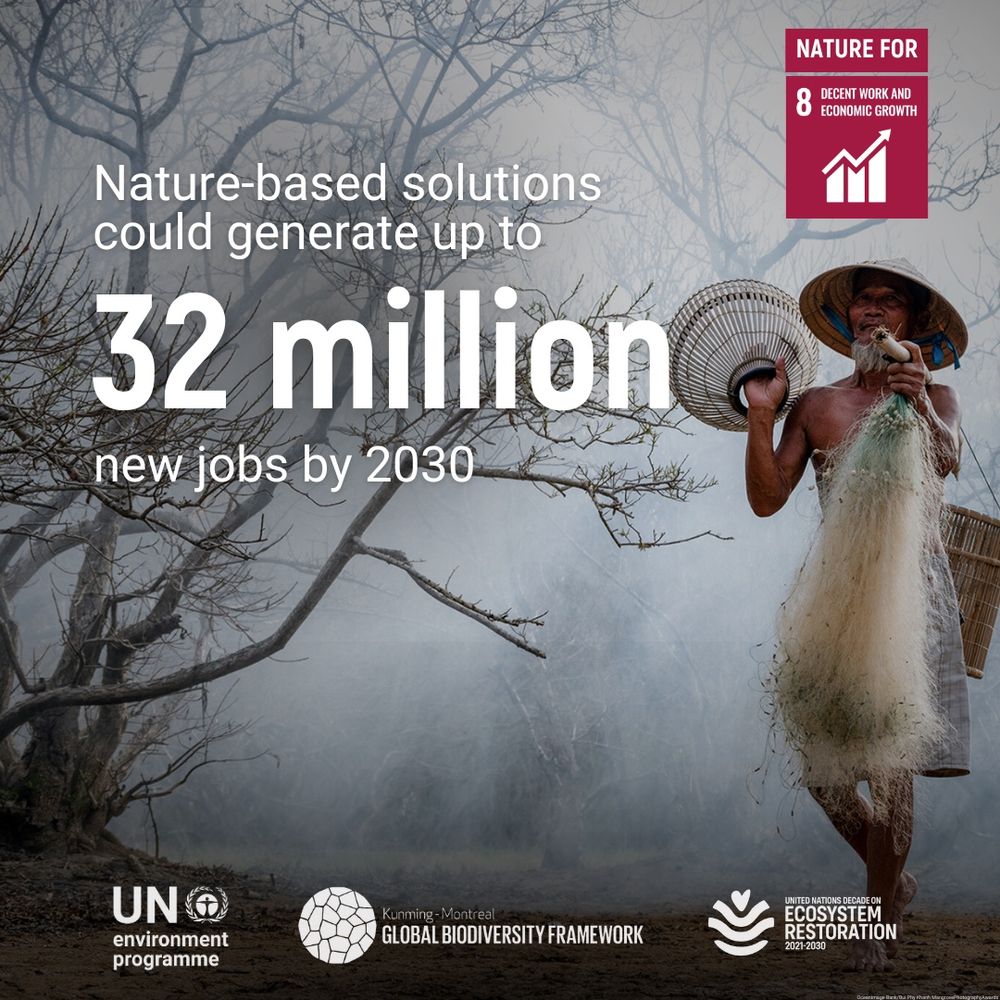
They offer affordable, effective ways to tackle climate change, biodiversity loss and pollution.
Explore how this approach works: unep.org/unep-and-nat...
Learn about these #EarthChamps fight for justice: www.unep.org/championsofe...

Governments must turn measurement into real cuts: https://www.unep.org/resources/eye-methane-2025-measurement-momentum
#CutMethane

See how this UNEP-supported, #GenerationRestoration project is making a difference for biodiversity: https://ow.ly/70xl50XRO5z

To achieve this, we regularly seek qualified professionals to join our talented team.
See current vacancies: https://unep.org/work-with-us

Discover how the #VanishingTreasures initiative is helping protect snow leopards, Bengal tigers, and mountain gorillas from #climatechange impacts, while supporting mountain communities.
vanishingtreasures.org
Reposted by Fabián Muniesa

Climate change directly impacts wildlife, outpacing species' ability to adapt, and indirectly accelerates habitat loss and ecosystem breakdown.
Stay updated on #ClimateAction news and data: bit.ly/44DCKyQ

It’s called the Fibonacci sequence, and it shows up in nature more often than one might think.
What are your favourite examples? 🌿🐌🥦🌲
Reposted by Stefan Reis

Pollution of the environment with antimicrobial-containing waste and runoff from factories, farms, hospitals, and other sources is contributing to its rise.
To reduce it, the 🌎 must #BeatChemicalPollution at source: www.unep.org/topics/pollu...
Reposted by Patrick A. Jansen

The @cms.int is the only international convention specialising in the conservation & sustainable use of migratory animals and their habitats.
Find out more: www.cms.int/what-are-mig...
Reposted by Stefan Reis, Peter Thorne

UNEP’s Eye on Methane shows the data is here, but action isn’t.
Governments must turn measurement into real cuts: www.unep.org/resources/ey...
#CutMethane #YearInReview

It’s urgent to expand marine protected areas & restore ocean habitats.
Together, we can turn the tide for the better: www.unep.org/events/confe...

Climate change refers to long-term temperature & weather shifts, which can occur naturally but have been mainly driven by human activity since the 1800s: www.un.org/en/climatech...

These shifts could unlock up to US$100 trillion in benefits every year.
Explore more: www.unep.org/news-and-sto...
Reposted by Thomas A. Tweed

But nature is in crisis. Biodiversity loss is accelerating at an unprecedented rate. One million animal & plant species are threatened with extinction.
Take action #ForNature today & every day: www.unep.org/topics/natur...

Hope isn’t always tangible, but it’s there:
in rivers being restored,
forests being replanted,
wildlife being protected,
and every act of care that helps a community heal.
🌿 It’s in more places than we might think.
What gives you hope?

🍂 Fallen leaves become soil 🦌 Animal droppings nourish plants 🪵 Dead trees become shelter 🪱 Worms turn scraps into compost
As we step into a #NewYear, let’s take inspiration from the ecosystems around us & #BeatWastePollution

People cannot fully enjoy human rights without a safe, clean, and healthy environment - and vice versa.
See what UNEP is doing to make environmental protection more accessible to people: bit.ly/4sampfm