Vegard Skirbekk
banner
vegardskirbekk.bsky.social
Vegard Skirbekk
@vegardskirbekk.bsky.social

Global Demography, Fertility, Aging, Cognition, Productivity, Religion. Interdisciplinarity.

Professor Columbia & Oslo - PI @theCEFH

https://scholar.google.com/citations?hl=no&user=OZOgxGEAAAAJ&view_op=list_works&sortby=pubdate
. .. more

Vegard Skirbekk is a Norwegian population economist and social scientist specializing in demographic analysis and cohort studies. He is a senior researcher at the Norwegian Institute of Public Health and also Professor of Population and Family Health at the Columbia Aging Center at Columbia University. .. more
Sociology 22%
Political science 22%
Pinned
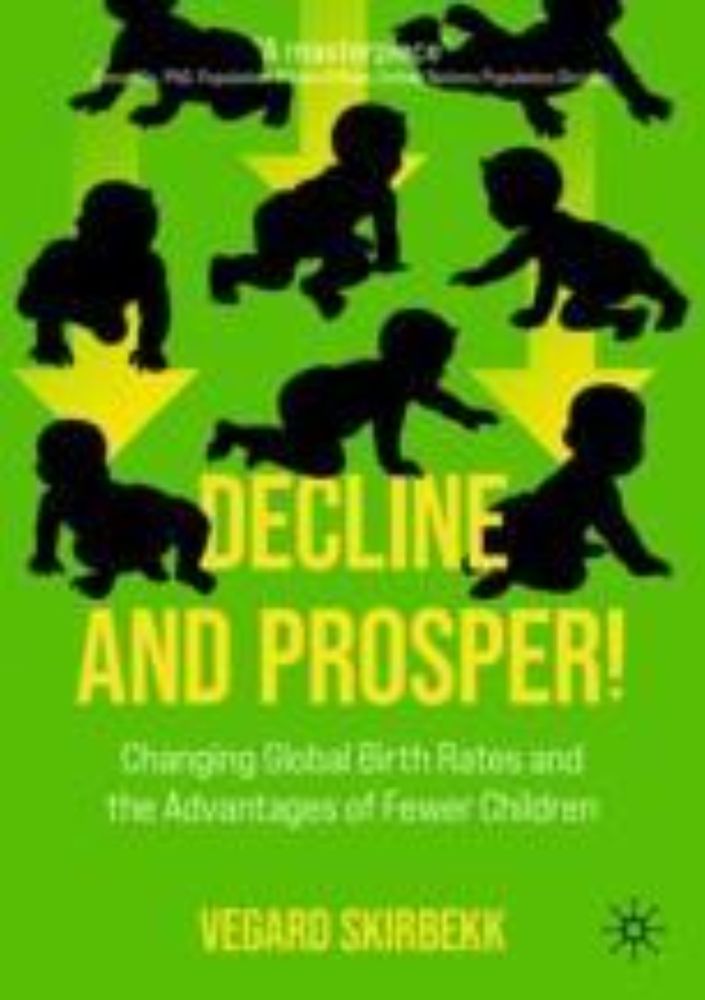
My book, "Decline and Prosper!", presents a comprehensive and evidence-based overview of the causes and consequences of global fertility decline.
I argue that low fertility is inevitable, yet also has positive effects. We should help people have the children they want bit.ly/35Hm3Yk
Decline and Prosper!
This book considers the historical context as well as the full breadth of factors that drive fertility rates across the globe.
bit.ly

Reposted by Vegard Skirbekk

New PostDoc opportunity at HOMME🎓
www.sv.uio.no/psi/english/...

We offer a 3 or 4 year Postdoctoral opportunity in the HOMME project in Oslo - www.jobbnorge.no/en/available...
Health, cognition, family, and employment among men (HOMME) - Department of Psychology
The project will examine men’s family, work, health and cognition in Norway particularly during the life period most characterized by family transitions and work experiences.
www.sv.uio.no

Reposted by Vegard Skirbekk

I’m very happy to share our new paper with Mariana Calderón-Jaramillo and colleagues Jeroen Spijker and Elisenda Renteria.. The study measures the Years of Life Expectancy with Care Needs combining (multi)morbidity and social care needs states. Link: link.springer.com/article/10.1...

Reposted by Vegard Skirbekk

Some hope that preferences for human interactions will save jobs from automation, but I think we often prefer being served by robots.

From my latest issue, where I also cover progress on crime, AI forecasting progress, belief in Anthropic, and much else.

www.update.news/p/the-prefer...

Reposted by Vegard Skirbekk

Our new Lancet study from the Norwegian HUNT cohort shows that modifying risk factors across adulthood relat to dementia, including family and work-related factors. www.thelancet.com/action/showP...
www.thelancet.com

Reposted by Vegard Skirbekk

In 1966, Japan's Fire Horse year superstition led to a ~25% drop in births due to fears about girls' futures. A study confirmed women born then faced no disadvantages in education, marriage rates, or household resources
Will fertility of 2026 be affected? 🤔
link.springer.com/article/10.1...
Superstition effects versus cohort effects: is it bad luck to be born in the year of the fire horse in Japan? - Review of Economics of the Household
The year of the fire horse (called “Hinoeuma” in Japanese) is one of the sixty Chinese zodiac symbols used to count years. According to superstition, fire horse women are said to have troubled marriag...
link.springer.com

Our paper "Potentially modifiable risk factors for dementia in Norway (HUNT4 70+)" is out & open access in Lancet Healthy Longevity!

Direct link: authors.elsevier.com/sd/article/S... Grateful to the team % participants.
ScienceDirect.com | Science, health and medical journals, full text articles and books.
authors.elsevier.com

Reposted by Vegard Skirbekk

Great answers! One thing I keep forgetting to mention, which @vegardskirbekk.bsky.social draws out in his book, is the importance of healthy aging as one solution to lower birth rates (which also comes from family-friendly and human capital investment)
Good! An early insight of human centered design is that it was possible to reduce airplane crashes by introducing tactile switches and toggle that did not create confusion or require people to take their eyes away from their core tasks donmoynihan.substack.com/p/the-origin...

New study on rapidly decreasing mortality among those with Down syndrome
Changes in survival probabilities and mortality risks among population living with Down syndrome born 1967–2018: a Norwegian registry-based study
eur04.safelinks.protection.outlook.com

Is Religiosity Related to the Risk of Technology-Induced Job Loss?
New study with Morten Blekesaune using large scale population data on the relationship between job loss risk and religiosity
www.scup.com/doi/abs/10.1...
Is Religiosity Related to the Risk of Technology-Induced Job Loss?
This study tests a hypothesis that religious individuals are less likely than non-religious individuals to work in occupations associated with a risk of technology-induced job loss due to a general te...
www.scup.com

Reposted by Vegard Skirbekk

Globally, more than one out of three births now occur to women aged 30 and above, compared to only one in four in 1990. New paper by Thomas Spoorenberg & @vegardskirbekk.bsky.social
<em>Population and Development Review</em> | Population Council Journal | Wiley Online Library
This study documents the concentration of childbearing to later reproductive ages, analyzing global patterns of fertility postponement from 1950 to 2040. We study late fertility (ages 30+) and very l...
onlinelibrary.wiley.com

We study late fertility (ages 30+) and very late fertility (ages 35+) trends at the global, subregional, and national levels. Globally, more than one out of three births in 2023 occurs to women aged 30 and above, compared to only one in four in 1990.

doi.org/10.1111/padr...
<em>Population and Development Review</em> | Population Council Journal | Wiley Online Library
This study documents the concentration of childbearing to later reproductive ages, analyzing global patterns of fertility postponement from 1950 to 2040. We study late fertility (ages 30+) and very l....
doi.org

Interview on global population change with Chris Bystroff, a Professor at Rensselaer Polytechnic Institute (RPI) in New York, where he heads a lab funded by NSF:

Bystroff concludes:

"I believe we will Decline and Prosper (book by Vegard Skirbekk)."

www.resilience.org/stories/2024...
Is World Population Peaking Now?
I think population decline will be a relief, like an escape valve in a pressure cooker. As we shrink in numbers we will grow in other areas, like resources per capita and free time.
www.resilience.org