



Alex MacKay
@amackay.bsky.social
Economist and professor at the University of Virginia.
www.alexandermackay.org
www.alexandermackay.org
The paper, joint with Chiara Farronato and
@andreyfradkin.bsky.social , is now available as an NBER working paper.
@nber.org link: nber.org/papers/w34135
@ssrn.bsky.social link: ssrn.com/abstract=538...
#EconSky
@andreyfradkin.bsky.social , is now available as an NBER working paper.
@nber.org link: nber.org/papers/w34135
@ssrn.bsky.social link: ssrn.com/abstract=538...
#EconSky
August 19, 2025 at 5:44 PM
The paper, joint with Chiara Farronato and
@andreyfradkin.bsky.social , is now available as an NBER working paper.
@nber.org link: nber.org/papers/w34135
@ssrn.bsky.social link: ssrn.com/abstract=538...
#EconSky
@andreyfradkin.bsky.social , is now available as an NBER working paper.
@nber.org link: nber.org/papers/w34135
@ssrn.bsky.social link: ssrn.com/abstract=538...
#EconSky
Our findings suggest that policymakers and regulators should exercise caution when the assessing the role of vertically integrated products and services on platforms.
Even corrections for self-preferencing can reduce consumer welfare, as we show in the paper.
Even corrections for self-preferencing can reduce consumer welfare, as we show in the paper.
August 19, 2025 at 5:44 PM
Our findings suggest that policymakers and regulators should exercise caution when the assessing the role of vertically integrated products and services on platforms.
Even corrections for self-preferencing can reduce consumer welfare, as we show in the paper.
Even corrections for self-preferencing can reduce consumer welfare, as we show in the paper.
A big reason why is that tastes vary, and some consumers have a preference for Amazon products. Amazon brands add about 5% to consumer surplus in the short run.
This effect varies a lot across categories. We found the largest benefits in acid reducers and batteries.
This effect varies a lot across categories. We found the largest benefits in acid reducers and batteries.

August 19, 2025 at 5:44 PM
A big reason why is that tastes vary, and some consumers have a preference for Amazon products. Amazon brands add about 5% to consumer surplus in the short run.
This effect varies a lot across categories. We found the largest benefits in acid reducers and batteries.
This effect varies a lot across categories. We found the largest benefits in acid reducers and batteries.
We found:
1. Consumers select similar products when Amazon brands are not available
2. No evidence for changes in search behavior
3. No evidence for shifts to other retailers
Despite these findings, we still found that consumers valued Amazon brands!
1. Consumers select similar products when Amazon brands are not available
2. No evidence for changes in search behavior
3. No evidence for shifts to other retailers
Despite these findings, we still found that consumers valued Amazon brands!
August 19, 2025 at 5:44 PM
We found:
1. Consumers select similar products when Amazon brands are not available
2. No evidence for changes in search behavior
3. No evidence for shifts to other retailers
Despite these findings, we still found that consumers valued Amazon brands!
1. Consumers select similar products when Amazon brands are not available
2. No evidence for changes in search behavior
3. No evidence for shifts to other retailers
Despite these findings, we still found that consumers valued Amazon brands!
We also used structural modeling to quantify the benefits to consumers of Amazon products and simulate the potential price effects of having low-cost Amazon brands.
August 19, 2025 at 5:44 PM
We also used structural modeling to quantify the benefits to consumers of Amazon products and simulate the potential price effects of having low-cost Amazon brands.
Using a custom browser extension we designed, we hid Amazon brands from a random subset of shoppers.
We then looked at:
- What products were selected in their absence
- If consumer search behavior changed
- If consumers went to other retail websites more often
We then looked at:
- What products were selected in their absence
- If consumer search behavior changed
- If consumers went to other retail websites more often
August 19, 2025 at 5:44 PM
Using a custom browser extension we designed, we hid Amazon brands from a random subset of shoppers.
We then looked at:
- What products were selected in their absence
- If consumer search behavior changed
- If consumers went to other retail websites more often
We then looked at:
- What products were selected in their absence
- If consumer search behavior changed
- If consumers went to other retail websites more often
There is more in the paper, including how dynamics in bargaining translate to dynamic in pass-through.
@nberpubs
link here: nber.org/papers/w34110
Also available on SSRN: dx.doi.org/10.2139/ssrn...
Joint with Santiago Alvarez-Blaser, Alberto Cavallo, and Paolo Mengano
#econsky
@nberpubs
link here: nber.org/papers/w34110
Also available on SSRN: dx.doi.org/10.2139/ssrn...
Joint with Santiago Alvarez-Blaser, Alberto Cavallo, and Paolo Mengano
#econsky

Markups and Cost Pass-through Along the Supply Chain
Founded in 1920, the NBER is a private, non-profit, non-partisan organization dedicated to conducting economic research and to disseminating research findings among academics, public policy makers, an...
nber.org
August 11, 2025 at 2:11 PM
There is more in the paper, including how dynamics in bargaining translate to dynamic in pass-through.
@nberpubs
link here: nber.org/papers/w34110
Also available on SSRN: dx.doi.org/10.2139/ssrn...
Joint with Santiago Alvarez-Blaser, Alberto Cavallo, and Paolo Mengano
#econsky
@nberpubs
link here: nber.org/papers/w34110
Also available on SSRN: dx.doi.org/10.2139/ssrn...
Joint with Santiago Alvarez-Blaser, Alberto Cavallo, and Paolo Mengano
#econsky
The model helps explain the observed patterns. It allows us to interpret manufacturer-retailer profit shifts as changes in bargaining leverage.
We evaluate the drivers of this leverage. The manufacturer gets a higher split with (e.g.) lower costs and greater market penetration.
We evaluate the drivers of this leverage. The manufacturer gets a higher split with (e.g.) lower costs and greater market penetration.
August 11, 2025 at 2:11 PM
The model helps explain the observed patterns. It allows us to interpret manufacturer-retailer profit shifts as changes in bargaining leverage.
We evaluate the drivers of this leverage. The manufacturer gets a higher split with (e.g.) lower costs and greater market penetration.
We evaluate the drivers of this leverage. The manufacturer gets a higher split with (e.g.) lower costs and greater market penetration.
Given the heterogeneity in product-level markups and the stability over time, we model pricing as occurring in two stages:
1. The manufacturer proposes downstream retail prices.
2. The manufacturer and retailers bargain over the wholesale price (and/or lump sum transfers).
1. The manufacturer proposes downstream retail prices.
2. The manufacturer and retailers bargain over the wholesale price (and/or lump sum transfers).
August 11, 2025 at 2:11 PM
Given the heterogeneity in product-level markups and the stability over time, we model pricing as occurring in two stages:
1. The manufacturer proposes downstream retail prices.
2. The manufacturer and retailers bargain over the wholesale price (and/or lump sum transfers).
1. The manufacturer proposes downstream retail prices.
2. The manufacturer and retailers bargain over the wholesale price (and/or lump sum transfers).
We document supply chain markups in the US, the UK, Canada, and Mexico. We find several similarities, though the split of markups between manufacturers and retailers varies across countries.

August 11, 2025 at 2:11 PM
We document supply chain markups in the US, the UK, Canada, and Mexico. We find several similarities, though the split of markups between manufacturers and retailers varies across countries.
But: manufacturer and retailer markups move up and down quite a bit. Retail markups fell at the end of 2020 and increased starting in 2022. Manufacturer markups did the opposite.
The movements offset each other, leading to stable total markups.
The movements offset each other, leading to stable total markups.

August 11, 2025 at 2:11 PM
But: manufacturer and retailer markups move up and down quite a bit. Retail markups fell at the end of 2020 and increased starting in 2022. Manufacturer markups did the opposite.
The movements offset each other, leading to stable total markups.
The movements offset each other, leading to stable total markups.
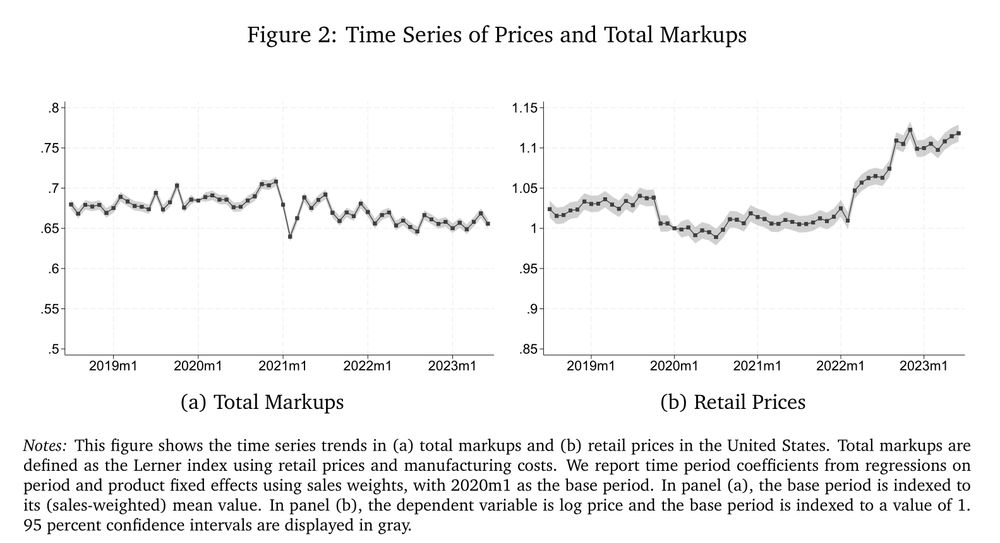
In the US, total product markups are around 0.67 and relatively flat from July 2018 through June 2023.
Retail prices increase starting in 2022, coinciding with general inflation.
But there is no increase in total markups, i.e., no evidence for "greedflation."
Retail prices increase starting in 2022, coinciding with general inflation.
But there is no increase in total markups, i.e., no evidence for "greedflation."
August 11, 2025 at 2:11 PM
In the US, total product markups are around 0.67 and relatively flat from July 2018 through June 2023.
Retail prices increase starting in 2022, coinciding with general inflation.
But there is no increase in total markups, i.e., no evidence for "greedflation."
Retail prices increase starting in 2022, coinciding with general inflation.
But there is no increase in total markups, i.e., no evidence for "greedflation."
Link here: www.nber.org/papers/w34070

Algorithmic Coercion with Faster Pricing
Founded in 1920, the NBER is a private, non-profit, non-partisan organization dedicated to conducting economic research and to disseminating research findings among academics, public policy makers, an...
www.nber.org
July 28, 2025 at 5:18 PM
Link here: www.nber.org/papers/w34070
Link here: alexandermackay.org/files/Algori...
This is joint work with Zach Brown. Comments welcome.
I'll wrap up this thread with a question:
What are some examples where you think pricing speed matters?
This is joint work with Zach Brown. Comments welcome.
I'll wrap up this thread with a question:
What are some examples where you think pricing speed matters?
alexandermackay.org
May 27, 2025 at 5:41 PM
Link here: alexandermackay.org/files/Algori...
This is joint work with Zach Brown. Comments welcome.
I'll wrap up this thread with a question:
What are some examples where you think pricing speed matters?
This is joint work with Zach Brown. Comments welcome.
I'll wrap up this thread with a question:
What are some examples where you think pricing speed matters?
This has implications for the pricing technology that platforms make available to sellers on the platform. Platforms that prioritize profits might allow some sellers faster pricing algorithms, as this softens competition without explicit coordination.
May 27, 2025 at 5:41 PM
This has implications for the pricing technology that platforms make available to sellers on the platform. Platforms that prioritize profits might allow some sellers faster pricing algorithms, as this softens competition without explicit coordination.