



Antoine Dujon
@amdujon.bsky.social
Scientist studying how cancer shapes the evolution of species.
Deakin University and French CNRS.
Deakin University and French CNRS.
🚨 📰 Evolutionary Applications is launching a special issue on the theme of Evolutionary Medicine for which I am honoured to be an editor. 📰🚨 LINK BELOW 👇 👇👇

December 10, 2025 at 10:51 PM
🚨 📰 Evolutionary Applications is launching a special issue on the theme of Evolutionary Medicine for which I am honoured to be an editor. 📰🚨 LINK BELOW 👇 👇👇
New IScience paper (link to the article bellow):
Invasive species that are really good with dealing with DNA damages and repairing them are a problem for our ecosystems and we tested this using freshwater planaria. (1/4)
Invasive species that are really good with dealing with DNA damages and repairing them are a problem for our ecosystems and we tested this using freshwater planaria. (1/4)

December 10, 2025 at 12:45 AM
New IScience paper (link to the article bellow):
Invasive species that are really good with dealing with DNA damages and repairing them are a problem for our ecosystems and we tested this using freshwater planaria. (1/4)
Invasive species that are really good with dealing with DNA damages and repairing them are a problem for our ecosystems and we tested this using freshwater planaria. (1/4)
Species named after celebrities receive more attention than others. Big effect for invertebrates!
conbio.onlinelibrary.wiley.com/doi/10.1111/...
conbio.onlinelibrary.wiley.com/doi/10.1111/...

December 9, 2025 at 3:08 AM
Species named after celebrities receive more attention than others. Big effect for invertebrates!
conbio.onlinelibrary.wiley.com/doi/10.1111/...
conbio.onlinelibrary.wiley.com/doi/10.1111/...
🚨In our latest preprint 🚨 we discovered that tumour prevalence is higher among captive species that enjoy greater public and scientific popularity and this is creating serious bias in comparative oncology studies (link to the paper bellow).
Here is what we found 👇👇👇
Here is what we found 👇👇👇

September 29, 2025 at 6:57 PM
🚨In our latest preprint 🚨 we discovered that tumour prevalence is higher among captive species that enjoy greater public and scientific popularity and this is creating serious bias in comparative oncology studies (link to the paper bellow).
Here is what we found 👇👇👇
Here is what we found 👇👇👇
A tumoural hydra from my laboratory with a lot of supernumerary tentacles (only tumoural individuals develop that many tentacles), and a little bud growing on top of it. We nickname those hydras "pumpkin" because the tumour grow so big it turns hydras into a pumpkin shape.

September 9, 2025 at 1:21 AM
A tumoural hydra from my laboratory with a lot of supernumerary tentacles (only tumoural individuals develop that many tentacles), and a little bud growing on top of it. We nickname those hydras "pumpkin" because the tumour grow so big it turns hydras into a pumpkin shape.
A pleasure to have contributed to this very stimulating manuscript proposing a novel hypothesis on how some pathologies of senescence structure themselves to persist over period of time of years to decades.
onlinelibrary.wiley.com/doi/10.1111/...
onlinelibrary.wiley.com/doi/10.1111/...

The Role of Selection for Function in Aging and Chronic Diseases: A Novel Evolutionary Perspective
This conceptual diagram shows how aging alters selection within the body: strong early-life Darwinian selection prevents aberrant structures, while weakened selective pressure in later life allows pe...
onlinelibrary.wiley.com
September 8, 2025 at 1:45 AM
A pleasure to have contributed to this very stimulating manuscript proposing a novel hypothesis on how some pathologies of senescence structure themselves to persist over period of time of years to decades.
onlinelibrary.wiley.com/doi/10.1111/...
onlinelibrary.wiley.com/doi/10.1111/...
Reposted by Antoine Dujon
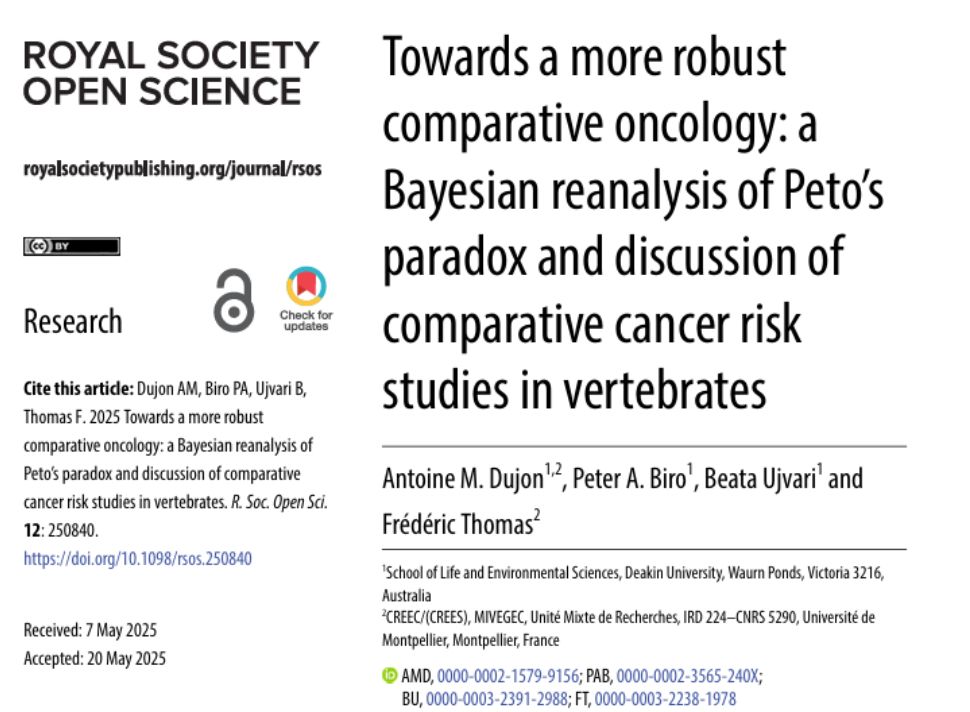
Towards a more robust comparative oncology: a Bayesian reanalysis of Peto’s paradox and discussion of comparative cancer risk studies in vertebrates
royalsocietypublishing.org/doi/10.1098/...
royalsocietypublishing.org/doi/10.1098/...

Towards a more robust comparative oncology: a Bayesian reanalysis of Peto’s paradox and discussion of comparative cancer risk studies in vertebrates | Royal Society Open Science
The multistage carcinogenesis model predicts that cancer risk should increase with
body size and longevity owing to greater cell numbers and divisions, which provide
more opportunities for mutations. ...
royalsocietypublishing.org
August 7, 2025 at 11:50 PM
Towards a more robust comparative oncology: a Bayesian reanalysis of Peto’s paradox and discussion of comparative cancer risk studies in vertebrates
royalsocietypublishing.org/doi/10.1098/...
royalsocietypublishing.org/doi/10.1098/...
A freshwater Hydra from my lab with a tumour so big it looks like more a pumpkin with tentacles rather than an hydra. It's more a tumour than anything else yet it can still eat.

July 10, 2025 at 12:17 AM
A freshwater Hydra from my lab with a tumour so big it looks like more a pumpkin with tentacles rather than an hydra. It's more a tumour than anything else yet it can still eat.
Are small trends observed between body mass and longevity enough to refute Peto's paradox? I don't think so, and in my new paper I show that those trends are so uncertain that we cannot conclude much from them. We need better stats in those studies.
royalsocietypublishing.org/doi/epdf/10....
royalsocietypublishing.org/doi/epdf/10....

July 9, 2025 at 2:27 AM
Are small trends observed between body mass and longevity enough to refute Peto's paradox? I don't think so, and in my new paper I show that those trends are so uncertain that we cannot conclude much from them. We need better stats in those studies.
royalsocietypublishing.org/doi/epdf/10....
royalsocietypublishing.org/doi/epdf/10....
A nice short paper arguing that a small significant trend between body size and cancer risk is not enough to disprove Peto's paradox. I agree with the author we need null models when we test the effect of a risk factor on cancer in comparative studies
doi.org/10.18632/agi...
doi.org/10.18632/agi...

Peto’s paradox’s relevance is off the scale | Aging
Aging | doi:10.18632/aging.206258. Mirre J.P. Simons
doi.org
June 10, 2025 at 1:10 AM
A nice short paper arguing that a small significant trend between body size and cancer risk is not enough to disprove Peto's paradox. I agree with the author we need null models when we test the effect of a risk factor on cancer in comparative studies
doi.org/10.18632/agi...
doi.org/10.18632/agi...
📰 ❤️ 🦠 New paper out!
In this study, we found that transmissible tumours, much like some parasites, can change the way their host looks and behaves to benefit themselves.
Link to the paper:
elifesciences.org/articles/97271
In this study, we found that transmissible tumours, much like some parasites, can change the way their host looks and behaves to benefit themselves.
Link to the paper:
elifesciences.org/articles/97271

March 18, 2025 at 9:56 PM
📰 ❤️ 🦠 New paper out!
In this study, we found that transmissible tumours, much like some parasites, can change the way their host looks and behaves to benefit themselves.
Link to the paper:
elifesciences.org/articles/97271
In this study, we found that transmissible tumours, much like some parasites, can change the way their host looks and behaves to benefit themselves.
Link to the paper:
elifesciences.org/articles/97271
If you're an Australian student interested in exploring the impact of human activities on wildlife and considering an honours project in 2025, I have a couple of exciting opportunities you might want to check out! Send me an email! #scisky #cancer #evolution #Australia

November 28, 2024 at 11:35 PM
If you're an Australian student interested in exploring the impact of human activities on wildlife and considering an honours project in 2025, I have a couple of exciting opportunities you might want to check out! Send me an email! #scisky #cancer #evolution #Australia
New paper in Evolution examining how the logic behind Peto's paradox can be applied to various aspects of cancer resistance across species. We highlight the importance of making hypotheses when investigating the effects of risk factors across species. #scisky
doi.org/10.1093/evol...
doi.org/10.1093/evol...

Beyond Peto’s paradox: expanding the study of cancer resistance across species
Abstract. Peto’s paradox, which highlights the lower-than-expected cancer rates in larger and/or longer-lived species, is a cornerstone of discussions at t
doi.org
November 20, 2024 at 10:28 PM
New paper in Evolution examining how the logic behind Peto's paradox can be applied to various aspects of cancer resistance across species. We highlight the importance of making hypotheses when investigating the effects of risk factors across species. #scisky
doi.org/10.1093/evol...
doi.org/10.1093/evol...

Hey #SciSky, what are good alternatives to BLAST to find a given gene in a published unannotated genome. Like when the genome is provided at the contig or scaffold level for example? Something that runs with R or Python would be cool, but open to alternatives.
November 17, 2024 at 11:24 PM
Hey #SciSky, what are good alternatives to BLAST to find a given gene in a published unannotated genome. Like when the genome is provided at the contig or scaffold level for example? Something that runs with R or Python would be cool, but open to alternatives.
Science can sometimes reward you with really pretty pictures!

November 13, 2024 at 9:02 PM
Science can sometimes reward you with really pretty pictures!
Little freshwater planarian sampled in an urban pond in Australia. This one is an invasive species from North America.

November 12, 2024 at 9:14 PM
Little freshwater planarian sampled in an urban pond in Australia. This one is an invasive species from North America.
The Geelong Botanical Garden's corpse flower is blooming, and they are livestreaming the event on YouTube.
www.youtube.com/watch?v=TcnS...
www.youtube.com/watch?v=TcnS...

Corpse Flower Livestream
YouTube video by City of Greater Geelong
www.youtube.com
November 11, 2024 at 7:49 AM
The Geelong Botanical Garden's corpse flower is blooming, and they are livestreaming the event on YouTube.
www.youtube.com/watch?v=TcnS...
www.youtube.com/watch?v=TcnS...
Our new opinion paper on evolutionary mismatches in #aquaculture systems and how to address them to maintain good production is now published in Reviews in Aquaculture. A collaboration between the CANECEV and NuSea.Lab at Deakin University
Link to the paper:
doi.org/10.1111/raq....
Link to the paper:
doi.org/10.1111/raq....

November 11, 2024 at 12:56 AM
Our new opinion paper on evolutionary mismatches in #aquaculture systems and how to address them to maintain good production is now published in Reviews in Aquaculture. A collaboration between the CANECEV and NuSea.Lab at Deakin University
Link to the paper:
doi.org/10.1111/raq....
Link to the paper:
doi.org/10.1111/raq....
‘Immortal’ creatures may reveal clues to contagious cancers
By studying how tumours are transmitted in hydras, researchers hope to learn how to predict or even prevent outbreaks in all sorts of wildlife
www.science.org/content/arti...
By studying how tumours are transmitted in hydras, researchers hope to learn how to predict or even prevent outbreaks in all sorts of wildlife
www.science.org/content/arti...

‘Immortal’ creatures may reveal clues to contagious cancers
By studying how tumors are transmitted in hydras, researchers hope to learn how to predict or even prevent outbreaks in all sorts of wildlife
www.science.org
September 19, 2024 at 8:41 AM
‘Immortal’ creatures may reveal clues to contagious cancers
By studying how tumours are transmitted in hydras, researchers hope to learn how to predict or even prevent outbreaks in all sorts of wildlife
www.science.org/content/arti...
By studying how tumours are transmitted in hydras, researchers hope to learn how to predict or even prevent outbreaks in all sorts of wildlife
www.science.org/content/arti...
Can individuals with tumours serve as potential vectors for symbiont spread in an ecosystem? We found that lab freshwater hydra with tumours caused their commensal ciliates to spill over onto neighbouring hydra from the same or different species.
Link: www.nature.com/articles/s41...
#SciSky
Link: www.nature.com/articles/s41...
#SciSky
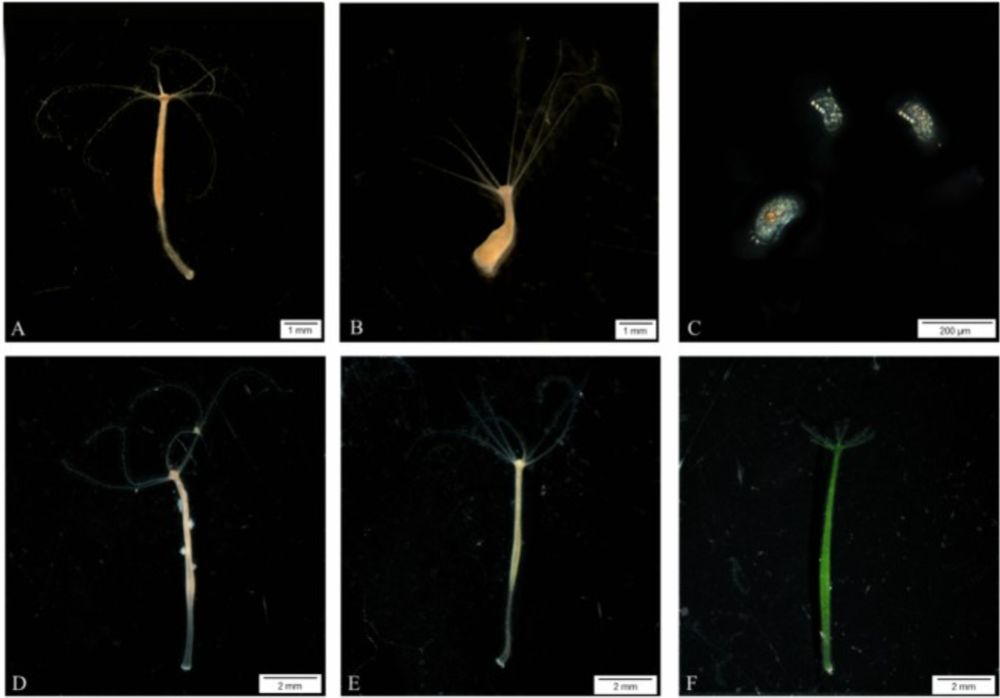
Cancer and One Health: tumor-bearing individuals can act as super spreaders of symbionts in communities - Scientific Reports
Scientific Reports - Cancer and One Health: tumor-bearing individuals can act as super spreaders of symbionts in communities
www.nature.com
September 18, 2024 at 1:35 AM
Can individuals with tumours serve as potential vectors for symbiont spread in an ecosystem? We found that lab freshwater hydra with tumours caused their commensal ciliates to spill over onto neighbouring hydra from the same or different species.
Link: www.nature.com/articles/s41...
#SciSky
Link: www.nature.com/articles/s41...
#SciSky
Check out our new publication in STOTEN !
Hydra oligactis show widespread vulnerability to tumours! In our lab, we use them as a model to understand how tumour progression affects the ecology of species and ecosystem functioning.
Link: doi.org/10.1016/j.sc...
Hydra oligactis show widespread vulnerability to tumours! In our lab, we use them as a model to understand how tumour progression affects the ecology of species and ecosystem functioning.
Link: doi.org/10.1016/j.sc...

September 3, 2024 at 12:41 AM
Check out our new publication in STOTEN !
Hydra oligactis show widespread vulnerability to tumours! In our lab, we use them as a model to understand how tumour progression affects the ecology of species and ecosystem functioning.
Link: doi.org/10.1016/j.sc...
Hydra oligactis show widespread vulnerability to tumours! In our lab, we use them as a model to understand how tumour progression affects the ecology of species and ecosystem functioning.
Link: doi.org/10.1016/j.sc...
Turns out you can create XKCD style plots with R. Here I used the data of a very serious competition. The farthest distance for periwinkle spitting is 10.4 m and is held by Alain Jourden (France).

November 23, 2023 at 10:37 AM
Turns out you can create XKCD style plots with R. Here I used the data of a very serious competition. The farthest distance for periwinkle spitting is 10.4 m and is held by Alain Jourden (France).
