



Arc Institute
@arcinstitute.org
A new scientific institution for curiosity-driven biomedical science and technology.
The team applied Stack to build Perturb Sapiens: An atlas of ~20,000 predicted cell responses across 28 tissues & 201 perturbations + a subset validated using held-out datasets, confirming that predictions capture real biology.

January 9, 2026 at 6:44 PM
The team applied Stack to build Perturb Sapiens: An atlas of ~20,000 predicted cell responses across 28 tissues & 201 perturbations + a subset validated using held-out datasets, confirming that predictions capture real biology.
Stack captures something that most models miss: cellular context. A T cell in inflamed tissue behaves differently, not just because of its own genes, but because of its environment. Stack processes cells together & learns from those relationships.

January 9, 2026 at 6:44 PM
Stack captures something that most models miss: cellular context. A T cell in inflamed tissue behaves differently, not just because of its own genes, but because of its environment. Stack processes cells together & learns from those relationships.
Predicting cell state in previously unseen conditions has typically required retraining for each new biological context. Today, Arc is releasing Stack, a foundation model that learns to simulate cell state under novel conditions directly at inference time, no fine-tuning required.

January 9, 2026 at 6:44 PM
Predicting cell state in previously unseen conditions has typically required retraining for each new biological context. Today, Arc is releasing Stack, a foundation model that learns to simulate cell state under novel conditions directly at inference time, no fine-tuning required.
Congratulations to all of the winners and a huge thank you to the community: Your thoughtful engagement with metric design questions and evaluation frameworks is already shaping next year's Challenge. Together we're building the future of predictive cell biology.

December 7, 2025 at 4:03 AM
Congratulations to all of the winners and a huge thank you to the community: Your thoughtful engagement with metric design questions and evaluation frameworks is already shaping next year's Challenge. Together we're building the future of predictive cell biology.
We also introduced a new award for broader evaluation:
🏆 Generalist Prize: Team @altos_labs ranked highest across 7 metrics. They showed the most reliable generalization—robust performance across diverse criteria vs. optimization for a single score.
🏆 Generalist Prize: Team @altos_labs ranked highest across 7 metrics. They showed the most reliable generalization—robust performance across diverse criteria vs. optimization for a single score.

December 7, 2025 at 4:03 AM
We also introduced a new award for broader evaluation:
🏆 Generalist Prize: Team @altos_labs ranked highest across 7 metrics. They showed the most reliable generalization—robust performance across diverse criteria vs. optimization for a single score.
🏆 Generalist Prize: Team @altos_labs ranked highest across 7 metrics. They showed the most reliable generalization—robust performance across diverse criteria vs. optimization for a single score.
🥉 Third Place: Team Outlier was a cross-institutional collaboration from U Chicago, Dartmouth, and HKU built TransPert—a statistical framework that predicts perturbations across cell lines using only summary-level data.

December 7, 2025 at 4:03 AM
🥉 Third Place: Team Outlier was a cross-institutional collaboration from U Chicago, Dartmouth, and HKU built TransPert—a statistical framework that predicts perturbations across cell lines using only summary-level data.
🥈 Second Place: Team XLearning Lab from Sichuan University took a streamlined approach: shift from noisy single-cell to pseudo-bulk data, use residual learning to predict perturbation changes, and strategically optimize for the highest-weighted metrics.

December 7, 2025 at 4:03 AM
🥈 Second Place: Team XLearning Lab from Sichuan University took a streamlined approach: shift from noisy single-cell to pseudo-bulk data, use residual learning to predict perturbation changes, and strategically optimize for the highest-weighted metrics.
🥇 First Place: Team BM_xTVC from BioMap Research built xTrimoSCPerturb, improving upon scFoundation architecture to better capture gene relationships and recover biological signals from technical noise.
Their key insight? Pure AI approaches didn't beat statistical baselines so they integrated both.
Their key insight? Pure AI approaches didn't beat statistical baselines so they integrated both.

December 7, 2025 at 4:03 AM
🥇 First Place: Team BM_xTVC from BioMap Research built xTrimoSCPerturb, improving upon scFoundation architecture to better capture gene relationships and recover biological signals from technical noise.
Their key insight? Pure AI approaches didn't beat statistical baselines so they integrated both.
Their key insight? Pure AI approaches didn't beat statistical baselines so they integrated both.
Thank you to everyone who made the inaugural Virtual Cell Challenge a success.
Over 5,000 participants from 114 countries competed to build AI models that predict cellular responses to genetic perturbations. Today we're announcing the winners and reflecting on what we learned.
Over 5,000 participants from 114 countries competed to build AI models that predict cellular responses to genetic perturbations. Today we're announcing the winners and reflecting on what we learned.

December 7, 2025 at 4:03 AM
Thank you to everyone who made the inaugural Virtual Cell Challenge a success.
Over 5,000 participants from 114 countries competed to build AI models that predict cellular responses to genetic perturbations. Today we're announcing the winners and reflecting on what we learned.
Over 5,000 participants from 114 countries competed to build AI models that predict cellular responses to genetic perturbations. Today we're announcing the winners and reflecting on what we learned.
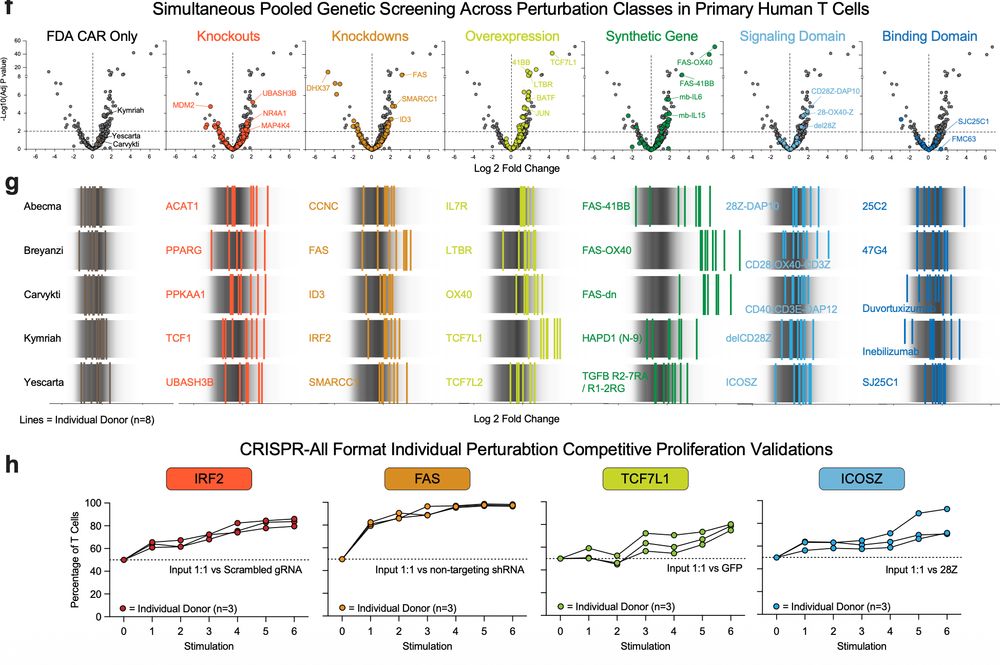
The strongest constructs from the pooled CACTUS proliferation screens were then validated independently, showing clear advantages in head-to-head competitive assays across all four major CRISPR All perturbation classes.
November 20, 2025 at 6:35 PM
The strongest constructs from the pooled CACTUS proliferation screens were then validated independently, showing clear advantages in head-to-head competitive assays across all four major CRISPR All perturbation classes.
Using this framework, the team built CACTUS, a curated library of 600+ proposed CAR and T-cell enhancements.
Evaluating them in matched conditions allowed the team to precisely identify which edits enhance function under chronic stimulation.
Evaluating them in matched conditions allowed the team to precisely identify which edits enhance function under chronic stimulation.

November 20, 2025 at 6:35 PM
Using this framework, the team built CACTUS, a curated library of 600+ proposed CAR and T-cell enhancements.
Evaluating them in matched conditions allowed the team to precisely identify which edits enhance function under chronic stimulation.
Evaluating them in matched conditions allowed the team to precisely identify which edits enhance function under chronic stimulation.
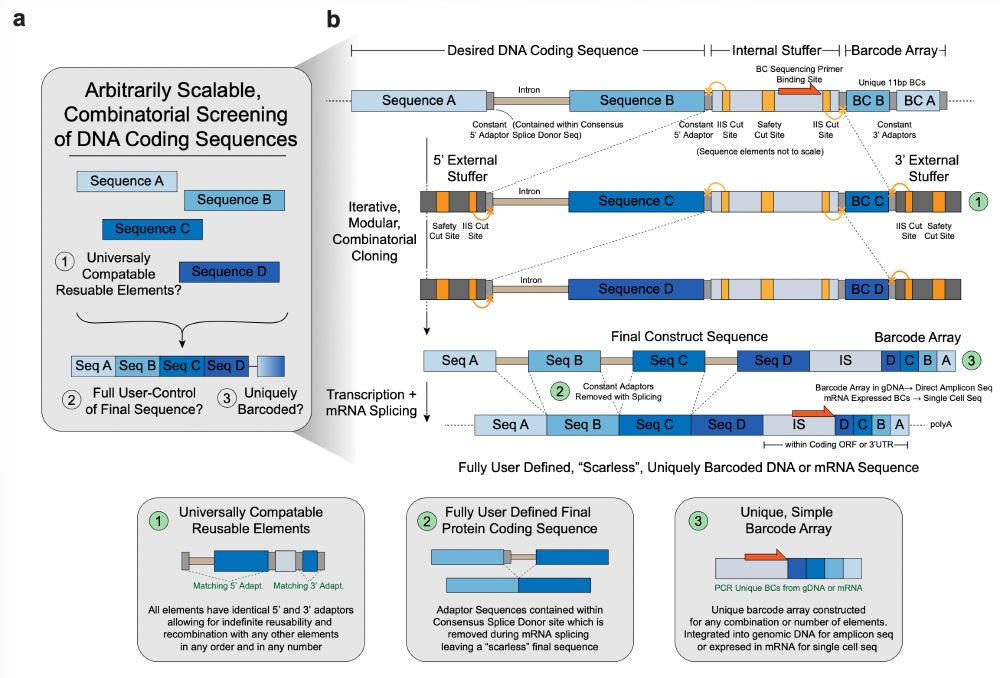
CRISPR All standardizes these approaches by giving every perturbation type a common DNA architecture. Genes, domains, knockouts and knockdowns are all interoperable and linked to a single mRNA-expressed barcode, enabling precise recovery of each cell’s engineered program.

November 20, 2025 at 6:35 PM
CRISPR All standardizes these approaches by giving every perturbation type a common DNA architecture. Genes, domains, knockouts and knockdowns are all interoperable and linked to a single mRNA-expressed barcode, enabling precise recovery of each cell’s engineered program.
Other editing methods remain siloed because knockouts, knockdowns, overexpression, and synthetic gene insertions each rely on distinct molecular systems.
November 20, 2025 at 6:35 PM
Other editing methods remain siloed because knockouts, knockdowns, overexpression, and synthetic gene insertions each rely on distinct molecular systems.
A preprint out today from Arc Innovation Investigator Theo Roth, Austin Hartman, Oliver Takacsi-Nagy, and colleagues introduces CRISPR All–a unified programming language for editing human cells across all major genetic perturbation types at once.

November 20, 2025 at 6:35 PM
A preprint out today from Arc Innovation Investigator Theo Roth, Austin Hartman, Oliver Takacsi-Nagy, and colleagues introduces CRISPR All–a unified programming language for editing human cells across all major genetic perturbation types at once.
Finally, the team scaled semantic design across prokaryotic genomes, using Evo to generate SynGenome––a collection of 120+ billion base pairs of AI-generated DNA that mirrors native genomic structure while producing sequences beyond those found in nature.

November 19, 2025 at 6:17 PM
Finally, the team scaled semantic design across prokaryotic genomes, using Evo to generate SynGenome––a collection of 120+ billion base pairs of AI-generated DNA that mirrors native genomic structure while producing sequences beyond those found in nature.
They next evaluated whether the approach extended to anti-CRISPR systems.
Evo was able to produce novel proteins that inhibited SpCas9 and improved phage survival, demonstrating its ability to propose functional products in systems where sequence-based approaches often fail.
Evo was able to produce novel proteins that inhibited SpCas9 and improved phage survival, demonstrating its ability to propose functional products in systems where sequence-based approaches often fail.

November 19, 2025 at 6:17 PM
They next evaluated whether the approach extended to anti-CRISPR systems.
Evo was able to produce novel proteins that inhibited SpCas9 and improved phage survival, demonstrating its ability to propose functional products in systems where sequence-based approaches often fail.
Evo was able to produce novel proteins that inhibited SpCas9 and improved phage survival, demonstrating its ability to propose functional products in systems where sequence-based approaches often fail.
To validate the approach, the team then applied semantic design to toxin–antitoxin systems.
Prompted on the genomic contexts typical of these pairs, Evo successfully generated a range of diverse candidates, including several experimentally confirmed toxins and antitoxins.
Prompted on the genomic contexts typical of these pairs, Evo successfully generated a range of diverse candidates, including several experimentally confirmed toxins and antitoxins.

November 19, 2025 at 6:17 PM
To validate the approach, the team then applied semantic design to toxin–antitoxin systems.
Prompted on the genomic contexts typical of these pairs, Evo successfully generated a range of diverse candidates, including several experimentally confirmed toxins and antitoxins.
Prompted on the genomic contexts typical of these pairs, Evo successfully generated a range of diverse candidates, including several experimentally confirmed toxins and antitoxins.
They began by testing if Evo had learned genomic semantics—the idea that genes with related functions appear in similar sequence contexts.
In sequence-recovery tests, Evo reliably reconstructed conserved genes from partial inputs, with accuracy improving across model versions.
In sequence-recovery tests, Evo reliably reconstructed conserved genes from partial inputs, with accuracy improving across model versions.

November 19, 2025 at 6:17 PM
They began by testing if Evo had learned genomic semantics—the idea that genes with related functions appear in similar sequence contexts.
In sequence-recovery tests, Evo reliably reconstructed conserved genes from partial inputs, with accuracy improving across model versions.
In sequence-recovery tests, Evo reliably reconstructed conserved genes from partial inputs, with accuracy improving across model versions.
Published today in @nature.com, @adititm.bsky.social & researchers from the @brianhie.bsky.social lab report that the large-scale genomic model, Evo, is capable of using surrounding genomic context to produce novel, functional genes, enabling an an emergent approach they've termed 'semantic design'.

November 19, 2025 at 6:17 PM
Published today in @nature.com, @adititm.bsky.social & researchers from the @brianhie.bsky.social lab report that the large-scale genomic model, Evo, is capable of using surrounding genomic context to produce novel, functional genes, enabling an an emergent approach they've termed 'semantic design'.
Congratulations to Arc Science Fellow, @uchemedoh.bsky.social, on being named a winner of the 2025 @science.org & @scilifelab.se Prize for Young Scientists!
His work solves a decades-old mystery in cell biology, revealing the enzyme responsible for BMP synthesis: www.aaas.org/news/researc...
His work solves a decades-old mystery in cell biology, revealing the enzyme responsible for BMP synthesis: www.aaas.org/news/researc...

November 13, 2025 at 8:19 PM
Congratulations to Arc Science Fellow, @uchemedoh.bsky.social, on being named a winner of the 2025 @science.org & @scilifelab.se Prize for Young Scientists!
His work solves a decades-old mystery in cell biology, revealing the enzyme responsible for BMP synthesis: www.aaas.org/news/researc...
His work solves a decades-old mystery in cell biology, revealing the enzyme responsible for BMP synthesis: www.aaas.org/news/researc...
The best variants achieved 97% specificity & up to 53% efficiency, a 7.5-fold increase in accuracy & 12-fold increase in efficiency over the starting enzyme.
This means researchers can now choose variants optimized for maximum efficiency, specificity, or a balance of both.
This means researchers can now choose variants optimized for maximum efficiency, specificity, or a balance of both.

November 6, 2025 at 5:46 PM
The best variants achieved 97% specificity & up to 53% efficiency, a 7.5-fold increase in accuracy & 12-fold increase in efficiency over the starting enzyme.
This means researchers can now choose variants optimized for maximum efficiency, specificity, or a balance of both.
This means researchers can now choose variants optimized for maximum efficiency, specificity, or a balance of both.
They tested thousands of mutations to identify which improved the enzyme, then used computational models to predict how combining mutations would impact performance, allowing them to build highly optimized variants rapidly.

November 6, 2025 at 5:46 PM
They tested thousands of mutations to identify which improved the enzyme, then used computational models to predict how combining mutations would impact performance, allowing them to build highly optimized variants rapidly.
The team developed a comprehensive engineering strategy to improve both efficiency & specificity, combining evolutionary screening to find better mutations, machine learning to predict which mutations work together & fusing the enzyme to dCas9 to guide it to the correct location.

November 6, 2025 at 5:46 PM
The team developed a comprehensive engineering strategy to improve both efficiency & specificity, combining evolutionary screening to find better mutations, machine learning to predict which mutations work together & fusing the enzyme to dCas9 to guide it to the correct location.
Recombinases are enzymes capable of inserting DNA at specific sites in the genome without needing to create double-strand breaks like CRISPR does.
Existing recombinases, however, have limitations–managing only ~5% efficiency & often hitting hundreds of off-target sites.
Existing recombinases, however, have limitations–managing only ~5% efficiency & often hitting hundreds of off-target sites.

November 6, 2025 at 5:46 PM
Recombinases are enzymes capable of inserting DNA at specific sites in the genome without needing to create double-strand breaks like CRISPR does.
Existing recombinases, however, have limitations–managing only ~5% efficiency & often hitting hundreds of off-target sites.
Existing recombinases, however, have limitations–managing only ~5% efficiency & often hitting hundreds of off-target sites.
Work published today in @natbiotech.nature.com from Arc’s Luke Gilbert and Patrick Hsu labs presents a new way to insert large DNA sequences into the genome using engineered recombinases that don’t require DNA cutting or rely on the cell's repair machinery.

November 6, 2025 at 5:46 PM
Work published today in @natbiotech.nature.com from Arc’s Luke Gilbert and Patrick Hsu labs presents a new way to insert large DNA sequences into the genome using engineered recombinases that don’t require DNA cutting or rely on the cell's repair machinery.