



Arc Institute
@arcinstitute.org
A new scientific institution for curiosity-driven biomedical science and technology.
Read more in Genetic Engineering and Biotechnology News: www.genengnews.com/topics/artif...

Tahoe, Arc Institute, and Biohub Join Forces on Massive Virtual Cell Dataset
The largest single cell perturbation dataset to-date will be generated and released open source in a new team effort.
www.genengnews.com
January 13, 2026 at 12:01 AM
Read more in Genetic Engineering and Biotechnology News: www.genengnews.com/topics/artif...
This perturbation dataset will be the largest of its kind, made up of 120M+ cells across 225,000 drug-patient interactions. The data will be released open source.
January 13, 2026 at 12:01 AM
This perturbation dataset will be the largest of its kind, made up of 120M+ cells across 225,000 drug-patient interactions. The data will be released open source.
Explore the full manuscript + code: www.biorxiv.org/content/10.6...

Stack: In-Context Learning of Single-Cell Biology
Single-cell transcriptomics offers the promise of measuring the diversity of cellular phenotypes across species, diseases, and other biological conditions. Recently, foundation models have emerged to ...
www.biorxiv.org
January 9, 2026 at 6:44 PM
Explore the full manuscript + code: www.biorxiv.org/content/10.6...
Learn more about the development of Stack: arcinstitute.org/news/foundat...

Stack: Simulating cellular conditions via prompt engineering, without the need for fine-tuning | Arc Institute
Arc Institute unveils a new foundation model with in-context learning of single-cell biology, and applies it to generate Perturb Sapiens, an atlas of simulated human cells
arcinstitute.org
January 9, 2026 at 6:44 PM
Learn more about the development of Stack: arcinstitute.org/news/foundat...
The team applied Stack to build Perturb Sapiens: An atlas of ~20,000 predicted cell responses across 28 tissues & 201 perturbations + a subset validated using held-out datasets, confirming that predictions capture real biology.

January 9, 2026 at 6:44 PM
The team applied Stack to build Perturb Sapiens: An atlas of ~20,000 predicted cell responses across 28 tissues & 201 perturbations + a subset validated using held-out datasets, confirming that predictions capture real biology.
Just as text prompts guide language models, cells serve as prompts in Stack. It can observe drug-treated immune cells & predict how epithelial cells would respond to the same drug, a task never explicitly trained for.
January 9, 2026 at 6:44 PM
Just as text prompts guide language models, cells serve as prompts in Stack. It can observe drug-treated immune cells & predict how epithelial cells would respond to the same drug, a task never explicitly trained for.
Stack captures something that most models miss: cellular context. A T cell in inflamed tissue behaves differently, not just because of its own genes, but because of its environment. Stack processes cells together & learns from those relationships.

January 9, 2026 at 6:44 PM
Stack captures something that most models miss: cellular context. A T cell in inflamed tissue behaves differently, not just because of its own genes, but because of its environment. Stack processes cells together & learns from those relationships.
Megan will oversee our multi-omics, genome engineering, cellular modeling, and mammalian disease modeling Technology Centers—coordinating efforts across our Virtual Cell and Alzheimer's Disease Initiatives.
Learn more: arcinstitute.org/news/megan-v...
Learn more: arcinstitute.org/news/megan-v...

Arc Institute Welcomes Metagenomi's Megan van Overbeek as First Chief Scientific Officer | Arc Institute
Arc has reached another institutional milestone—a full leadership team—with the appointment of Megan van Overbeek, PhD, as our first Chief Scientific Officer. In this role, Megan will drive the discov...
arcinstitute.org
January 5, 2026 at 6:37 PM
Megan will oversee our multi-omics, genome engineering, cellular modeling, and mammalian disease modeling Technology Centers—coordinating efforts across our Virtual Cell and Alzheimer's Disease Initiatives.
Learn more: arcinstitute.org/news/megan-v...
Learn more: arcinstitute.org/news/megan-v...
Thank you again to our sponsors @nvidia, @10xGenomics and @UltimaGenomics.
The final leaderboards are now posted on the competition website: virtualcellchallenge.org
Virtual Cell Challenge 2026 kicks off mid-year. See you then!
The final leaderboards are now posted on the competition website: virtualcellchallenge.org
Virtual Cell Challenge 2026 kicks off mid-year. See you then!
December 7, 2025 at 4:03 AM
Thank you again to our sponsors @nvidia, @10xGenomics and @UltimaGenomics.
The final leaderboards are now posted on the competition website: virtualcellchallenge.org
Virtual Cell Challenge 2026 kicks off mid-year. See you then!
The final leaderboards are now posted on the competition website: virtualcellchallenge.org
Virtual Cell Challenge 2026 kicks off mid-year. See you then!
For more details on the winners and our reflections on what we learned—from hybrid models outperforming pure neural networks to the value of multi-modal features—please visit our website: arcinstitute.org/news/virtual...

Virtual Cell Challenge 2025 Wrap-Up: Winners and Reflections | Arc Institute
Thank you to every participant who made the inaugural Virtual Cell Challenge a success. The response far exceeded our expectations: over 5,000 people registered across 114 countries, over 1,200 teams ...
arcinstitute.org
December 7, 2025 at 4:03 AM
For more details on the winners and our reflections on what we learned—from hybrid models outperforming pure neural networks to the value of multi-modal features—please visit our website: arcinstitute.org/news/virtual...
Congratulations to all of the winners and a huge thank you to the community: Your thoughtful engagement with metric design questions and evaluation frameworks is already shaping next year's Challenge. Together we're building the future of predictive cell biology.

December 7, 2025 at 4:03 AM
Congratulations to all of the winners and a huge thank you to the community: Your thoughtful engagement with metric design questions and evaluation frameworks is already shaping next year's Challenge. Together we're building the future of predictive cell biology.
We also introduced a new award for broader evaluation:
🏆 Generalist Prize: Team @altos_labs ranked highest across 7 metrics. They showed the most reliable generalization—robust performance across diverse criteria vs. optimization for a single score.
🏆 Generalist Prize: Team @altos_labs ranked highest across 7 metrics. They showed the most reliable generalization—robust performance across diverse criteria vs. optimization for a single score.

December 7, 2025 at 4:03 AM
We also introduced a new award for broader evaluation:
🏆 Generalist Prize: Team @altos_labs ranked highest across 7 metrics. They showed the most reliable generalization—robust performance across diverse criteria vs. optimization for a single score.
🏆 Generalist Prize: Team @altos_labs ranked highest across 7 metrics. They showed the most reliable generalization—robust performance across diverse criteria vs. optimization for a single score.
🥉 Third Place: Team Outlier was a cross-institutional collaboration from U Chicago, Dartmouth, and HKU built TransPert—a statistical framework that predicts perturbations across cell lines using only summary-level data.

December 7, 2025 at 4:03 AM
🥉 Third Place: Team Outlier was a cross-institutional collaboration from U Chicago, Dartmouth, and HKU built TransPert—a statistical framework that predicts perturbations across cell lines using only summary-level data.
🥈 Second Place: Team XLearning Lab from Sichuan University took a streamlined approach: shift from noisy single-cell to pseudo-bulk data, use residual learning to predict perturbation changes, and strategically optimize for the highest-weighted metrics.

December 7, 2025 at 4:03 AM
🥈 Second Place: Team XLearning Lab from Sichuan University took a streamlined approach: shift from noisy single-cell to pseudo-bulk data, use residual learning to predict perturbation changes, and strategically optimize for the highest-weighted metrics.
🥇 First Place: Team BM_xTVC from BioMap Research built xTrimoSCPerturb, improving upon scFoundation architecture to better capture gene relationships and recover biological signals from technical noise.
Their key insight? Pure AI approaches didn't beat statistical baselines so they integrated both.
Their key insight? Pure AI approaches didn't beat statistical baselines so they integrated both.

December 7, 2025 at 4:03 AM
🥇 First Place: Team BM_xTVC from BioMap Research built xTrimoSCPerturb, improving upon scFoundation architecture to better capture gene relationships and recover biological signals from technical noise.
Their key insight? Pure AI approaches didn't beat statistical baselines so they integrated both.
Their key insight? Pure AI approaches didn't beat statistical baselines so they integrated both.
By enabling exploration of a combinatorial perturbation space that approaches the diversity accessed by natural evolution, CRISPR All opens new possibilities for both biological discovery and therapeutic design.
Learn more in the preprint: www.biorxiv.org/content/10.1...
Learn more in the preprint: www.biorxiv.org/content/10.1...
A unified genetic perturbation language for human cellular programming
Evolution simultaneously and combinatorially explores complex genetic changes across perturbation classes, including gene knockouts, knockdowns, overexpression, and the creation of new genes from exis...
www.biorxiv.org
November 20, 2025 at 6:35 PM
By enabling exploration of a combinatorial perturbation space that approaches the diversity accessed by natural evolution, CRISPR All opens new possibilities for both biological discovery and therapeutic design.
Learn more in the preprint: www.biorxiv.org/content/10.1...
Learn more in the preprint: www.biorxiv.org/content/10.1...
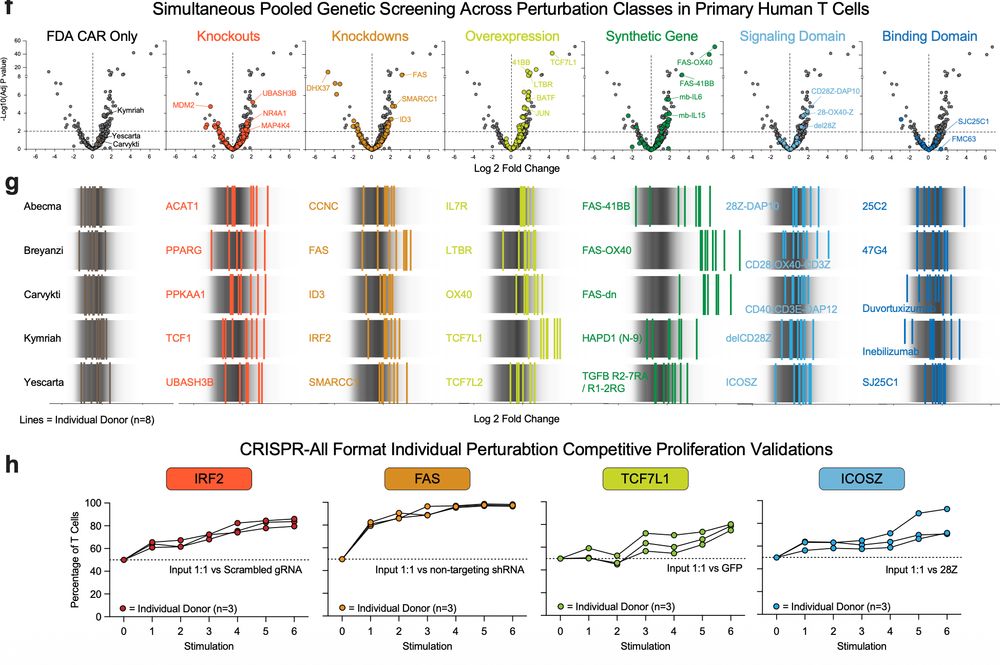
The strongest constructs from the pooled CACTUS proliferation screens were then validated independently, showing clear advantages in head-to-head competitive assays across all four major CRISPR All perturbation classes.
November 20, 2025 at 6:35 PM
The strongest constructs from the pooled CACTUS proliferation screens were then validated independently, showing clear advantages in head-to-head competitive assays across all four major CRISPR All perturbation classes.
Using this framework, the team built CACTUS, a curated library of 600+ proposed CAR and T-cell enhancements.
Evaluating them in matched conditions allowed the team to precisely identify which edits enhance function under chronic stimulation.
Evaluating them in matched conditions allowed the team to precisely identify which edits enhance function under chronic stimulation.

November 20, 2025 at 6:35 PM
Using this framework, the team built CACTUS, a curated library of 600+ proposed CAR and T-cell enhancements.
Evaluating them in matched conditions allowed the team to precisely identify which edits enhance function under chronic stimulation.
Evaluating them in matched conditions allowed the team to precisely identify which edits enhance function under chronic stimulation.