


Badr AlKhamissi
@bkhmsi.bsky.social
PhD at EPFL 🧠💻
Ex @MetaAI, @SonyAI, @Microsoft
Egyptian 🇪🇬
Ex @MetaAI, @SonyAI, @Microsoft
Egyptian 🇪🇬
We also added a statistics page visualizing key aspects of the community: academia vs. industry, research areas, positions, etc.
Webpage: egyptians-in-cs.github.io#/en/stats
Webpage: egyptians-in-cs.github.io#/en/stats


January 19, 2026 at 8:16 PM
We also added a statistics page visualizing key aspects of the community: academia vs. industry, research areas, positions, etc.
Webpage: egyptians-in-cs.github.io#/en/stats
Webpage: egyptians-in-cs.github.io#/en/stats
The website now has much better filtering by subfield, making it easier to explore different areas of Computer Science and discover researchers working on specific topics.

January 19, 2026 at 8:16 PM
The website now has much better filtering by subfield, making it easier to explore different areas of Computer Science and discover researchers working on specific topics.
One of the most powerful additions: an interactive map showing where Egyptian researchers are around the world 🌍
It highlights the global Egyptian diaspora, and how widely Egyptian researchers are contributing across the world.
It highlights the global Egyptian diaspora, and how widely Egyptian researchers are contributing across the world.

January 19, 2026 at 8:16 PM
One of the most powerful additions: an interactive map showing where Egyptian researchers are around the world 🌍
It highlights the global Egyptian diaspora, and how widely Egyptian researchers are contributing across the world.
It highlights the global Egyptian diaspora, and how widely Egyptian researchers are contributing across the world.
The website now features 262 Egyptian researchers across all of Computer Science — from systems and theory to AI, security, HCI, and more.
What started as a short list became a much broader story about visibility and representation.
What started as a short list became a much broader story about visibility and representation.

January 19, 2026 at 8:16 PM
The website now features 262 Egyptian researchers across all of Computer Science — from systems and theory to AI, security, HCI, and more.
What started as a short list became a much broader story about visibility and representation.
What started as a short list became a much broader story about visibility and representation.
4/
🤝 Re-Align 2026 is made possible by an interdisciplinary team of co-organizers:
@bkhmsi.bsky.social, Brian Cheung, @dotadotadota.bsky.social, @eringrant.me, Stephanie Fu, @kushinm.bsky.social, @sucholutsky.bsky.social, and @siddsuresh97.bsky.social!
🤝 Re-Align 2026 is made possible by an interdisciplinary team of co-organizers:
@bkhmsi.bsky.social, Brian Cheung, @dotadotadota.bsky.social, @eringrant.me, Stephanie Fu, @kushinm.bsky.social, @sucholutsky.bsky.social, and @siddsuresh97.bsky.social!

January 7, 2026 at 4:27 PM
4/
🤝 Re-Align 2026 is made possible by an interdisciplinary team of co-organizers:
@bkhmsi.bsky.social, Brian Cheung, @dotadotadota.bsky.social, @eringrant.me, Stephanie Fu, @kushinm.bsky.social, @sucholutsky.bsky.social, and @siddsuresh97.bsky.social!
🤝 Re-Align 2026 is made possible by an interdisciplinary team of co-organizers:
@bkhmsi.bsky.social, Brian Cheung, @dotadotadota.bsky.social, @eringrant.me, Stephanie Fu, @kushinm.bsky.social, @sucholutsky.bsky.social, and @siddsuresh97.bsky.social!
3/
🌟 Joining us at Re-Align 2026 is a fantastic lineup of invited speakers covering ML, neuroscience, and cognitive science:
David Bau, Arturo Deza, @judithfan.bsky.social, @alonaf.bsky.social, @phillipisola.bsky.social, and Danielle Perszyk!
🌟 Joining us at Re-Align 2026 is a fantastic lineup of invited speakers covering ML, neuroscience, and cognitive science:
David Bau, Arturo Deza, @judithfan.bsky.social, @alonaf.bsky.social, @phillipisola.bsky.social, and Danielle Perszyk!

January 7, 2026 at 4:27 PM
3/
🌟 Joining us at Re-Align 2026 is a fantastic lineup of invited speakers covering ML, neuroscience, and cognitive science:
David Bau, Arturo Deza, @judithfan.bsky.social, @alonaf.bsky.social, @phillipisola.bsky.social, and Danielle Perszyk!
🌟 Joining us at Re-Align 2026 is a fantastic lineup of invited speakers covering ML, neuroscience, and cognitive science:
David Bau, Arturo Deza, @judithfan.bsky.social, @alonaf.bsky.social, @phillipisola.bsky.social, and Danielle Perszyk!
🎉 Re-Align is back for its 4th edition at ICLR 2026!
📣 We invite submissions on representational alignment, spanning ML, Neuroscience, CogSci, and related fields.
📝 Tracks: Short (≤5p), Long (≤10p), Challenge (blog)
⏰ Deadline: Feb 5, 2026 for papers
🔗 representational-alignment.github.io/2026/
📣 We invite submissions on representational alignment, spanning ML, Neuroscience, CogSci, and related fields.
📝 Tracks: Short (≤5p), Long (≤10p), Challenge (blog)
⏰ Deadline: Feb 5, 2026 for papers
🔗 representational-alignment.github.io/2026/

January 7, 2026 at 4:27 PM
🎉 Re-Align is back for its 4th edition at ICLR 2026!
📣 We invite submissions on representational alignment, spanning ML, Neuroscience, CogSci, and related fields.
📝 Tracks: Short (≤5p), Long (≤10p), Challenge (blog)
⏰ Deadline: Feb 5, 2026 for papers
🔗 representational-alignment.github.io/2026/
📣 We invite submissions on representational alignment, spanning ML, Neuroscience, CogSci, and related fields.
📝 Tracks: Short (≤5p), Long (≤10p), Challenge (blog)
⏰ Deadline: Feb 5, 2026 for papers
🔗 representational-alignment.github.io/2026/
This year was hard, personally and globally, from ongoing visa issues that disrupted my life and may prevent me from achieving one of my dreams, to the state of the world itself.
Still grateful for what I achieved and for everyone who supported me.
Wishing us all a brighter year ahead. ✨
Still grateful for what I achieved and for everyone who supported me.
Wishing us all a brighter year ahead. ✨

December 31, 2025 at 3:43 PM
This year was hard, personally and globally, from ongoing visa issues that disrupted my life and may prevent me from achieving one of my dreams, to the state of the world itself.
Still grateful for what I achieved and for everyone who supported me.
Wishing us all a brighter year ahead. ✨
Still grateful for what I achieved and for everyone who supported me.
Wishing us all a brighter year ahead. ✨
Looking forward to be speaking at IndabaX Sudan on Building Responsible and Ethical LLMs!
📅 Saturday, December 13th
⏰ 2:00 PM (GMT+2)
Register here: docs.google.com/forms/d/e/1F...
See you all there! :)
📅 Saturday, December 13th
⏰ 2:00 PM (GMT+2)
Register here: docs.google.com/forms/d/e/1F...
See you all there! :)

December 7, 2025 at 3:43 PM
Looking forward to be speaking at IndabaX Sudan on Building Responsible and Ethical LLMs!
📅 Saturday, December 13th
⏰ 2:00 PM (GMT+2)
Register here: docs.google.com/forms/d/e/1F...
See you all there! :)
📅 Saturday, December 13th
⏰ 2:00 PM (GMT+2)
Register here: docs.google.com/forms/d/e/1F...
See you all there! :)
On my way to #EMNLP2025 🇨🇳
I’ll be presenting our work (Oral) on Nov 5, Special Theme session, Room A106-107 at 14:30.
Let’s talk brains 🧠, machines 🤖, and everything in between :D
Looking forward to all the amazing discussions!
I’ll be presenting our work (Oral) on Nov 5, Special Theme session, Room A106-107 at 14:30.
Let’s talk brains 🧠, machines 🤖, and everything in between :D
Looking forward to all the amazing discussions!

November 2, 2025 at 12:06 PM
On my way to #EMNLP2025 🇨🇳
I’ll be presenting our work (Oral) on Nov 5, Special Theme session, Room A106-107 at 14:30.
Let’s talk brains 🧠, machines 🤖, and everything in between :D
Looking forward to all the amazing discussions!
I’ll be presenting our work (Oral) on Nov 5, Special Theme session, Room A106-107 at 14:30.
Let’s talk brains 🧠, machines 🤖, and everything in between :D
Looking forward to all the amazing discussions!
6/
We also wondered: if neuroscientists use functional localizers to map networks in the brain, could we do the same for MiCRo’s experts?
The answer: yes! The very same localizers successfully recovered the corresponding expert modules in our models!
We also wondered: if neuroscientists use functional localizers to map networks in the brain, could we do the same for MiCRo’s experts?
The answer: yes! The very same localizers successfully recovered the corresponding expert modules in our models!

October 20, 2025 at 12:10 PM
6/
We also wondered: if neuroscientists use functional localizers to map networks in the brain, could we do the same for MiCRo’s experts?
The answer: yes! The very same localizers successfully recovered the corresponding expert modules in our models!
We also wondered: if neuroscientists use functional localizers to map networks in the brain, could we do the same for MiCRo’s experts?
The answer: yes! The very same localizers successfully recovered the corresponding expert modules in our models!
5/
One result I was particularly excited about is the emergent hierarchy we found across MiCRo layers:
🔺Earlier layers route tokens to Language experts.
🔻Deeper layers shift toward domain-relevant experts.
This emergent hierarchy mirrors patterns observed in the human brain 🧠
One result I was particularly excited about is the emergent hierarchy we found across MiCRo layers:
🔺Earlier layers route tokens to Language experts.
🔻Deeper layers shift toward domain-relevant experts.
This emergent hierarchy mirrors patterns observed in the human brain 🧠

October 20, 2025 at 12:10 PM
5/
One result I was particularly excited about is the emergent hierarchy we found across MiCRo layers:
🔺Earlier layers route tokens to Language experts.
🔻Deeper layers shift toward domain-relevant experts.
This emergent hierarchy mirrors patterns observed in the human brain 🧠
One result I was particularly excited about is the emergent hierarchy we found across MiCRo layers:
🔺Earlier layers route tokens to Language experts.
🔻Deeper layers shift toward domain-relevant experts.
This emergent hierarchy mirrors patterns observed in the human brain 🧠
4/
We find that MiCRo matches or outperforms baselines on reasoning tasks (e.g., GSM8K, BBH) and aligns better with human behavior (CogBench), while maintaining interpretability!!
We find that MiCRo matches or outperforms baselines on reasoning tasks (e.g., GSM8K, BBH) and aligns better with human behavior (CogBench), while maintaining interpretability!!

October 20, 2025 at 12:10 PM
4/
We find that MiCRo matches or outperforms baselines on reasoning tasks (e.g., GSM8K, BBH) and aligns better with human behavior (CogBench), while maintaining interpretability!!
We find that MiCRo matches or outperforms baselines on reasoning tasks (e.g., GSM8K, BBH) and aligns better with human behavior (CogBench), while maintaining interpretability!!
2/
🧩 Recap:
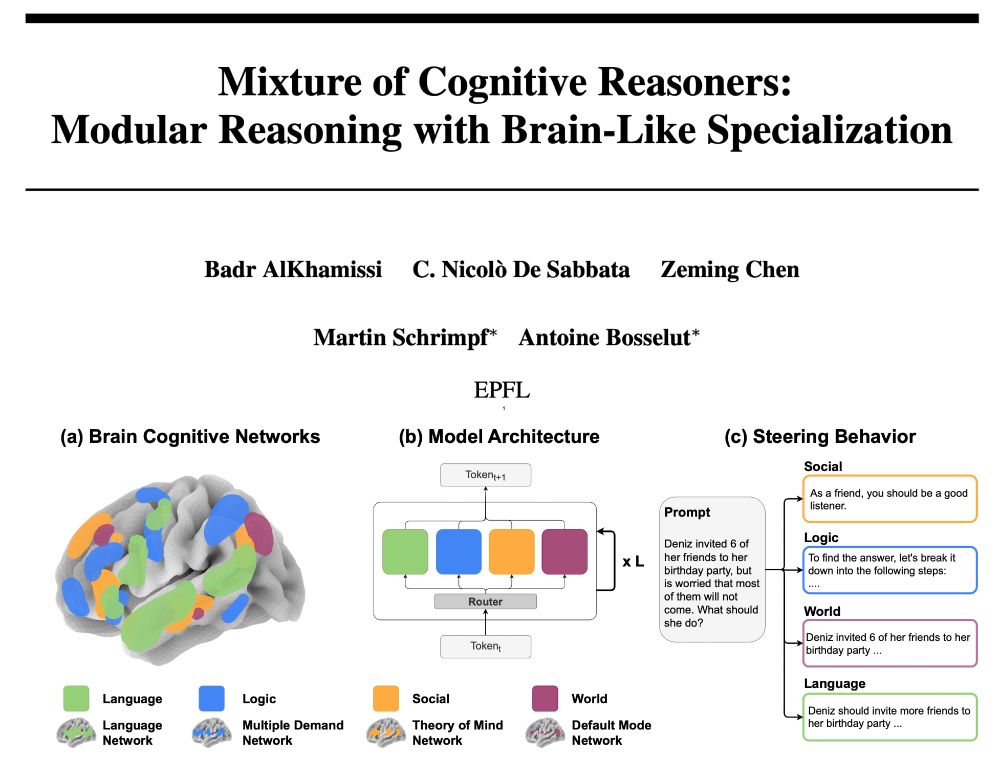
MiCRo takes a pretrained language model and post-trains it to develop distinct, brain-inspired modules aligned with four cognitive networks:
🗣️ Language
🔢 Logic / Multiple Demand
🧍♂️ Social / Theory of Mind
🌍 World / Default Mode Network
🧩 Recap:
MiCRo takes a pretrained language model and post-trains it to develop distinct, brain-inspired modules aligned with four cognitive networks:
🗣️ Language
🔢 Logic / Multiple Demand
🧍♂️ Social / Theory of Mind
🌍 World / Default Mode Network

October 20, 2025 at 12:10 PM
2/
🧩 Recap:
MiCRo takes a pretrained language model and post-trains it to develop distinct, brain-inspired modules aligned with four cognitive networks:
🗣️ Language
🔢 Logic / Multiple Demand
🧍♂️ Social / Theory of Mind
🌍 World / Default Mode Network
🧩 Recap:
MiCRo takes a pretrained language model and post-trains it to develop distinct, brain-inspired modules aligned with four cognitive networks:
🗣️ Language
🔢 Logic / Multiple Demand
🧍♂️ Social / Theory of Mind
🌍 World / Default Mode Network
🚀 Excited to share a major update to our “Mixture of Cognitive Reasoners” (MiCRo) paper!
We ask: What benefits can we unlock by designing language models whose inner structure mirrors the brain’s functional specialization?
More below 🧠👇
cognitive-reasoners.epfl.ch
We ask: What benefits can we unlock by designing language models whose inner structure mirrors the brain’s functional specialization?
More below 🧠👇
cognitive-reasoners.epfl.ch

October 20, 2025 at 12:10 PM
🚀 Excited to share a major update to our “Mixture of Cognitive Reasoners” (MiCRo) paper!
We ask: What benefits can we unlock by designing language models whose inner structure mirrors the brain’s functional specialization?
More below 🧠👇
cognitive-reasoners.epfl.ch
We ask: What benefits can we unlock by designing language models whose inner structure mirrors the brain’s functional specialization?
More below 🧠👇
cognitive-reasoners.epfl.ch
Excited to be part of this cool work led by Melika Honarmand!
We show that by selectively targeting VLM units that mirror the brain’s visual word form area, models develop dyslexic-like reading impairments, while leaving other abilities intact!! 🧠🤖
Details in the 🧵👇
We show that by selectively targeting VLM units that mirror the brain’s visual word form area, models develop dyslexic-like reading impairments, while leaving other abilities intact!! 🧠🤖
Details in the 🧵👇

October 2, 2025 at 1:27 PM
Excited to be part of this cool work led by Melika Honarmand!
We show that by selectively targeting VLM units that mirror the brain’s visual word form area, models develop dyslexic-like reading impairments, while leaving other abilities intact!! 🧠🤖
Details in the 🧵👇
We show that by selectively targeting VLM units that mirror the brain’s visual word form area, models develop dyslexic-like reading impairments, while leaving other abilities intact!! 🧠🤖
Details in the 🧵👇
8/ 🧬 Brain alignment:
Neuroscience localizers (e.g., for language, multiple-demand) rediscover the corresponding experts in MiCRo, showing functional alignment with brain networks. However, ToM localizer fail to identify the social expert.
Figures for MiCRo-Llama & MiCRo-OLMo.
Neuroscience localizers (e.g., for language, multiple-demand) rediscover the corresponding experts in MiCRo, showing functional alignment with brain networks. However, ToM localizer fail to identify the social expert.
Figures for MiCRo-Llama & MiCRo-OLMo.

June 17, 2025 at 3:07 PM
8/ 🧬 Brain alignment:
Neuroscience localizers (e.g., for language, multiple-demand) rediscover the corresponding experts in MiCRo, showing functional alignment with brain networks. However, ToM localizer fail to identify the social expert.
Figures for MiCRo-Llama & MiCRo-OLMo.
Neuroscience localizers (e.g., for language, multiple-demand) rediscover the corresponding experts in MiCRo, showing functional alignment with brain networks. However, ToM localizer fail to identify the social expert.
Figures for MiCRo-Llama & MiCRo-OLMo.
7/ 🧩 Steering & controllability:
Removing or emphasizing specific experts steers model behavior: Ablating logic expert hurts math accuracy; suppressing social reasoning improves math slightly—showcasing fine-grained control.
Removing or emphasizing specific experts steers model behavior: Ablating logic expert hurts math accuracy; suppressing social reasoning improves math slightly—showcasing fine-grained control.

June 17, 2025 at 3:07 PM
7/ 🧩 Steering & controllability:
Removing or emphasizing specific experts steers model behavior: Ablating logic expert hurts math accuracy; suppressing social reasoning improves math slightly—showcasing fine-grained control.
Removing or emphasizing specific experts steers model behavior: Ablating logic expert hurts math accuracy; suppressing social reasoning improves math slightly—showcasing fine-grained control.
6/ 🔄 Interpretable routing:
Early layers route most tokens to the language expert; deeper layers route to domain-relevant experts (e.g., logic expert for math), matching task semantics.
Early layers route most tokens to the language expert; deeper layers route to domain-relevant experts (e.g., logic expert for math), matching task semantics.

June 17, 2025 at 3:07 PM
6/ 🔄 Interpretable routing:
Early layers route most tokens to the language expert; deeper layers route to domain-relevant experts (e.g., logic expert for math), matching task semantics.
Early layers route most tokens to the language expert; deeper layers route to domain-relevant experts (e.g., logic expert for math), matching task semantics.
5/ 📈 Performance gains:
We evaluate on 6 reasoning benchmarks (MATH, GSM8K, MMLU, BBH…), MiCRo outperforms both dense and “general‑expert” baselines: modular models with random specialist assignment in Stage 1.
We evaluate on 6 reasoning benchmarks (MATH, GSM8K, MMLU, BBH…), MiCRo outperforms both dense and “general‑expert” baselines: modular models with random specialist assignment in Stage 1.

June 17, 2025 at 3:07 PM
5/ 📈 Performance gains:
We evaluate on 6 reasoning benchmarks (MATH, GSM8K, MMLU, BBH…), MiCRo outperforms both dense and “general‑expert” baselines: modular models with random specialist assignment in Stage 1.
We evaluate on 6 reasoning benchmarks (MATH, GSM8K, MMLU, BBH…), MiCRo outperforms both dense and “general‑expert” baselines: modular models with random specialist assignment in Stage 1.
4/ 📚 Training curriculum (3 stages):
• Stage 1: Expert training on small curated domain-specific datasets (~3k samples)
• Stage 2: Router training, experts frozen
• Stage 3: End-to-end finetuning on large instruction corpus (939k samples)
This seeds specialization effectively.
• Stage 1: Expert training on small curated domain-specific datasets (~3k samples)
• Stage 2: Router training, experts frozen
• Stage 3: End-to-end finetuning on large instruction corpus (939k samples)
This seeds specialization effectively.

June 17, 2025 at 3:07 PM
4/ 📚 Training curriculum (3 stages):
• Stage 1: Expert training on small curated domain-specific datasets (~3k samples)
• Stage 2: Router training, experts frozen
• Stage 3: End-to-end finetuning on large instruction corpus (939k samples)
This seeds specialization effectively.
• Stage 1: Expert training on small curated domain-specific datasets (~3k samples)
• Stage 2: Router training, experts frozen
• Stage 3: End-to-end finetuning on large instruction corpus (939k samples)
This seeds specialization effectively.
2/ 🔍 Motivation:
Humans rely on specialized brain networks—e.g., language, multiple-demand, ToM, default mode—for different cognitive tasks. MiCRo mimics this by dividing transformer layers into four experts.
Figure from @evfedorenko.bsky.social's review paper: www.nature.com/articles/s41...
Humans rely on specialized brain networks—e.g., language, multiple-demand, ToM, default mode—for different cognitive tasks. MiCRo mimics this by dividing transformer layers into four experts.
Figure from @evfedorenko.bsky.social's review paper: www.nature.com/articles/s41...

June 17, 2025 at 3:07 PM
2/ 🔍 Motivation:
Humans rely on specialized brain networks—e.g., language, multiple-demand, ToM, default mode—for different cognitive tasks. MiCRo mimics this by dividing transformer layers into four experts.
Figure from @evfedorenko.bsky.social's review paper: www.nature.com/articles/s41...
Humans rely on specialized brain networks—e.g., language, multiple-demand, ToM, default mode—for different cognitive tasks. MiCRo mimics this by dividing transformer layers into four experts.
Figure from @evfedorenko.bsky.social's review paper: www.nature.com/articles/s41...
🚨 New Preprint!!
Thrilled to share with you our latest work: “Mixture of Cognitive Reasoners”, a modular transformer architecture inspired by the brain’s functional networks: language, logic, social reasoning, and world knowledge.
1/ 🧵👇
Thrilled to share with you our latest work: “Mixture of Cognitive Reasoners”, a modular transformer architecture inspired by the brain’s functional networks: language, logic, social reasoning, and world knowledge.
1/ 🧵👇
June 17, 2025 at 3:07 PM
🚨 New Preprint!!
Thrilled to share with you our latest work: “Mixture of Cognitive Reasoners”, a modular transformer architecture inspired by the brain’s functional networks: language, logic, social reasoning, and world knowledge.
1/ 🧵👇
Thrilled to share with you our latest work: “Mixture of Cognitive Reasoners”, a modular transformer architecture inspired by the brain’s functional networks: language, logic, social reasoning, and world knowledge.
1/ 🧵👇
Excited to present tomorrow at the @c3nlp.bsky.social workshop at #NAACL2025 our position paper:
"Hire Your Anthropologist!" 🎓
Led by the amazing Mai Alkhamissi & @lrz-persona.bsky.social, under the supervision of @monadiab77.bsky.social. Don’t miss it! 😄
arXiv link coming soon!
"Hire Your Anthropologist!" 🎓
Led by the amazing Mai Alkhamissi & @lrz-persona.bsky.social, under the supervision of @monadiab77.bsky.social. Don’t miss it! 😄
arXiv link coming soon!

May 4, 2025 at 12:53 AM
Excited to present tomorrow at the @c3nlp.bsky.social workshop at #NAACL2025 our position paper:
"Hire Your Anthropologist!" 🎓
Led by the amazing Mai Alkhamissi & @lrz-persona.bsky.social, under the supervision of @monadiab77.bsky.social. Don’t miss it! 😄
arXiv link coming soon!
"Hire Your Anthropologist!" 🎓
Led by the amazing Mai Alkhamissi & @lrz-persona.bsky.social, under the supervision of @monadiab77.bsky.social. Don’t miss it! 😄
arXiv link coming soon!
Excited to be at #NAACL2025 in Albuquerque! I’ll be presenting our paper “The LLM Language Network” as an Oral tomorrow at 2:00 PM in Ballroom C, hope to see you there!
Looking forward to all the discussions! 🎤 🧠
Looking forward to all the discussions! 🎤 🧠
April 30, 2025 at 12:38 AM
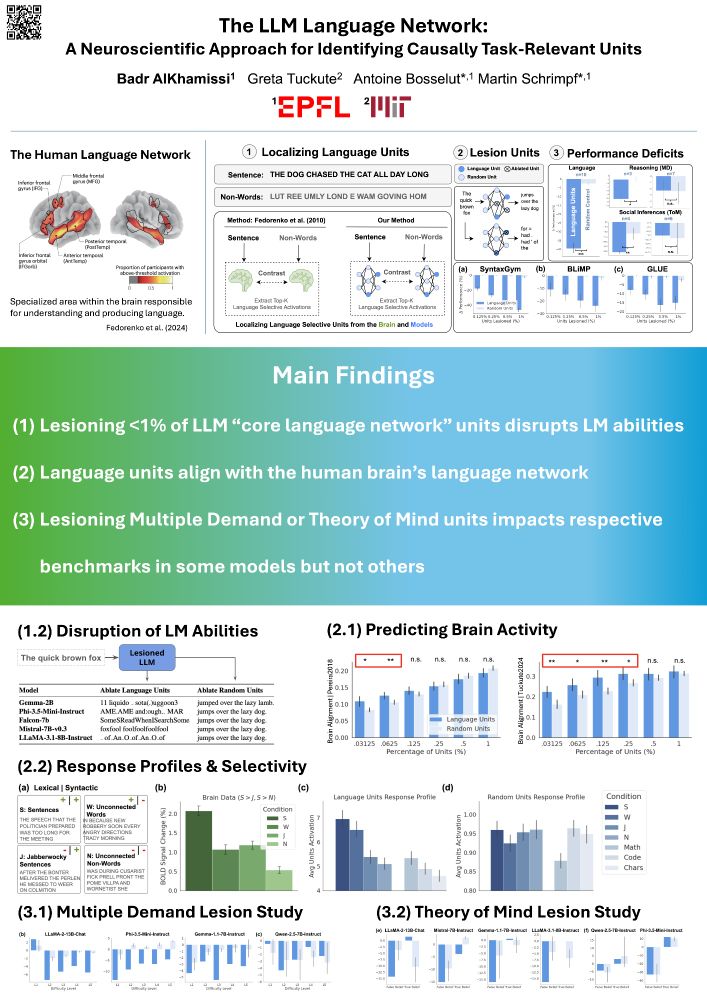
Excited to be at #NAACL2025 in Albuquerque! I’ll be presenting our paper “The LLM Language Network” as an Oral tomorrow at 2:00 PM in Ballroom C, hope to see you there!
Looking forward to all the discussions! 🎤 🧠
Looking forward to all the discussions! 🎤 🧠