



Matteo Bonvini
@bonv.bsky.social
Assistant Professor in the Department of Statistics at Rutgers
He/him 🏳️🌈
He/him 🏳️🌈
It was great to chair a panel on Veridical Data Science (vdsbook.com) in Education at #JSM2025 with panelists Rebecca Barter, Bin Yu, Andrew Bray, Joshua Rosenberg, and Robin Gong! Consider integrating VDS in your next course! The textbook contains examples, code, and many exercises.
Veridical Data Science
vdsbook.com
August 8, 2025 at 12:16 PM
It was great to chair a panel on Veridical Data Science (vdsbook.com) in Education at #JSM2025 with panelists Rebecca Barter, Bin Yu, Andrew Bray, Joshua Rosenberg, and Robin Gong! Consider integrating VDS in your next course! The textbook contains examples, code, and many exercises.
Reposted by Matteo Bonvini

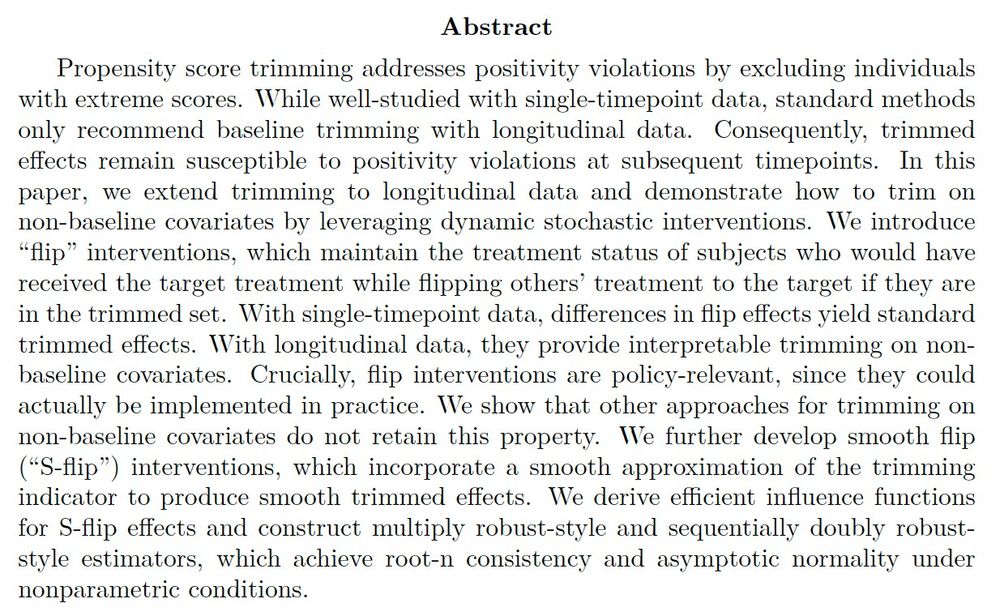
Excited to present on Thursday @eurocim.bsky.social on new work with @idiaz.bsky.social on (smooth) trimming with longitudinal data!
"Longitudinal trimming and smooth trimming with flip and S-flip interventions"
Prelim draft: alecmcclean.github.io/files/LSTTEs...
"Longitudinal trimming and smooth trimming with flip and S-flip interventions"
Prelim draft: alecmcclean.github.io/files/LSTTEs...
April 8, 2025 at 3:34 PM
Excited to present on Thursday @eurocim.bsky.social on new work with @idiaz.bsky.social on (smooth) trimming with longitudinal data!
"Longitudinal trimming and smooth trimming with flip and S-flip interventions"
Prelim draft: alecmcclean.github.io/files/LSTTEs...
"Longitudinal trimming and smooth trimming with flip and S-flip interventions"
Prelim draft: alecmcclean.github.io/files/LSTTEs...
Reposted by Matteo Bonvini

Rebecca Farina, Arun Kumar Kuchibhotla, Eric J. Tchetgen Tchetgen
Doubly Robust and Efficient Calibration of Prediction Sets for Censored Time-to-Event Outcomes
https://arxiv.org/abs/2501.04615
Doubly Robust and Efficient Calibration of Prediction Sets for Censored Time-to-Event Outcomes
https://arxiv.org/abs/2501.04615
January 9, 2025 at 5:06 AM
Rebecca Farina, Arun Kumar Kuchibhotla, Eric J. Tchetgen Tchetgen
Doubly Robust and Efficient Calibration of Prediction Sets for Censored Time-to-Event Outcomes
https://arxiv.org/abs/2501.04615
Doubly Robust and Efficient Calibration of Prediction Sets for Censored Time-to-Event Outcomes
https://arxiv.org/abs/2501.04615
Reposted by Matteo Bonvini

Happy to announce some new work with my student Kaitlyn Lee!
arxiv.org/abs/2501.04871
If you're not in the know, Riesz regression is a general tool to estimate things like propensity weights without actually having to know that they are propensity weights in the first place.
arxiv.org/abs/2501.04871
If you're not in the know, Riesz regression is a general tool to estimate things like propensity weights without actually having to know that they are propensity weights in the first place.

RieszBoost: Gradient Boosting for Riesz Regression
Answering causal questions often involves estimating linear functionals of conditional expectations, such as the average treatment effect or the effect of a longitudinal modified treatment policy. By ...
arxiv.org
January 10, 2025 at 10:55 PM
Happy to announce some new work with my student Kaitlyn Lee!
arxiv.org/abs/2501.04871
If you're not in the know, Riesz regression is a general tool to estimate things like propensity weights without actually having to know that they are propensity weights in the first place.
arxiv.org/abs/2501.04871
If you're not in the know, Riesz regression is a general tool to estimate things like propensity weights without actually having to know that they are propensity weights in the first place.
Reposted by Matteo Bonvini
My 2024 “highlights” (or what consumed my work year):
1. Double cross-fitting (arxiv.org/abs/2403.15175)
2. Calibrated sensitivity models (arxiv.org/abs/2405.08738)
3. Fair comparisons (arxiv.org/abs/2410.13522)
For #3, bsky.app/profile/alec....
Below: gory details for 1 and 2 (new to bsky)
1/9
1. Double cross-fitting (arxiv.org/abs/2403.15175)
2. Calibrated sensitivity models (arxiv.org/abs/2405.08738)
3. Fair comparisons (arxiv.org/abs/2410.13522)
For #3, bsky.app/profile/alec....
Below: gory details for 1 and 2 (new to bsky)
1/9
New-ish paper alert! arxiv.org/abs/2410.13522
We tackle the challenge of comparing multiple treatments when some subjects have zero prob. of receiving certain treatments. Eg, provider profiling: comparing hospitals (the “treatments”) for patient outcomes. Positivity violations are everywhere.
We tackle the challenge of comparing multiple treatments when some subjects have zero prob. of receiving certain treatments. Eg, provider profiling: comparing hospitals (the “treatments”) for patient outcomes. Positivity violations are everywhere.

Fair comparisons of causal parameters with many treatments and positivity violations
Comparing outcomes across treatments is essential in medicine and public policy. To do so, researchers typically estimate a set of parameters, possibly counterfactual, with each targeting a different ...
arxiv.org
December 28, 2024 at 11:28 AM
My 2024 “highlights” (or what consumed my work year):
1. Double cross-fitting (arxiv.org/abs/2403.15175)
2. Calibrated sensitivity models (arxiv.org/abs/2405.08738)
3. Fair comparisons (arxiv.org/abs/2410.13522)
For #3, bsky.app/profile/alec....
Below: gory details for 1 and 2 (new to bsky)
1/9
1. Double cross-fitting (arxiv.org/abs/2403.15175)
2. Calibrated sensitivity models (arxiv.org/abs/2405.08738)
3. Fair comparisons (arxiv.org/abs/2410.13522)
For #3, bsky.app/profile/alec....
Below: gory details for 1 and 2 (new to bsky)
1/9
Reposted by Matteo Bonvini

I have a new working paper with Yi Zhang & Kosuke Imai on estimating generalizable heterogeneous treatment effects (HTEs)! We account for distribution shifts in *both* individual covariates & treatment effect heterogeneity across different source sites. Details below--
arxiv.org/abs/2412.11136
arxiv.org/abs/2412.11136

Minimax Regret Estimation for Generalizing Heterogeneous Treatment Effects with Multisite Data
To test scientific theories and develop individualized treatment rules, researchers often wish to learn heterogeneous treatment effects that can be consistently found across diverse populations and co...
arxiv.org
December 17, 2024 at 4:11 PM
I have a new working paper with Yi Zhang & Kosuke Imai on estimating generalizable heterogeneous treatment effects (HTEs)! We account for distribution shifts in *both* individual covariates & treatment effect heterogeneity across different source sites. Details below--
arxiv.org/abs/2412.11136
arxiv.org/abs/2412.11136
Reposted by Matteo Bonvini

Thank you Alec for leading this project, I learned a lot! This paper has a very useful study of what contrasts are feasible in situations with many treatments and positivity violations, including necessary assumptions and efficient one-step estimators. Check it out!
New-ish paper alert! arxiv.org/abs/2410.13522
We tackle the challenge of comparing multiple treatments when some subjects have zero prob. of receiving certain treatments. Eg, provider profiling: comparing hospitals (the “treatments”) for patient outcomes. Positivity violations are everywhere.
We tackle the challenge of comparing multiple treatments when some subjects have zero prob. of receiving certain treatments. Eg, provider profiling: comparing hospitals (the “treatments”) for patient outcomes. Positivity violations are everywhere.
Fair comparisons of causal parameters with many treatments and positivity violations
Comparing outcomes across treatments is essential in medicine and public policy. To do so, researchers typically estimate a set of parameters, possibly counterfactual, with each targeting a different ...
arxiv.org
December 13, 2024 at 11:53 PM
Thank you Alec for leading this project, I learned a lot! This paper has a very useful study of what contrasts are feasible in situations with many treatments and positivity violations, including necessary assumptions and efficient one-step estimators. Check it out!
Reposted by Matteo Bonvini
New-ish paper alert! arxiv.org/abs/2410.13522
We tackle the challenge of comparing multiple treatments when some subjects have zero prob. of receiving certain treatments. Eg, provider profiling: comparing hospitals (the “treatments”) for patient outcomes. Positivity violations are everywhere.
We tackle the challenge of comparing multiple treatments when some subjects have zero prob. of receiving certain treatments. Eg, provider profiling: comparing hospitals (the “treatments”) for patient outcomes. Positivity violations are everywhere.
Fair comparisons of causal parameters with many treatments and positivity violations
Comparing outcomes across treatments is essential in medicine and public policy. To do so, researchers typically estimate a set of parameters, possibly counterfactual, with each targeting a different ...
arxiv.org
December 13, 2024 at 11:17 PM
New-ish paper alert! arxiv.org/abs/2410.13522
We tackle the challenge of comparing multiple treatments when some subjects have zero prob. of receiving certain treatments. Eg, provider profiling: comparing hospitals (the “treatments”) for patient outcomes. Positivity violations are everywhere.
We tackle the challenge of comparing multiple treatments when some subjects have zero prob. of receiving certain treatments. Eg, provider profiling: comparing hospitals (the “treatments”) for patient outcomes. Positivity violations are everywhere.
Reposted by Matteo Bonvini

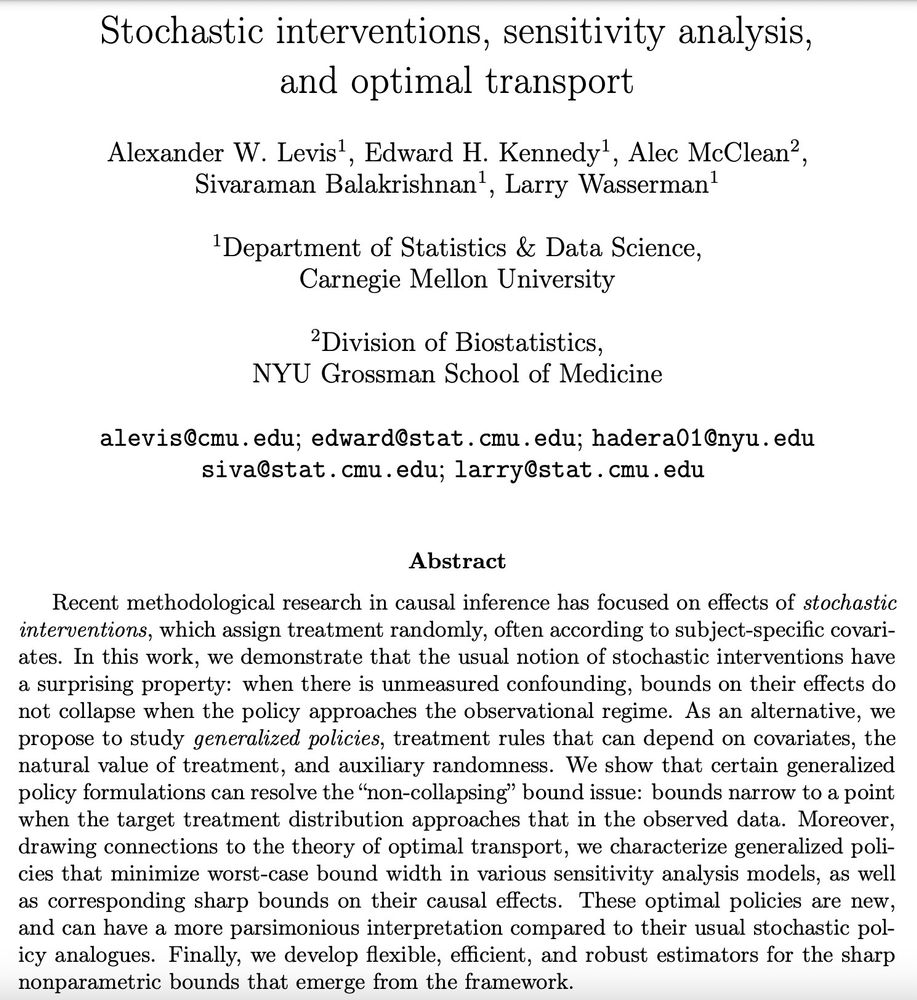
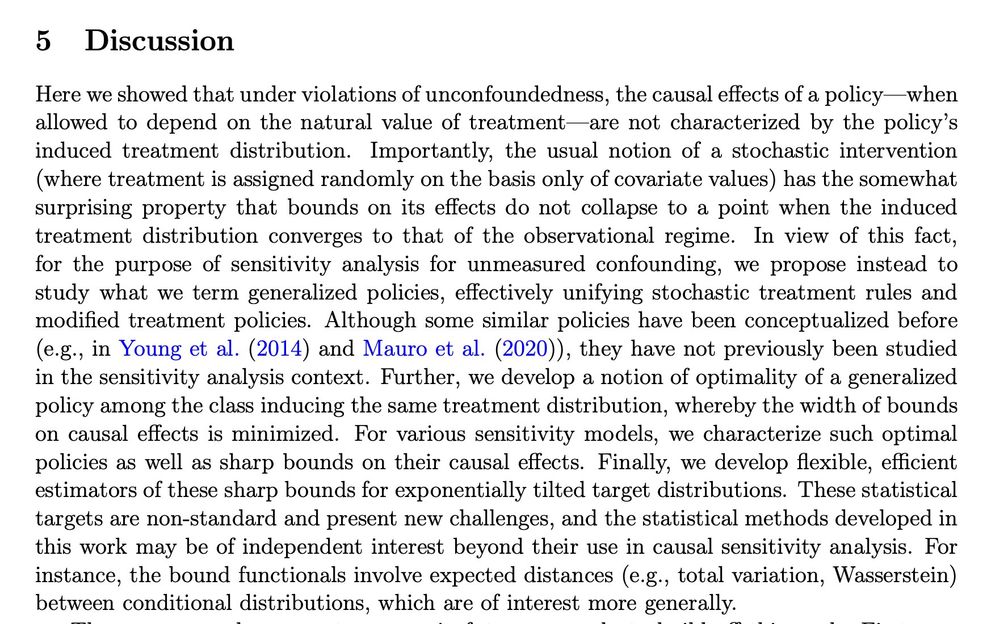
New paper! arxiv.org/pdf/2411.14285
Led by amazing postdoc Alex Levis: www.awlevis.com/about/
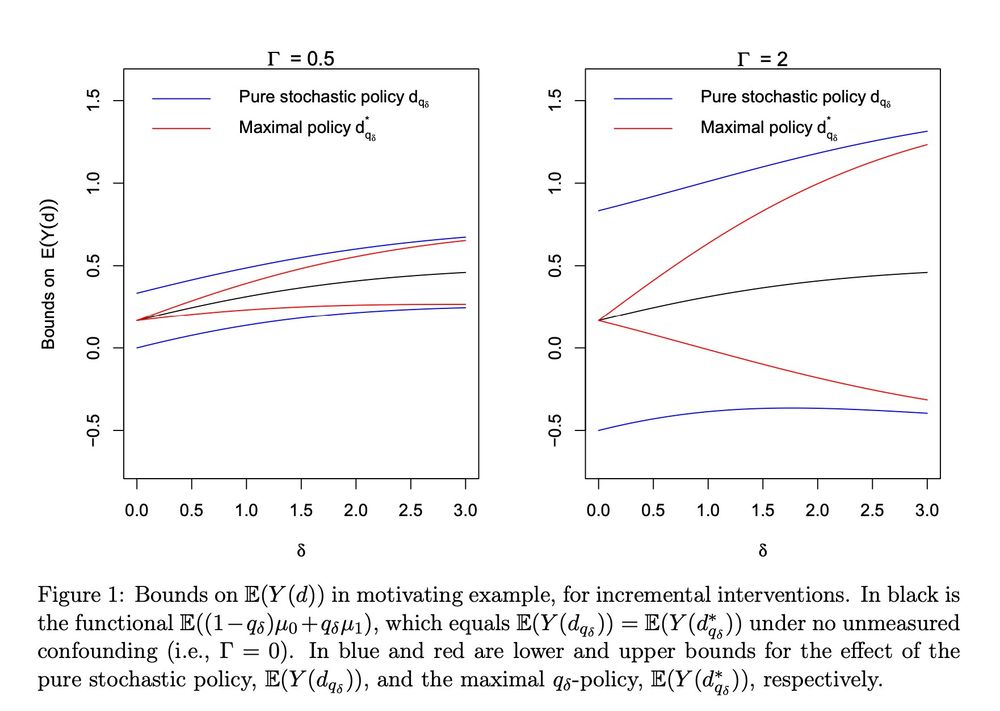
We show causal effects of new "soft" interventions are less sensitive to unmeasured confounding
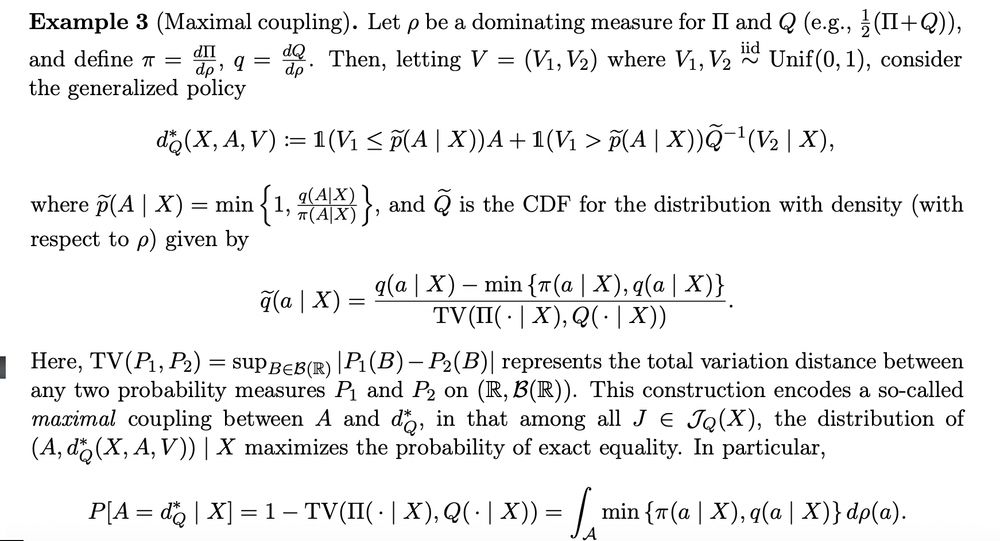
& study which effects are *least* sensitive to confounding -> makes new connections to optimal transport
Led by amazing postdoc Alex Levis: www.awlevis.com/about/
We show causal effects of new "soft" interventions are less sensitive to unmeasured confounding
& study which effects are *least* sensitive to confounding -> makes new connections to optimal transport
November 22, 2024 at 4:39 AM
New paper! arxiv.org/pdf/2411.14285
Led by amazing postdoc Alex Levis: www.awlevis.com/about/
We show causal effects of new "soft" interventions are less sensitive to unmeasured confounding
& study which effects are *least* sensitive to confounding -> makes new connections to optimal transport
Led by amazing postdoc Alex Levis: www.awlevis.com/about/
We show causal effects of new "soft" interventions are less sensitive to unmeasured confounding
& study which effects are *least* sensitive to confounding -> makes new connections to optimal transport
Reposted by Matteo Bonvini
Should we use structure-agnostic (arxiv.org/abs/2305.04116) or smooth (arxiv.org/pdf/1512.02174) models for causal inference?
Why not both?
Here we propose novel hybrid smooth+agnostic model, give minimax rates, & new optimal methods
arxiv.org/pdf/2405.08525
-> fast rates under weaker conditions
Why not both?
Here we propose novel hybrid smooth+agnostic model, give minimax rates, & new optimal methods
arxiv.org/pdf/2405.08525
-> fast rates under weaker conditions


December 13, 2024 at 4:07 AM
Should we use structure-agnostic (arxiv.org/abs/2305.04116) or smooth (arxiv.org/pdf/1512.02174) models for causal inference?
Why not both?
Here we propose novel hybrid smooth+agnostic model, give minimax rates, & new optimal methods
arxiv.org/pdf/2405.08525
-> fast rates under weaker conditions
Why not both?
Here we propose novel hybrid smooth+agnostic model, give minimax rates, & new optimal methods
arxiv.org/pdf/2405.08525
-> fast rates under weaker conditions