


Lukasz Bugaj
@bugajlab.bsky.social
Asst. Professor @ Penn Bioengineering. Cell Signaling, optogenetics, synthetic biology, cancer signaling, regenerative medicine, bio-tinkering. www.bugajlab.com
Speaker lineup posted for FASEB: Dynamics and Encoding in Cell Signaling (June 2026)! Live-cell imaging, biosensors, signal dynamics, and quant. modeling/analysis, across the biosciences.
Stellar lineup, Keynotes from Tobias Meyer and Jin Zhang
Join us in Nashville!
tinyurl.com/bd9wmyve
Stellar lineup, Keynotes from Tobias Meyer and Jin Zhang
Join us in Nashville!
tinyurl.com/bd9wmyve

January 12, 2026 at 3:13 PM
Speaker lineup posted for FASEB: Dynamics and Encoding in Cell Signaling (June 2026)! Live-cell imaging, biosensors, signal dynamics, and quant. modeling/analysis, across the biosciences.
Stellar lineup, Keynotes from Tobias Meyer and Jin Zhang
Join us in Nashville!
tinyurl.com/bd9wmyve
Stellar lineup, Keynotes from Tobias Meyer and Jin Zhang
Join us in Nashville!
tinyurl.com/bd9wmyve
5) Finally, a panel of other oncogenic RTK fusions shows that only few form condensates, and none show correlation between condensation and signaling at single-cell.

December 17, 2025 at 3:10 PM
5) Finally, a panel of other oncogenic RTK fusions shows that only few form condensates, and none show correlation between condensation and signaling at single-cell.
4) Unexpectedly, even cytoplasmic *monomers* (const. active) can drive signaling and tumor formation, despite complete lack of multimerization that is essential for condensation.

December 17, 2025 at 3:10 PM
4) Unexpectedly, even cytoplasmic *monomers* (const. active) can drive signaling and tumor formation, despite complete lack of multimerization that is essential for condensation.
3) If condensates are dispensable, diffuse (non-condensing) ALK fusions should be able to signal and drive tumor growth. Indeed they can! Synthetic, cytoplasmic ALK dimers don’t condense but do signal, and also form tumors in mice.

December 17, 2025 at 3:10 PM
3) If condensates are dispensable, diffuse (non-condensing) ALK fusions should be able to signal and drive tumor growth. Indeed they can! Synthetic, cytoplasmic ALK dimers don’t condense but do signal, and also form tumors in mice.
2) There is lots of active oncogene (pALK) in the diffuse phase, and when treated with ALK inhibitor, timescale of decay in the diffuse phase matches that of downstream signals, but decay in condensates is much slower.

December 17, 2025 at 3:10 PM
2) There is lots of active oncogene (pALK) in the diffuse phase, and when treated with ALK inhibitor, timescale of decay in the diffuse phase matches that of downstream signals, but decay in condensates is much slower.
Evidence of dispensability?
1) EML4-ALK condensation is biphasic (highest at mid levels), but signaling increases monotonically w expression. Thus the strongest signaling is in cells with *no* condensates.
1) EML4-ALK condensation is biphasic (highest at mid levels), but signaling increases monotonically w expression. Thus the strongest signaling is in cells with *no* condensates.

December 17, 2025 at 3:10 PM
Evidence of dispensability?
1) EML4-ALK condensation is biphasic (highest at mid levels), but signaling increases monotonically w expression. Thus the strongest signaling is in cells with *no* condensates.
1) EML4-ALK condensation is biphasic (highest at mid levels), but signaling increases monotonically w expression. Thus the strongest signaling is in cells with *no* condensates.
The condensate (large foci) model suggests that condensates of fusions (e.g. EML4-ALK) are an essential organizer of signaling in the cyto, in the absence of membrane. Causality is unclear though because perturb's of condensates are often also perturb's of kinase activity.

December 17, 2025 at 3:10 PM
The condensate (large foci) model suggests that condensates of fusions (e.g. EML4-ALK) are an essential organizer of signaling in the cyto, in the absence of membrane. Causality is unclear though because perturb's of condensates are often also perturb's of kinase activity.
🚨Preprint 2/2: Several studies implicate condensates in RTK fusion onco-signaling. So we were surprised to find that condensates are entirely dispensable😮(!). A study from proteins to mice, by dynamic duo @davidgonzmar.bsky.social and @trmumford.bsky.social.
www.biorxiv.org/content/10.6...
👇
www.biorxiv.org/content/10.6...
👇

December 17, 2025 at 3:10 PM
🚨Preprint 2/2: Several studies implicate condensates in RTK fusion onco-signaling. So we were surprised to find that condensates are entirely dispensable😮(!). A study from proteins to mice, by dynamic duo @davidgonzmar.bsky.social and @trmumford.bsky.social.
www.biorxiv.org/content/10.6...
👇
www.biorxiv.org/content/10.6...
👇
Finally, synthetic optogenetic RTK fusions demonstrated the key principles: 1) Grb2 binding and sequestration could be decoupled from fusion signaling, and 2) Grb2 sequestration in the cyto is sufficient to desensitize cells to EGFR stim (without signaling).

December 16, 2025 at 12:05 PM
Finally, synthetic optogenetic RTK fusions demonstrated the key principles: 1) Grb2 binding and sequestration could be decoupled from fusion signaling, and 2) Grb2 sequestration in the cyto is sufficient to desensitize cells to EGFR stim (without signaling).
Targeted therapy (kinase inhibitors) releases Grb2 and relieves suppression. Potential therapeutic importance because drugs permit receptor signaling that promotes tolerance.

December 16, 2025 at 12:05 PM
Targeted therapy (kinase inhibitors) releases Grb2 and relieves suppression. Potential therapeutic importance because drugs permit receptor signaling that promotes tolerance.
Mechanism? Fusions sequester adapters like Grb2 in cyto and prevent translocation to active EGFR at membrane. Previously shown for EML4-ALK, below for TPM3-ROS, same for (almost) all fusions tested
December 16, 2025 at 12:05 PM
Mechanism? Fusions sequester adapters like Grb2 in cyto and prevent translocation to active EGFR at membrane. Previously shown for EML4-ALK, below for TPM3-ROS, same for (almost) all fusions tested
Main surprise: condensates (large foci) are *not* important for EGFR suppression. For EML4-ALK, condensates co-occur with suppression, but for most fusions -- no condensates.
See concurrent preprint for more surprises on the role of condensates in fusions.
www.biorxiv.org/content/10.6...
See concurrent preprint for more surprises on the role of condensates in fusions.
www.biorxiv.org/content/10.6...

December 16, 2025 at 12:05 PM
Main surprise: condensates (large foci) are *not* important for EGFR suppression. For EML4-ALK, condensates co-occur with suppression, but for most fusions -- no condensates.
See concurrent preprint for more surprises on the role of condensates in fusions.
www.biorxiv.org/content/10.6...
See concurrent preprint for more surprises on the role of condensates in fusions.
www.biorxiv.org/content/10.6...
Main finding: Across a panel of 10 oncogenic fusions and patient-derived cell lines, active fusions broadly suppressed the cell’s response to EGF.

December 16, 2025 at 12:05 PM
Main finding: Across a panel of 10 oncogenic fusions and patient-derived cell lines, active fusions broadly suppressed the cell’s response to EGF.
Previously we’d shown that EML4-ALK (onco-fusion) doesn’t only drive cancer signaling—it also suppresses EGFR, and suppression was reversed during therapy.
www.nature.com/articles/s41....
Do other fusions also suppress EGFR? Also EML4-ALK formed condensates -- are condensates important?
www.nature.com/articles/s41....
Do other fusions also suppress EGFR? Also EML4-ALK formed condensates -- are condensates important?

December 16, 2025 at 12:05 PM
Previously we’d shown that EML4-ALK (onco-fusion) doesn’t only drive cancer signaling—it also suppresses EGFR, and suppression was reversed during therapy.
www.nature.com/articles/s41....
Do other fusions also suppress EGFR? Also EML4-ALK formed condensates -- are condensates important?
www.nature.com/articles/s41....
Do other fusions also suppress EGFR? Also EML4-ALK formed condensates -- are condensates important?
🚨New preprint(1/2)! We show that RTK fusion oncoproteins broadly suppress EGFR signaling. How? Sequestration of adapters as the shared principle.
Led by superb PhD student Carol Gao.
www.biorxiv.org/content/10.1...
Implications for drug tolerance/resistance, and includes one big surprise🫧.👇
Led by superb PhD student Carol Gao.
www.biorxiv.org/content/10.1...
Implications for drug tolerance/resistance, and includes one big surprise🫧.👇
December 16, 2025 at 12:05 PM
🚨New preprint(1/2)! We show that RTK fusion oncoproteins broadly suppress EGFR signaling. How? Sequestration of adapters as the shared principle.
Led by superb PhD student Carol Gao.
www.biorxiv.org/content/10.1...
Implications for drug tolerance/resistance, and includes one big surprise🫧.👇
Led by superb PhD student Carol Gao.
www.biorxiv.org/content/10.1...
Implications for drug tolerance/resistance, and includes one big surprise🫧.👇
#Cellbio2025 come see the latest from the lab, including on opto/thermogenetics, condensates, RTK fusions, stress granules, biosensors of clustering. Talks and posters today and tomorrow!

December 8, 2025 at 12:12 PM
#Cellbio2025 come see the latest from the lab, including on opto/thermogenetics, condensates, RTK fusions, stress granules, biosensors of clustering. Talks and posters today and tomorrow!
#CellBio2025 come check out the workshop on applying optogenetic tools in cell biology! Today (Sunday) at 5:30p in Rm 121.
Note that this session does *not* appear in the app for some reason
Note that this session does *not* appear in the app for some reason

December 7, 2025 at 3:34 PM
#CellBio2025 come check out the workshop on applying optogenetic tools in cell biology! Today (Sunday) at 5:30p in Rm 121.
Note that this session does *not* appear in the app for some reason
Note that this session does *not* appear in the app for some reason
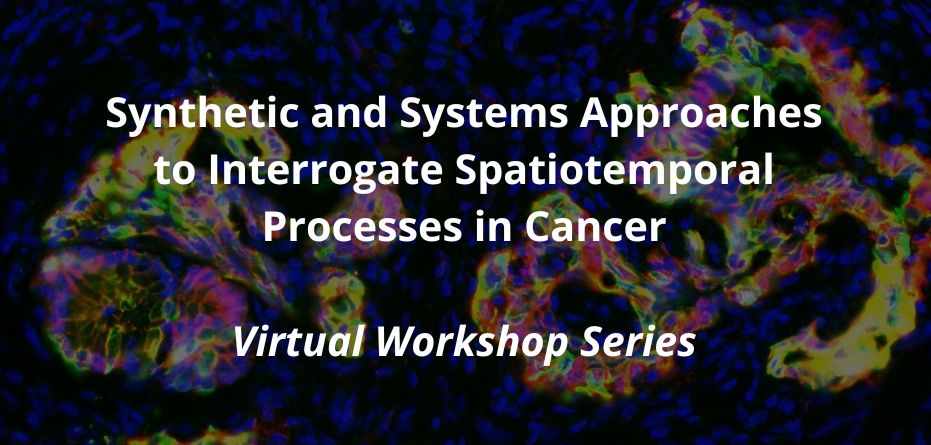
Are you interested in synthetic and systems biology approaches to study #spatiotemporal processes in cancer? Join NCI for virtual workshops on May 13, 15, & 20 (next week!) from 12:00–4:30 PM ET:
registration: events.cancer.gov/nci/syntheti...
#SynSysBio4SpatialCancerResearch
registration: events.cancer.gov/nci/syntheti...
#SynSysBio4SpatialCancerResearch
May 9, 2025 at 3:48 PM
Are you interested in synthetic and systems biology approaches to study #spatiotemporal processes in cancer? Join NCI for virtual workshops on May 13, 15, & 20 (next week!) from 12:00–4:30 PM ET:
registration: events.cancer.gov/nci/syntheti...
#SynSysBio4SpatialCancerResearch
registration: events.cancer.gov/nci/syntheti...
#SynSysBio4SpatialCancerResearch
We also developed a "universal" Aviatar that can localize to any GFP-tagged compartment using a weak nanobody, and we used it to localize to stress granules through endogenously-tagged G3BP1
April 30, 2025 at 2:09 PM
We also developed a "universal" Aviatar that can localize to any GFP-tagged compartment using a weak nanobody, and we used it to localize to stress granules through endogenously-tagged G3BP1
Aviatar regulated actin polymerization at the membrane and revealed compartment-specific differences of RTK fragments commonly mislocalized in cancer
April 30, 2025 at 2:09 PM
Aviatar regulated actin polymerization at the membrane and revealed compartment-specific differences of RTK fragments commonly mislocalized in cancer
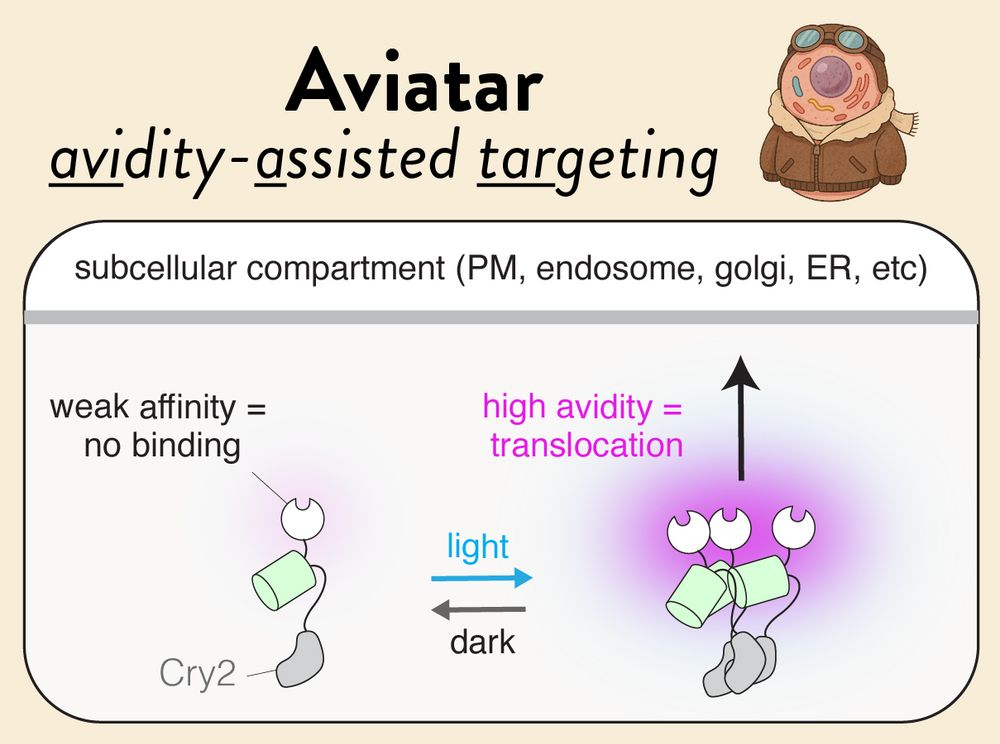
Aviatar can target any desired compartment for which a weak binder can be found. We show common targets: plasma membrane, endosomes, Golgi, ER, and microtubules.
April 30, 2025 at 2:09 PM
Aviatar can target any desired compartment for which a weak binder can be found. We show common targets: plasma membrane, endosomes, Golgi, ER, and microtubules.
In Aviatar (Avidity assisted targeting), a single light-sensitive protein translocates from the cytoplasm to an unmodified subcellular compartment. Light induces clustering, clustering turns a weak binder to a high-avidity assembly, and Aviatar flies to its target location.
April 30, 2025 at 2:09 PM
In Aviatar (Avidity assisted targeting), a single light-sensitive protein translocates from the cytoplasm to an unmodified subcellular compartment. Light induces clustering, clustering turns a weak binder to a high-avidity assembly, and Aviatar flies to its target location.
Proteins often bind targets using avidity, the combined interaction strength of multiple weak binders. Now we’ve harnessed this principle for compact, *single*-component optogenetic tools for translocation. Lead by phenom PhD student @dennishuang.bsky.social #synbiosky🧵
📝 tinyurl.com/aviatar
📝 tinyurl.com/aviatar
April 30, 2025 at 2:09 PM
Proteins often bind targets using avidity, the combined interaction strength of multiple weak binders. Now we’ve harnessed this principle for compact, *single*-component optogenetic tools for translocation. Lead by phenom PhD student @dennishuang.bsky.social #synbiosky🧵
📝 tinyurl.com/aviatar
📝 tinyurl.com/aviatar
New preprint! We found dynamic signal processing (IFFL) in a single protein, which pulses in response to step inputs. New insights for capability of protein computation + implications for new opto and thermo probes
www.biorxiv.org/content/10.1...
Check out the 🧵 from first author Dennis Huang:
www.biorxiv.org/content/10.1...
Check out the 🧵 from first author Dennis Huang:
April 16, 2025 at 1:55 PM
New preprint! We found dynamic signal processing (IFFL) in a single protein, which pulses in response to step inputs. New insights for capability of protein computation + implications for new opto and thermo probes
www.biorxiv.org/content/10.1...
Check out the 🧵 from first author Dennis Huang:
www.biorxiv.org/content/10.1...
Check out the 🧵 from first author Dennis Huang:
and the second
www.sciencedirect.com/science/arti...
www.sciencedirect.com/science/arti...
March 17, 2025 at 3:52 PM
and the second
www.sciencedirect.com/science/arti...
www.sciencedirect.com/science/arti...