



@camilla-roselli.bsky.social
Reposted

📣First preprint of the lab📣 Did that really happen?😅
Enteric neurons, aka somatic postmitotic cells, must hold on to their sex identity tight, to deliver a tuned response to signals from the ovary that instruct the animal to engage sex-matched behavioural programmes.
www.biorxiv.org/content/10.6...
Enteric neurons, aka somatic postmitotic cells, must hold on to their sex identity tight, to deliver a tuned response to signals from the ovary that instruct the animal to engage sex-matched behavioural programmes.
www.biorxiv.org/content/10.6...

Genetic sex of enteric neurons enables ovarian relaxin to gate maternal gut plasticity
Animals must align intestinal plasticity and feeding with reproductive state, yet the checkpoint that gates these adaptations is unknown. Here we show that an ovary-to-enteric-neuron axis gates the on...
www.biorxiv.org
January 11, 2026 at 3:32 PM
📣First preprint of the lab📣 Did that really happen?😅
Enteric neurons, aka somatic postmitotic cells, must hold on to their sex identity tight, to deliver a tuned response to signals from the ovary that instruct the animal to engage sex-matched behavioural programmes.
www.biorxiv.org/content/10.6...
Enteric neurons, aka somatic postmitotic cells, must hold on to their sex identity tight, to deliver a tuned response to signals from the ovary that instruct the animal to engage sex-matched behavioural programmes.
www.biorxiv.org/content/10.6...
Reposted

An animal study in Nature Neuroscience shows that high estrogen levels can enhance learning capabilities. #Neuroskyence 🧪

Estrogen modulates reward prediction errors and reinforcement learning - Nature Neuroscience
Dopamine encoding of reward prediction errors naturally fluctuates over females’ reproductive cycles with estrogenic signaling due to reduced expression of dopamine reuptake proteins.
go.nature.com
November 25, 2025 at 2:32 AM
An animal study in Nature Neuroscience shows that high estrogen levels can enhance learning capabilities. #Neuroskyence 🧪
Reposted

We have two advertised fully-funded PhD positions to work on memory or disease models in Drosophila! Please check the SWBio DTP website for more information and reach out if you are interested:
www.swbio.ac.uk/molecular-me...
www.swbio.ac.uk/molecular-me...
Molecular Mechanisms & Pathways projects – SWBiosciences Doctoral Training Partnership
www.swbio.ac.uk
November 4, 2025 at 3:35 PM
We have two advertised fully-funded PhD positions to work on memory or disease models in Drosophila! Please check the SWBio DTP website for more information and reach out if you are interested:
www.swbio.ac.uk/molecular-me...
www.swbio.ac.uk/molecular-me...
Reposted

The world’s “most dangerous animal” just got easier to study 🦟
HHMI’s @leslievosshall.bsky.social & #VosshallLab at @rockefeller.edu have built the 1st cellular atlas of Aedes aegypti, mapping everything from legs to antennae. Available now to all researchers, & the public: bit.ly/4oO4MzB
HHMI’s @leslievosshall.bsky.social & #VosshallLab at @rockefeller.edu have built the 1st cellular atlas of Aedes aegypti, mapping everything from legs to antennae. Available now to all researchers, & the public: bit.ly/4oO4MzB

Researchers release the world’s first head-to-toe cellular atlas of the mosquito - News
The atlas makes the most dangerous animal in the world a lot easier to study—and perhaps defeat one day.
bit.ly
November 3, 2025 at 6:50 PM
The world’s “most dangerous animal” just got easier to study 🦟
HHMI’s @leslievosshall.bsky.social & #VosshallLab at @rockefeller.edu have built the 1st cellular atlas of Aedes aegypti, mapping everything from legs to antennae. Available now to all researchers, & the public: bit.ly/4oO4MzB
HHMI’s @leslievosshall.bsky.social & #VosshallLab at @rockefeller.edu have built the 1st cellular atlas of Aedes aegypti, mapping everything from legs to antennae. Available now to all researchers, & the public: bit.ly/4oO4MzB
Reposted

Exciting news for #drosophila #connectomics and #neuroscience enthusiasts: the Drosophila male central nervous system connectome is now live for exploration. Find out more at the landing page hosted by our Janelia FlyEM collaborators www.janelia.org/project-team....

Male CNS Connectome
A team of researchers has unveiled the complete connectome of a male fruit fly central nervous system —a seamless map of all the neurons in the brain and nerve cord of a single male fruit fly and the ...
www.janelia.org
October 5, 2025 at 3:40 PM
Exciting news for #drosophila #connectomics and #neuroscience enthusiasts: the Drosophila male central nervous system connectome is now live for exploration. Find out more at the landing page hosted by our Janelia FlyEM collaborators www.janelia.org/project-team....
Reposted

How do we time our daily rhythms as a function of seasons?
Our answer to this lies in a neuropeptide-directed bilayered plasticity mechanism elaborated in this freshly online study.
www.science.org/doi/10.1126/...
Our answer to this lies in a neuropeptide-directed bilayered plasticity mechanism elaborated in this freshly online study.
www.science.org/doi/10.1126/...

Neuropeptide dynamics coordinate layered plasticity mechanisms adapting Drosophila circadian behavior to changing environment
Neuropeptide-guided plasticity of the clock neuron network operation enables behavioral adaptation to seasonal changes.
www.science.org
August 31, 2025 at 12:55 PM
How do we time our daily rhythms as a function of seasons?
Our answer to this lies in a neuropeptide-directed bilayered plasticity mechanism elaborated in this freshly online study.
www.science.org/doi/10.1126/...
Our answer to this lies in a neuropeptide-directed bilayered plasticity mechanism elaborated in this freshly online study.
www.science.org/doi/10.1126/...
Reposted
📣 Paper alert!!!! 📣Very happy to have participated a tiny bit in this super exciting piece of work by the @bentonlab.bsky.social lab! @joybabadeep.bsky.social and @camilla-roselli.bsky.social
www.biorxiv.org/content/10.1...
www.biorxiv.org/content/10.1...
Intersecting experimental evolution and CRISPR screens to identify novel toxin resistance loci
Understanding toxin resistance in insects is key to appreciate niche adaptations and for pest management, but remains challenging due to complex genetics. To investigate how Drosophila sechellia evolv...
www.biorxiv.org
August 29, 2025 at 4:20 PM
📣 Paper alert!!!! 📣Very happy to have participated a tiny bit in this super exciting piece of work by the @bentonlab.bsky.social lab! @joybabadeep.bsky.social and @camilla-roselli.bsky.social
www.biorxiv.org/content/10.1...
www.biorxiv.org/content/10.1...
Reposted

Exciting new Ruta lab preprint by @annaryba.bsky.social et al. on the neural underpinnings of intraspecific behavioral variation: Strain variation identifies a neural substrate for behavioral evolution Drosophila
www.biorxiv.org/content/10.1...
www.biorxiv.org/content/10.1...

Strain variation identifies a neural substrate for behavioral evolution in Drosophila
Sexual selection acts on heritable differences within species, driving the parallel diversification of signal production in one sex and behavioral responses in the other. This coevolution implies that...
www.biorxiv.org
August 21, 2025 at 9:43 AM
Exciting new Ruta lab preprint by @annaryba.bsky.social et al. on the neural underpinnings of intraspecific behavioral variation: Strain variation identifies a neural substrate for behavioral evolution Drosophila
www.biorxiv.org/content/10.1...
www.biorxiv.org/content/10.1...
Reposted
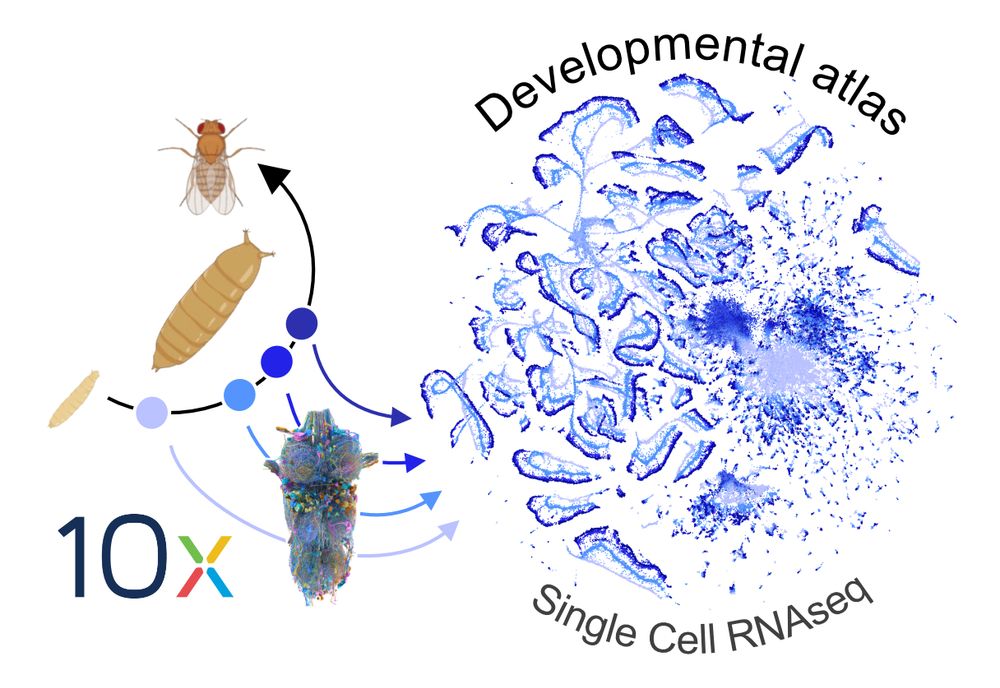
Neuronal diversity is written in transcriptional codes 🧬. But what is the logic of these codes that define cell types and wiring patterns?
To find out we built a #scRNAseq developmental atlas of the Drosophila nerve cord and linked it to the #connectome 🪰🧠
#preprint thread ⬇️1/8
To find out we built a #scRNAseq developmental atlas of the Drosophila nerve cord and linked it to the #connectome 🪰🧠
#preprint thread ⬇️1/8
August 21, 2025 at 4:04 PM
Neuronal diversity is written in transcriptional codes 🧬. But what is the logic of these codes that define cell types and wiring patterns?
To find out we built a #scRNAseq developmental atlas of the Drosophila nerve cord and linked it to the #connectome 🪰🧠
#preprint thread ⬇️1/8
To find out we built a #scRNAseq developmental atlas of the Drosophila nerve cord and linked it to the #connectome 🪰🧠
#preprint thread ⬇️1/8
Reposted

New 3D reconstructions of Drosophila sensory neurons reveal striking diversity in dendrite shape, even among neurons of the same type. These findings open up new questions about how neuron structure relates to sensory function.
buff.ly/dfRVVsm
buff.ly/dfRVVsm
August 21, 2025 at 1:44 PM
New 3D reconstructions of Drosophila sensory neurons reveal striking diversity in dendrite shape, even among neurons of the same type. These findings open up new questions about how neuron structure relates to sensory function.
buff.ly/dfRVVsm
buff.ly/dfRVVsm
Reposted

New from the Kinghorn Lab! 🧠🔬 Our latest preprint shows that in fly 🪰🧬 Gaucher’s & Parkinson’s 🧠 models, kidney dysfunction drives neurodegeneration - supporting emerging links between renal health & Parkinson's. You can read it here:
www.biorxiv.org/content/10.1...
www.biorxiv.org/content/10.1...

Redox Dyshomeostasis Links Renal and Neuronal Dysfunction in Drosophila Models of Gaucher and Parkinson's Disease
Gaucher disease (GD), the most common lysosomal storage disorder, is caused by bi-allelic mutations in the GBA1 gene. Variants in GBA1 also represent the most frequent genetic risk factor for Parkinso...
www.biorxiv.org
August 10, 2025 at 8:10 PM
New from the Kinghorn Lab! 🧠🔬 Our latest preprint shows that in fly 🪰🧬 Gaucher’s & Parkinson’s 🧠 models, kidney dysfunction drives neurodegeneration - supporting emerging links between renal health & Parkinson's. You can read it here:
www.biorxiv.org/content/10.1...
www.biorxiv.org/content/10.1...
Reposted

A reminder you/your lab can support FlyBase at Cambridge through the following link. Every bit helps. Please share if you yourself can't donate.
www.philanthropy.cam.ac.uk/give-to-camb...
www.philanthropy.cam.ac.uk/give-to-camb...
August 14, 2025 at 5:25 AM
A reminder you/your lab can support FlyBase at Cambridge through the following link. Every bit helps. Please share if you yourself can't donate.
www.philanthropy.cam.ac.uk/give-to-camb...
www.philanthropy.cam.ac.uk/give-to-camb...
Reposted

Explore neurons that enter/exit the fly central nervous system by body part with this clickable fly!: codex.flywire.ai/app/body_par...
(graphics: @mottcallie.bsky.social, tool: Arie Matisliah)
Vector graphics! github.com/wilson-lab/s...
Effector cells in 3D! ng.banc.community/2025a/effere...
(graphics: @mottcallie.bsky.social, tool: Arie Matisliah)
Vector graphics! github.com/wilson-lab/s...
Effector cells in 3D! ng.banc.community/2025a/effere...

August 7, 2025 at 10:33 PM
Explore neurons that enter/exit the fly central nervous system by body part with this clickable fly!: codex.flywire.ai/app/body_par...
(graphics: @mottcallie.bsky.social, tool: Arie Matisliah)
Vector graphics! github.com/wilson-lab/s...
Effector cells in 3D! ng.banc.community/2025a/effere...
(graphics: @mottcallie.bsky.social, tool: Arie Matisliah)
Vector graphics! github.com/wilson-lab/s...
Effector cells in 3D! ng.banc.community/2025a/effere...
Reposted

The ataxin-2 protein is required in kenyon cells for RNP-granule assembly and appetitive long-term memory formation
#Drosophila
#Drosophila
The ataxin-2 protein is required in kenyon cells for RNP-granule assembly and appetitive long-term memory formation
#Drosophila
PubMed link
pubmed.ncbi.nlm.nih.gov
August 4, 2025 at 4:23 PM
The ataxin-2 protein is required in kenyon cells for RNP-granule assembly and appetitive long-term memory formation
#Drosophila
#Drosophila
Reposted
Public access to the first fly connectome that spans the whole CNS - BANC!: codex.flywire.ai?dataset=banc
Different from prior connectomes - it is brain + cord (think spinal cord)
We use it to ‘embody’ the system and find it resembles ‘subsumption architecture’ doi.org/10.1101/2025...
Different from prior connectomes - it is brain + cord (think spinal cord)
We use it to ‘embody’ the system and find it resembles ‘subsumption architecture’ doi.org/10.1101/2025...
August 2, 2025 at 2:30 PM
Public access to the first fly connectome that spans the whole CNS - BANC!: codex.flywire.ai?dataset=banc
Different from prior connectomes - it is brain + cord (think spinal cord)
We use it to ‘embody’ the system and find it resembles ‘subsumption architecture’ doi.org/10.1101/2025...
Different from prior connectomes - it is brain + cord (think spinal cord)
We use it to ‘embody’ the system and find it resembles ‘subsumption architecture’ doi.org/10.1101/2025...
🧠 Our latest paper is out!
Here, we show that Ataxin-2 is essential for memory formation via RNP granule dynamics in Drosophila.
🔗 doi.org/10.1080/0167...
#Neuroscience #Memory #RNA #Drosophila #NewPaper
@tamaraboto.bsky.social @simon-sprecher.bsky.social
Here, we show that Ataxin-2 is essential for memory formation via RNP granule dynamics in Drosophila.
🔗 doi.org/10.1080/0167...
#Neuroscience #Memory #RNA #Drosophila #NewPaper
@tamaraboto.bsky.social @simon-sprecher.bsky.social

The ataxin-2 protein is required in kenyon cells for RNP-granule assembly and appetitive long-term memory formation
Ribonucleoprotein granules (mRNP granules) are thought to contribute to the control of neuronal mRNA translation required for consolidation of long-term memories. Consistent with this, the function...
doi.org
August 4, 2025 at 4:35 PM
🧠 Our latest paper is out!
Here, we show that Ataxin-2 is essential for memory formation via RNP granule dynamics in Drosophila.
🔗 doi.org/10.1080/0167...
#Neuroscience #Memory #RNA #Drosophila #NewPaper
@tamaraboto.bsky.social @simon-sprecher.bsky.social
Here, we show that Ataxin-2 is essential for memory formation via RNP granule dynamics in Drosophila.
🔗 doi.org/10.1080/0167...
#Neuroscience #Memory #RNA #Drosophila #NewPaper
@tamaraboto.bsky.social @simon-sprecher.bsky.social
Reposted

The Ataxin-2 protein is required in Kenyon cells for RNP-granule assembly and appetitive long-term memory formation. https://www.biorxiv.org/content/10.1101/2025.05.15.654326v1
May 16, 2025 at 7:15 AM
The Ataxin-2 protein is required in Kenyon cells for RNP-granule assembly and appetitive long-term memory formation. https://www.biorxiv.org/content/10.1101/2025.05.15.654326v1