


Cees Bassa
@cbassa.bsky.social
Astronomer at ASTRON in the Netherlands, working with the LOFAR low frequency radio telescope.
An absolutely awesome display of Northern Lights over the Netherlands during the past hour! Red glow in the North and a green curtain passing over whose motion was very obvious with the naked eye. This is 1 hour worth of 15 second exposures with my all sky camera from 21to 22UTC. #auroraBorealis
January 19, 2026 at 10:27 PM
An absolutely awesome display of Northern Lights over the Netherlands during the past hour! Red glow in the North and a green curtain passing over whose motion was very obvious with the naked eye. This is 1 hour worth of 15 second exposures with my all sky camera from 21to 22UTC. #auroraBorealis
Picking up the old hobby of catching radio signals from newly launched satellites. These are 5 satellites from the Space X launch that happened less than 3 hours ago. Signals from 4 CONNECTA IOT satellites on 401.5MHz and 2240MHz, as well as CarbSAR at 2243.333MHz.


January 11, 2026 at 4:53 PM
Picking up the old hobby of catching radio signals from newly launched satellites. These are 5 satellites from the Space X launch that happened less than 3 hours ago. Signals from 4 CONNECTA IOT satellites on 401.5MHz and 2240MHz, as well as CarbSAR at 2243.333MHz.
Yes, here it is. Tracking the motion of the planets is a bit tricky, but the motion of the Sun and Moon is very obvious.
January 8, 2026 at 3:47 PM
Yes, here it is. Tracking the motion of the planets is a bit tricky, but the motion of the Sun and Moon is very obvious.
Indeed, the keogram is the observed version of the S&T almanac. In the high resolution zoomable version at astron.nl/~dijkema/keo... you can even see the motion of the stars and planets. This part of the keogram shows Mars (left) and Jupiter (center) moving earlier in the sky.

January 6, 2026 at 5:21 PM
Indeed, the keogram is the observed version of the S&T almanac. In the high resolution zoomable version at astron.nl/~dijkema/keo... you can even see the motion of the stars and planets. This part of the keogram shows Mars (left) and Jupiter (center) moving earlier in the sky.
Well spotted! That is because the Earth's orbit around the Sun is elliptical and the inclination of the Earth with respect to its orbit, resulting in the Sun passing through the Southern meridian early/late depending on the time of year (see the yellow line at 12h). en.wikipedia.org/wiki/Equatio...

January 6, 2026 at 1:34 PM
Well spotted! That is because the Earth's orbit around the Sun is elliptical and the inclination of the Earth with respect to its orbit, resulting in the Sun passing through the Southern meridian early/late depending on the time of year (see the yellow line at 12h). en.wikipedia.org/wiki/Equatio...
This plot shows the exposure time and gain (camera sensitivity) used by the camera for one night, when compared to the keogram for that night. Sunset and sunrise are at the red lines. The camera remains sensitive to colors during evening and morning twilight.

January 6, 2026 at 1:19 PM
This plot shows the exposure time and gain (camera sensitivity) used by the camera for one night, when compared to the keogram for that night. Sunset and sunrise are at the red lines. The camera remains sensitive to colors during evening and morning twilight.
For the 2024 keogram I compared the observed keogram with predictions, where the yellow lines show sunset (dash-dotted), sunrise (dotted) and when the Sun is in the South (solid line), while the red lines show the same for the Moon. They match though the camera is sensitive to color into twilight.
January 6, 2026 at 1:19 PM
For the 2024 keogram I compared the observed keogram with predictions, where the yellow lines show sunset (dash-dotted), sunrise (dotted) and when the Sun is in the South (solid line), while the red lines show the same for the Moon. They match though the camera is sensitive to color into twilight.
This is the 5th year that the all sky camera has been running 24/7/365, and hence the 5th year-long keogram I've been able to make. These are the keograms from 2021, 2022, 2023 and 2024. The hourglass shape is the same, but the diagonal bands of the Moon shift from year to year.


January 6, 2026 at 1:19 PM
This is the 5th year that the all sky camera has been running 24/7/365, and hence the 5th year-long keogram I've been able to make. These are the keograms from 2021, 2022, 2023 and 2024. The hourglass shape is the same, but the diagonal bands of the Moon shift from year to year.
In the year-long keogram, 365 of these daily keograms are concatenated vertically to make up the full keogram. This image shows the 2021 keogram and daily keograms and separate all sky images for 3 separate days spread throughout the year.

January 6, 2026 at 1:19 PM
In the year-long keogram, 365 of these daily keograms are concatenated vertically to make up the full keogram. This image shows the 2021 keogram and daily keograms and separate all sky images for 3 separate days spread throughout the year.
In a keogram, the pixel values along a line running (approximately) from South to North are extracted from each image and concatenated in time. This video shows 24 hours of images, and the resulting keogram. It shows the colors of the night and day and the passage of the Sun, Moon and stars.
January 6, 2026 at 1:19 PM
In a keogram, the pixel values along a line running (approximately) from South to North are extracted from each image and concatenated in time. This video shows 24 hours of images, and the resulting keogram. It shows the colors of the night and day and the passage of the Sun, Moon and stars.
Sometimes can camera captures rare events, such as Aurora borealis (Northern lights), an Earth grazing meteor, or even the atmospheric re-entry of a Space X rocket.


January 6, 2026 at 1:19 PM
Sometimes can camera captures rare events, such as Aurora borealis (Northern lights), an Earth grazing meteor, or even the atmospheric re-entry of a Space X rocket.
Every 15 seconds, the camera takes a picture of the entire sky such as these, showing the Sun, Moon, stars and their constellations, but being in the Netherlands, lots of clouds. The exposure & gain of the camera are automatically adjusted, to 15 seconds at night, and 32 microseconds during daytime.


January 6, 2026 at 1:19 PM
Every 15 seconds, the camera takes a picture of the entire sky such as these, showing the Sun, Moon, stars and their constellations, but being in the Netherlands, lots of clouds. The exposure & gain of the camera are automatically adjusted, to 15 seconds at night, and 32 microseconds during daytime.
The all sky camera consists of a 6 mega pixel astronomical color camera from ZWO with a fish-eye lens that is controled by a Raspberry Pi mini computer and housed in a weather proof enclosure with an acrylic dome. The computer also controls a relay to enable a fan and a dew-heater against moisture.

January 6, 2026 at 1:19 PM
The all sky camera consists of a 6 mega pixel astronomical color camera from ZWO with a fish-eye lens that is controled by a Raspberry Pi mini computer and housed in a weather proof enclosure with an acrylic dome. The computer also controls a relay to enable a fan and a dew-heater against moisture.
Since posting this 2025 year-long keogram, there have been quite a few questions asking how it was created and what is visible. In this thread I'll try to explain how it all works.

January 6, 2026 at 1:19 PM
Since posting this 2025 year-long keogram, there have been quite a few questions asking how it was created and what is visible. In this thread I'll try to explain how it all works.
Happy new year! My all sky camera imaged the sky every 15 seconds and this picture shows what happened in the sky in 2025. It shows the length of the night and day with the hourglass shape, the monthly lunar cycle with the diagonal bands, the elevation of the Sun at local noon, and lots of clouds.

January 1, 2026 at 8:54 PM
Happy new year! My all sky camera imaged the sky every 15 seconds and this picture shows what happened in the sky in 2025. It shows the length of the night and day with the hourglass shape, the monthly lunar cycle with the diagonal bands, the elevation of the Sun at local noon, and lots of clouds.
Two days too late and perhaps only funny for those speaking Dutch. (H/T Gemma Janssen.)

May 9, 2025 at 7:14 PM
Two days too late and perhaps only funny for those speaking Dutch. (H/T Gemma Janssen.)
Original paper is at ui.adsabs.harvard.edu/abs/1967AJ..... and our simulations could reproduce the observed curves for all their observing dates. The backscatter power relation we used is from Evans & Hagfors (Radar Astronomy, p306).

April 20, 2025 at 2:57 PM
Original paper is at ui.adsabs.harvard.edu/abs/1967AJ..... and our simulations could reproduce the observed curves for all their observing dates. The backscatter power relation we used is from Evans & Hagfors (Radar Astronomy, p306).
Thanks for the independent analysis! The doppler spread curve is one that we had looked at to estimate the loss in the link budget, which was about 3dB in 1Hz. Using Arecibo radar measurements of Venus from 1964 we could reproduce the delay-doppler curve from Dyce et al. 1967 (red points).

April 20, 2025 at 2:57 PM
Thanks for the independent analysis! The doppler spread curve is one that we had looked at to estimate the loss in the link budget, which was about 3dB in 1Hz. Using Arecibo radar measurements of Venus from 1964 we could reproduce the delay-doppler curve from Dyce et al. 1967 (red points).
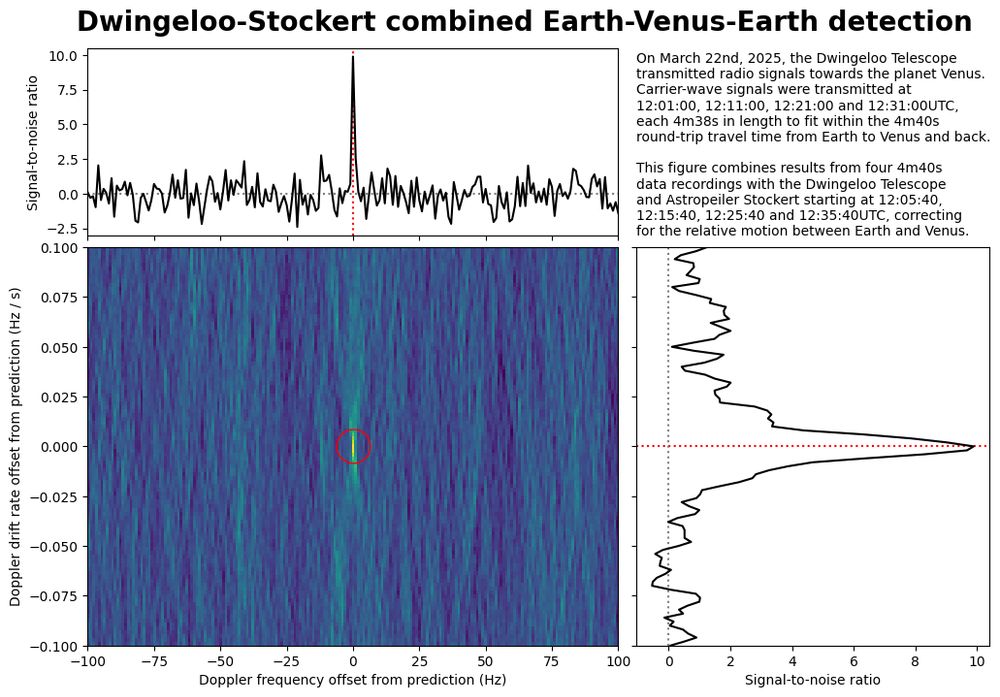
A bit late, but here is some additional analysis of the Earth-Venus-Earth radar experiments with @radiotelescoop.bsky.social from March 22nd, 2025. It takes the 4 recordings at the Dwingeloo and Stockert telescopes and searches in Doppler frequency and Doppler rates for the radar reflections.
April 10, 2025 at 7:26 PM
A bit late, but here is some additional analysis of the Earth-Venus-Earth radar experiments with @radiotelescoop.bsky.social from March 22nd, 2025. It takes the 4 recordings at the Dwingeloo and Stockert telescopes and searches in Doppler frequency and Doppler rates for the radar reflections.
This video shows the Moon occulting several stars from the Pleiades star cluster (M45) earlier this evening. The 40 minute observing run is condensed into 40 seconds. The brightest star is Merope (23 Tau) at magnitude 4.2. Now to work through 20GB of timestamped images to extract occultation times.
April 1, 2025 at 10:11 PM
This video shows the Moon occulting several stars from the Pleiades star cluster (M45) earlier this evening. The 40 minute observing run is condensed into 40 seconds. The brightest star is Merope (23 Tau) at magnitude 4.2. Now to work through 20GB of timestamped images to extract occultation times.
Some how I completely missed the fact that the Moon was going to occult several of the stars in the Pleiades. I managed to quickly put together a CMOS camera and a 300mm lens to capture the motion of the Moon across these stars at 10fps. Here's the occultation of the 8th magnitude star HD23361.
April 1, 2025 at 9:41 PM
Some how I completely missed the fact that the Moon was going to occult several of the stars in the Pleiades. I managed to quickly put together a CMOS camera and a 300mm lens to capture the motion of the Moon across these stars at 10fps. Here's the occultation of the 8th magnitude star HD23361.
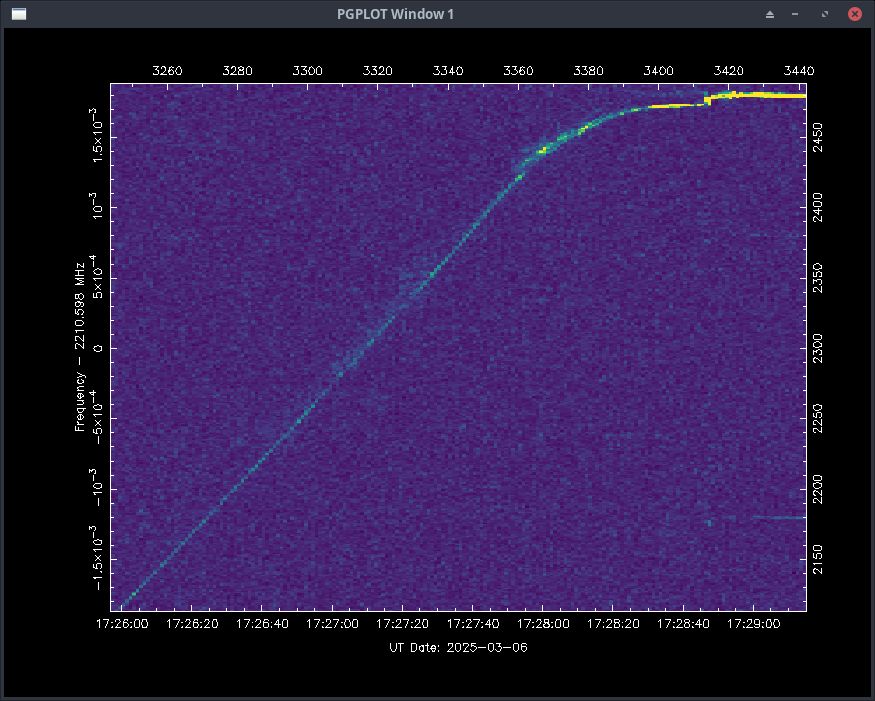
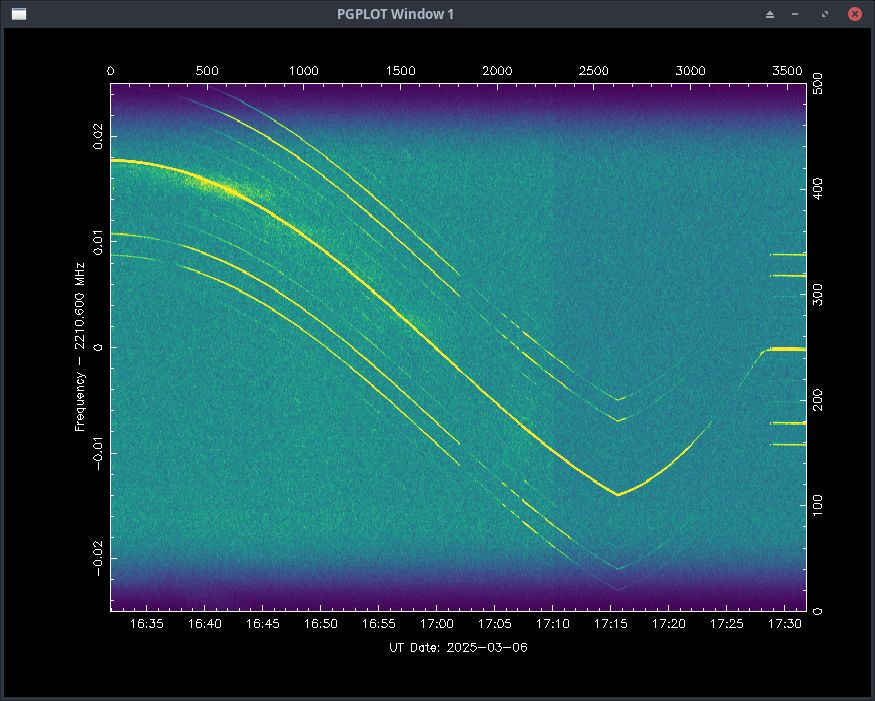
Zooming in on the final minutes of the descent burn, we can see the braking burn transitioning into a hover around 17:28UTC and then a slower descent. At 17:28:45UTC there's a jump in frequency and then a slower leveling off to the Doppler frequency of the Moon. Congratulations on the landing!
March 6, 2025 at 9:01 PM
Zooming in on the final minutes of the descent burn, we can see the braking burn transitioning into a hover around 17:28UTC and then a slower descent. At 17:28:45UTC there's a jump in frequency and then a slower leveling off to the Doppler frequency of the Moon. Congratulations on the landing!
This spectrogram shows the signal from when #IM-2 emerged from behind the Moon around 16:30UTC, and then started its descent burn at 17:16UTC. The signals faded a bit during powered descent, but around 17:28:55UTC the frequency drift stopped, indicated it had successfully landed!

March 6, 2025 at 9:01 PM
This spectrogram shows the signal from when #IM-2 emerged from behind the Moon around 16:30UTC, and then started its descent burn at 17:16UTC. The signals faded a bit during powered descent, but around 17:28:55UTC the frequency drift stopped, indicated it had successfully landed!
For the second time this week, the @radiotelescoop.bsky.social had a front row seat on a lunar landing attempt. This time by @intuitivemachines.bsky.social #IM-2 lunar lander. We listed to Doppler effect on the S-band signals at 2210.6MHz during its successful descent to the lunar surface.
March 6, 2025 at 9:01 PM
For the second time this week, the @radiotelescoop.bsky.social had a front row seat on a lunar landing attempt. This time by @intuitivemachines.bsky.social #IM-2 lunar lander. We listed to Doppler effect on the S-band signals at 2210.6MHz during its successful descent to the lunar surface.
As we've seen with other spacecraft near the Moon, we also see reflected radio signals from the lunar surface as the fuzzy signals above the carrier signal from 08:26 to 08:33UTC. When the velocity of the spacecraft decreases, these signals merge with the carrier as they have the same Doppler shift.

March 2, 2025 at 1:38 PM
As we've seen with other spacecraft near the Moon, we also see reflected radio signals from the lunar surface as the fuzzy signals above the carrier signal from 08:26 to 08:33UTC. When the velocity of the spacecraft decreases, these signals merge with the carrier as they have the same Doppler shift.