


Cees Bassa
@cbassa.bsky.social
Astronomer at ASTRON in the Netherlands, working with the LOFAR low frequency radio telescope.
Yes, this is caused by the Doppler effect.
January 11, 2026 at 5:24 PM
Yes, this is caused by the Doppler effect.
Yes, here it is. Tracking the motion of the planets is a bit tricky, but the motion of the Sun and Moon is very obvious.
January 8, 2026 at 3:47 PM
Yes, here it is. Tracking the motion of the planets is a bit tricky, but the motion of the Sun and Moon is very obvious.
You are absolutely right, there are many many ways of visualizing this dataset. I've played a bit to try to visualize the motion of the planets, but nothing good enough yet to share. Hopefully in the future.
January 8, 2026 at 3:46 PM
You are absolutely right, there are many many ways of visualizing this dataset. I've played a bit to try to visualize the motion of the planets, but nothing good enough yet to share. Hopefully in the future.
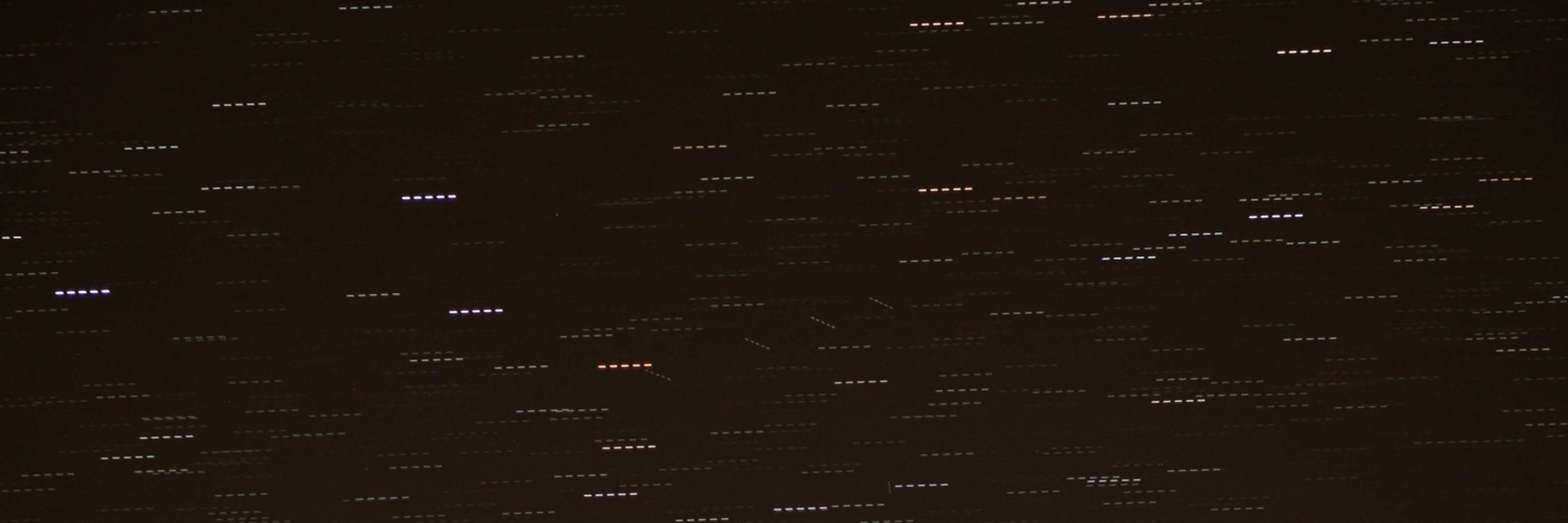
Indeed, the keogram is the observed version of the S&T almanac. In the high resolution zoomable version at astron.nl/~dijkema/keo... you can even see the motion of the stars and planets. This part of the keogram shows Mars (left) and Jupiter (center) moving earlier in the sky.

January 6, 2026 at 5:21 PM
Indeed, the keogram is the observed version of the S&T almanac. In the high resolution zoomable version at astron.nl/~dijkema/keo... you can even see the motion of the stars and planets. This part of the keogram shows Mars (left) and Jupiter (center) moving earlier in the sky.
Thanks! I hope you were able to capture some cool shots over Christmas! Having an all sky camera is very useful in checking if it is clear enough or not, I can just look at my phone instead of having to go outside and possibly have my eyes dark adapt. If patchy clouds, it tells me where it is clear.
January 6, 2026 at 5:15 PM
Thanks! I hope you were able to capture some cool shots over Christmas! Having an all sky camera is very useful in checking if it is clear enough or not, I can just look at my phone instead of having to go outside and possibly have my eyes dark adapt. If patchy clouds, it tells me where it is clear.
It basically boils down to that while the Moon moves 13deg East every day, it doesn't rise and set about an hour later every day. When it is moving to higher declinations, the rises bunch in time of day and the moonsets spread, while the opposite occurs when the Moon is moving to lower declinations.
January 6, 2026 at 5:11 PM
It basically boils down to that while the Moon moves 13deg East every day, it doesn't rise and set about an hour later every day. When it is moving to higher declinations, the rises bunch in time of day and the moonsets spread, while the opposite occurs when the Moon is moving to lower declinations.
Excellent question, and your answer is correct. The keogram is mapped to the 24h schedule of the Sun which shows this hourglass shape over a year. For the Moon this hourglass shape happens every 29 days or so, so this hourglass shape is stretched diagonally.
January 6, 2026 at 5:09 PM
Excellent question, and your answer is correct. The keogram is mapped to the 24h schedule of the Sun which shows this hourglass shape over a year. For the Moon this hourglass shape happens every 29 days or so, so this hourglass shape is stretched diagonally.
Ah, I see what you mean now. Yes, that might indeed be possible. I don't know enough about HDR how to make that work though. On the other hand, the camera does support RGGB output as 16 bit integers, so there certainly is room for more dynamic range already in the images.
January 6, 2026 at 5:01 PM
Ah, I see what you mean now. Yes, that might indeed be possible. I don't know enough about HDR how to make that work though. On the other hand, the camera does support RGGB output as 16 bit integers, so there certainly is room for more dynamic range already in the images.
Unfortunately, taking these observations in HDR would be impractical given the factor 500000 difference in exposure times between day and night time.
January 6, 2026 at 3:55 PM
Unfortunately, taking these observations in HDR would be impractical given the factor 500000 difference in exposure times between day and night time.
No, the gain and exposure are determined from the preceding image, where the exposure time is adjusted first, and gain second. This ensures that 15 second exposure times are used for most of the night and twilight shots, increasing the chance of detecting satellites and meteors etc.
January 6, 2026 at 3:53 PM
No, the gain and exposure are determined from the preceding image, where the exposure time is adjusted first, and gain second. This ensures that 15 second exposure times are used for most of the night and twilight shots, increasing the chance of detecting satellites and meteors etc.
I have tried to explain it in this thread. Let me know if there are questions that aren't answered by it.
bsky.app/profile/cbas...
bsky.app/profile/cbas...
Since posting this 2025 year-long keogram, there have been quite a few questions asking how it was created and what is visible. In this thread I'll try to explain how it all works.

January 6, 2026 at 2:30 PM
I have tried to explain it in this thread. Let me know if there are questions that aren't answered by it.
bsky.app/profile/cbas...
bsky.app/profile/cbas...
Well spotted! That is because the Earth's orbit around the Sun is elliptical and the inclination of the Earth with respect to its orbit, resulting in the Sun passing through the Southern meridian early/late depending on the time of year (see the yellow line at 12h). en.wikipedia.org/wiki/Equatio...

January 6, 2026 at 1:34 PM
Well spotted! That is because the Earth's orbit around the Sun is elliptical and the inclination of the Earth with respect to its orbit, resulting in the Sun passing through the Southern meridian early/late depending on the time of year (see the yellow line at 12h). en.wikipedia.org/wiki/Equatio...
A high resolution zoomable version of the 2025 keogram was made by @tammo80.bsky.social, which also shows the motion of clouds, stars and planets from day to day. astron.nl/~dijkema/keo...
Year-long keogram 2025
astron.nl
January 6, 2026 at 1:28 PM
A high resolution zoomable version of the 2025 keogram was made by @tammo80.bsky.social, which also shows the motion of clouds, stars and planets from day to day. astron.nl/~dijkema/keo...
See this thread that I just posted, that explains how the 2.1 million images make up the year-long keogram. bsky.app/profile/cbas...
Also check this high resolution zoomable version of the 2025 keogram, made by @tammo80.bsky.social astron.nl/~dijkema/keo...
Also check this high resolution zoomable version of the 2025 keogram, made by @tammo80.bsky.social astron.nl/~dijkema/keo...
January 6, 2026 at 1:27 PM
See this thread that I just posted, that explains how the 2.1 million images make up the year-long keogram. bsky.app/profile/cbas...
Also check this high resolution zoomable version of the 2025 keogram, made by @tammo80.bsky.social astron.nl/~dijkema/keo...
Also check this high resolution zoomable version of the 2025 keogram, made by @tammo80.bsky.social astron.nl/~dijkema/keo...
See also this high resolution zoomable version made by @tammo80.bsky.social for the 2025 year-long keogram. There you can also see planets and the stars in the daily keograms, as well as the direction of cloud movement. astron.nl/~dijkema/keo...
Year-long keogram 2025
astron.nl
January 6, 2026 at 1:25 PM
See also this high resolution zoomable version made by @tammo80.bsky.social for the 2025 year-long keogram. There you can also see planets and the stars in the daily keograms, as well as the direction of cloud movement. astron.nl/~dijkema/keo...
I've tried to explain this in this thread bsky.app/profile/cbas... For each image pixels along a vertical line from (approximately) South to North are taken and concatenated. The 15 seconds cadence is then averaged to once a minute. In the yearlong keogram each daily keogram is averaged to 4 pixels.
Since posting this 2025 year-long keogram, there have been quite a few questions asking how it was created and what is visible. In this thread I'll try to explain how it all works.
January 6, 2026 at 1:23 PM
I've tried to explain this in this thread bsky.app/profile/cbas... For each image pixels along a vertical line from (approximately) South to North are taken and concatenated. The 15 seconds cadence is then averaged to once a minute. In the yearlong keogram each daily keogram is averaged to 4 pixels.
This plot shows the exposure time and gain (camera sensitivity) used by the camera for one night, when compared to the keogram for that night. Sunset and sunrise are at the red lines. The camera remains sensitive to colors during evening and morning twilight.

January 6, 2026 at 1:19 PM
This plot shows the exposure time and gain (camera sensitivity) used by the camera for one night, when compared to the keogram for that night. Sunset and sunrise are at the red lines. The camera remains sensitive to colors during evening and morning twilight.
For the 2024 keogram I compared the observed keogram with predictions, where the yellow lines show sunset (dash-dotted), sunrise (dotted) and when the Sun is in the South (solid line), while the red lines show the same for the Moon. They match though the camera is sensitive to color into twilight.
January 6, 2026 at 1:19 PM
For the 2024 keogram I compared the observed keogram with predictions, where the yellow lines show sunset (dash-dotted), sunrise (dotted) and when the Sun is in the South (solid line), while the red lines show the same for the Moon. They match though the camera is sensitive to color into twilight.
This is the 5th year that the all sky camera has been running 24/7/365, and hence the 5th year-long keogram I've been able to make. These are the keograms from 2021, 2022, 2023 and 2024. The hourglass shape is the same, but the diagonal bands of the Moon shift from year to year.


January 6, 2026 at 1:19 PM
This is the 5th year that the all sky camera has been running 24/7/365, and hence the 5th year-long keogram I've been able to make. These are the keograms from 2021, 2022, 2023 and 2024. The hourglass shape is the same, but the diagonal bands of the Moon shift from year to year.
In the year-long keogram, 365 of these daily keograms are concatenated vertically to make up the full keogram. This image shows the 2021 keogram and daily keograms and separate all sky images for 3 separate days spread throughout the year.

January 6, 2026 at 1:19 PM
In the year-long keogram, 365 of these daily keograms are concatenated vertically to make up the full keogram. This image shows the 2021 keogram and daily keograms and separate all sky images for 3 separate days spread throughout the year.