



Conrado Pedebos
@conradopedebos.bsky.social
Computational Biochem/Biophys/Pharm Scientist
PDRA at LAMMASU-UFCSPA
PDRA at LAMMASU-UFCSPA
Reposted by Conrado Pedebos

🎉 New publication in JCIM at @pubs.acs.org!
We present eRMSF, a Python package for ensemble-based RMSF analysis of biomolecular systems, supporting MD, PDB, and ML ensembles.
Proud to collaborate with Rodrigo Ligabue-Braun and @conradopedebos.bsky.social
pubs.acs.org/doi/10.1021/...
We present eRMSF, a Python package for ensemble-based RMSF analysis of biomolecular systems, supporting MD, PDB, and ML ensembles.
Proud to collaborate with Rodrigo Ligabue-Braun and @conradopedebos.bsky.social
pubs.acs.org/doi/10.1021/...

eRMSF: A Python Package for Ensemble-Based RMSF Analysis of Biomolecular Systems
Understanding molecular flexibility and dynamics across different structural ensembles is essential for interpreting the behavior of complex biological systems. Here, we introduce eRMSF, a fast and user-friendly Python package built with MDAKit from MDAnalysis, designed to perform ensemble-based root mean square fluctuation (RMSF) analyses. Unlike traditional approaches limited to molecular dynamics trajectories, eRMSF extends flexibility analysis to ensembles generated by different methods, such as MD simulations, BioEmu (a deep learning tool for equilibrium ensemble prediction), subsampled AlphaFold2 (AlphaFold ensemble generation), and other computational or experimental sources. By enabling RMSF calculations across heterogeneous ensembles, eRMSF provides a unified framework to evaluate residue or atomic fluctuations in both simulated and predicted structures. Users can easily customize atom, residue, or region selections, tailoring analyses to specific research questions. This approach delivers high-resolution insights into localized motions, complements global stability assessments, and reveals dynamic regions often overlooked by single-method analyses. The repository for eRMSF is available at https://github.com/pablo-arantes/ermsfkit.
pubs.acs.org
November 19, 2025 at 11:08 AM
🎉 New publication in JCIM at @pubs.acs.org!
We present eRMSF, a Python package for ensemble-based RMSF analysis of biomolecular systems, supporting MD, PDB, and ML ensembles.
Proud to collaborate with Rodrigo Ligabue-Braun and @conradopedebos.bsky.social
pubs.acs.org/doi/10.1021/...
We present eRMSF, a Python package for ensemble-based RMSF analysis of biomolecular systems, supporting MD, PDB, and ML ensembles.
Proud to collaborate with Rodrigo Ligabue-Braun and @conradopedebos.bsky.social
pubs.acs.org/doi/10.1021/...
Reposted by Conrado Pedebos
🚀 Making it Rain ☁️💦 just got an AI-powered upgrade! 🚀
First, we made MD simulations rain down from the cloud. Now, we’re bringing deep learning into the mix! 🌩️🤖
First, we made MD simulations rain down from the cloud. Now, we’re bringing deep learning into the mix! 🌩️🤖

a robot says hey guys in a purple light
ALT: a robot says hey guys in a purple light
media.tenor.com
March 1, 2025 at 1:36 AM
🚀 Making it Rain ☁️💦 just got an AI-powered upgrade! 🚀
First, we made MD simulations rain down from the cloud. Now, we’re bringing deep learning into the mix! 🌩️🤖
First, we made MD simulations rain down from the cloud. Now, we’re bringing deep learning into the mix! 🌩️🤖
Reposted by Conrado Pedebos

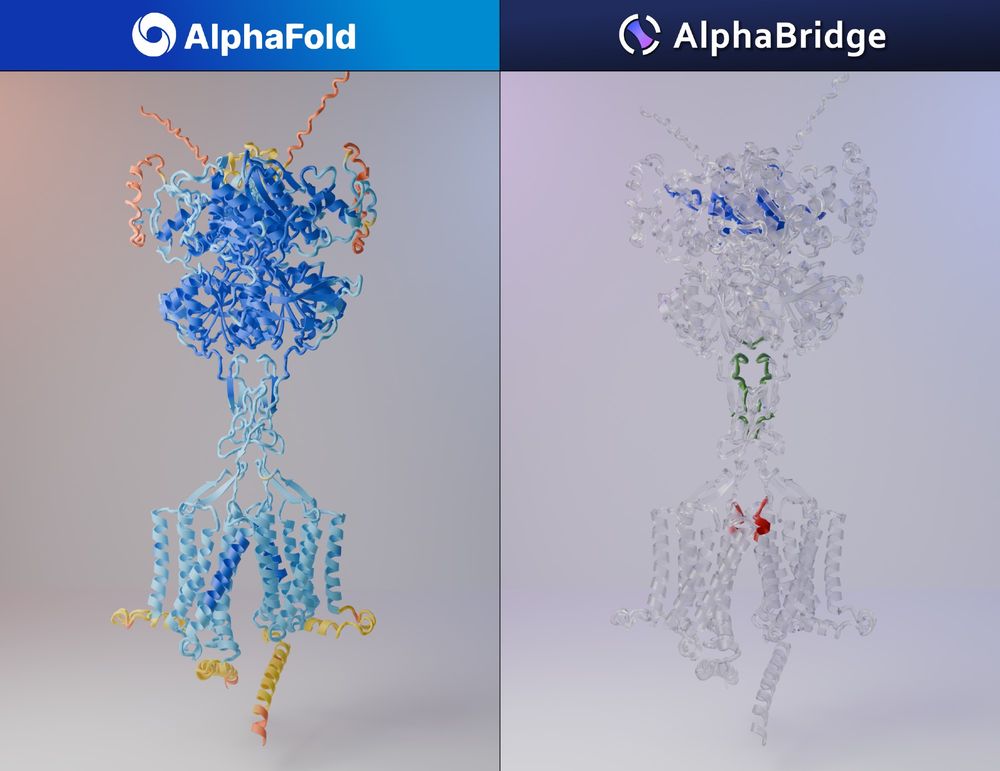
AlphaFold can predict protein, DNA, or RNA complexes.. BUT is it easy to determine the reliable interactions?🤔
➡️ AlphaBridge will identify the most confident interactions, making your analysis easier!
🌐Try it here: alpha-bridge.eu
👀Read more: www.biorxiv.org/content/10.1...
➡️ AlphaBridge will identify the most confident interactions, making your analysis easier!
🌐Try it here: alpha-bridge.eu
👀Read more: www.biorxiv.org/content/10.1...
November 5, 2024 at 12:18 AM
AlphaFold can predict protein, DNA, or RNA complexes.. BUT is it easy to determine the reliable interactions?🤔
➡️ AlphaBridge will identify the most confident interactions, making your analysis easier!
🌐Try it here: alpha-bridge.eu
👀Read more: www.biorxiv.org/content/10.1...
➡️ AlphaBridge will identify the most confident interactions, making your analysis easier!
🌐Try it here: alpha-bridge.eu
👀Read more: www.biorxiv.org/content/10.1...
Reposted by Conrado Pedebos

So seems like the group is on a roll this month!
Here’s our latest work on parametrising coarse-grained models of sugars (disaccharides) by Astrid Brandner & in collaboration with Iain Smith, @pauloctsouza.bsky.social and @cg-martini.bsky.social pubs.acs.org/doi/10.1021/... #glycotime
Here’s our latest work on parametrising coarse-grained models of sugars (disaccharides) by Astrid Brandner & in collaboration with Iain Smith, @pauloctsouza.bsky.social and @cg-martini.bsky.social pubs.acs.org/doi/10.1021/... #glycotime
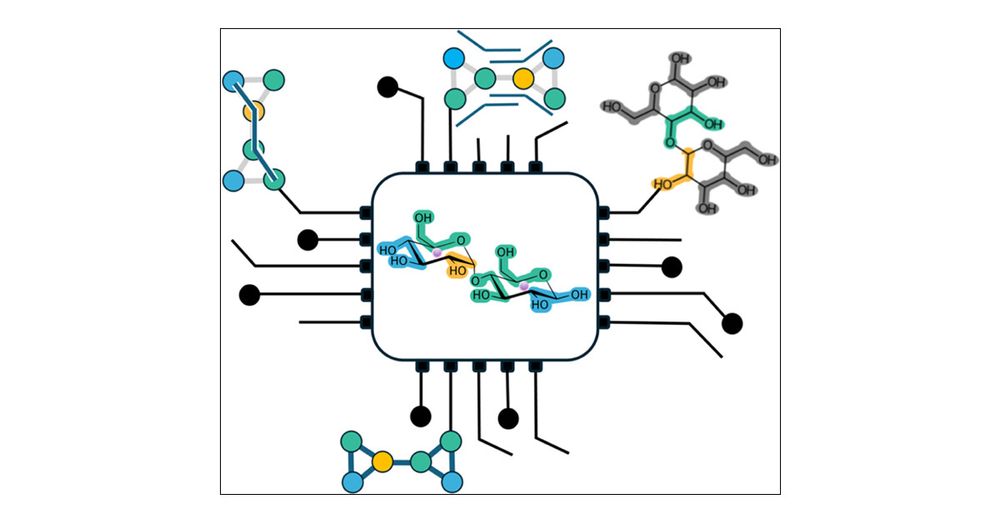
Systematic Approach to Parametrization of Disaccharides for the Martini 3 Coarse-Grained Force Field
Sugars are ubiquitous in biology; they occur in all kingdoms of life. Despite their prevalence, they have often been somewhat neglected in studies of structure–dynamics–function relationships of macro...
pubs.acs.org
January 17, 2025 at 12:27 PM
So seems like the group is on a roll this month!
Here’s our latest work on parametrising coarse-grained models of sugars (disaccharides) by Astrid Brandner & in collaboration with Iain Smith, @pauloctsouza.bsky.social and @cg-martini.bsky.social pubs.acs.org/doi/10.1021/... #glycotime
Here’s our latest work on parametrising coarse-grained models of sugars (disaccharides) by Astrid Brandner & in collaboration with Iain Smith, @pauloctsouza.bsky.social and @cg-martini.bsky.social pubs.acs.org/doi/10.1021/... #glycotime
Reposted by Conrado Pedebos
Charged peptides instead of phospholipids? Another multidisciplinary study - a collaboration led by Neal Devaraj at UCSD. Sims done in my lab by @conradopedebos.bsky.social
Out now in Angew Chemie
onlinelibrary.wiley.com/doi/10.1002/...
Out now in Angew Chemie
onlinelibrary.wiley.com/doi/10.1002/...

Diacylation of Peptides Enables the Construction of Functional Vesicles for Drug‐Carrying Liposomes
Membrane-forming phospholipids are generated in cells by enzymatic diacylation of non-amphiphilic polar head groups. Analogous non-enzymatic processes may have been relevant at the origin of life and....
onlinelibrary.wiley.com
January 17, 2025 at 8:18 AM
Charged peptides instead of phospholipids? Another multidisciplinary study - a collaboration led by Neal Devaraj at UCSD. Sims done in my lab by @conradopedebos.bsky.social
Out now in Angew Chemie
onlinelibrary.wiley.com/doi/10.1002/...
Out now in Angew Chemie
onlinelibrary.wiley.com/doi/10.1002/...
Reposted by Conrado Pedebos
In a multidisciplinary study led by Georgina Benn and Tom Silhavy we show the role of OmpA in controlling the organisation of the outer membrane and in sharing the mechanical load. www.pnas.org/doi/10.1073/....
PNAS
Proceedings of the National Academy of Sciences (PNAS), a peer reviewed journal of the National Academy of Sciences (NAS) - an authoritative source of high-impact, original research that broadly spans...
www.pnas.org
December 4, 2024 at 10:07 PM
In a multidisciplinary study led by Georgina Benn and Tom Silhavy we show the role of OmpA in controlling the organisation of the outer membrane and in sharing the mechanical load. www.pnas.org/doi/10.1073/....
Reposted by Conrado Pedebos

Who remembers running away from the ref on FIFA? 😂
November 26, 2024 at 6:49 PM
Who remembers running away from the ref on FIFA? 😂
Reposted by Conrado Pedebos

If you want to help your students move from just writing code and scripts to actually developing scientific software that is useable and maintainable in the long-term, check out our latest paper in JCE. pubs.acs.org/doi/10.1021/...

Cookiecutter for Computational Molecular Sciences: A Best Practices Ready Python Project Generator
Scientific software development takes far more than good programming abilities and scientific reasoning. Concepts such as version control, continuous integration, packaging, deployment, automatic documentation compiling, licensing, and even file structure are not traditionally taught to scientific programmers. The skill gap leads to inconsistent code quality and difficulty deploying products to the broader audience. Most of the implementation of these skills however can be constructed at project inception. The Cookiecutter for Computational Molecular Sciences generates ready-to-go Python projects that incorporate all of the concepts above from a single command. The final product is then a software project which lets developers focus on the science and minimizes worries about nonscientific and nonprogramming concepts because the best practices, as established by the Molecular Sciences Software Institute, have already been incorporated for them. This is a community driven project with widespread adoption across the computational molecular sciences. The Molecular Sciences Software Institute and Computational Molecular Sciences community also continually contribute and update the Cookiecutter for Computational Molecular Science, ensuring that the project is responsive to community needs and tool updates. All are welcome to suggest changes and contribute to making this the best starting point for Python-based scientific code.
pubs.acs.org
November 16, 2024 at 10:08 PM
If you want to help your students move from just writing code and scripts to actually developing scientific software that is useable and maintainable in the long-term, check out our latest paper in JCE. pubs.acs.org/doi/10.1021/...
Reposted by Conrado Pedebos
Accessing GPU clusters or high-performance computers can be a challenge in Brazil, so I created a Colab notebook for NetSci to perform GC analysis. It works seamlessly, even with Colab’s free tier! Check it out here:
colab.research.google.com/drive/1GGJKr...
Paper: t.co/evNxaX2omW
colab.research.google.com/drive/1GGJKr...
Paper: t.co/evNxaX2omW

Google Colab
colab.research.google.com
November 16, 2024 at 2:47 AM
Accessing GPU clusters or high-performance computers can be a challenge in Brazil, so I created a Colab notebook for NetSci to perform GC analysis. It works seamlessly, even with Colab’s free tier! Check it out here:
colab.research.google.com/drive/1GGJKr...
Paper: t.co/evNxaX2omW
colab.research.google.com/drive/1GGJKr...
Paper: t.co/evNxaX2omW
Super happy to see this one out!
Our latest paper - led by Dhanuska Weerakoon helped by @Conrado Pedebos, Jan Marzinek & Peter Bond jbc.org/article/S0021-…
@jbiolchem
Polymyxin B1 in the E. coli inner membrane: a complex story of protein and lipopolysaccharide mediated insertion
@jbiolchem
Polymyxin B1 in the E. coli inner membrane: a complex story of protein and lipopolysaccharide mediated insertion
https://jbc.org/article/S0021-…
September 10, 2024 at 10:30 PM
Super happy to see this one out!