



David Broockman
@dbroockman.bsky.social
Day job = Associate Prof. of Political Science at UC Berkeley. Tweets = personal views.
To provide a different kind of causal leverage, we also tested this with video. Watching a short clip that framed modern "boxy" architecture as ugly reduced support for upzoning. Aesthetic complaints create opposition to supply-side reforms.

November 25, 2025 at 8:12 PM
To provide a different kind of causal leverage, we also tested this with video. Watching a short clip that framed modern "boxy" architecture as ugly reduced support for upzoning. Aesthetic complaints create opposition to supply-side reforms.
These are the building designs we used in the second experiment.
NB: I used to live in building (b), and it passed SF's design review. Voters hate it and don't want to approve housing like it! Maybe our design review processes should be better.
NB: I used to live in building (b), and it passed SF's design review. Voters hate it and don't want to approve housing like it! Maybe our design review processes should be better.

November 25, 2025 at 8:12 PM
These are the building designs we used in the second experiment.
NB: I used to live in building (b), and it passed SF's design review. Voters hate it and don't want to approve housing like it! Maybe our design review processes should be better.
NB: I used to live in building (b), and it passed SF's design review. Voters hate it and don't want to approve housing like it! Maybe our design review processes should be better.
In a second vignette, we showed respondents images of buildings.
The results also confirm that both visual appeal and fit in context powerfully drive support for housing, and seemingly far more than affordability concerns.
The results also confirm that both visual appeal and fit in context powerfully drive support for housing, and seemingly far more than affordability concerns.

November 25, 2025 at 8:12 PM
In a second vignette, we showed respondents images of buildings.
The results also confirm that both visual appeal and fit in context powerfully drive support for housing, and seemingly far more than affordability concerns.
The results also confirm that both visual appeal and fit in context powerfully drive support for housing, and seemingly far more than affordability concerns.
We then ran an experiment varying attributes of a proposed building: taxes, parking, and the architect's design reputation.
Result 1: The aesthetic quality of the project was a massive driver of support--outweighing concerns about parking or tax revenue.
Result 2...
Result 1: The aesthetic quality of the project was a massive driver of support--outweighing concerns about parking or tax revenue.
Result 2...

November 25, 2025 at 8:12 PM
We then ran an experiment varying attributes of a proposed building: taxes, parking, and the architect's design reputation.
Result 1: The aesthetic quality of the project was a massive driver of support--outweighing concerns about parking or tax revenue.
Result 2...
Result 1: The aesthetic quality of the project was a massive driver of support--outweighing concerns about parking or tax revenue.
Result 2...
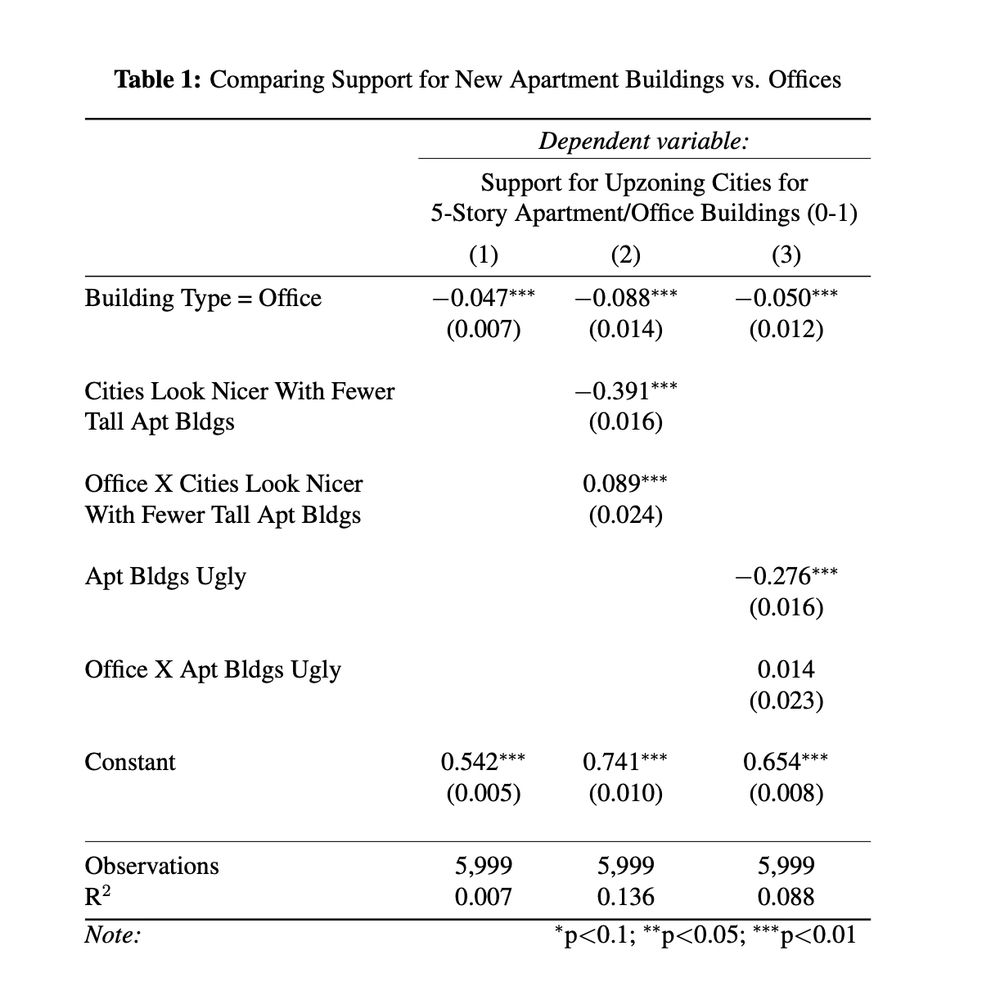
Is "aesthetics" just a pretext for excluding lower-income residents? We tested this by comparing support for apartments vs. similarly sized office buildings. If it was about residents, people should prefer offices. But they oppose offices even more. Physical structure matters.
November 25, 2025 at 8:12 PM
Is "aesthetics" just a pretext for excluding lower-income residents? We tested this by comparing support for apartments vs. similarly sized office buildings. If it was about residents, people should prefer offices. But they oppose offices even more. Physical structure matters.
How much does "ugliness" actually matter compared to other concerns? A lot.
We surveyed voters on various objections to housing. As Figure 3 shows, the belief that "Cities look nicer when they have fewer tall apartment buildings" is a top predictor of opposition.
We surveyed voters on various objections to housing. As Figure 3 shows, the belief that "Cities look nicer when they have fewer tall apartment buildings" is a top predictor of opposition.

November 25, 2025 at 8:12 PM
How much does "ugliness" actually matter compared to other concerns? A lot.
We surveyed voters on various objections to housing. As Figure 3 shows, the belief that "Cities look nicer when they have fewer tall apartment buildings" is a top predictor of opposition.
We surveyed voters on various objections to housing. As Figure 3 shows, the belief that "Cities look nicer when they have fewer tall apartment buildings" is a top predictor of opposition.
We found widespread support for 5-story apartments along commercial corridors (where they fit), but sharp opposition in single-family neighborhoods (where they clash).
Even people who live in dense areas support density more where they live than elsewhere!
Even people who live in dense areas support density more where they live than elsewhere!

November 25, 2025 at 8:12 PM
We found widespread support for 5-story apartments along commercial corridors (where they fit), but sharp opposition in single-family neighborhoods (where they clash).
Even people who live in dense areas support density more where they live than elsewhere!
Even people who live in dense areas support density more where they live than elsewhere!
As motivation, look at this puzzle
Existing theories predict homeowners in dense areas should be the biggest opponents of more density in already-dense areas--it's their backyard!
But homeowners on corridors are actually *most* supportive of AB 2011-style upzoning of corridors!
Existing theories predict homeowners in dense areas should be the biggest opponents of more density in already-dense areas--it's their backyard!
But homeowners on corridors are actually *most* supportive of AB 2011-style upzoning of corridors!

November 25, 2025 at 8:12 PM
As motivation, look at this puzzle
Existing theories predict homeowners in dense areas should be the biggest opponents of more density in already-dense areas--it's their backyard!
But homeowners on corridors are actually *most* supportive of AB 2011-style upzoning of corridors!
Existing theories predict homeowners in dense areas should be the biggest opponents of more density in already-dense areas--it's their backyard!
But homeowners on corridors are actually *most* supportive of AB 2011-style upzoning of corridors!
NEW PAPER w/ @cselmendorf.bsky.social & @jkalla.bsky.social:
An under-appreciated reason why voters oppose dense new housing, especially in less-dense neighborhoods: they think it looks ugly and want to prevent that, even in other neighborhoods.
Some of what we think is NIMBYism might not be!
An under-appreciated reason why voters oppose dense new housing, especially in less-dense neighborhoods: they think it looks ugly and want to prevent that, even in other neighborhoods.
Some of what we think is NIMBYism might not be!

November 25, 2025 at 8:12 PM
NEW PAPER w/ @cselmendorf.bsky.social & @jkalla.bsky.social:
An under-appreciated reason why voters oppose dense new housing, especially in less-dense neighborhoods: they think it looks ugly and want to prevent that, even in other neighborhoods.
Some of what we think is NIMBYism might not be!
An under-appreciated reason why voters oppose dense new housing, especially in less-dense neighborhoods: they think it looks ugly and want to prevent that, even in other neighborhoods.
Some of what we think is NIMBYism might not be!
Some caveats: This is observational data from 27 districts in 2024. Voters might care about other things like compromise or ideology that we didn't study. For issue voting, projection is a threat to causal inference–but we discuss why that’s unlikely to explain our findings.

May 27, 2025 at 2:07 PM
Some caveats: This is observational data from 27 districts in 2024. Voters might care about other things like compromise or ideology that we didn't study. For issue voting, projection is a threat to causal inference–but we discuss why that’s unlikely to explain our findings.
Parties face a dilemma. Nominating moderates in close districts helps win—but most voters infer that candidates hold the party’s typical positions. To win some seats, a party needs a *nationwide* moderate reputation. But groups & others might not want to build it (e.g., by moderates in safe seats).

May 27, 2025 at 2:07 PM
Parties face a dilemma. Nominating moderates in close districts helps win—but most voters infer that candidates hold the party’s typical positions. To win some seats, a party needs a *nationwide* moderate reputation. But groups & others might not want to build it (e.g., by moderates in safe seats).
FINDING #3: Evidence that groups contribute to polarization. Group endorsements have major influence. Voters who learn about them are ~15 pp more likely to vote for endorsed candidates. This effect is driven by endorsements from liked groups—negative cues barely register.


May 27, 2025 at 2:07 PM
FINDING #3: Evidence that groups contribute to polarization. Group endorsements have major influence. Voters who learn about them are ~15 pp more likely to vote for endorsed candidates. This effect is driven by endorsements from liked groups—negative cues barely register.
This creates a problem for primary voters: party cues are useless in primaries where everyone's the same party. So primary voters stay confused about who's closest to them, even as they learn what candidates of their party stand for.

May 27, 2025 at 2:07 PM
This creates a problem for primary voters: party cues are useless in primaries where everyone's the same party. So primary voters stay confused about who's closest to them, even as they learn what candidates of their party stand for.
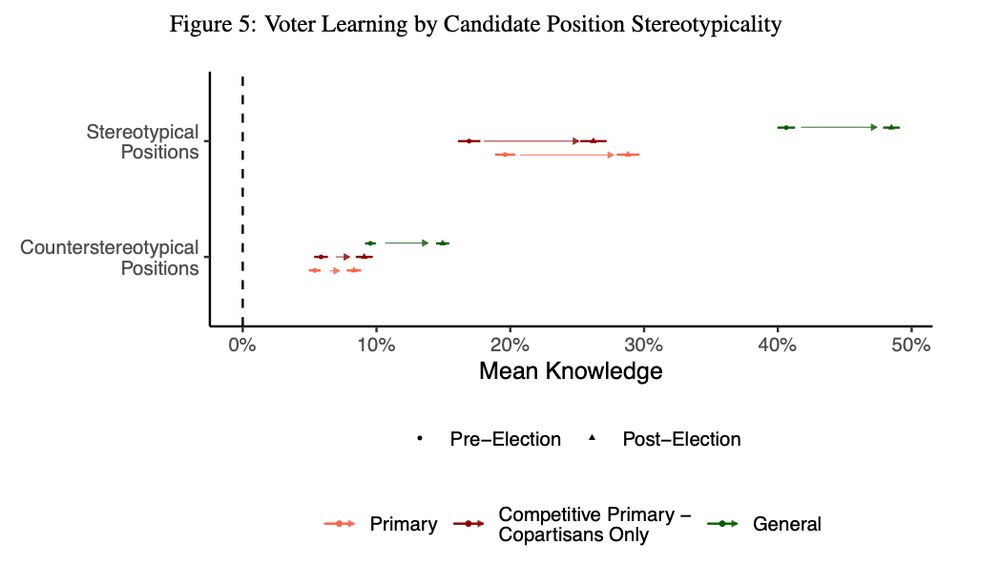
We found evidence that voters learn about candidates partly by learning national party reputations: a) voters somehow learn just as much about no-name candidates, & b) voters are 3x more likely to learn "stereotypical" positions (like Dems supporting healthcare) than unusual ones

May 27, 2025 at 2:07 PM
We found evidence that voters learn about candidates partly by learning national party reputations: a) voters somehow learn just as much about no-name candidates, & b) voters are 3x more likely to learn "stereotypical" positions (like Dems supporting healthcare) than unusual ones
When primary AND general voters learn a candidate agrees with them on an issue, they're ~14 percentage points more likely to vote for that candidate.
In generals, this includes when the closest candidate is an outpartisan–party loyalty isn’t everything.
In generals, this includes when the closest candidate is an outpartisan–party loyalty isn’t everything.


May 27, 2025 at 2:07 PM
When primary AND general voters learn a candidate agrees with them on an issue, they're ~14 percentage points more likely to vote for that candidate.
In generals, this includes when the closest candidate is an outpartisan–party loyalty isn’t everything.
In generals, this includes when the closest candidate is an outpartisan–party loyalty isn’t everything.
FINDING #1: General election voters know MORE about candidate positions than primary voters.
By election day, general election voters correctly identify 40% of candidate positions vs just 22% for primary voters.
By election day, general election voters correctly identify 40% of candidate positions vs just 22% for primary voters.

May 27, 2025 at 2:07 PM
FINDING #1: General election voters know MORE about candidate positions than primary voters.
By election day, general election voters correctly identify 40% of candidate positions vs just 22% for primary voters.
By election day, general election voters correctly identify 40% of candidate positions vs just 22% for primary voters.
This gives us a ton of unique data.
We measure knowledge & learning of 122 candidate issue positions in the 2024 Congressional primaries and 269 candidate issue positions in the 2024 Congressional generals.
We measure knowledge & learning of 122 candidate issue positions in the 2024 Congressional primaries and 269 candidate issue positions in the 2024 Congressional generals.

May 27, 2025 at 2:07 PM
This gives us a ton of unique data.
We measure knowledge & learning of 122 candidate issue positions in the 2024 Congressional primaries and 269 candidate issue positions in the 2024 Congressional generals.
We measure knowledge & learning of 122 candidate issue positions in the 2024 Congressional primaries and 269 candidate issue positions in the 2024 Congressional generals.
Conventional wisdom blames:
• Primary voters who closely follow politics & prefer extremists
• General election voters who are too ignorant of candidate positions—or too “intoxicated” by party loyalty—to vote for moderates over extremists
But our data tells a different story…
• Primary voters who closely follow politics & prefer extremists
• General election voters who are too ignorant of candidate positions—or too “intoxicated” by party loyalty—to vote for moderates over extremists
But our data tells a different story…

May 27, 2025 at 2:07 PM
Conventional wisdom blames:
• Primary voters who closely follow politics & prefer extremists
• General election voters who are too ignorant of candidate positions—or too “intoxicated” by party loyalty—to vote for moderates over extremists
But our data tells a different story…
• Primary voters who closely follow politics & prefer extremists
• General election voters who are too ignorant of candidate positions—or too “intoxicated” by party loyalty—to vote for moderates over extremists
But our data tells a different story…
🚨NEW PAPER: Why are Members of Congress so extreme?
We conducted a 4-wave panel of thousands of voters in 27 districts during last year’s primary AND general elections to trace polarization’s roots
The results challenge conventional wisdom… and suggest lessons for parties🧵👇
We conducted a 4-wave panel of thousands of voters in 27 districts during last year’s primary AND general elections to trace polarization’s roots
The results challenge conventional wisdom… and suggest lessons for parties🧵👇

May 27, 2025 at 2:07 PM
🚨NEW PAPER: Why are Members of Congress so extreme?
We conducted a 4-wave panel of thousands of voters in 27 districts during last year’s primary AND general elections to trace polarization’s roots
The results challenge conventional wisdom… and suggest lessons for parties🧵👇
We conducted a 4-wave panel of thousands of voters in 27 districts during last year’s primary AND general elections to trace polarization’s roots
The results challenge conventional wisdom… and suggest lessons for parties🧵👇
4. Consistent with that, we find some effects on attitudes towards work: people who get the transfer seem to value work *more*. There's a few potential explanations, including that people answering our survey sought to distance themselves from perception they would misuse the $.


December 2, 2024 at 7:00 PM
4. Consistent with that, we find some effects on attitudes towards work: people who get the transfer seem to value work *more*. There's a few potential explanations, including that people answering our survey sought to distance themselves from perception they would misuse the $.
3. Does getting a big cash transfer make ppl more supportive of... cash transfers? Liberal policy in general?
Surprising answer: no!
Political dispositions are hard to change! E.g., in interviews, some who received the transfer said they thought *others* would misuse it.
Surprising answer: no!
Political dispositions are hard to change! E.g., in interviews, some who received the transfer said they thought *others* would misuse it.

December 2, 2024 at 7:00 PM
3. Does getting a big cash transfer make ppl more supportive of... cash transfers? Liberal policy in general?
Surprising answer: no!
Political dispositions are hard to change! E.g., in interviews, some who received the transfer said they thought *others* would misuse it.
Surprising answer: no!
Political dispositions are hard to change! E.g., in interviews, some who received the transfer said they thought *others* would misuse it.
2. We find evidence consistent with "mood misattribution": recipients feel (a bit) warmer towards other racial groups, their own racial groups, & even governor of their state (& maybe both political parties).
But no fx on dispositions like authoritarianism or trust in democracy.
But no fx on dispositions like authoritarianism or trust in democracy.


December 2, 2024 at 7:00 PM
2. We find evidence consistent with "mood misattribution": recipients feel (a bit) warmer towards other racial groups, their own racial groups, & even governor of their state (& maybe both political parties).
But no fx on dispositions like authoritarianism or trust in democracy.
But no fx on dispositions like authoritarianism or trust in democracy.
Those null findings contrast with studies finding gov't-sponsored transfers mobilize, consistent with interpretations that it matters where people think $ is coming from when they experience income shocks. Our participants were (correctly) aware that this $ was not from gov't.

December 2, 2024 at 7:00 PM
Those null findings contrast with studies finding gov't-sponsored transfers mobilize, consistent with interpretations that it matters where people think $ is coming from when they experience income shocks. Our participants were (correctly) aware that this $ was not from gov't.
1. Resource theories of political participation would expect big increases in turnout & participation: participants had more $ and free time.
But we find nulls on participation, knowledge, etc. & can rule out observational association.
But we find nulls on participation, knowledge, etc. & can rule out observational association.

December 2, 2024 at 7:00 PM
1. Resource theories of political participation would expect big increases in turnout & participation: participants had more $ and free time.
But we find nulls on participation, knowledge, etc. & can rule out observational association.
But we find nulls on participation, knowledge, etc. & can rule out observational association.
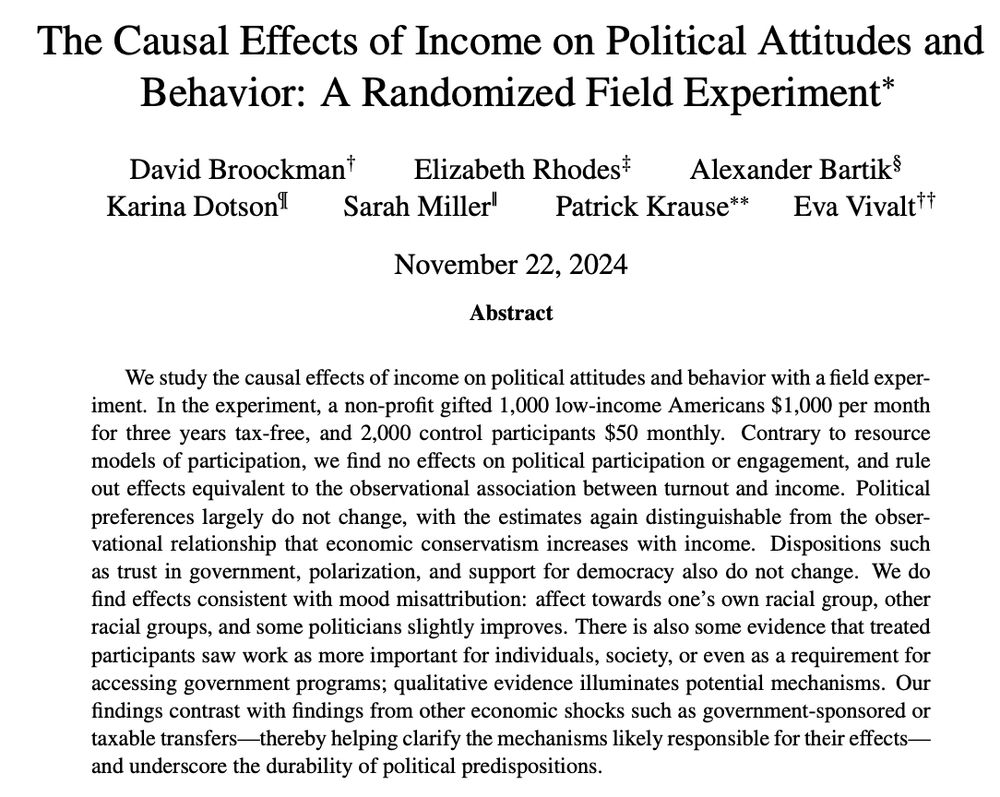
🚨 NEW PAPER: When low-income Americans get $1,000/month for 3 years, what happens to their political views & behavior?
The OpenResearch Unconditional income Study reveals surprising findings about the effects of income on politics... 🧵
The OpenResearch Unconditional income Study reveals surprising findings about the effects of income on politics... 🧵
December 2, 2024 at 7:00 PM
🚨 NEW PAPER: When low-income Americans get $1,000/month for 3 years, what happens to their political views & behavior?
The OpenResearch Unconditional income Study reveals surprising findings about the effects of income on politics... 🧵
The OpenResearch Unconditional income Study reveals surprising findings about the effects of income on politics... 🧵