



David Broockman
@dbroockman.bsky.social
Day job = Associate Prof. of Political Science at UC Berkeley. Tweets = personal views.
We don't claim homeowner self-interest or NIMBYism don't matter.
But our findings suggest that "fear of an ugly America" is an underrated driver of the housing crisis and could contribute to what has been called NIMBYism. Addressing it could unlock new support for more housing.
But our findings suggest that "fear of an ugly America" is an underrated driver of the housing crisis and could contribute to what has been called NIMBYism. Addressing it could unlock new support for more housing.
November 25, 2025 at 8:12 PM
We don't claim homeowner self-interest or NIMBYism don't matter.
But our findings suggest that "fear of an ugly America" is an underrated driver of the housing crisis and could contribute to what has been called NIMBYism. Addressing it could unlock new support for more housing.
But our findings suggest that "fear of an ugly America" is an underrated driver of the housing crisis and could contribute to what has been called NIMBYism. Addressing it could unlock new support for more housing.
Second, this explains why "missing middle" housing or upzoning commercial strips is often more politically feasible than general upzoning. It respects the voter's desire for visual congruence—putting taller buildings where they "look right."
November 25, 2025 at 8:12 PM
Second, this explains why "missing middle" housing or upzoning commercial strips is often more politically feasible than general upzoning. It respects the voter's desire for visual congruence—putting taller buildings where they "look right."
What are the potential policy implications?
First, design matters. If the YIMBY movement wants to build broad coalitions, it cannot ignore aesthetics. Policies that ensure better design or "fitting in" (like form-based codes) might reduce political friction.
First, design matters. If the YIMBY movement wants to build broad coalitions, it cannot ignore aesthetics. Policies that ensure better design or "fitting in" (like form-based codes) might reduce political friction.
November 25, 2025 at 8:12 PM
What are the potential policy implications?
First, design matters. If the YIMBY movement wants to build broad coalitions, it cannot ignore aesthetics. Policies that ensure better design or "fitting in" (like form-based codes) might reduce political friction.
First, design matters. If the YIMBY movement wants to build broad coalitions, it cannot ignore aesthetics. Policies that ensure better design or "fitting in" (like form-based codes) might reduce political friction.
To provide a different kind of causal leverage, we also tested this with video. Watching a short clip that framed modern "boxy" architecture as ugly reduced support for upzoning. Aesthetic complaints create opposition to supply-side reforms.

November 25, 2025 at 8:12 PM
To provide a different kind of causal leverage, we also tested this with video. Watching a short clip that framed modern "boxy" architecture as ugly reduced support for upzoning. Aesthetic complaints create opposition to supply-side reforms.
These judgments are *sociotropic*. Voters didn't just oppose ugly buildings on their own block; they opposed policies that would allow "ugly" buildings anywhere. Just as people support redistribution for the "greater good" they support aesthetic regulation for the "greater good"
November 25, 2025 at 8:12 PM
These judgments are *sociotropic*. Voters didn't just oppose ugly buildings on their own block; they opposed policies that would allow "ugly" buildings anywhere. Just as people support redistribution for the "greater good" they support aesthetic regulation for the "greater good"
These are the building designs we used in the second experiment.
NB: I used to live in building (b), and it passed SF's design review. Voters hate it and don't want to approve housing like it! Maybe our design review processes should be better.
NB: I used to live in building (b), and it passed SF's design review. Voters hate it and don't want to approve housing like it! Maybe our design review processes should be better.

November 25, 2025 at 8:12 PM
These are the building designs we used in the second experiment.
NB: I used to live in building (b), and it passed SF's design review. Voters hate it and don't want to approve housing like it! Maybe our design review processes should be better.
NB: I used to live in building (b), and it passed SF's design review. Voters hate it and don't want to approve housing like it! Maybe our design review processes should be better.
In a second vignette, we showed respondents images of buildings.
The results also confirm that both visual appeal and fit in context powerfully drive support for housing, and seemingly far more than affordability concerns.
The results also confirm that both visual appeal and fit in context powerfully drive support for housing, and seemingly far more than affordability concerns.

November 25, 2025 at 8:12 PM
In a second vignette, we showed respondents images of buildings.
The results also confirm that both visual appeal and fit in context powerfully drive support for housing, and seemingly far more than affordability concerns.
The results also confirm that both visual appeal and fit in context powerfully drive support for housing, and seemingly far more than affordability concerns.
The drop in support from the project being "on your block" is half the size of it being in a non-dense vs. already-dense area elsewhere
Perhaps part of why single family homeowners oppose local density isn't NIMBYism, but a widely shared view density should go in already-dense areas
Perhaps part of why single family homeowners oppose local density isn't NIMBYism, but a widely shared view density should go in already-dense areas
November 25, 2025 at 8:12 PM
The drop in support from the project being "on your block" is half the size of it being in a non-dense vs. already-dense area elsewhere
Perhaps part of why single family homeowners oppose local density isn't NIMBYism, but a widely shared view density should go in already-dense areas
Perhaps part of why single family homeowners oppose local density isn't NIMBYism, but a widely shared view density should go in already-dense areas
We then ran an experiment varying attributes of a proposed building: taxes, parking, and the architect's design reputation.
Result 1: The aesthetic quality of the project was a massive driver of support--outweighing concerns about parking or tax revenue.
Result 2...
Result 1: The aesthetic quality of the project was a massive driver of support--outweighing concerns about parking or tax revenue.
Result 2...

November 25, 2025 at 8:12 PM
We then ran an experiment varying attributes of a proposed building: taxes, parking, and the architect's design reputation.
Result 1: The aesthetic quality of the project was a massive driver of support--outweighing concerns about parking or tax revenue.
Result 2...
Result 1: The aesthetic quality of the project was a massive driver of support--outweighing concerns about parking or tax revenue.
Result 2...
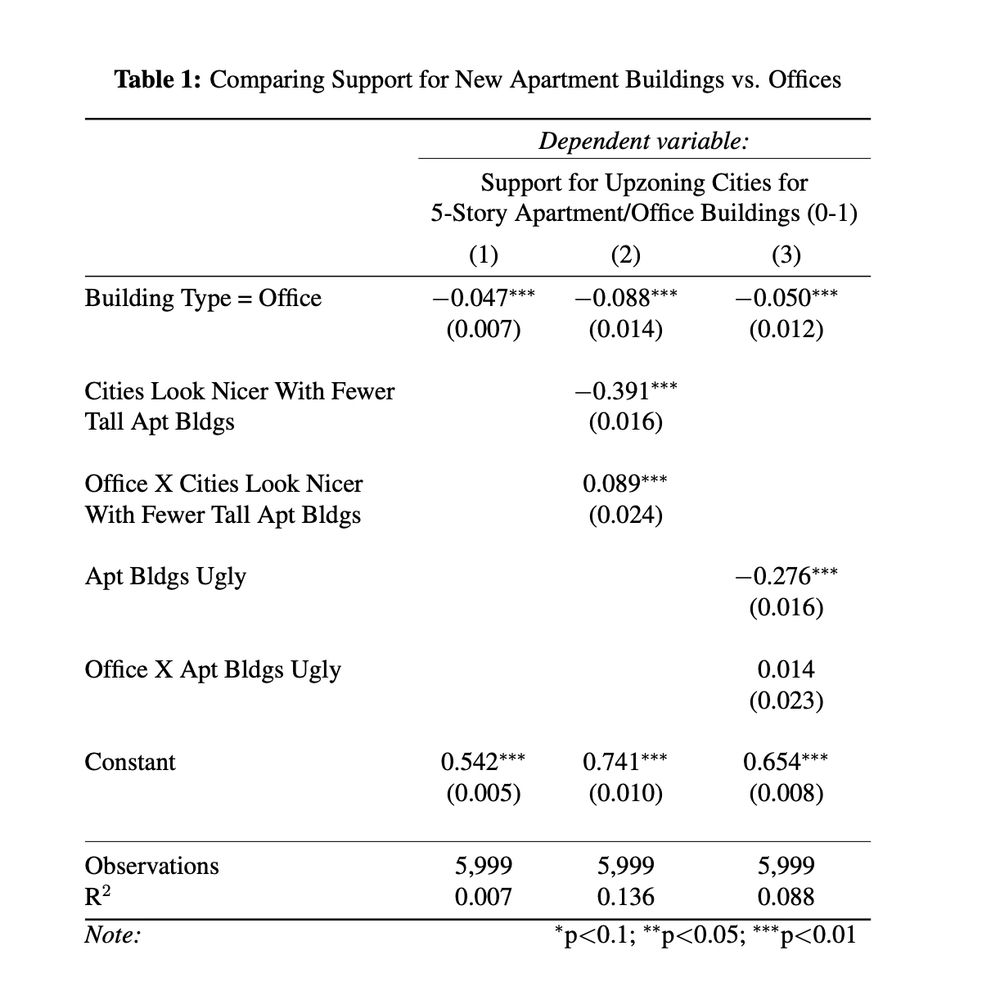
Is "aesthetics" just a pretext for excluding lower-income residents? We tested this by comparing support for apartments vs. similarly sized office buildings. If it was about residents, people should prefer offices. But they oppose offices even more. Physical structure matters.
November 25, 2025 at 8:12 PM
Is "aesthetics" just a pretext for excluding lower-income residents? We tested this by comparing support for apartments vs. similarly sized office buildings. If it was about residents, people should prefer offices. But they oppose offices even more. Physical structure matters.
How much does "ugliness" actually matter compared to other concerns? A lot.
We surveyed voters on various objections to housing. As Figure 3 shows, the belief that "Cities look nicer when they have fewer tall apartment buildings" is a top predictor of opposition.
We surveyed voters on various objections to housing. As Figure 3 shows, the belief that "Cities look nicer when they have fewer tall apartment buildings" is a top predictor of opposition.

November 25, 2025 at 8:12 PM
How much does "ugliness" actually matter compared to other concerns? A lot.
We surveyed voters on various objections to housing. As Figure 3 shows, the belief that "Cities look nicer when they have fewer tall apartment buildings" is a top predictor of opposition.
We surveyed voters on various objections to housing. As Figure 3 shows, the belief that "Cities look nicer when they have fewer tall apartment buildings" is a top predictor of opposition.
This may explain the political success of "commercial corridor" upzoning policies (like CA's AB 2011). It's not just about avoiding NIMBY homeowners; it's that voters view density as aesthetically appropriate in already-dense areas, regardless of where they personally live.
November 25, 2025 at 8:12 PM
This may explain the political success of "commercial corridor" upzoning policies (like CA's AB 2011). It's not just about avoiding NIMBY homeowners; it's that voters view density as aesthetically appropriate in already-dense areas, regardless of where they personally live.
We found widespread support for 5-story apartments along commercial corridors (where they fit), but sharp opposition in single-family neighborhoods (where they clash).
Even people who live in dense areas support density more where they live than elsewhere!
Even people who live in dense areas support density more where they live than elsewhere!

November 25, 2025 at 8:12 PM
We found widespread support for 5-story apartments along commercial corridors (where they fit), but sharp opposition in single-family neighborhoods (where they clash).
Even people who live in dense areas support density more where they live than elsewhere!
Even people who live in dense areas support density more where they live than elsewhere!
We think two things are going on here:
1. People self-select into neighborhoods that match their aesthetic tastes. If you live in density, you likely have a "taste" for it.
2. Voters prefer development that "fits in" with the existing built environment....
1. People self-select into neighborhoods that match their aesthetic tastes. If you live in density, you likely have a "taste" for it.
2. Voters prefer development that "fits in" with the existing built environment....
November 25, 2025 at 8:12 PM
We think two things are going on here:
1. People self-select into neighborhoods that match their aesthetic tastes. If you live in density, you likely have a "taste" for it.
2. Voters prefer development that "fits in" with the existing built environment....
1. People self-select into neighborhoods that match their aesthetic tastes. If you live in density, you likely have a "taste" for it.
2. Voters prefer development that "fits in" with the existing built environment....
As motivation, look at this puzzle
Existing theories predict homeowners in dense areas should be the biggest opponents of more density in already-dense areas--it's their backyard!
But homeowners on corridors are actually *most* supportive of AB 2011-style upzoning of corridors!
Existing theories predict homeowners in dense areas should be the biggest opponents of more density in already-dense areas--it's their backyard!
But homeowners on corridors are actually *most* supportive of AB 2011-style upzoning of corridors!

November 25, 2025 at 8:12 PM
As motivation, look at this puzzle
Existing theories predict homeowners in dense areas should be the biggest opponents of more density in already-dense areas--it's their backyard!
But homeowners on corridors are actually *most* supportive of AB 2011-style upzoning of corridors!
Existing theories predict homeowners in dense areas should be the biggest opponents of more density in already-dense areas--it's their backyard!
But homeowners on corridors are actually *most* supportive of AB 2011-style upzoning of corridors!
We propose a third explanation: Sociotropic Aesthetic Judgments.
Voters form automatic judgments about whether a building is visually appealing or "fits in."
Importantly, they apply these aesthetic standards broadly—not just on their own block, but wherever housing is proposed.
Voters form automatic judgments about whether a building is visually appealing or "fits in."
Importantly, they apply these aesthetic standards broadly—not just on their own block, but wherever housing is proposed.
November 25, 2025 at 8:12 PM
We propose a third explanation: Sociotropic Aesthetic Judgments.
Voters form automatic judgments about whether a building is visually appealing or "fits in."
Importantly, they apply these aesthetic standards broadly—not just on their own block, but wherever housing is proposed.
Voters form automatic judgments about whether a building is visually appealing or "fits in."
Importantly, they apply these aesthetic standards broadly—not just on their own block, but wherever housing is proposed.
These theories have clear merits, but also gaps:
Difference between homeowners & renters often aren't large.
& noting that NIMBYism is real leaves open the question of the content of NIMBY concerns and how they can be mitigated.
Difference between homeowners & renters often aren't large.
& noting that NIMBYism is real leaves open the question of the content of NIMBY concerns and how they can be mitigated.
November 25, 2025 at 8:12 PM
These theories have clear merits, but also gaps:
Difference between homeowners & renters often aren't large.
& noting that NIMBYism is real leaves open the question of the content of NIMBY concerns and how they can be mitigated.
Difference between homeowners & renters often aren't large.
& noting that NIMBYism is real leaves open the question of the content of NIMBY concerns and how they can be mitigated.
The US housing shortage is acute & driven by policy. The prevailing explanations for why voters oppose new supply focus on two things:
"Homevoters": Homeowners protecting property values.
"NIMBYism": Neighbors fearing local nuisances (traffic, parking) in their "backyard."
"Homevoters": Homeowners protecting property values.
"NIMBYism": Neighbors fearing local nuisances (traffic, parking) in their "backyard."
November 25, 2025 at 8:12 PM
The US housing shortage is acute & driven by policy. The prevailing explanations for why voters oppose new supply focus on two things:
"Homevoters": Homeowners protecting property values.
"NIMBYism": Neighbors fearing local nuisances (traffic, parking) in their "backyard."
"Homevoters": Homeowners protecting property values.
"NIMBYism": Neighbors fearing local nuisances (traffic, parking) in their "backyard."