



Uri Wolkowski
@deinocurious.bsky.social
M.Sc. student in Evolutionary and Environmental Biology | Studying hartebeest 🐐 ancient DNA 🧬 🦴 and Ecological Niche Modelling 🌍 🌧️| likes hiking, birding, and all wildlife living and extinct 🏔️ 🦅 🦤 🐆 🦣
The first Megatherium fossils shipped to Europe (and eventually described by Georges Cuvier) were presented to King Carlos III of Spain. He requested a live or stuffed specimen of this beast. Sadly, none were ever found.

January 2, 2026 at 7:04 PM
The first Megatherium fossils shipped to Europe (and eventually described by Georges Cuvier) were presented to King Carlos III of Spain. He requested a live or stuffed specimen of this beast. Sadly, none were ever found.
Andrey Atuchin and Julius Csotonyi worked on this book but I don't think this is one of theirs. I assume it is by one of the other artists: Alain Beneteau, Peter Barrett, Stuart Carter or Anthony Duke
January 1, 2026 at 11:03 AM
Andrey Atuchin and Julius Csotonyi worked on this book but I don't think this is one of theirs. I assume it is by one of the other artists: Alain Beneteau, Peter Barrett, Stuart Carter or Anthony Duke
Some more photos, part of the MEF "hall of fame" exhibit


December 12, 2025 at 11:28 PM
Some more photos, part of the MEF "hall of fame" exhibit
Over at the renovated Museo Paleontologico Egidio Feruglio (MEF), not too far from the site where Carnotaurus was found - there is a "hall of fame" featuring almost any Carnotaurus media appearance, and I mean EVERY ONE (incl. #PrehistoricPlanet !)
(P.S might make another post only about this hall!)
(P.S might make another post only about this hall!)
December 12, 2025 at 11:25 PM
Over at the renovated Museo Paleontologico Egidio Feruglio (MEF), not too far from the site where Carnotaurus was found - there is a "hall of fame" featuring almost any Carnotaurus media appearance, and I mean EVERY ONE (incl. #PrehistoricPlanet !)
(P.S might make another post only about this hall!)
(P.S might make another post only about this hall!)
A personal highlight for me are the Great dusky swifts. Watching them fluttering in and out of the raucous waterfalls is just amazing!
December 8, 2025 at 4:22 PM
A personal highlight for me are the Great dusky swifts. Watching them fluttering in and out of the raucous waterfalls is just amazing!
Long thought to have possessed a trunk, recent research indicates this wasn't the case. However, this "paleomeme" is still very common.
Haven't watched #PrehistoricPlanetIceAge (yet!), and I'm excited to see their depiction of this species without the classic trunk!
#Megafauna
#Iceage #fossil
Haven't watched #PrehistoricPlanetIceAge (yet!), and I'm excited to see their depiction of this species without the classic trunk!
#Megafauna
#Iceage #fossil

December 5, 2025 at 11:53 PM
Long thought to have possessed a trunk, recent research indicates this wasn't the case. However, this "paleomeme" is still very common.
Haven't watched #PrehistoricPlanetIceAge (yet!), and I'm excited to see their depiction of this species without the classic trunk!
#Megafauna
#Iceage #fossil
Haven't watched #PrehistoricPlanetIceAge (yet!), and I'm excited to see their depiction of this species without the classic trunk!
#Megafauna
#Iceage #fossil
I've worked on this thesis (part time) for around 3 years, and it is very fulfilling to see it finally published for the world to see! And who knows, maybe even set the seeds for a new species reintroduction project in the Levant. 13/13

December 3, 2025 at 1:35 AM
I've worked on this thesis (part time) for around 3 years, and it is very fulfilling to see it finally published for the world to see! And who knows, maybe even set the seeds for a new species reintroduction project in the Levant. 13/13
In the discussion we talk about the possibility of reintroducing hartebeest to the Levant, and some genetic and ecological benefits of such a project.
Today the species is mostly restricted to natural reserves and parks, and populations are more fragmented than ever
#rewilding #reintroduction 12/13
Today the species is mostly restricted to natural reserves and parks, and populations are more fragmented than ever
#rewilding #reintroduction 12/13
December 3, 2025 at 1:33 AM
In the discussion we talk about the possibility of reintroducing hartebeest to the Levant, and some genetic and ecological benefits of such a project.
Today the species is mostly restricted to natural reserves and parks, and populations are more fragmented than ever
#rewilding #reintroduction 12/13
Today the species is mostly restricted to natural reserves and parks, and populations are more fragmented than ever
#rewilding #reintroduction 12/13
We took it one step further and applied the ecological model to different climate change scenarios for the 21st century. All different scenarios, even extreme ones, predict a minor decline in suitable habitat. 11/13

December 3, 2025 at 1:33 AM
We took it one step further and applied the ecological model to different climate change scenarios for the 21st century. All different scenarios, even extreme ones, predict a minor decline in suitable habitat. 11/13
This lends support to human pressures - not only hunting, but pastoralism and agriculture too - as the culprit behind the earliest case of hartebeest extinction. Many other hartebeest populations met the same fate at human hands, especially in the 19-20th century. 10/13
December 3, 2025 at 1:31 AM
This lends support to human pressures - not only hunting, but pastoralism and agriculture too - as the culprit behind the earliest case of hartebeest extinction. Many other hartebeest populations met the same fate at human hands, especially in the 19-20th century. 10/13
The climatic model shows that during the #Holocene (and even before) suitable habitat for hartebeest was present in the southern Levant, and is still present today. The most significant cooling and drying event occurred mid-Holocene, yet hartebeest were still around after that 9/13

December 3, 2025 at 1:31 AM
The climatic model shows that during the #Holocene (and even before) suitable habitat for hartebeest was present in the southern Levant, and is still present today. The most significant cooling and drying event occurred mid-Holocene, yet hartebeest were still around after that 9/13
To learn more about the cause of extirpation, I trained Ecological Niche Models based on present day distribution of hartebeest and bioclimatoc variables. This could reveal if a climatic shift during the Holocene was strong enough to affect hartbeest in any way.
#ecology #enms #modelling #R 8/13
#ecology #enms #modelling #R 8/13
December 3, 2025 at 1:29 AM
To learn more about the cause of extirpation, I trained Ecological Niche Models based on present day distribution of hartebeest and bioclimatoc variables. This could reveal if a climatic shift during the Holocene was strong enough to affect hartbeest in any way.
#ecology #enms #modelling #R 8/13
#ecology #enms #modelling #R 8/13
In our phylogenetic analysis the Levantine hartebeest is nested deep within the Bubal+western Hartebeest clade. In other words, we have genetic evidence confirming the hitherto null hypothesis, and no support for East African affinities. 7/13

December 3, 2025 at 1:28 AM
In our phylogenetic analysis the Levantine hartebeest is nested deep within the Bubal+western Hartebeest clade. In other words, we have genetic evidence confirming the hitherto null hypothesis, and no support for East African affinities. 7/13
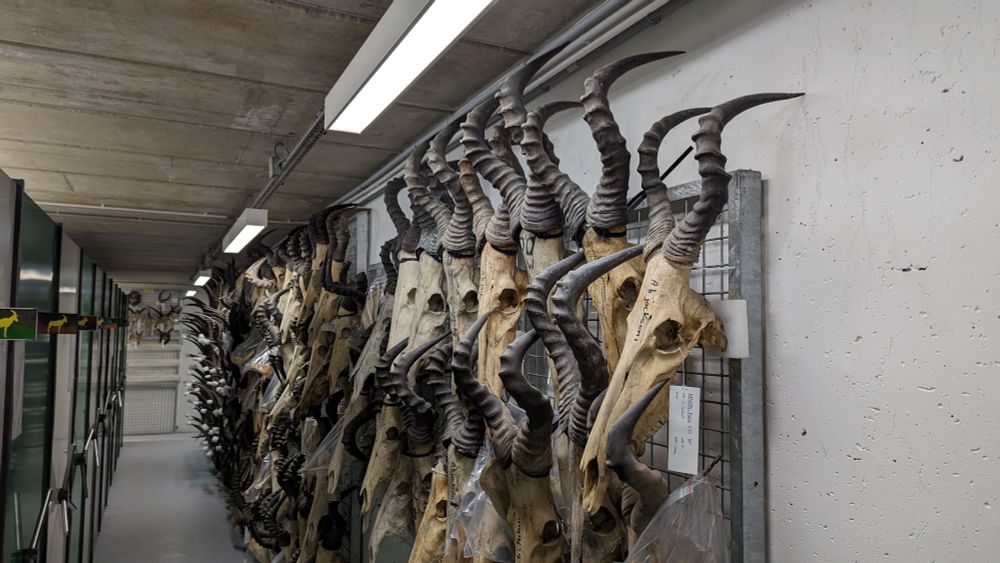
We extracted DNA from less sampled hartebeest populations, especially the Bubal and Tora hartebeest (the two geographically closest forms, too). Many thanks to the staff at the MNHN in Paris for access to their collections, as there are very few specimens of these taxa! 6/13

December 3, 2025 at 1:27 AM
We extracted DNA from less sampled hartebeest populations, especially the Bubal and Tora hartebeest (the two geographically closest forms, too). Many thanks to the staff at the MNHN in Paris for access to their collections, as there are very few specimens of these taxa! 6/13
A real challenge was extracting DNA from archaeological Levantine remains. The Negev desert is not ideal for genetic materials! Luckily, after several attempts and using mammalian mtDNA capture, we obtained good coverage for two of the most recent samples (Nessana)
#archaeology 5/13
#archaeology 5/13

December 3, 2025 at 1:24 AM
A real challenge was extracting DNA from archaeological Levantine remains. The Negev desert is not ideal for genetic materials! Luckily, after several attempts and using mammalian mtDNA capture, we obtained good coverage for two of the most recent samples (Nessana)
#archaeology 5/13
#archaeology 5/13
In the paper we extracted the #aDNA of the Levantine hartebeest and compared it to other ssp. - is it a Bubal, or something distinct?
We also tried to infer the cause of #extinction of this population, centuries earlier than any other. Are humans to blame, or a local climatic shift? 4/13
We also tried to infer the cause of #extinction of this population, centuries earlier than any other. Are humans to blame, or a local climatic shift? 4/13
December 3, 2025 at 1:22 AM
In the paper we extracted the #aDNA of the Levantine hartebeest and compared it to other ssp. - is it a Bubal, or something distinct?
We also tried to infer the cause of #extinction of this population, centuries earlier than any other. Are humans to blame, or a local climatic shift? 4/13
We also tried to infer the cause of #extinction of this population, centuries earlier than any other. Are humans to blame, or a local climatic shift? 4/13