


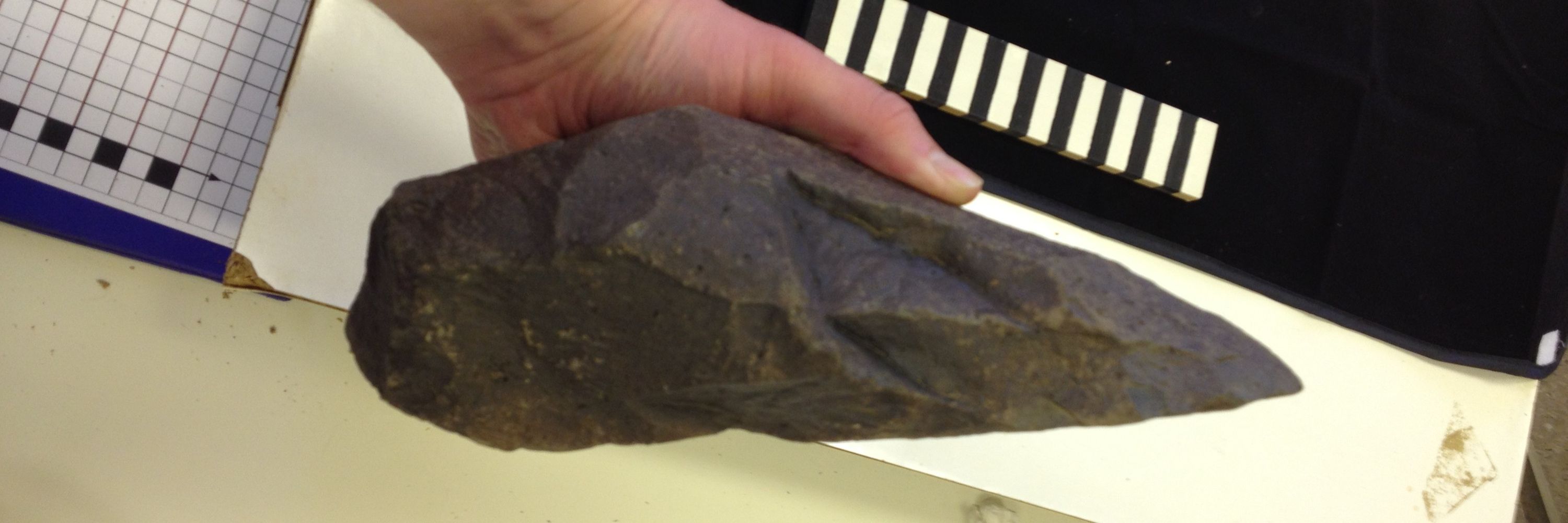

Dr Freddie Foulds
@drfrederickfoulds.bsky.social
Palaeolithic Archaeology, currently between jobs. Interested in using digital technologies to trace social traditions in the Acheulean. Specialist in the lithic technologies of the Lower Palaeolithic.
Nerd posts: @judgefredd.bsky.social
Nerd posts: @judgefredd.bsky.social
Pinned
My other account (@judgefredd.bsky.social) is gaining #archaeologist followers, so this is a separate account to split academic posts out from my hobby related content.
By way of an intro, I'm a #Palaeolithic #archaeologist at Durham working on social traditions in #Acheulean #handaxe manufacture.
By way of an intro, I'm a #Palaeolithic #archaeologist at Durham working on social traditions in #Acheulean #handaxe manufacture.
Our latest paper on the pronounced increase in handaxe knapping skill present between the earliest Acheulean and that appearing in MIS 13 in Britain is now out in JAS: Reports.
www.sciencedirect.com/science/arti...
#archaeology #palaeolithic #openaccess #handaxes
www.sciencedirect.com/science/arti...
#archaeology #palaeolithic #openaccess #handaxes

Pronounced increase in biface knapping skill half a million years ago in Britain
Flake scar patterning indicates Acheulean knappers were attempting to make thin, symmetrical handaxes with regular edges. In this study we quantify th…
www.sciencedirect.com
January 13, 2026 at 8:06 AM
Our latest paper on the pronounced increase in handaxe knapping skill present between the earliest Acheulean and that appearing in MIS 13 in Britain is now out in JAS: Reports.
www.sciencedirect.com/science/arti...
#archaeology #palaeolithic #openaccess #handaxes
www.sciencedirect.com/science/arti...
#archaeology #palaeolithic #openaccess #handaxes
Another new paper out in the wild, this time exploring tranchet technique at the Lower #Palaeolithic site of #Boxgrove and the transmission of complex knapping via social signalling.
doi.org/10.1017/S095...
doi.org/10.1017/S095...
Turning-the-edge, Tranchet, and Social Signalling at Boxgrove | Cambridge Archaeological Journal | Cambridge Core
Turning-the-edge, Tranchet, and Social Signalling at Boxgrove
doi.org
September 16, 2025 at 7:48 AM
Another new paper out in the wild, this time exploring tranchet technique at the Lower #Palaeolithic site of #Boxgrove and the transmission of complex knapping via social signalling.
doi.org/10.1017/S095...
doi.org/10.1017/S095...
Exciting possibilities for lithic imaging with the new RTI superdome that's just been installed at Durham. It will be interesting to see what kind of images can be produced of the experimental battering damage that we've been creating on replica handaxes...
August 27, 2025 at 3:25 PM
Exciting possibilities for lithic imaging with the new RTI superdome that's just been installed at Durham. It will be interesting to see what kind of images can be produced of the experimental battering damage that we've been creating on replica handaxes...
If you like a bit of #Acheulean in your life, I have a new paper out today looking at the putative twisted ovate handaxe assemblage at Swanscombe and what they can tell us about changing hominin technological traditions at the site.
#Palaeolithic #lithics #archaeology
doi.org/10.1016/j.qu...
#Palaeolithic #lithics #archaeology
doi.org/10.1016/j.qu...

A twist in the tail: on the validity and characteristics of the Phase III handaxe assemblage from Barnfield Pit, Swanscombe, UK
The Lower Palaeolithic site of Barnfield Pit, Swanscombe, UK, is famous for its extensive geological sequence that represents the whole of the Marine …
www.sciencedirect.com
August 26, 2025 at 10:26 AM
If you like a bit of #Acheulean in your life, I have a new paper out today looking at the putative twisted ovate handaxe assemblage at Swanscombe and what they can tell us about changing hominin technological traditions at the site.
#Palaeolithic #lithics #archaeology
doi.org/10.1016/j.qu...
#Palaeolithic #lithics #archaeology
doi.org/10.1016/j.qu...
Reposted by Dr Freddie Foulds
Join our innovative community from around the world.
As a member you will get:
• Free or reduced ticket prices to many of our events
• Access to members-only events
• Our Journal
• Networking opportunities
Plus much more
You can join for only £15 per year via the link here www.lithics.org/joining/
As a member you will get:
• Free or reduced ticket prices to many of our events
• Access to members-only events
• Our Journal
• Networking opportunities
Plus much more
You can join for only £15 per year via the link here www.lithics.org/joining/

January 18, 2025 at 5:44 PM
Join our innovative community from around the world.
As a member you will get:
• Free or reduced ticket prices to many of our events
• Access to members-only events
• Our Journal
• Networking opportunities
Plus much more
You can join for only £15 per year via the link here www.lithics.org/joining/
As a member you will get:
• Free or reduced ticket prices to many of our events
• Access to members-only events
• Our Journal
• Networking opportunities
Plus much more
You can join for only £15 per year via the link here www.lithics.org/joining/
Reposted by Dr Freddie Foulds
JHE Update: First, we are profoundly grateful for the outpouring of support from the human evolution community for the collective decision to resign. While Andrea and I intended to continue handling our existing manuscripts for 3 months following resignation and were continuing to do so ... (1/3)
January 13, 2025 at 9:01 AM
JHE Update: First, we are profoundly grateful for the outpouring of support from the human evolution community for the collective decision to resign. While Andrea and I intended to continue handling our existing manuscripts for 3 months following resignation and were continuing to do so ... (1/3)
Interesting start to 2025 seeing the Editorial Board of JHE resign en masse. I support their exceptionally difficult decision in the face of what can only be described as a profiteering company blatantly trying to make the largest amount of money from the smallest degree of intellectual oversight.


January 2, 2025 at 9:36 AM
Interesting start to 2025 seeing the Editorial Board of JHE resign en masse. I support their exceptionally difficult decision in the face of what can only be described as a profiteering company blatantly trying to make the largest amount of money from the smallest degree of intellectual oversight.
This brilliant synthesis of the work into revising the terrace stratigraphy of the Little Ouse River & what it can tell us about the Palaeolithic archaeology of central East Anglia just came out last Friday. I helped with the work at Santon Downham as part of it. doi.org/10.1016/j.qe...
Redirecting
doi.org
December 4, 2024 at 3:19 PM
This brilliant synthesis of the work into revising the terrace stratigraphy of the Little Ouse River & what it can tell us about the Palaeolithic archaeology of central East Anglia just came out last Friday. I helped with the work at Santon Downham as part of it. doi.org/10.1016/j.qe...
@drefoulds.bsky.social - of any interest to you?

Twelve-thousand years ago, people in a coastal village in the Levant used stone weights on their spindles to spin thread faster and more evenly—and, archeologists are arguing, in the process they pioneered the basic mechanics that eventually made cart wheels possible. arstechnica.com/science/2024...

Key wheel ideas may have come from weaving
The tools used to make threads could have seeded concepts that eventually led to the wheel.
arstechnica.com
November 19, 2024 at 9:12 AM
@drefoulds.bsky.social - of any interest to you?
Highly recommend getting yourself on one of James' courses if you're interesting in learning the ins and outs of flintknapping.
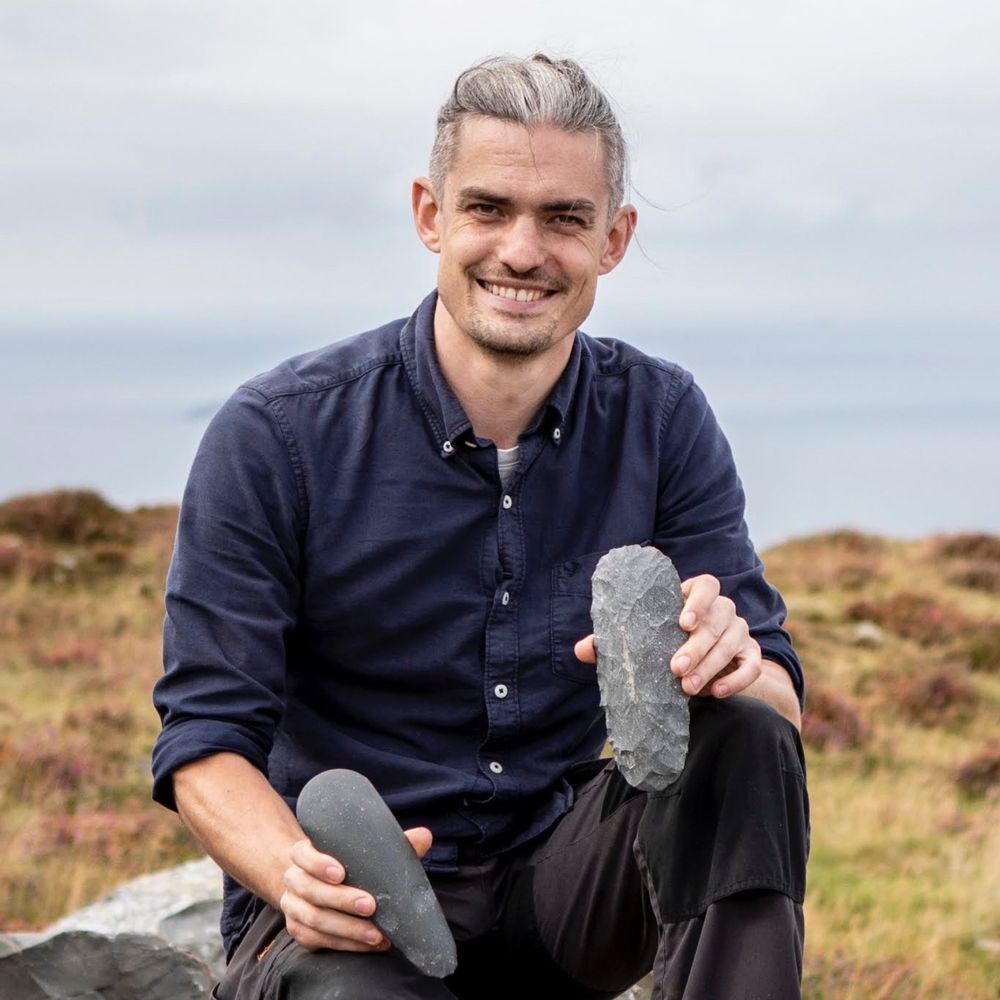
How were handaxes made in the Stone Age?
They were made & used by several different hominin species in the Palaeolithic from just under 2 million years ago up until the last Neanderthal ~ 40,000 yrs ago.
I make these for our prehistoric replicas shop (link in bio)
🎥 @emmalouwynjones.bsky.social
They were made & used by several different hominin species in the Palaeolithic from just under 2 million years ago up until the last Neanderthal ~ 40,000 yrs ago.
I make these for our prehistoric replicas shop (link in bio)
🎥 @emmalouwynjones.bsky.social
November 15, 2024 at 1:04 PM
Highly recommend getting yourself on one of James' courses if you're interesting in learning the ins and outs of flintknapping.
My other account (@judgefredd.bsky.social) is gaining #archaeologist followers, so this is a separate account to split academic posts out from my hobby related content.
By way of an intro, I'm a #Palaeolithic #archaeologist at Durham working on social traditions in #Acheulean #handaxe manufacture.
By way of an intro, I'm a #Palaeolithic #archaeologist at Durham working on social traditions in #Acheulean #handaxe manufacture.
November 15, 2024 at 12:55 PM
My other account (@judgefredd.bsky.social) is gaining #archaeologist followers, so this is a separate account to split academic posts out from my hobby related content.
By way of an intro, I'm a #Palaeolithic #archaeologist at Durham working on social traditions in #Acheulean #handaxe manufacture.
By way of an intro, I'm a #Palaeolithic #archaeologist at Durham working on social traditions in #Acheulean #handaxe manufacture.