



Dr Freddie Foulds
@drfrederickfoulds.bsky.social
Palaeolithic Archaeology, currently between jobs. Interested in using digital technologies to trace social traditions in the Acheulean. Specialist in the lithic technologies of the Lower Palaeolithic.
Nerd posts: @judgefredd.bsky.social
Nerd posts: @judgefredd.bsky.social
Thanks 🙏 I’ve been practicing since - still working on getting my thinning up to par (I’ve a lot of fat handaxes) but getting there.
November 16, 2024 at 10:15 AM
Thanks 🙏 I’ve been practicing since - still working on getting my thinning up to par (I’ve a lot of fat handaxes) but getting there.
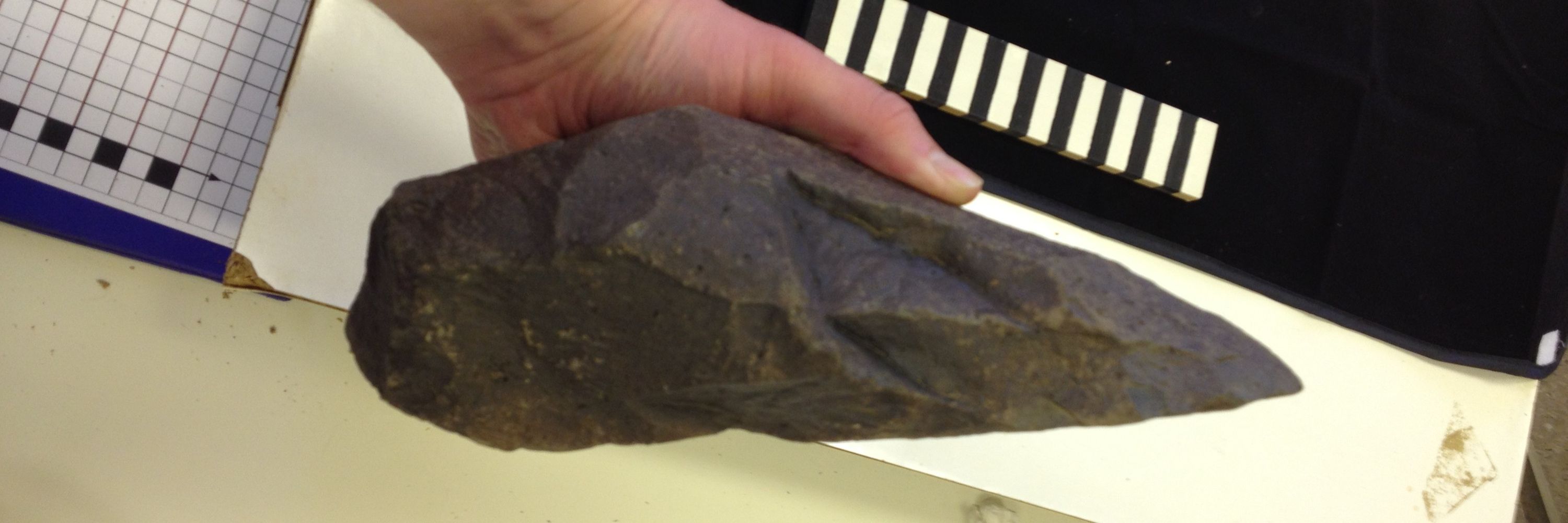
With a bit of help and instruction, I was able to knock out this last year at one of James' courses held at Cresswell Crags.

November 15, 2024 at 1:11 PM
With a bit of help and instruction, I was able to knock out this last year at one of James' courses held at Cresswell Crags.
My research interests include applications of digital technologies, including 3D scanning, to studying lithic artefacts, symmetry in Lower Palaeolithic bifaces and its relationship to aesthetic and reward experience & the use of early prehistoric lithic artefacts in folklore and magic.
November 15, 2024 at 12:55 PM
My research interests include applications of digital technologies, including 3D scanning, to studying lithic artefacts, symmetry in Lower Palaeolithic bifaces and its relationship to aesthetic and reward experience & the use of early prehistoric lithic artefacts in folklore and magic.
Also, our recent study of the preponderance of giant handaxes in MIS 9 compared to the other marine isotope stages within the Lower Palaeolithic. doi.org/10.15184/aqy...

Big enough to matter: on the frequency and chronology of giant handaxes in the British Lower Palaeolithic | Antiquity | Cambridge Core
Big enough to matter: on the frequency and chronology of giant handaxes in the British Lower Palaeolithic - Volume 98 Issue 398
doi.org
November 15, 2024 at 12:55 PM
Also, our recent study of the preponderance of giant handaxes in MIS 9 compared to the other marine isotope stages within the Lower Palaeolithic. doi.org/10.15184/aqy...
Some recent papers I've contributed to as part of the project include the reassessment of the "simple prepared cores" from the Lower Palaeolithic site of Purfleet, in which we suggest these are not prepared and thus not a precursor to true Levallois, which arrives in MIS 7. doi.org/10.1007/s419...

Making a U-turn on the Purfleet Interchange: Stone Tool Technology in Marine Isotope Stage 9 Britain and the Emergence of the Middle Palaeolithic in Europe - Journal of Paleolithic Archaeology
This paper re-examines earlier Palaeolithic core technology from British sites assigned to MIS 11, 9, and 7 using primarily a châine opératoire approach, with the objective of better understanding the...
doi.org
November 15, 2024 at 12:55 PM
Some recent papers I've contributed to as part of the project include the reassessment of the "simple prepared cores" from the Lower Palaeolithic site of Purfleet, in which we suggest these are not prepared and thus not a precursor to true Levallois, which arrives in MIS 7. doi.org/10.1007/s419...