



Keith Smith
@drkeithsmith.bsky.social
PhD, occasional astronomer, talking head, science geek, cynic. Senior Editor at @Science.org, responsible for research papers in astronomy and planetary science. Views own, duh. Bio: https://www.science.org/content/author/keith-t-smith
Now published in final print format, with my editor's summary. ☄️🔭
www.science.org/doi/10.1126/...
www.science.org/doi/10.1126/...

January 23, 2026 at 2:05 PM
Now published in final print format, with my editor's summary. ☄️🔭
www.science.org/doi/10.1126/...
www.science.org/doi/10.1126/...
Li et al. monitored a repeating fast radio burst (FRB). They identify a transient excursion of its rotation measure (RM), which increases by orders of magnitude for 2 weeks. Possible causes include a coronal mass ejection from a binary companion star. ☄️ #radioastro
www.science.org/doi/10.1126/...
www.science.org/doi/10.1126/...

January 15, 2026 at 8:03 PM
Li et al. monitored a repeating fast radio burst (FRB). They identify a transient excursion of its rotation measure (RM), which increases by orders of magnitude for 2 weeks. Possible causes include a coronal mass ejection from a binary companion star. ☄️ #radioastro
www.science.org/doi/10.1126/...
www.science.org/doi/10.1126/...
Kader, @justtheletteru.bsky.social et al. use multi-wavelength observations to show a precessing jet in an active galaxy is driving a gas outflow. This galactic feedback is removing enough material to affect the star formation rate.
☄️ #extragalactic #AAS247
www.science.org/doi/10.1126/...
☄️ #extragalactic #AAS247
www.science.org/doi/10.1126/...

January 8, 2026 at 5:33 PM
Kader, @justtheletteru.bsky.social et al. use multi-wavelength observations to show a precessing jet in an active galaxy is driving a gas outflow. This galactic feedback is removing enough material to affect the star formation rate.
☄️ #extragalactic #AAS247
www.science.org/doi/10.1126/...
☄️ #extragalactic #AAS247
www.science.org/doi/10.1126/...
The nearby star Fomalhaut is orbited by a dust belt. Kalas et al. use coronagraphic imaging to identify a transient source at the edge of the belt. They interpret it as a dust cloud, generated by a collision between two planetesimals. ☄️
www.science.org/doi/10.1126/...
www.science.org/doi/10.1126/...

December 19, 2025 at 6:23 PM
The nearby star Fomalhaut is orbited by a dust belt. Kalas et al. use coronagraphic imaging to identify a transient source at the edge of the belt. They interpret it as a dust cloud, generated by a collision between two planetesimals. ☄️
www.science.org/doi/10.1126/...
www.science.org/doi/10.1126/...
Williford et al. have used the Perseverance rover on Mars to investigate rocks around the rim of Jezero crater. They find igneous intrusions that were later modified by liquid water with dissolved CO2, producing carbonates. ☄️ #planetsci #AGU2025
www.science.org/doi/10.1126/...
www.science.org/doi/10.1126/...

December 17, 2025 at 5:22 PM
Williford et al. have used the Perseverance rover on Mars to investigate rocks around the rim of Jezero crater. They find igneous intrusions that were later modified by liquid water with dissolved CO2, producing carbonates. ☄️ #planetsci #AGU2025
www.science.org/doi/10.1126/...
www.science.org/doi/10.1126/...
Well this is worrying. NASA has maintained funding for ADS but not SciX (a broader database). In response, management is planning to *close* ADS in Feb 2026, forcing all users to switch to SciX. ☄️🔭
Funding info: ads.harvard.edu/adsug/2025/0...
Transition plan: ads.harvard.edu/adsug/2025/0...
Funding info: ads.harvard.edu/adsug/2025/0...
Transition plan: ads.harvard.edu/adsug/2025/0...


December 9, 2025 at 12:59 PM
Well this is worrying. NASA has maintained funding for ADS but not SciX (a broader database). In response, management is planning to *close* ADS in Feb 2026, forcing all users to switch to SciX. ☄️🔭
Funding info: ads.harvard.edu/adsug/2025/0...
Transition plan: ads.harvard.edu/adsug/2025/0...
Funding info: ads.harvard.edu/adsug/2025/0...
Transition plan: ads.harvard.edu/adsug/2025/0...
I wrote a longer editor's summary of this paper than usual, for the #ScienceAdviser newsletter. Take a look if you'd like a popular-level explanation of how Hopp et al. determined where Theia came from. ☄️🧪 #planetsci
www.science.org/content/arti...
www.science.org/content/arti...

November 24, 2025 at 12:17 PM
I wrote a longer editor's summary of this paper than usual, for the #ScienceAdviser newsletter. Take a look if you'd like a popular-level explanation of how Hopp et al. determined where Theia came from. ☄️🧪 #planetsci
www.science.org/content/arti...
www.science.org/content/arti...
This paper is now available in final print format, with my editor's summary. #stellarastro #exoplanet ☄️
www.science.org/doi/10.1126/...
www.science.org/doi/10.1126/...

November 14, 2025 at 4:22 PM
This paper is now available in final print format, with my editor's summary. #stellarastro #exoplanet ☄️
www.science.org/doi/10.1126/...
www.science.org/doi/10.1126/...
No astronomy per se in this week's issue of @science.org, but there is a fascinating study by Pavia et al. that uses cosmic dust to trace sea ice coverage in the Arctic. 3He from micrometeorites records when the ocean was ice free, over the last 30,000 years. 🧪🌊
www.science.org/doi/10.1126/...
www.science.org/doi/10.1126/...

November 6, 2025 at 7:33 PM
No astronomy per se in this week's issue of @science.org, but there is a fascinating study by Pavia et al. that uses cosmic dust to trace sea ice coverage in the Arctic. 3He from micrometeorites records when the ocean was ice free, over the last 30,000 years. 🧪🌊
www.science.org/doi/10.1126/...
www.science.org/doi/10.1126/...
How can we tell what's inside an #exoplanet? @timlichtenberg.bsky.social et al review how a planet's atmosphere interacts with its interior. Atmospheric observations can distinguish between lava worlds, water worlds, temperate surfaces or supercritical interiors. ☄️
www.science.org/doi/10.1126/...
www.science.org/doi/10.1126/...

October 9, 2025 at 6:20 PM
How can we tell what's inside an #exoplanet? @timlichtenberg.bsky.social et al review how a planet's atmosphere interacts with its interior. Atmospheric observations can distinguish between lava worlds, water worlds, temperate surfaces or supercritical interiors. ☄️
www.science.org/doi/10.1126/...
www.science.org/doi/10.1126/...
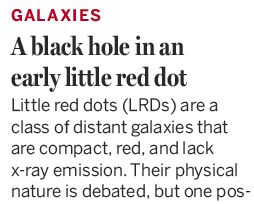
Editor's choice: little red dots (LRDs) are compact distant galaxies with unusual properties, of uncertain origin. Taylor et al. have found an LRD at redshift 9.2, and show it contains a supermassive black hole >5% of the stellar mass in the galaxy. ☄️ #extragalactic
www.science.org/doi/10.1126/...
www.science.org/doi/10.1126/...
October 8, 2025 at 12:46 PM
Editor's choice: little red dots (LRDs) are compact distant galaxies with unusual properties, of uncertain origin. Taylor et al. have found an LRD at redshift 9.2, and show it contains a supermassive black hole >5% of the stellar mass in the galaxy. ☄️ #extragalactic
www.science.org/doi/10.1126/...
www.science.org/doi/10.1126/...
… and saw Isaac Newton’s own copy of the first edition Principia Mathematica, with his hand-written corrections for the second edition. 🔭⚛️🧪

September 13, 2025 at 4:40 PM
… and saw Isaac Newton’s own copy of the first edition Principia Mathematica, with his hand-written corrections for the second edition. 🔭⚛️🧪
Today I looked through Fred Hoyle’s telescope… 🔭⚛️

September 13, 2025 at 4:38 PM
Today I looked through Fred Hoyle’s telescope… 🔭⚛️
In @science.org, Buchli et al. have applied sophisticated machine learning techniques to the control electronics of @ligo.org. This improves the sensitivity of the detector at low frequencies - expanding its cosmological reach, particularly for low-mass mergers. ⚛️☄️
www.science.org/doi/10.1126/...
www.science.org/doi/10.1126/...

September 4, 2025 at 6:30 PM
In @science.org, Buchli et al. have applied sophisticated machine learning techniques to the control electronics of @ligo.org. This improves the sensitivity of the detector at low frequencies - expanding its cosmological reach, particularly for low-mass mergers. ⚛️☄️
www.science.org/doi/10.1126/...
www.science.org/doi/10.1126/...
Editor's choice: Jerjen et al. have found a pair of galaxies in the early phase of a merger. The gravitational forces have rearranged their satellite dwarf galaxies into a single plane. ☄️ #extragalactic #cosmology
www.science.org/doi/10.1126/...
www.science.org/doi/10.1126/...

September 2, 2025 at 3:43 PM
Editor's choice: Jerjen et al. have found a pair of galaxies in the early phase of a merger. The gravitational forces have rearranged their satellite dwarf galaxies into a single plane. ☄️ #extragalactic #cosmology
www.science.org/doi/10.1126/...
www.science.org/doi/10.1126/...
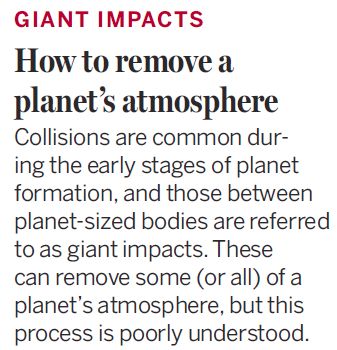
Editor's choice: Roche et al. simulate how giant impacts can remove a planet's atmosphere. They simulate hundreds of impact configurations, from which they derive a scaling law for what fraction of the atmosphere is lost in each impact. ☄️ #planetsci #exoplanet
www.science.org/doi/10.1126/...
www.science.org/doi/10.1126/...
July 25, 2025 at 12:02 PM
Editor's choice: Roche et al. simulate how giant impacts can remove a planet's atmosphere. They simulate hundreds of impact configurations, from which they derive a scaling law for what fraction of the atmosphere is lost in each impact. ☄️ #planetsci #exoplanet
www.science.org/doi/10.1126/...
www.science.org/doi/10.1126/...
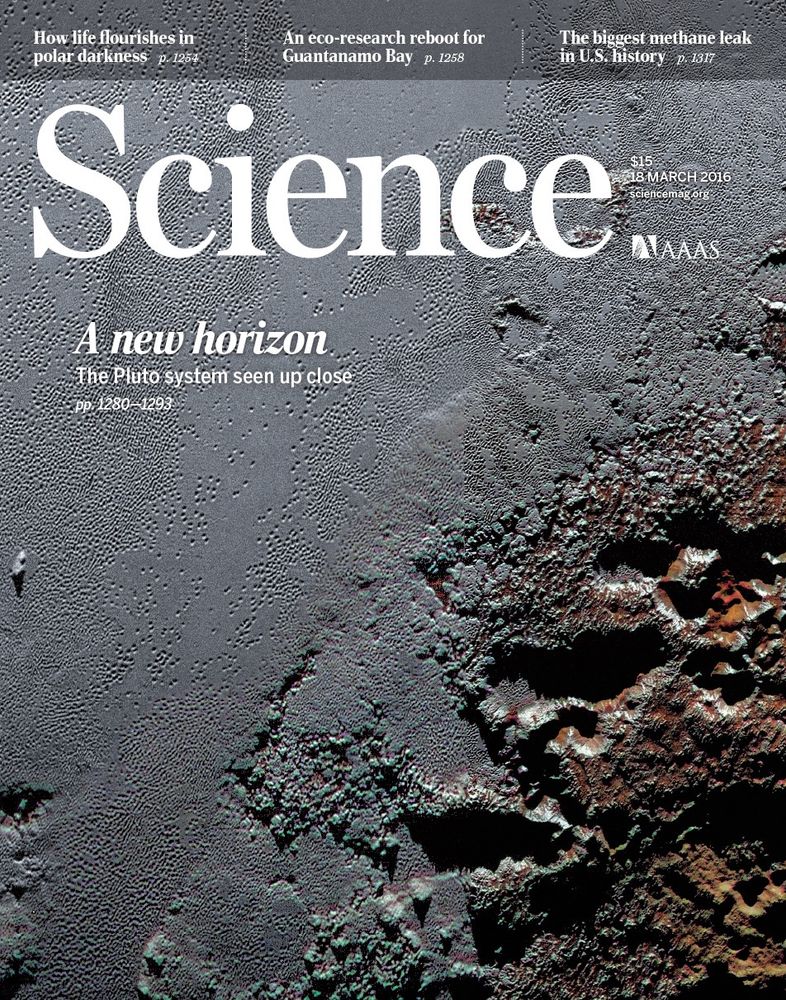
That image was the cover of @science.org on 16 March 2016. That issue contained five papers by the New Horizons team reporting results from the flyby of Pluto.
www.science.org/toc/science/...
www.science.org/toc/science/...
July 24, 2025 at 9:43 PM
That image was the cover of @science.org on 16 March 2016. That issue contained five papers by the New Horizons team reporting results from the flyby of Pluto.
www.science.org/toc/science/...
www.science.org/toc/science/...
This week I am attending the UK National Astronomy Meeting in Durham (@nam25-durham.bsky.social).
If you’re here and curious about publishing your work in @science.org, I’m happy to chat! #NAM2025 ☄️
If you’re here and curious about publishing your work in @science.org, I’m happy to chat! #NAM2025 ☄️

July 6, 2025 at 9:24 PM
This week I am attending the UK National Astronomy Meeting in Durham (@nam25-durham.bsky.social).
If you’re here and curious about publishing your work in @science.org, I’m happy to chat! #NAM2025 ☄️
If you’re here and curious about publishing your work in @science.org, I’m happy to chat! #NAM2025 ☄️
The number of satellites in Earth orbit is doubling every 18 months, which is hugely damaging to astronomy, near-Earth space and the upper atmosphere. We need a new approach to space environmentalism, writes @e-astronomer.bsky.social in his @science.org column. 🧪🔭☄️
www.science.org/doi/10.1126/...
www.science.org/doi/10.1126/...
July 4, 2025 at 11:13 AM
The number of satellites in Earth orbit is doubling every 18 months, which is hugely damaging to astronomy, near-Earth space and the upper atmosphere. We need a new approach to space environmentalism, writes @e-astronomer.bsky.social in his @science.org column. 🧪🔭☄️
www.science.org/doi/10.1126/...
www.science.org/doi/10.1126/...
Editor's choice: gas giant #exoplanets can be formed by either core accretion or gravitational instability. Hotnisky et al. identify two large gas giants orbiting M dwarf stars, and use the planet-to-star mass ratio to determine how they formed. ☄️
www.science.org/doi/10.1126/...
www.science.org/doi/10.1126/...

June 30, 2025 at 7:03 PM
Editor's choice: gas giant #exoplanets can be formed by either core accretion or gravitational instability. Hotnisky et al. identify two large gas giants orbiting M dwarf stars, and use the planet-to-star mass ratio to determine how they formed. ☄️
www.science.org/doi/10.1126/...
www.science.org/doi/10.1126/...
This paper has now been published in final print format, with my editor's summary. ☄️☀️
www.science.org/doi/10.1126/...
www.science.org/doi/10.1126/...

June 24, 2025 at 1:54 PM
This paper has now been published in final print format, with my editor's summary. ☄️☀️
www.science.org/doi/10.1126/...
www.science.org/doi/10.1126/...
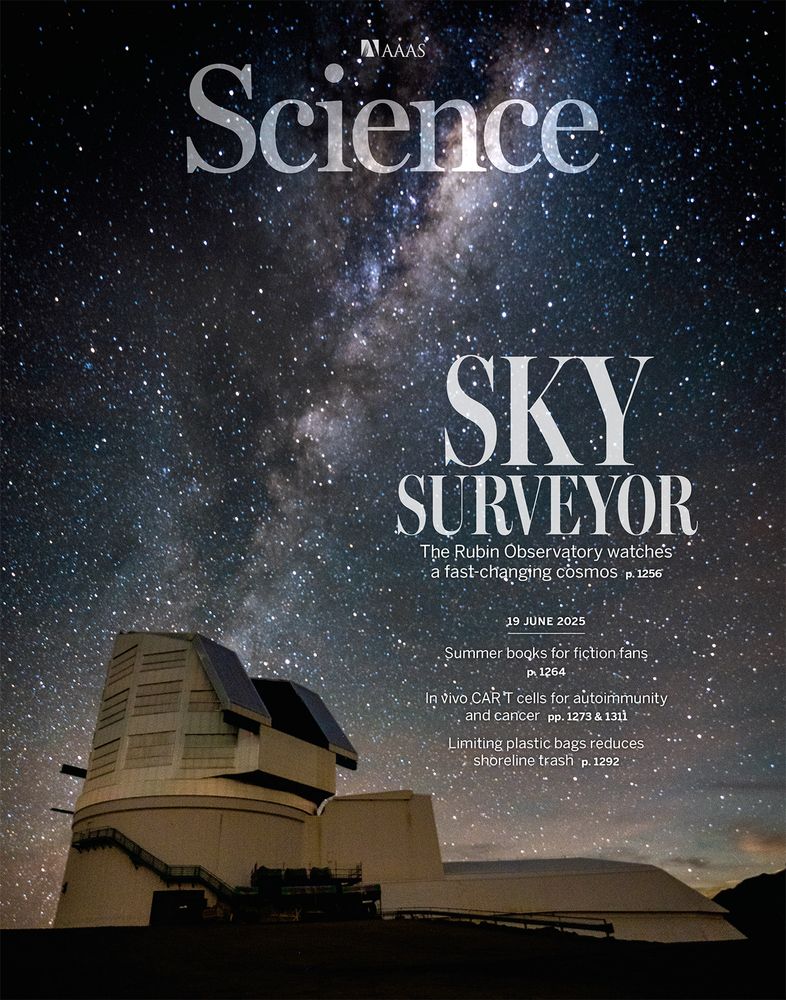
The new Rubin Observatory and its LSST survey will provide a torrent of data for time-domain astronomy, reports @danclery.bsky.social. 🧪🔭☄️
It's the cover story for the current print issue of @science.org; the animations in the online version are even more impressive!
www.science.org/content/arti...
It's the cover story for the current print issue of @science.org; the animations in the online version are even more impressive!
www.science.org/content/arti...
June 23, 2025 at 3:34 PM
The new Rubin Observatory and its LSST survey will provide a torrent of data for time-domain astronomy, reports @danclery.bsky.social. 🧪🔭☄️
It's the cover story for the current print issue of @science.org; the animations in the online version are even more impressive!
www.science.org/content/arti...
It's the cover story for the current print issue of @science.org; the animations in the online version are even more impressive!
www.science.org/content/arti...
Downs et al. have developed a data-assimilation technique to simulate the Sun's corona. Satellite observations are incorporated on the fly and model predictions update hourly, akin to weather forecasting. They applied the method to the 2024 total solar eclipse. 🔭🧪☀️
www.science.org/doi/10.1126/...
www.science.org/doi/10.1126/...

June 11, 2025 at 11:38 AM
Downs et al. have developed a data-assimilation technique to simulate the Sun's corona. Satellite observations are incorporated on the fly and model predictions update hourly, akin to weather forecasting. They applied the method to the 2024 total solar eclipse. 🔭🧪☀️
www.science.org/doi/10.1126/...
www.science.org/doi/10.1126/...
An interesting description of the palaeontologist Mary Anning (1799-1847), displayed in the Lyme Regis Museum.
The museum stands on the site of Anning’s fossil shop; this statue of her is nearby. 🧪
The museum stands on the site of Anning’s fossil shop; this statue of her is nearby. 🧪


May 27, 2025 at 5:24 PM
An interesting description of the palaeontologist Mary Anning (1799-1847), displayed in the Lyme Regis Museum.
The museum stands on the site of Anning’s fossil shop; this statue of her is nearby. 🧪
The museum stands on the site of Anning’s fossil shop; this statue of her is nearby. 🧪
Editor's choice: Beatrice Vaia et al. have used X-ray light echoes from a gamma-ray burst to investigate the distribution of foreground dust within the Milky Way. ☄️
www.science.org/doi/10.1126/...
www.science.org/doi/10.1126/...

May 23, 2025 at 3:26 PM
Editor's choice: Beatrice Vaia et al. have used X-ray light echoes from a gamma-ray burst to investigate the distribution of foreground dust within the Milky Way. ☄️
www.science.org/doi/10.1126/...
www.science.org/doi/10.1126/...