



Erik Oystein.
@erik7-64.bsky.social
I am an active 60yrs old , I am family oriented and I enjoy spending time with family and friends. I am from the Badger state .
Reposted by Erik Oystein.

Scientists trained Hubble’s sharp vision on a starless, gas-rich, dark-matter cloud and identified a new type of astronomical object—a failed galaxy that never produced stars. Nicknamed Cloud-9, it is considered a fossil from the early universe: https://news.stsci.edu/4bdj2Ov #AAS247
January 5, 2026 at 5:18 PM
Scientists trained Hubble’s sharp vision on a starless, gas-rich, dark-matter cloud and identified a new type of astronomical object—a failed galaxy that never produced stars. Nicknamed Cloud-9, it is considered a fossil from the early universe: https://news.stsci.edu/4bdj2Ov #AAS247
Reposted by Erik Oystein.
#NASAWebb researchers found iron-rich dust and complex carbon molecules in Sextans A, a nearby galaxy with similar properties to those in the early universe. Why the finding is surprising: https://news.stsci.edu/4st0ccz #AAS247 🔭

January 6, 2026 at 6:00 PM
#NASAWebb researchers found iron-rich dust and complex carbon molecules in Sextans A, a nearby galaxy with similar properties to those in the early universe. Why the finding is surprising: https://news.stsci.edu/4st0ccz #AAS247 🔭
Reposted by Erik Oystein.
The varying brightness of red supergiant Betelgeuse could be explained by Hubble’s latest reveal: The bright star in Orion’s shoulder has an elusive companion star orbiting it in its extended atmosphere, leaving a “wake” of dense gas: https://news.stsci.edu/4sunaQH #AAS247 🔭

January 5, 2026 at 9:16 PM
The varying brightness of red supergiant Betelgeuse could be explained by Hubble’s latest reveal: The bright star in Orion’s shoulder has an elusive companion star orbiting it in its extended atmosphere, leaving a “wake” of dense gas: https://news.stsci.edu/4sunaQH #AAS247 🔭
Reposted by Erik Oystein.

✨ NGC 6951: a starbusting spiral galaxy.
Nestled away at its core, NGC 6951 has another remarkable feature: a white-blue ring that encloses the very heart of the galaxy.
The dense gas in this starburst ring is the perfect environment to churn out an impressive number of stars.
Nestled away at its core, NGC 6951 has another remarkable feature: a white-blue ring that encloses the very heart of the galaxy.
The dense gas in this starburst ring is the perfect environment to churn out an impressive number of stars.

October 6, 2025 at 3:03 PM
✨ NGC 6951: a starbusting spiral galaxy.
Nestled away at its core, NGC 6951 has another remarkable feature: a white-blue ring that encloses the very heart of the galaxy.
The dense gas in this starburst ring is the perfect environment to churn out an impressive number of stars.
Nestled away at its core, NGC 6951 has another remarkable feature: a white-blue ring that encloses the very heart of the galaxy.
The dense gas in this starburst ring is the perfect environment to churn out an impressive number of stars.
Reposted by Erik Oystein.
#APOD Astronomy Picture of the Day
NGC 7380: The Wizard Nebula
Credit: Nevenka Blagovic Horvat & Miroslav Horvat
www.star.ucl.ac.uk/~apod/apod/a... 🧪🔭
NGC 7380: The Wizard Nebula
Credit: Nevenka Blagovic Horvat & Miroslav Horvat
www.star.ucl.ac.uk/~apod/apod/a... 🧪🔭

October 8, 2025 at 1:24 PM
#APOD Astronomy Picture of the Day
NGC 7380: The Wizard Nebula
Credit: Nevenka Blagovic Horvat & Miroslav Horvat
www.star.ucl.ac.uk/~apod/apod/a... 🧪🔭
NGC 7380: The Wizard Nebula
Credit: Nevenka Blagovic Horvat & Miroslav Horvat
www.star.ucl.ac.uk/~apod/apod/a... 🧪🔭
Reposted by Erik Oystein.
Sagittarius B2, the most active star-forming region in the heart of our Milky Way, looks dramatically different depending on the light. The near-infrared light captured by #NASAWebb’s NIRCam shows thousands of colorful stars. Webb’s MIRI shows more of the region’s gas and dust structure. 🔭 🧪

Sagittarius B2 in Infrared - James Webb Space Telescope
Sagittarius B2, the most active star-forming region in the heart of our Milky Way, looks dramatically different depending on the light.
The near-infrared light captured by the James Webb Space Telescope's NIRCam (Near-Infrared Camera) shows thousands o...
youtu.be
October 7, 2025 at 5:26 PM
Sagittarius B2, the most active star-forming region in the heart of our Milky Way, looks dramatically different depending on the light. The near-infrared light captured by #NASAWebb’s NIRCam shows thousands of colorful stars. Webb’s MIRI shows more of the region’s gas and dust structure. 🔭 🧪
Reposted by Erik Oystein.
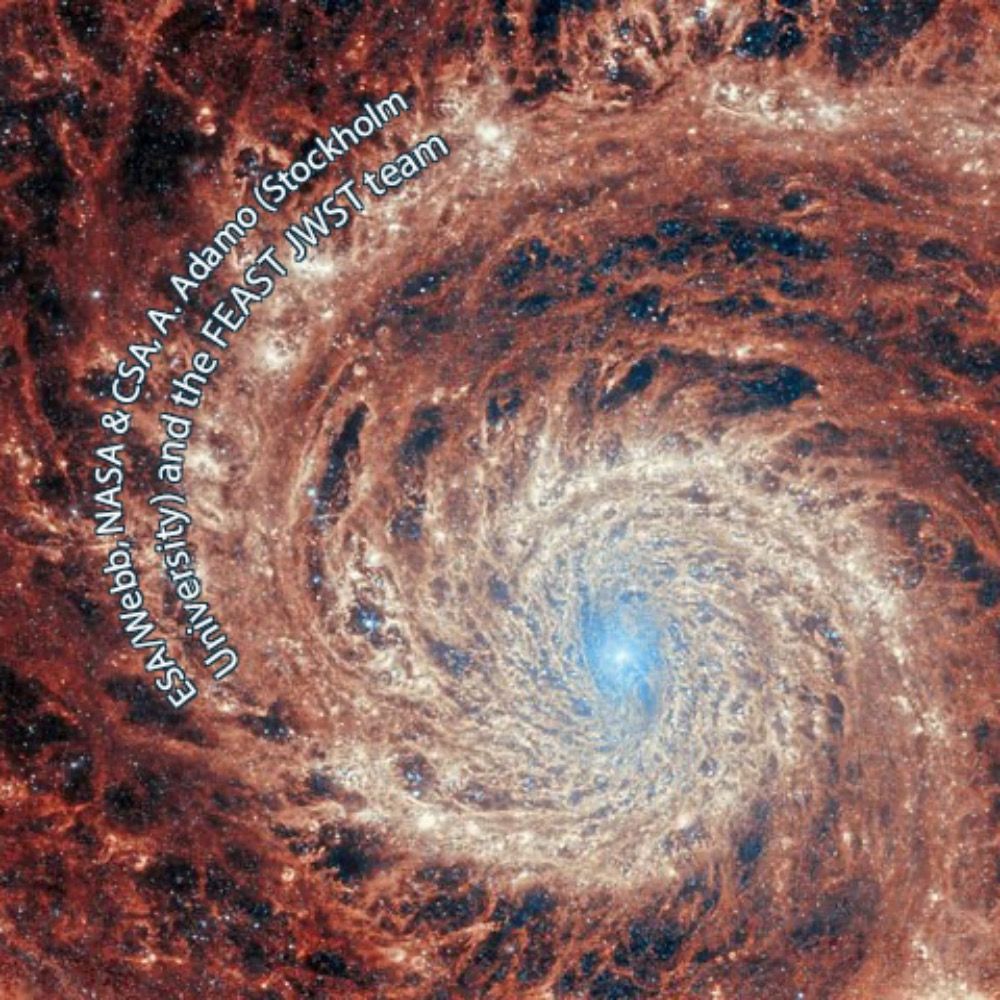
A barred spiral galaxy, possibly merging, observed with the Apache Point 2.5m Telescope in the SDSS survey.
It is at redshift 0.008 (lookback time 114.4 million years) with coordinates (165.49580, 45.22805).
42 volunteers classified this galaxy in Galaxy Zoo 2.
It is at redshift 0.008 (lookback time 114.4 million years) with coordinates (165.49580, 45.22805).
42 volunteers classified this galaxy in Galaxy Zoo 2.

October 7, 2025 at 1:20 AM
A barred spiral galaxy, possibly merging, observed with the Apache Point 2.5m Telescope in the SDSS survey.
It is at redshift 0.008 (lookback time 114.4 million years) with coordinates (165.49580, 45.22805).
42 volunteers classified this galaxy in Galaxy Zoo 2.
It is at redshift 0.008 (lookback time 114.4 million years) with coordinates (165.49580, 45.22805).
42 volunteers classified this galaxy in Galaxy Zoo 2.
Reposted by Erik Oystein.


October 5, 2025 at 1:36 PM
Reposted by Erik Oystein.
Spiral, elliptical or neither? 🍩
Today’s NASA/ESA Hubble Space Telescope image features the galaxy NGC 2775.
NGC 2775 sports a smooth, featureless centre that is devoid of gas, resembling an elliptical galaxy. It also has a dusty ring with patchy star clusters, like a spiral galaxy.
Today’s NASA/ESA Hubble Space Telescope image features the galaxy NGC 2775.
NGC 2775 sports a smooth, featureless centre that is devoid of gas, resembling an elliptical galaxy. It also has a dusty ring with patchy star clusters, like a spiral galaxy.

September 22, 2025 at 9:05 AM
Spiral, elliptical or neither? 🍩
Today’s NASA/ESA Hubble Space Telescope image features the galaxy NGC 2775.
NGC 2775 sports a smooth, featureless centre that is devoid of gas, resembling an elliptical galaxy. It also has a dusty ring with patchy star clusters, like a spiral galaxy.
Today’s NASA/ESA Hubble Space Telescope image features the galaxy NGC 2775.
NGC 2775 sports a smooth, featureless centre that is devoid of gas, resembling an elliptical galaxy. It also has a dusty ring with patchy star clusters, like a spiral galaxy.
Reposted by Erik Oystein.
Spot the tiny scientific “puzzle pieces” in the Flame Nebula! In 2023, scientists used #NASAWebb’s infrared instruments to find several low-mass objects to better understand the lowest mass limit of brown dwarfs or “failed stars.” Credit: NASA, ESA, CSA, STScI. 🔭 🧪

September 15, 2025 at 2:22 PM
Spot the tiny scientific “puzzle pieces” in the Flame Nebula! In 2023, scientists used #NASAWebb’s infrared instruments to find several low-mass objects to better understand the lowest mass limit of brown dwarfs or “failed stars.” Credit: NASA, ESA, CSA, STScI. 🔭 🧪
Reposted by Erik Oystein.
We’re seeing double: two interacting galaxies imaged by #Hubble and #NASAWebb. Hubble shows obscuring brown dust and blue star-filled regions, while Webb shows glowing cold dust as white material and pink stars still embedded in dust: https://bit.ly/3F72M4a 🔭 🧪
September 12, 2025 at 3:01 PM
We’re seeing double: two interacting galaxies imaged by #Hubble and #NASAWebb. Hubble shows obscuring brown dust and blue star-filled regions, while Webb shows glowing cold dust as white material and pink stars still embedded in dust: https://bit.ly/3F72M4a 🔭 🧪
Reposted by Erik Oystein.
Newly captured by #NASAWebb: a cosmic lightsaber! The gigantic, rare, eight-light-year-long jet erupting from a baby star 15,000 light-years away is reshaping our understanding of how massive stars form: https://bit.ly/4p6GbXF 🔭 🧪

September 10, 2025 at 2:04 PM
Newly captured by #NASAWebb: a cosmic lightsaber! The gigantic, rare, eight-light-year-long jet erupting from a baby star 15,000 light-years away is reshaping our understanding of how massive stars form: https://bit.ly/4p6GbXF 🔭 🧪
Reposted by Erik Oystein.
A stellar jet on the edge of our milky way 💥
These seething twin jets of hot gasses, captured by NASA/ESA/CSA James #Webb Space Telescope, are blazing across 8 light-years – twice the distance between our Sun and the nearest star system, Alpha Centauri.
These seething twin jets of hot gasses, captured by NASA/ESA/CSA James #Webb Space Telescope, are blazing across 8 light-years – twice the distance between our Sun and the nearest star system, Alpha Centauri.

September 10, 2025 at 2:02 PM
A stellar jet on the edge of our milky way 💥
These seething twin jets of hot gasses, captured by NASA/ESA/CSA James #Webb Space Telescope, are blazing across 8 light-years – twice the distance between our Sun and the nearest star system, Alpha Centauri.
These seething twin jets of hot gasses, captured by NASA/ESA/CSA James #Webb Space Telescope, are blazing across 8 light-years – twice the distance between our Sun and the nearest star system, Alpha Centauri.
Reposted by Erik Oystein.
Observatories, assemble! Hubble and #NASAWebb combined forces, producing this amazing view of star clusters NGC 460 and NGC 456. Hubble captures glowing, ionized gas in blue, while Webb highlights clumps and delicate filamentary dust in red. Credit: NASA, ESA. 🔭 🧪

August 28, 2025 at 2:08 PM
Observatories, assemble! Hubble and #NASAWebb combined forces, producing this amazing view of star clusters NGC 460 and NGC 456. Hubble captures glowing, ionized gas in blue, while Webb highlights clumps and delicate filamentary dust in red. Credit: NASA, ESA. 🔭 🧪
Reposted by Erik Oystein.
This spiral galaxy, IC 4709, hosts an active supermassive black hole that is gathering matter at its core, also known as an active galactic nucleus. This process causes the core to glow in many different wavelengths of light.
Credit: ESA, NASA, M. Koss, A. Barth. 🔭 🧪
Credit: ESA, NASA, M. Koss, A. Barth. 🔭 🧪

September 3, 2025 at 4:14 PM
This spiral galaxy, IC 4709, hosts an active supermassive black hole that is gathering matter at its core, also known as an active galactic nucleus. This process causes the core to glow in many different wavelengths of light.
Credit: ESA, NASA, M. Koss, A. Barth. 🔭 🧪
Credit: ESA, NASA, M. Koss, A. Barth. 🔭 🧪
Reposted by Erik Oystein.
This may be my favorite JWST image so far 🤩
🔭🧪
🔭🧪
What appears to be a craggy, starlit mountaintop kissed by wispy clouds is actually a cosmic dust-scape being eaten away by the blistering winds and ultraviolet light of nearby, massive, infant stars. What else did #NASAWebb find in Pismis 24? https://bit.ly/4mr3cmt

September 4, 2025 at 2:21 PM
This may be my favorite JWST image so far 🤩
🔭🧪
🔭🧪
Reposted by Erik Oystein.
The Taffy Galaxies, UGC 12914 and UGC 12915. They experienced a head on collision 25 million years ago which created a bridge of turbulent gas spanning the gap between them.
(International Gemini Observatory/NOIRLab/NSF/AURA)
#space #galaxies #cosmos #stars #astrophysics
(International Gemini Observatory/NOIRLab/NSF/AURA)
#space #galaxies #cosmos #stars #astrophysics

August 30, 2025 at 8:35 AM
The Taffy Galaxies, UGC 12914 and UGC 12915. They experienced a head on collision 25 million years ago which created a bridge of turbulent gas spanning the gap between them.
(International Gemini Observatory/NOIRLab/NSF/AURA)
#space #galaxies #cosmos #stars #astrophysics
(International Gemini Observatory/NOIRLab/NSF/AURA)
#space #galaxies #cosmos #stars #astrophysics
Reposted by Erik Oystein.
What appears to be a craggy, starlit mountaintop kissed by wispy clouds is actually a cosmic dust-scape being eaten away by the blistering winds and ultraviolet light of nearby, massive, infant stars. What else did #NASAWebb find in Pismis 24? https://bit.ly/4mr3cmt
September 4, 2025 at 2:12 PM
What appears to be a craggy, starlit mountaintop kissed by wispy clouds is actually a cosmic dust-scape being eaten away by the blistering winds and ultraviolet light of nearby, massive, infant stars. What else did #NASAWebb find in Pismis 24? https://bit.ly/4mr3cmt
Reposted by Erik Oystein.
Two takes on the Eagle Nebula by Hubble and #NASAWebb. Hubble shows dark brown pillars of gas and dust in visible light, while Webb’s infrared view is able to see through the dust to reveal many still-forming stars: https://bit.ly/43ra9N0 🔭 🧪
September 5, 2025 at 2:50 PM
Two takes on the Eagle Nebula by Hubble and #NASAWebb. Hubble shows dark brown pillars of gas and dust in visible light, while Webb’s infrared view is able to see through the dust to reveal many still-forming stars: https://bit.ly/43ra9N0 🔭 🧪
Reposted by Erik Oystein.
This scientific visualization takes viewers on a journey to a glittering young star cluster called Pismis 24. #NASAWebb captured this fantastical scene in the heart of the Lobster Nebula, approximately 5,500 light-years from Earth. 🔭 🧪

Expedition to Star Cluster Pismis 24
This scientific visualization takes viewers on a journey to a glittering young star cluster called Pismis 24. NASA's James Webb Space Telescope captured this fantastical scene in the heart of the Lobster Nebula, approximately 5,500 light-years from Eart...
youtube.com
September 5, 2025 at 6:58 PM
This scientific visualization takes viewers on a journey to a glittering young star cluster called Pismis 24. #NASAWebb captured this fantastical scene in the heart of the Lobster Nebula, approximately 5,500 light-years from Earth. 🔭 🧪
Reposted by Erik Oystein.


September 5, 2025 at 3:56 PM