



Fatima Najeeb
@fnajeeb.bsky.social
fatimanajeeb.com
PhD Candidate at University of Maryland, College Park | On the 2024-25 job market | Applied micro, development, family, and environmental economics | Previously @WorldBank @Yale @LUMS #EconSky #EnvEcon #DevEcon
PhD Candidate at University of Maryland, College Park | On the 2024-25 job market | Applied micro, development, family, and environmental economics | Previously @WorldBank @Yale @LUMS #EconSky #EnvEcon #DevEcon
Floods hit some parts of the world harder than others. 🌍
My #EconJMP uncovers how floods change resource sharing within households in one of the most flood-prone countries in the world. 🌊📊
Read my blog on EconThatMatters: www.econthatmatters.com/2024/12/the-...
Or dive into the 🧵👇:
#EconSky
My #EconJMP uncovers how floods change resource sharing within households in one of the most flood-prone countries in the world. 🌊📊
Read my blog on EconThatMatters: www.econthatmatters.com/2024/12/the-...
Or dive into the 🧵👇:
#EconSky

December 4, 2024 at 1:20 PM
Floods hit some parts of the world harder than others. 🌍
My #EconJMP uncovers how floods change resource sharing within households in one of the most flood-prone countries in the world. 🌊📊
Read my blog on EconThatMatters: www.econthatmatters.com/2024/12/the-...
Or dive into the 🧵👇:
#EconSky
My #EconJMP uncovers how floods change resource sharing within households in one of the most flood-prone countries in the world. 🌊📊
Read my blog on EconThatMatters: www.econthatmatters.com/2024/12/the-...
Or dive into the 🧵👇:
#EconSky
10/
The link between women’s declining earnings and resource shares is clear: As women’s relative earnings fall, so does their share of household resources. Addressing this is critical for reducing vulnerabilities.
The link between women’s declining earnings and resource shares is clear: As women’s relative earnings fall, so does their share of household resources. Addressing this is critical for reducing vulnerabilities.

November 27, 2024 at 11:20 AM
10/
The link between women’s declining earnings and resource shares is clear: As women’s relative earnings fall, so does their share of household resources. Addressing this is critical for reducing vulnerabilities.
The link between women’s declining earnings and resource shares is clear: As women’s relative earnings fall, so does their share of household resources. Addressing this is critical for reducing vulnerabilities.
8/
The material impact? After 4 years, women in flooded households have an individual-level budget of $4.7/day, compared to $7.9/day for men.
For context, the extreme poverty line is $2.15/day. These shifts push women closer to this poverty threshold while men move further from it.
The material impact? After 4 years, women in flooded households have an individual-level budget of $4.7/day, compared to $7.9/day for men.
For context, the extreme poverty line is $2.15/day. These shifts push women closer to this poverty threshold while men move further from it.

November 27, 2024 at 11:20 AM
8/
The material impact? After 4 years, women in flooded households have an individual-level budget of $4.7/day, compared to $7.9/day for men.
For context, the extreme poverty line is $2.15/day. These shifts push women closer to this poverty threshold while men move further from it.
The material impact? After 4 years, women in flooded households have an individual-level budget of $4.7/day, compared to $7.9/day for men.
For context, the extreme poverty line is $2.15/day. These shifts push women closer to this poverty threshold while men move further from it.
7/
Intrahousehold gender inequalities increase with the number of floods experienced.
Intrahousehold gender inequalities increase with the number of floods experienced.

November 27, 2024 at 11:20 AM
7/
Intrahousehold gender inequalities increase with the number of floods experienced.
Intrahousehold gender inequalities increase with the number of floods experienced.
6/
Floods trigger a redistribution of household resources:
🌊Women lose ~9 pp of their resource share (compared to women in unaffected households), while men gain ~11 pp within 6 months.
🌊These shifts persist: ~7 pp lower for women & ~12 pp higher for men even 4 years later.
Floods trigger a redistribution of household resources:
🌊Women lose ~9 pp of their resource share (compared to women in unaffected households), while men gain ~11 pp within 6 months.
🌊These shifts persist: ~7 pp lower for women & ~12 pp higher for men even 4 years later.

November 27, 2024 at 11:20 AM
6/
Floods trigger a redistribution of household resources:
🌊Women lose ~9 pp of their resource share (compared to women in unaffected households), while men gain ~11 pp within 6 months.
🌊These shifts persist: ~7 pp lower for women & ~12 pp higher for men even 4 years later.
Floods trigger a redistribution of household resources:
🌊Women lose ~9 pp of their resource share (compared to women in unaffected households), while men gain ~11 pp within 6 months.
🌊These shifts persist: ~7 pp lower for women & ~12 pp higher for men even 4 years later.
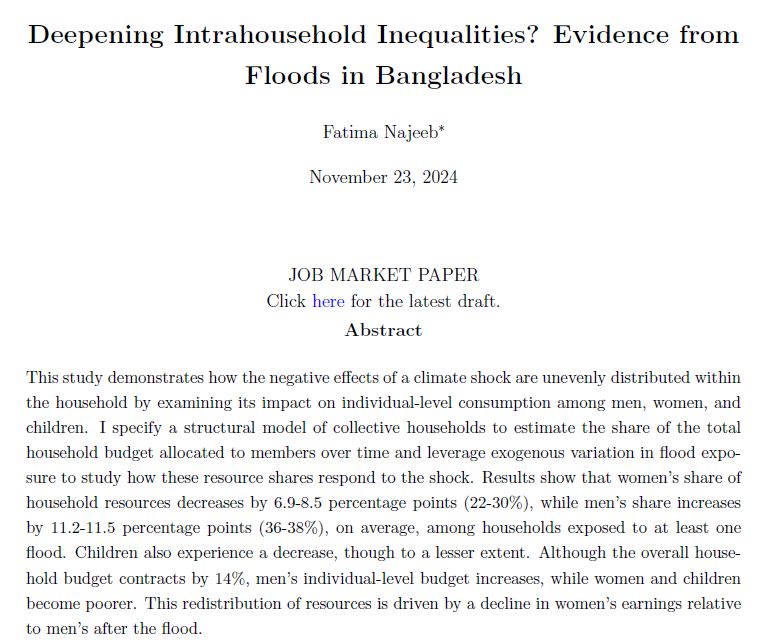
1/ How do climate shocks reshape lives inside households? 🏠🌍
My #EconJMP explores how climate shocks can change the way household members share resources, deepening intrahousehold inequalities. This has important implications for climate resilience and policy design. #EconSky
My #EconJMP explores how climate shocks can change the way household members share resources, deepening intrahousehold inequalities. This has important implications for climate resilience and policy design. #EconSky
November 27, 2024 at 11:20 AM