



Isaac Fradkin
@fradkinisaac.bsky.social
Assistant Professor at HUJI. Studying computational psychopathology, thought dynamics, disorders of thought and communication, semantic cognition and alignment, free association
https://sites.google.com/view/thought-dynamics-lab/
https://sites.google.com/view/thought-dynamics-lab/
(8/8) We hope this work helps bridge NLP in psychiatry and theory-driven computational modeling by highlighting the potential use of simulations to enhance understanding.
A huge thanks to @schizbulletin.bsky.social, the editor, and the insightful reviewers for their pivotal input.
A huge thanks to @schizbulletin.bsky.social, the editor, and the insightful reviewers for their pivotal input.
November 30, 2025 at 12:28 PM
(8/8) We hope this work helps bridge NLP in psychiatry and theory-driven computational modeling by highlighting the potential use of simulations to enhance understanding.
A huge thanks to @schizbulletin.bsky.social, the editor, and the insightful reviewers for their pivotal input.
A huge thanks to @schizbulletin.bsky.social, the editor, and the insightful reviewers for their pivotal input.
(7/8) These new 'semantic density metrics' were also better at detecting repetitiveness in a reanalysis of a previous dataset, particularly for psychopathological dimensions corresponding with depressive and internalizing symptoms more generally. An interesting finding for future work!

November 30, 2025 at 12:28 PM
(7/8) These new 'semantic density metrics' were also better at detecting repetitiveness in a reanalysis of a previous dataset, particularly for psychopathological dimensions corresponding with depressive and internalizing symptoms more generally. An interesting finding for future work!
(6/8)
Findings: Cosine distance metrics were suboptimal in detecting simulated perseveration. They were outperformed by new semantic density metrics using dimensionality reduction to examine (roughly speaking) if a smaller number of sentences could have conveyed the same message.
Findings: Cosine distance metrics were suboptimal in detecting simulated perseveration. They were outperformed by new semantic density metrics using dimensionality reduction to examine (roughly speaking) if a smaller number of sentences could have conveyed the same message.

November 30, 2025 at 12:28 PM
(6/8)
Findings: Cosine distance metrics were suboptimal in detecting simulated perseveration. They were outperformed by new semantic density metrics using dimensionality reduction to examine (roughly speaking) if a smaller number of sentences could have conveyed the same message.
Findings: Cosine distance metrics were suboptimal in detecting simulated perseveration. They were outperformed by new semantic density metrics using dimensionality reduction to examine (roughly speaking) if a smaller number of sentences could have conveyed the same message.
(5/8)
To tackle this, we used generative language modeling to simulate texts characterized by derailment, repetitiveness, or both, and tested whether different NLP metrics could accurately capture these manipulations.
To tackle this, we used generative language modeling to simulate texts characterized by derailment, repetitiveness, or both, and tested whether different NLP metrics could accurately capture these manipulations.

November 30, 2025 at 12:28 PM
(5/8)
To tackle this, we used generative language modeling to simulate texts characterized by derailment, repetitiveness, or both, and tested whether different NLP metrics could accurately capture these manipulations.
To tackle this, we used generative language modeling to simulate texts characterized by derailment, repetitiveness, or both, and tested whether different NLP metrics could accurately capture these manipulations.
(4/8)
This leads to the key questions: Should we predict larger or smaller cosine distances in psychosis? What happens when derailment and repetitiveness in language co-occur?
This leads to the key questions: Should we predict larger or smaller cosine distances in psychosis? What happens when derailment and repetitiveness in language co-occur?
November 30, 2025 at 12:28 PM
(4/8)
This leads to the key questions: Should we predict larger or smaller cosine distances in psychosis? What happens when derailment and repetitiveness in language co-occur?
This leads to the key questions: Should we predict larger or smaller cosine distances in psychosis? What happens when derailment and repetitiveness in language co-occur?
(3/8)
But here’s a conundrum: Early findings correlated psychosis with greater cosine distances between utterances, yet recent studies found the opposite. Reduced distances may reflect repetitive language, common in psychosis, but also in other conditions, like depression🤷♂️
But here’s a conundrum: Early findings correlated psychosis with greater cosine distances between utterances, yet recent studies found the opposite. Reduced distances may reflect repetitive language, common in psychosis, but also in other conditions, like depression🤷♂️
November 30, 2025 at 12:28 PM
(3/8)
But here’s a conundrum: Early findings correlated psychosis with greater cosine distances between utterances, yet recent studies found the opposite. Reduced distances may reflect repetitive language, common in psychosis, but also in other conditions, like depression🤷♂️
But here’s a conundrum: Early findings correlated psychosis with greater cosine distances between utterances, yet recent studies found the opposite. Reduced distances may reflect repetitive language, common in psychosis, but also in other conditions, like depression🤷♂️
(2/8)
With the rise of Language Models, NLP in psychiatry is rapidly growing. Cosine distance metrics, for instance, are widely used to capture derailment and other forms of incoherence in conditions like psychosis.
With the rise of Language Models, NLP in psychiatry is rapidly growing. Cosine distance metrics, for instance, are widely used to capture derailment and other forms of incoherence in conditions like psychosis.
November 30, 2025 at 12:28 PM
(2/8)
With the rise of Language Models, NLP in psychiatry is rapidly growing. Cosine distance metrics, for instance, are widely used to capture derailment and other forms of incoherence in conditions like psychosis.
With the rise of Language Models, NLP in psychiatry is rapidly growing. Cosine distance metrics, for instance, are widely used to capture derailment and other forms of incoherence in conditions like psychosis.
If you find this work interesting, and would like to know more about how we use modeling and NLP to uncover semantic processes and mentalization in interacting individuals, please get in touch or see our lab website sites.google.com/view/thought...

Thought Dynamics Lab
We study thought, communication, and psychopathology
sites.google.com
November 25, 2024 at 6:36 PM
If you find this work interesting, and would like to know more about how we use modeling and NLP to uncover semantic processes and mentalization in interacting individuals, please get in touch or see our lab website sites.google.com/view/thought...
I want to thank my amazing collaborators, Ray Dolan, Rani Moran, @drrickadams.bsky.social, and Noam Siegelman, Max Planck Centre for Computational Psychiatry, Editor and reviewers at Nature Mental Health, as well as the EU Horizon 2020 MSCA-IF program for supporting this work.
November 25, 2024 at 6:36 PM
I want to thank my amazing collaborators, Ray Dolan, Rani Moran, @drrickadams.bsky.social, and Noam Siegelman, Max Planck Centre for Computational Psychiatry, Editor and reviewers at Nature Mental Health, as well as the EU Horizon 2020 MSCA-IF program for supporting this work.
Our findings also extend previous work using NLP to characterize language incoherence in psychosis in a large, general population sample, thereby allowing for rigorous testing of the psychometric properties of different NLP measures.
November 25, 2024 at 6:36 PM
Our findings also extend previous work using NLP to characterize language incoherence in psychosis in a large, general population sample, thereby allowing for rigorous testing of the psychometric properties of different NLP measures.
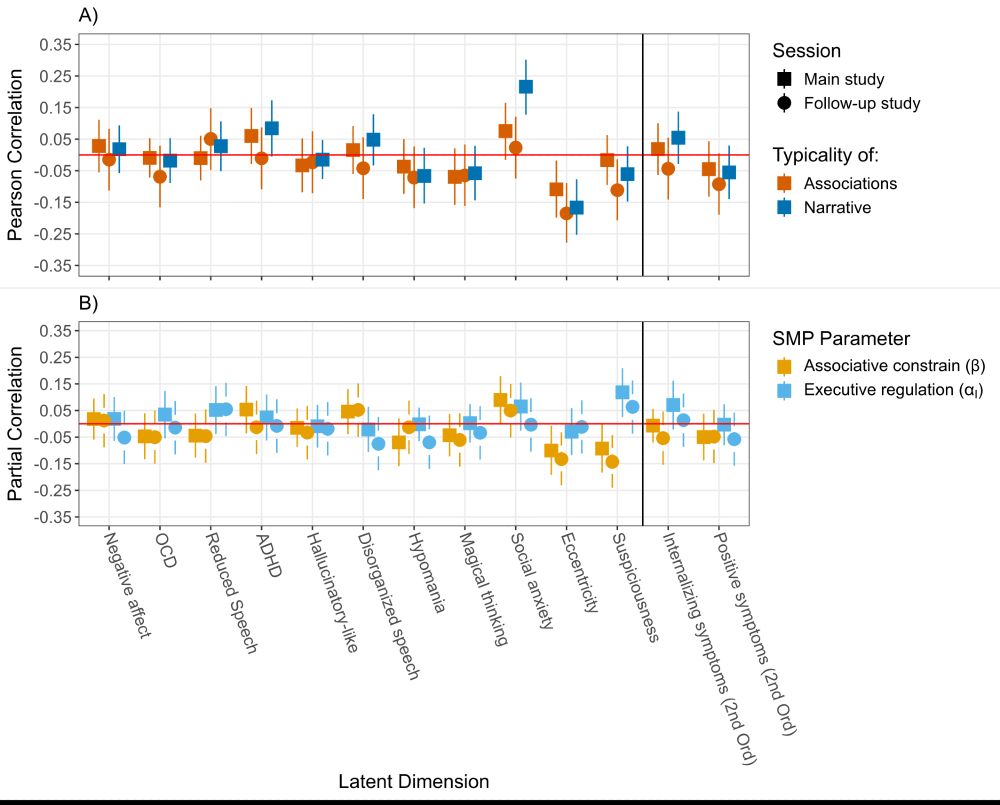
Our finding that alterations in speech and thought are relatively specific is striking given the ubiquity of transdiagnostic findings in psychopathology. Notably, the relevant dimensions were distinctly interpersonal, reflecting the inherently social nature of language.
November 25, 2024 at 6:36 PM
Our finding that alterations in speech and thought are relatively specific is striking given the ubiquity of transdiagnostic findings in psychopathology. Notably, the relevant dimensions were distinctly interpersonal, reflecting the inherently social nature of language.
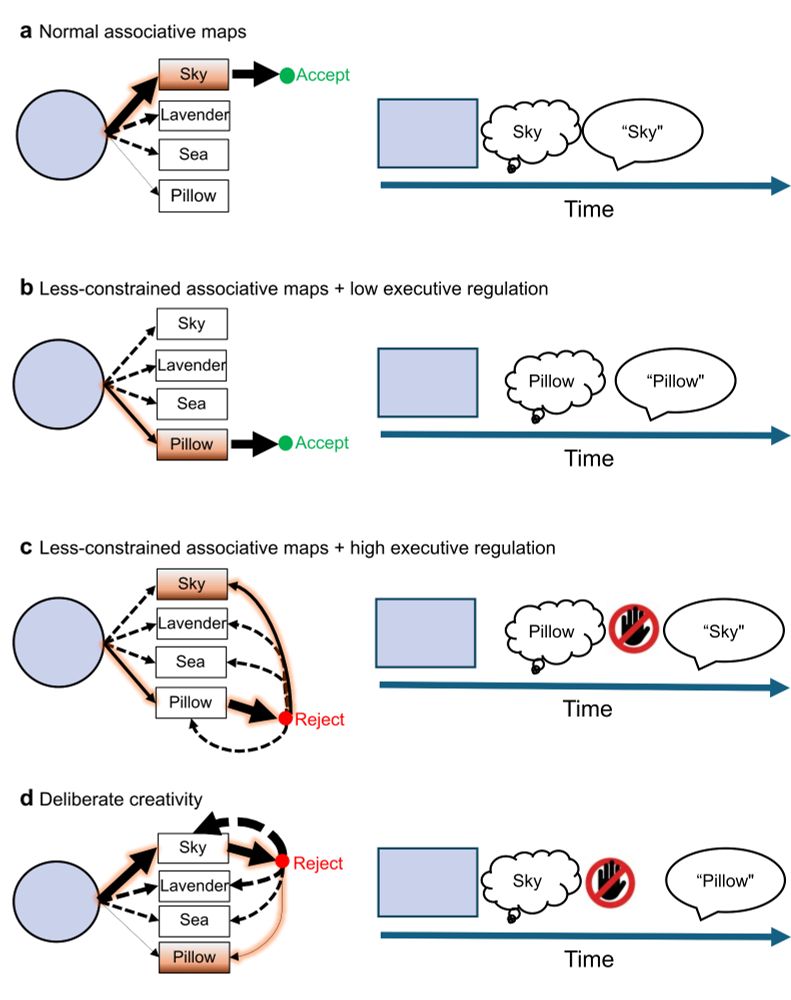
Whereas Formal Thought Disorder, prevalent in psychosis, is usually diagnosed based on speech incoherence, computational modeling of associative output allowed us to uncover disorganized semantic retrieval as a core mechanism, evident even when language output is intact.
November 25, 2024 at 6:36 PM
Whereas Formal Thought Disorder, prevalent in psychosis, is usually diagnosed based on speech incoherence, computational modeling of associative output allowed us to uncover disorganized semantic retrieval as a core mechanism, evident even when language output is intact.
Our findings suggest a core mechanism underlying language incoherence in psychosis is more widespread than commonly assumed, while also showing notable specificity to particular dimensions of psychopathology.
November 25, 2024 at 6:36 PM
Our findings suggest a core mechanism underlying language incoherence in psychosis is more widespread than commonly assumed, while also showing notable specificity to particular dimensions of psychopathology.
We aimed to map alterations in thought and discourse across dimensions of psychopathology and detail their underlying mechanisms. We combine a transdiagnostic approach, inspired by @clairegillan.bsky.social, @tobywise.bsky.social, and others, with NLP and comp. modeling of associative thinking.
November 25, 2024 at 6:36 PM
We aimed to map alterations in thought and discourse across dimensions of psychopathology and detail their underlying mechanisms. We combine a transdiagnostic approach, inspired by @clairegillan.bsky.social, @tobywise.bsky.social, and others, with NLP and comp. modeling of associative thinking.