




Grammar Tree
@grammartree.bsky.social
🌟Help you grasp complex sentences effortlessly by turning them into vibrant, interactive trees 🌳 with grammartree.io✨


Test your understanding! Reply with a sentence using both "Preposition + which" and "where." ⬇️

January 5, 2025 at 12:41 PM
Test your understanding! Reply with a sentence using both "Preposition + which" and "where." ⬇️


💡 How to Choose:
For specific moments, use "when."
For durations or overlapping actions, use "while."
Test your understanding! Share a sentence with "when" and another with "while" below. Let’s practice! ⬇️
For specific moments, use "when."
For durations or overlapping actions, use "while."
Test your understanding! Share a sentence with "when" and another with "while" below. Let’s practice! ⬇️
January 1, 2025 at 11:50 AM
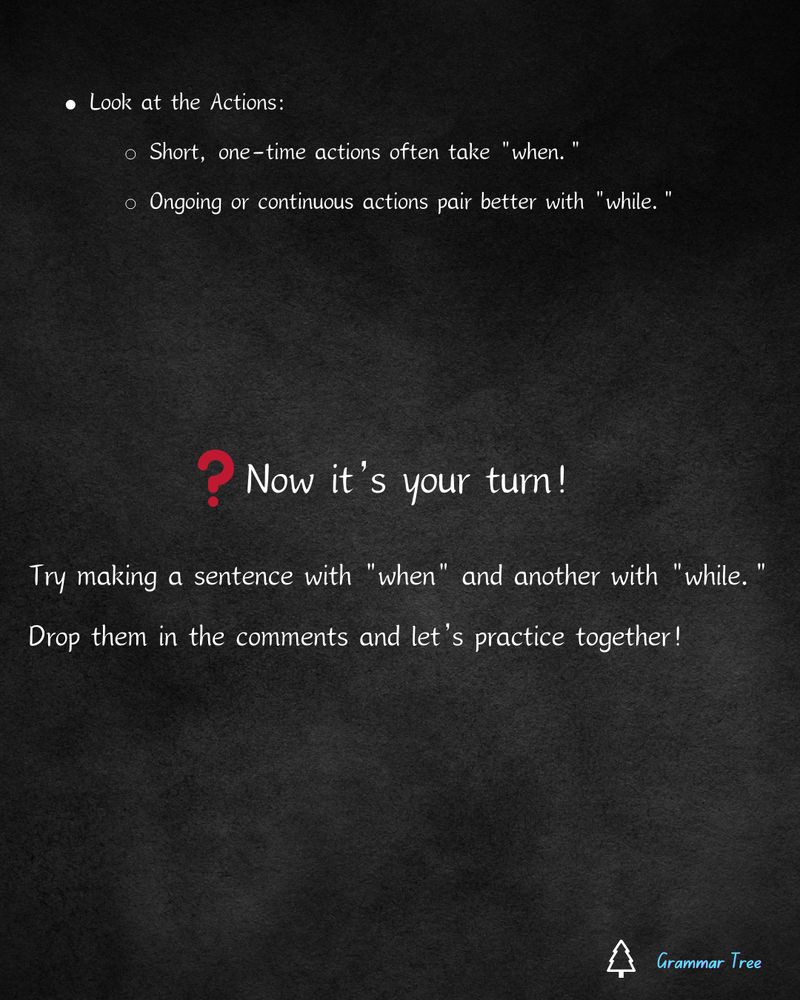
💡 How to Choose:
For specific moments, use "when."
For durations or overlapping actions, use "while."
Test your understanding! Share a sentence with "when" and another with "while" below. Let’s practice! ⬇️
For specific moments, use "when."
For durations or overlapping actions, use "while."
Test your understanding! Share a sentence with "when" and another with "while" below. Let’s practice! ⬇️
2️⃣ "While" for overlapping actions:
"While" is used for two actions happening simultaneously. It emphasizes overlapping or ongoing events.
✔️ Example: I listened to music while working on my project.
💡 Quick Tip: Use "while" for actions that happen at the same time.
"While" is used for two actions happening simultaneously. It emphasizes overlapping or ongoing events.
✔️ Example: I listened to music while working on my project.
💡 Quick Tip: Use "while" for actions that happen at the same time.

January 1, 2025 at 11:50 AM
2️⃣ "While" for overlapping actions:
"While" is used for two actions happening simultaneously. It emphasizes overlapping or ongoing events.
✔️ Example: I listened to music while working on my project.
💡 Quick Tip: Use "while" for actions that happen at the same time.
"While" is used for two actions happening simultaneously. It emphasizes overlapping or ongoing events.
✔️ Example: I listened to music while working on my project.
💡 Quick Tip: Use "while" for actions that happen at the same time.
1️⃣ "When" for specific points in time:
"Use when" to talk about a specific moment or trigger event.
✔️ Example: I was cooking dinner when the phone rang.
✔️ Example: Let me know when you arrive.
💡 Quick Tip: If you’re emphasizing a time point or a trigger, go with "when."
"Use when" to talk about a specific moment or trigger event.
✔️ Example: I was cooking dinner when the phone rang.
✔️ Example: Let me know when you arrive.
💡 Quick Tip: If you’re emphasizing a time point or a trigger, go with "when."

January 1, 2025 at 11:50 AM
1️⃣ "When" for specific points in time:
"Use when" to talk about a specific moment or trigger event.
✔️ Example: I was cooking dinner when the phone rang.
✔️ Example: Let me know when you arrive.
💡 Quick Tip: If you’re emphasizing a time point or a trigger, go with "when."
"Use when" to talk about a specific moment or trigger event.
✔️ Example: I was cooking dinner when the phone rang.
✔️ Example: Let me know when you arrive.
💡 Quick Tip: If you’re emphasizing a time point or a trigger, go with "when."

💡 Pro Tip:
When in doubt, test whether "to" can be removed or replaced. This helps clarify its role in the sentence!
Drop your examples of "to do" and "to doing" in the replies. Let’s practice together! ⬇️
When in doubt, test whether "to" can be removed or replaced. This helps clarify its role in the sentence!
Drop your examples of "to do" and "to doing" in the replies. Let’s practice together! ⬇️

December 25, 2024 at 1:49 PM
💡 Pro Tip:
When in doubt, test whether "to" can be removed or replaced. This helps clarify its role in the sentence!
Drop your examples of "to do" and "to doing" in the replies. Let’s practice together! ⬇️
When in doubt, test whether "to" can be removed or replaced. This helps clarify its role in the sentence!
Drop your examples of "to do" and "to doing" in the replies. Let’s practice together! ⬇️
2️⃣ To + Verb-ing (Gerund):
If "to" works as a preposition, it’s followed by a gerund (-ing).
✔️ Test: Replace the gerund with a noun.
I’m looking forward to meeting you. → I’m looking forward to the meeting. ✅
Since it works, "to" is a preposition here.
If "to" works as a preposition, it’s followed by a gerund (-ing).
✔️ Test: Replace the gerund with a noun.
I’m looking forward to meeting you. → I’m looking forward to the meeting. ✅
Since it works, "to" is a preposition here.

December 25, 2024 at 1:49 PM
2️⃣ To + Verb-ing (Gerund):
If "to" works as a preposition, it’s followed by a gerund (-ing).
✔️ Test: Replace the gerund with a noun.
I’m looking forward to meeting you. → I’m looking forward to the meeting. ✅
Since it works, "to" is a preposition here.
If "to" works as a preposition, it’s followed by a gerund (-ing).
✔️ Test: Replace the gerund with a noun.
I’m looking forward to meeting you. → I’m looking forward to the meeting. ✅
Since it works, "to" is a preposition here.
1️⃣ To + Base Verb (Infinitive):
If "to" introduces a verb indicating purpose or future action, it’s part of an infinitive.
✔️ Test: Remove "to" and check the sentence.
I need to finish my work. → I need finish my work. ❌
"To" is necessary, so it’s part of the infinitive!
If "to" introduces a verb indicating purpose or future action, it’s part of an infinitive.
✔️ Test: Remove "to" and check the sentence.
I need to finish my work. → I need finish my work. ❌
"To" is necessary, so it’s part of the infinitive!

December 25, 2024 at 1:49 PM
1️⃣ To + Base Verb (Infinitive):
If "to" introduces a verb indicating purpose or future action, it’s part of an infinitive.
✔️ Test: Remove "to" and check the sentence.
I need to finish my work. → I need finish my work. ❌
"To" is necessary, so it’s part of the infinitive!
If "to" introduces a verb indicating purpose or future action, it’s part of an infinitive.
✔️ Test: Remove "to" and check the sentence.
I need to finish my work. → I need finish my work. ❌
"To" is necessary, so it’s part of the infinitive!


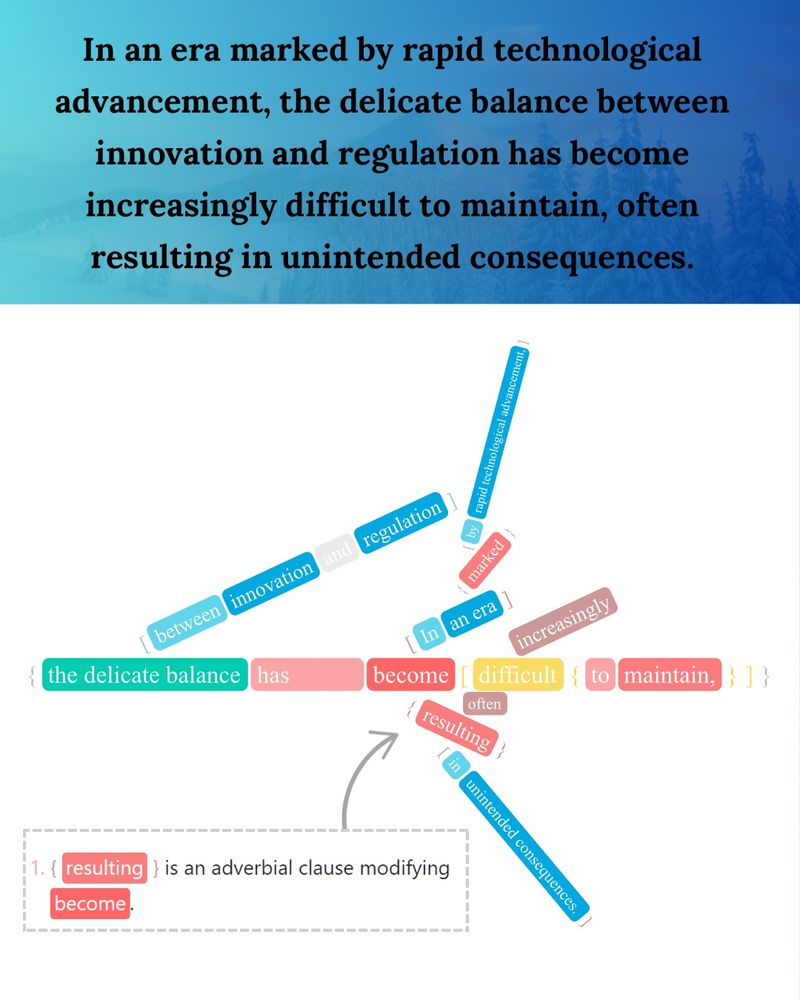


When your mind craves stability, lean in instead of stepping back, and turn uncertainty into momentum!


December 23, 2024 at 10:20 AM
When your mind craves stability, lean in instead of stepping back, and turn uncertainty into momentum!
Ever feel self-doubt spike just before a big win? That’s the “success threshold.” Learn to spot it, and check our grammar-tree breakdown for English tips.
#english #英語 #英语 #영어 #PersonalGrowth #grammar #englishgrammar #englishlearning #englishtips
#english #英語 #英语 #영어 #PersonalGrowth #grammar #englishgrammar #englishlearning #englishtips


December 23, 2024 at 10:20 AM
Ever feel self-doubt spike just before a big win? That’s the “success threshold.” Learn to spot it, and check our grammar-tree breakdown for English tips.
#english #英語 #英语 #영어 #PersonalGrowth #grammar #englishgrammar #englishlearning #englishtips
#english #英語 #英语 #영어 #PersonalGrowth #grammar #englishgrammar #englishlearning #englishtips
Sentence trees make grammar relationships crystal clear. They break down structures, helping you decode long, complex sentences easily!


December 22, 2024 at 11:33 AM
Sentence trees make grammar relationships crystal clear. They break down structures, helping you decode long, complex sentences easily!
Boost your English skills while enjoying stunning Norwegian views! 🌄 Bing’s images + concise English texts help improve reading & writing! 🌟 #english #grammar #englishgrammar #englishlearning #englishteacher #英語 #英语 #영어 #Inglés #Anglais


December 22, 2024 at 11:33 AM
Boost your English skills while enjoying stunning Norwegian views! 🌄 Bing’s images + concise English texts help improve reading & writing! 🌟 #english #grammar #englishgrammar #englishlearning #englishteacher #英語 #英语 #영어 #Inglés #Anglais

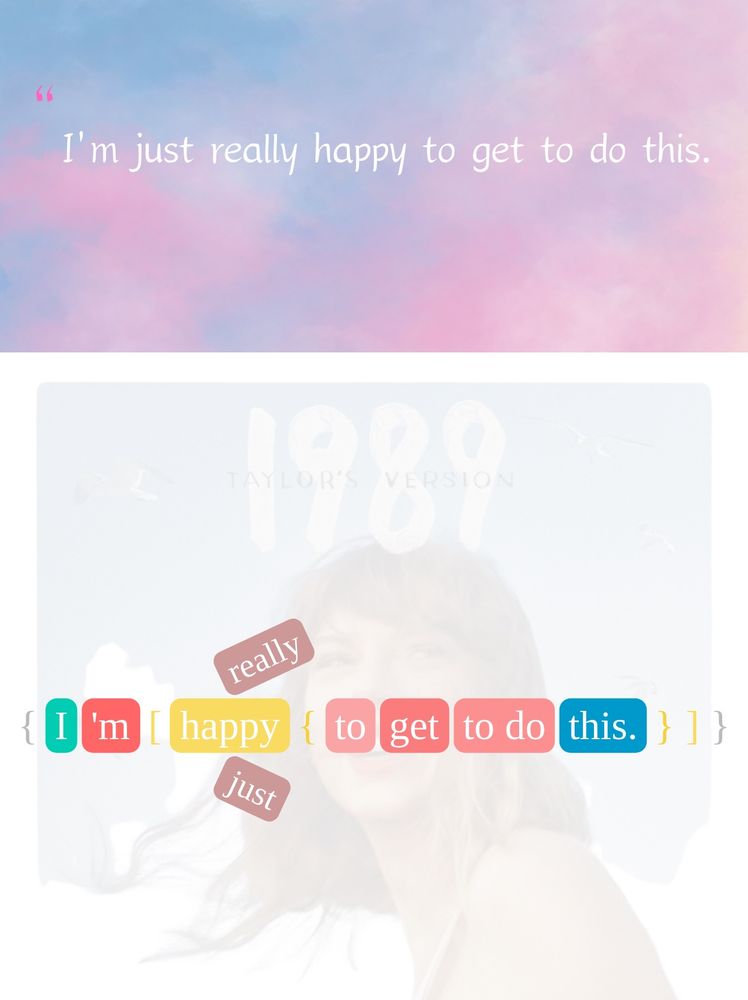

Taylor Swift turned her heartbreaks into songs that became global hits. Writing can turn your experiences into something extraordinary. #english #grammar #englishgrammar #englishlearning #englishteacher #sentencestructure #英語 #英语 #영어 #Inglés #Anglais


December 20, 2024 at 2:22 PM
Taylor Swift turned her heartbreaks into songs that became global hits. Writing can turn your experiences into something extraordinary. #english #grammar #englishgrammar #englishlearning #englishteacher #sentencestructure #英語 #英语 #영어 #Inglés #Anglais

The -ing form isn’t just about actions—it’s all about the process! Think: doing == do... 🎥
Fun fact: -ing isn’t always about the present; it can indicate past, present, future, or no specific time. 🕒 #english #grammar #englishgrammar #englishlearning #englishteacher #sentencestructure #英語 #英语 #영어
Fun fact: -ing isn’t always about the present; it can indicate past, present, future, or no specific time. 🕒 #english #grammar #englishgrammar #englishlearning #englishteacher #sentencestructure #英語 #英语 #영어


December 19, 2024 at 11:34 AM
The -ing form isn’t just about actions—it’s all about the process! Think: doing == do... 🎥
Fun fact: -ing isn’t always about the present; it can indicate past, present, future, or no specific time. 🕒 #english #grammar #englishgrammar #englishlearning #englishteacher #sentencestructure #英語 #英语 #영어
Fun fact: -ing isn’t always about the present; it can indicate past, present, future, or no specific time. 🕒 #english #grammar #englishgrammar #englishlearning #englishteacher #sentencestructure #英語 #英语 #영어

