




International Centre for Animal Rights and Ethics
@icareanimals.bsky.social
We educate, mentor, and unite animal rights advocates globally to turn research and advocacy into legal protections for animals. Join us for legal updates and more information about animal rights and ethics: https://www.icare-animals.org
🫎 The result is a thought-provoking proposal. However, his theory does not reject hunting. What do you think of this contradiction? 🧐
📖 Read the paper and join the conversation!: drive.google.com/file/d/1wPSF...
These debates are crucial for shaping a non-speciest, future-looking animal ethics.
📖 Read the paper and join the conversation!: drive.google.com/file/d/1wPSF...
These debates are crucial for shaping a non-speciest, future-looking animal ethics.


December 1, 2025 at 9:45 PM
🫎 The result is a thought-provoking proposal. However, his theory does not reject hunting. What do you think of this contradiction? 🧐
📖 Read the paper and join the conversation!: drive.google.com/file/d/1wPSF...
These debates are crucial for shaping a non-speciest, future-looking animal ethics.
📖 Read the paper and join the conversation!: drive.google.com/file/d/1wPSF...
These debates are crucial for shaping a non-speciest, future-looking animal ethics.
They have no rulers, no central authority, no presidents or kings.👑 Instead, he turns to Indigenous frameworks, especially ideas of shared jurisdictions and Grounded Authority, to build a more accurate and respectful account of wild animals’ political relations.


December 1, 2025 at 9:45 PM
They have no rulers, no central authority, no presidents or kings.👑 Instead, he turns to Indigenous frameworks, especially ideas of shared jurisdictions and Grounded Authority, to build a more accurate and respectful account of wild animals’ political relations.
Dennis Papadopoulos challenges the classic Zoopolis view by arguing that sovereignty, as traditionally understood, does not reflect how wild animals actually live.

December 1, 2025 at 9:45 PM
Dennis Papadopoulos challenges the classic Zoopolis view by arguing that sovereignty, as traditionally understood, does not reflect how wild animals actually live.
Understanding these systems helps us imagine new relationships with the animals we share our homes with, beyond profit-driven innovation.
Would you trust AI to diagnose your cat or dog? 🐶🐱
#AIandAnimals #AnimalRights #CompanionAnimals #AnimalWelfare #AnimalHealth #AIRegulation #DigitalHealthcare
Would you trust AI to diagnose your cat or dog? 🐶🐱
#AIandAnimals #AnimalRights #CompanionAnimals #AnimalWelfare #AnimalHealth #AIRegulation #DigitalHealthcare

November 27, 2025 at 3:30 PM
Understanding these systems helps us imagine new relationships with the animals we share our homes with, beyond profit-driven innovation.
Would you trust AI to diagnose your cat or dog? 🐶🐱
#AIandAnimals #AnimalRights #CompanionAnimals #AnimalWelfare #AnimalHealth #AIRegulation #DigitalHealthcare
Would you trust AI to diagnose your cat or dog? 🐶🐱
#AIandAnimals #AnimalRights #CompanionAnimals #AnimalWelfare #AnimalHealth #AIRegulation #DigitalHealthcare
This lack of regulation raises important ethical questions about safety, accuracy, and animal well-being.
'Artificial intelligence and companion animals: Perspectives on digital healthcare for dogs, cats, and pet ownership' (2025) provides an overview of how AI is used with companion animals.
'Artificial intelligence and companion animals: Perspectives on digital healthcare for dogs, cats, and pet ownership' (2025) provides an overview of how AI is used with companion animals.


November 27, 2025 at 3:30 PM
This lack of regulation raises important ethical questions about safety, accuracy, and animal well-being.
'Artificial intelligence and companion animals: Perspectives on digital healthcare for dogs, cats, and pet ownership' (2025) provides an overview of how AI is used with companion animals.
'Artificial intelligence and companion animals: Perspectives on digital healthcare for dogs, cats, and pet ownership' (2025) provides an overview of how AI is used with companion animals.
Most AI systems designed for cats and dogs are created for commercial purposes. From behaviour-analysis apps to diagnostic tools, these systems promise convenience but operate in a context where harming animals remains largely legal, with few exceptions.


November 27, 2025 at 3:30 PM
Most AI systems designed for cats and dogs are created for commercial purposes. From behaviour-analysis apps to diagnostic tools, these systems promise convenience but operate in a context where harming animals remains largely legal, with few exceptions.
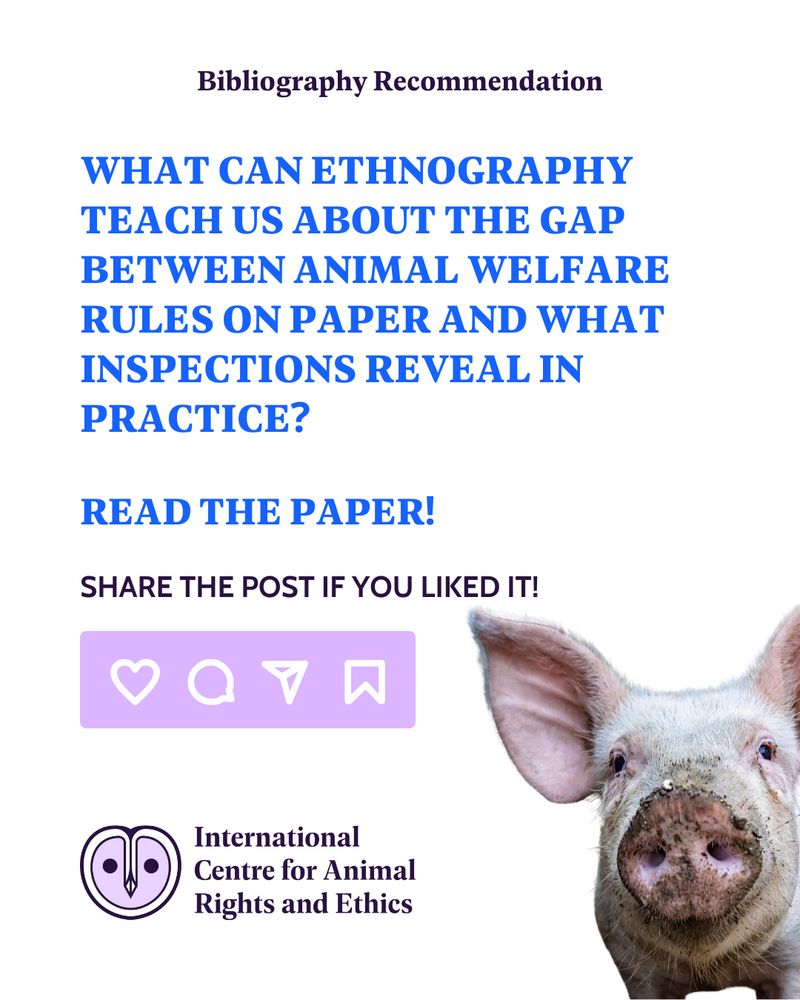
💬 What does ethnography reveal about the gap between welfare rules on paper and what inspections uncover in practice?
📄 Read the paper: drive.google.com/file/d/1-wXM...
📚 Explore more recommendations in ICARE’s Resource Library: icare-animals.org/resource-library
📄 Read the paper: drive.google.com/file/d/1-wXM...
📚 Explore more recommendations in ICARE’s Resource Library: icare-animals.org/resource-library
November 25, 2025 at 4:02 PM
💬 What does ethnography reveal about the gap between welfare rules on paper and what inspections uncover in practice?
📄 Read the paper: drive.google.com/file/d/1-wXM...
📚 Explore more recommendations in ICARE’s Resource Library: icare-animals.org/resource-library
📄 Read the paper: drive.google.com/file/d/1-wXM...
📚 Explore more recommendations in ICARE’s Resource Library: icare-animals.org/resource-library
💡 For anyone seeking to understand why welfare regulation so often breaks down in practice, and how inspectors themselves wrestle with these tensions, this paper is essential reading.

November 25, 2025 at 4:02 PM
💡 For anyone seeking to understand why welfare regulation so often breaks down in practice, and how inspectors themselves wrestle with these tensions, this paper is essential reading.
These field-level insights expose how, even with animal welfare legislation in place, current compliance systems routinely fail the very animals they are meant to protect. 🐖💔

November 25, 2025 at 4:02 PM
These field-level insights expose how, even with animal welfare legislation in place, current compliance systems routinely fail the very animals they are meant to protect. 🐖💔
Her account reveals inspectors navigating indeterminate rules, standards left unmet, systemic pressures to prioritise 'overall results' and the normalisation of animal suffering as merely part of the job.

November 25, 2025 at 4:01 PM
Her account reveals inspectors navigating indeterminate rules, standards left unmet, systemic pressures to prioritise 'overall results' and the normalisation of animal suffering as merely part of the job.
🔍 Drawing on on-site observation with inspectors in pig farms and slaughterhouses, McLoughlin reveals the contradictions at the heart of current welfare systems.

November 25, 2025 at 4:01 PM
🔍 Drawing on on-site observation with inspectors in pig farms and slaughterhouses, McLoughlin reveals the contradictions at the heart of current welfare systems.
💡 Which animal rights have both a 'do not harm' side and an 'actively protect' side, in your view?
#AnimalRights #AnimalLaw #AnimalRightsLaw #AnimalRightsTheory #AnimalEthics #AnimalJustice #AnimalPolitics #LegalTheory #PositiveRights #NegativeRights #AnimalProtection #JusticeForAnimals
#AnimalRights #AnimalLaw #AnimalRightsLaw #AnimalRightsTheory #AnimalEthics #AnimalJustice #AnimalPolitics #LegalTheory #PositiveRights #NegativeRights #AnimalProtection #JusticeForAnimals

November 24, 2025 at 5:15 PM
💡 Which animal rights have both a 'do not harm' side and an 'actively protect' side, in your view?
#AnimalRights #AnimalLaw #AnimalRightsLaw #AnimalRightsTheory #AnimalEthics #AnimalJustice #AnimalPolitics #LegalTheory #PositiveRights #NegativeRights #AnimalProtection #JusticeForAnimals
#AnimalRights #AnimalLaw #AnimalRightsLaw #AnimalRightsTheory #AnimalEthics #AnimalJustice #AnimalPolitics #LegalTheory #PositiveRights #NegativeRights #AnimalProtection #JusticeForAnimals
Many theorists argue that while negative rights apply very broadly to all sentient animals, the content of positive rights differs depending on an animal’s relationship to human societies: for example, whether they are domesticated, liminal, or wild. 🐶🐦🦁


November 24, 2025 at 5:15 PM
Many theorists argue that while negative rights apply very broadly to all sentient animals, the content of positive rights differs depending on an animal’s relationship to human societies: for example, whether they are domesticated, liminal, or wild. 🐶🐦🦁
🤝 The right to life shows a dual structure. Not killing is a negative duty. But safeguarding life, that is, providing care, preventing foreseeable risks, or rescuing an animal in danger, reflects the positive side of that same right.


November 24, 2025 at 5:15 PM
🤝 The right to life shows a dual structure. Not killing is a negative duty. But safeguarding life, that is, providing care, preventing foreseeable risks, or rescuing an animal in danger, reflects the positive side of that same right.
🛡️Negative rights protect them from harm: they require others not to kill, exploit, or interfere with their lives.
⚕️Positive rights require action: caring for animals who rely on us, assisting those in danger, protecting habitats, or including their interests in decisions affecting them.
⚕️Positive rights require action: caring for animals who rely on us, assisting those in danger, protecting habitats, or including their interests in decisions affecting them.

November 24, 2025 at 5:15 PM
🛡️Negative rights protect them from harm: they require others not to kill, exploit, or interfere with their lives.
⚕️Positive rights require action: caring for animals who rely on us, assisting those in danger, protecting habitats, or including their interests in decisions affecting them.
⚕️Positive rights require action: caring for animals who rely on us, assisting those in danger, protecting habitats, or including their interests in decisions affecting them.
💬 How did your own education shape the way you understand animals today? What do you wish had been different?
If you found this useful, please share it! 🔁
💡 Did you know you can find all legal news about animals (and more!) at our new resource library? icare-animals.org/resource-library 📚
If you found this useful, please share it! 🔁
💡 Did you know you can find all legal news about animals (and more!) at our new resource library? icare-animals.org/resource-library 📚


November 17, 2025 at 5:30 PM
💬 How did your own education shape the way you understand animals today? What do you wish had been different?
If you found this useful, please share it! 🔁
💡 Did you know you can find all legal news about animals (and more!) at our new resource library? icare-animals.org/resource-library 📚
If you found this useful, please share it! 🔁
💡 Did you know you can find all legal news about animals (and more!) at our new resource library? icare-animals.org/resource-library 📚
Colombia recognises animals as sentient beings who are not things (Law 1774, 2016). Ley Empatía operationalises this status in the classroom. 📚
Strengthening education on animals’ moral status can help build the foundations needed for more ambitious recognition of their fundamental interests.
Strengthening education on animals’ moral status can help build the foundations needed for more ambitious recognition of their fundamental interests.


November 17, 2025 at 5:30 PM
Colombia recognises animals as sentient beings who are not things (Law 1774, 2016). Ley Empatía operationalises this status in the classroom. 📚
Strengthening education on animals’ moral status can help build the foundations needed for more ambitious recognition of their fundamental interests.
Strengthening education on animals’ moral status can help build the foundations needed for more ambitious recognition of their fundamental interests.
🎓🍎 Once in force, the law will require Colombia’s core environmental education instrument to include systematic teaching on the ethical treatment of animals, duties of care, prevention of maltreatment, and the ecological role of animals in healthy ecosystems.

November 17, 2025 at 5:30 PM
🎓🍎 Once in force, the law will require Colombia’s core environmental education instrument to include systematic teaching on the ethical treatment of animals, duties of care, prevention of maltreatment, and the ecological role of animals in healthy ecosystems.
Instead, it embraced an interpretation that triggered public outrage across Europe. 🚨😠
📖 Read the blog: verfassungsblog.de/sentient-com... and share if you agree that sentient companions are not luggage. ✊🐕
👉 Check ICARE's pre-ruling legal analysis: www.icare-animals.org/publications...
📖 Read the blog: verfassungsblog.de/sentient-com... and share if you agree that sentient companions are not luggage. ✊🐕
👉 Check ICARE's pre-ruling legal analysis: www.icare-animals.org/publications...

November 11, 2025 at 4:30 PM
Instead, it embraced an interpretation that triggered public outrage across Europe. 🚨😠
📖 Read the blog: verfassungsblog.de/sentient-com... and share if you agree that sentient companions are not luggage. ✊🐕
👉 Check ICARE's pre-ruling legal analysis: www.icare-animals.org/publications...
📖 Read the blog: verfassungsblog.de/sentient-com... and share if you agree that sentient companions are not luggage. ✊🐕
👉 Check ICARE's pre-ruling legal analysis: www.icare-animals.org/publications...