




John Hawks
@johnhawks.net
Paleoanthropologist | Chair and Professor of Anthropology, University of Wisconsin–Madison 🧪🏺💀https://www.johnhawks.net
Ushbulak, Kazakhstan, is a stratified open-air site with archaeological finds dating to between 42,000 and 36,000 years ago. Blades and blade cores from the site resemble similar-age initial Upper Paleolithic sites in the Altai and Mongolia.
Photo: Mikhail Shunkov and coworkers
Photo: Mikhail Shunkov and coworkers

January 2, 2026 at 2:37 PM
Ushbulak, Kazakhstan, is a stratified open-air site with archaeological finds dating to between 42,000 and 36,000 years ago. Blades and blade cores from the site resemble similar-age initial Upper Paleolithic sites in the Altai and Mongolia.
Photo: Mikhail Shunkov and coworkers
Photo: Mikhail Shunkov and coworkers
This is a neat new study using LIDAR to document pre-colonization raised agricultural beds along the Menominee River that separates Wisconsin from Michigan, north of Green Bay.
“massive field systems like these were much more common than previously recognized”
www.science.org/doi/10.1126/...
“massive field systems like these were much more common than previously recognized”
www.science.org/doi/10.1126/...

December 30, 2025 at 9:12 PM
This is a neat new study using LIDAR to document pre-colonization raised agricultural beds along the Menominee River that separates Wisconsin from Michigan, north of Green Bay.
“massive field systems like these were much more common than previously recognized”
www.science.org/doi/10.1126/...
“massive field systems like these were much more common than previously recognized”
www.science.org/doi/10.1126/...
In writing about the new discovery of a tooth of an archaic human from Gua Danang, Sarawak, I reviewed what is known about the “Deep Skull” from nearby Gua Niah: one of the earliest-known modern people in island Southeast Asia, adapted to island rainforest life.
www.johnhawks.net/p/a-possible...
www.johnhawks.net/p/a-possible...

December 29, 2025 at 5:29 PM
In writing about the new discovery of a tooth of an archaic human from Gua Danang, Sarawak, I reviewed what is known about the “Deep Skull” from nearby Gua Niah: one of the earliest-known modern people in island Southeast Asia, adapted to island rainforest life.
www.johnhawks.net/p/a-possible...
www.johnhawks.net/p/a-possible...
Con Moong Cave, Vietnam, has evidence of ash, burials, and shell middens from the terminal Pleistocene. Even earlier—by 42,000 years ago—people used the cave, alternating with periods when bats were present and humans absent, evidenced by sediment geochemistry.
Photo: Thanh Hoa Newspaper
Photo: Thanh Hoa Newspaper

December 24, 2025 at 4:09 PM
Con Moong Cave, Vietnam, has evidence of ash, burials, and shell middens from the terminal Pleistocene. Even earlier—by 42,000 years ago—people used the cave, alternating with periods when bats were present and humans absent, evidenced by sediment geochemistry.
Photo: Thanh Hoa Newspaper
Photo: Thanh Hoa Newspaper
The Yarımburgaz cave complex is around 22 km west of Istanbul, in the Thracian part of Turkey. An upper cave is the location of a Byzantine church, while a lower chamber has much older Middle Pleistocene record of choppers, modified flake tools, and remains of cave bears.
Photo: CeeGee (Wikipedia)
Photo: CeeGee (Wikipedia)

December 20, 2025 at 6:21 PM
The Yarımburgaz cave complex is around 22 km west of Istanbul, in the Thracian part of Turkey. An upper cave is the location of a Byzantine church, while a lower chamber has much older Middle Pleistocene record of choppers, modified flake tools, and remains of cave bears.
Photo: CeeGee (Wikipedia)
Photo: CeeGee (Wikipedia)
Ghar-e Boof, Iran, has Upper Paleolithic stone and faunal assemblages from 42,000–35,000 years ago. The people who used the cave over time shifted their hunting toward more difficult-to-hunt small animals, using tools made with bladelets.
Photo: Nicholas Conard
Photo: Nicholas Conard

December 17, 2025 at 3:35 PM
Ghar-e Boof, Iran, has Upper Paleolithic stone and faunal assemblages from 42,000–35,000 years ago. The people who used the cave over time shifted their hunting toward more difficult-to-hunt small animals, using tools made with bladelets.
Photo: Nicholas Conard
Photo: Nicholas Conard
Oued Bousmane, Algeria, is a striking rockshelter on Djebel Dyr. The Late Pleistocene sediments in the site contain stone assemblages of the kind categorized as Aterian across North Africa, although with few of the tanged points that are the type indicator of that industry.
Photo: Nadia Bahra
Photo: Nadia Bahra

December 15, 2025 at 6:06 PM
Oued Bousmane, Algeria, is a striking rockshelter on Djebel Dyr. The Late Pleistocene sediments in the site contain stone assemblages of the kind categorized as Aterian across North Africa, although with few of the tanged points that are the type indicator of that industry.
Photo: Nadia Bahra
Photo: Nadia Bahra
Cueva de Nerja, Spain, has many paintings from Magdalenian (around 15,000 years ago) and earlier periods. These include depictions of fish, rare in the cave art of other sites. Remains of fish are also well represented in the bone assemblage from the cave.
Photo: Diputación de Málaga
Photo: Diputación de Málaga

December 14, 2025 at 8:00 PM
Cueva de Nerja, Spain, has many paintings from Magdalenian (around 15,000 years ago) and earlier periods. These include depictions of fish, rare in the cave art of other sites. Remains of fish are also well represented in the bone assemblage from the cave.
Photo: Diputación de Málaga
Photo: Diputación de Málaga
Amud Cave, Israel. Years ago I hiked to the site, named for the striking natural pillar of rock, just north of the Sea of Galilee. Here, archaeologists unearthed the remains of several Neandertals, who lived between 50,000 and 70,000 years ago.

December 13, 2025 at 3:08 PM
Amud Cave, Israel. Years ago I hiked to the site, named for the striking natural pillar of rock, just north of the Sea of Galilee. Here, archaeologists unearthed the remains of several Neandertals, who lived between 50,000 and 70,000 years ago.
Maybe we got up to some nonsense at the end of semester gathering

December 10, 2025 at 3:07 AM
Maybe we got up to some nonsense at the end of semester gathering
Sometimes I’m in caves for nonprofessional reasons. Beautiful a capella holiday concert last night.

December 8, 2025 at 12:57 AM
Sometimes I’m in caves for nonprofessional reasons. Beautiful a capella holiday concert last night.
Ancestors around the table can try anyone's patience

November 27, 2025 at 1:59 PM
Ancestors around the table can try anyone's patience
We saw these from home last night but it turns out my office had an even better view. Wonderful aurora photo by Xiaomeng Shen in front of the Carillon tower and Social Sciences Building at @uwmadison.bsky.social

November 12, 2025 at 8:59 PM
We saw these from home last night but it turns out my office had an even better view. Wonderful aurora photo by Xiaomeng Shen in front of the Carillon tower and Social Sciences Building at @uwmadison.bsky.social
Great day yesterday sharing fossil hominins with more than a hundred sixth-graders here in Madison. I was able to tell them that—even though many are extinct today—our fossil relatives had families, they came from many parts of the world, and they came in all colors that today's people do. #inktober

October 31, 2025 at 3:41 PM
Great day yesterday sharing fossil hominins with more than a hundred sixth-graders here in Madison. I was able to tell them that—even though many are extinct today—our fossil relatives had families, they came from many parts of the world, and they came in all colors that today's people do. #inktober
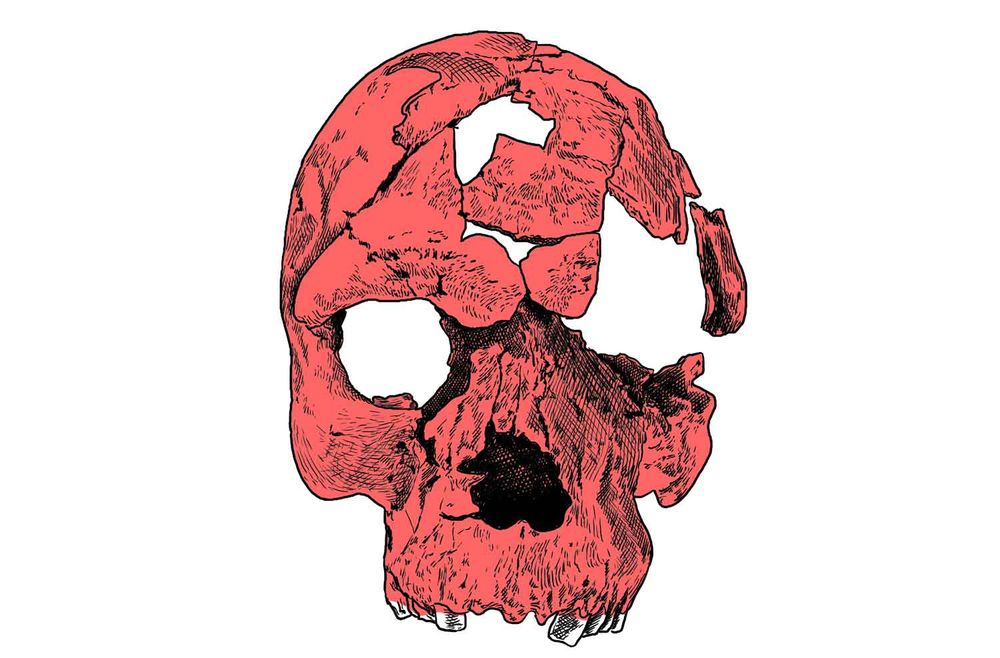
The D3444 calvaria was uncovered at Dmanisi, Georgia, in 2002. The individual represented by this cranium lived sometime around 1.77 million years ago, and most scientists attribute the fossil to Homo erectus. The individual had lost nearly all teeth at the time of death. #inktober

October 30, 2025 at 2:38 PM
The D3444 calvaria was uncovered at Dmanisi, Georgia, in 2002. The individual represented by this cranium lived sometime around 1.77 million years ago, and most scientists attribute the fossil to Homo erectus. The individual had lost nearly all teeth at the time of death. #inktober
The skull from near Herto, Ethiopia, BOU-VP-16/1 represents a person who lived sometime between 162,000 and 147,000 years ago. The skull bears two cutmarks on the right parietal and temporal, suggesting that other individuals may have conducted mortuary practices upon his death. #inktober
October 29, 2025 at 9:34 PM
The skull from near Herto, Ethiopia, BOU-VP-16/1 represents a person who lived sometime between 162,000 and 147,000 years ago. The skull bears two cutmarks on the right parietal and temporal, suggesting that other individuals may have conducted mortuary practices upon his death. #inktober
The rockshelter at La Ferrassie in the Dordogne of southern France contained the remains of several Neanderthals. The most complete of the skeletons was La Ferrassie 1, who lived an estimated 70,000 to 50,000 years ago. His body like the others was buried, likely by members of his group. #inktober

October 28, 2025 at 2:11 PM
The rockshelter at La Ferrassie in the Dordogne of southern France contained the remains of several Neanderthals. The most complete of the skeletons was La Ferrassie 1, who lived an estimated 70,000 to 50,000 years ago. His body like the others was buried, likely by members of his group. #inktober
KNM-WT 17000 is one of the most iconic skulls in the hominin fossil record due to its natural manganese staining, rendering it as the Black Skull. At around 2.5 million years old it is one of the first with pronounced large jaw musculature that would characterize big-molared Paranthropus. #inktober

October 27, 2025 at 7:30 PM
KNM-WT 17000 is one of the most iconic skulls in the hominin fossil record due to its natural manganese staining, rendering it as the Black Skull. At around 2.5 million years old it is one of the first with pronounced large jaw musculature that would characterize big-molared Paranthropus. #inktober
The skull known as OH 5 was first uncovered by Mary Leakey in 1959, soon became the type fossil of the species Zinjanthropus boisei. Around 1.75 million years old, I'm sure that this individual would have loved pumpkins if they had existed in Africa at the time. #inktober

October 26, 2025 at 11:04 PM
The skull known as OH 5 was first uncovered by Mary Leakey in 1959, soon became the type fossil of the species Zinjanthropus boisei. Around 1.75 million years old, I'm sure that this individual would have loved pumpkins if they had existed in Africa at the time. #inktober
Great to still have the peak of fall color happening in Wisconsin as I get back from the other side of the planet.

October 26, 2025 at 10:51 PM
Great to still have the peak of fall color happening in Wisconsin as I get back from the other side of the planet.
The fossil sample from Sterkfontein Caves, South Africa, is one of the largest known of human relatives. Sts 71 (left) and StW 505 (right) are close to the extremes of cranial size of fossils from the site that are usually attributed to Australopithecus africanus. #inktober

October 26, 2025 at 12:51 AM
The fossil sample from Sterkfontein Caves, South Africa, is one of the largest known of human relatives. Sts 71 (left) and StW 505 (right) are close to the extremes of cranial size of fossils from the site that are usually attributed to Australopithecus africanus. #inktober
Marcel de Puydt and Max Lohest excavated in the Grotte de Spy, discovering partial skeletons of Neandertals in 1886 including this one, Spy 1. It the first time that Neandertal skeletal remains were recorded in stratigraphic context, keeping associated artifacts and animal bones together. #inktober

October 24, 2025 at 7:34 PM
Marcel de Puydt and Max Lohest excavated in the Grotte de Spy, discovering partial skeletons of Neandertals in 1886 including this one, Spy 1. It the first time that Neandertal skeletal remains were recorded in stratigraphic context, keeping associated artifacts and animal bones together. #inktober
The skull numbered KNM-WT 40000 was first found by Justus Erus in 1999 and is between 3.57 and 3.4 million years old. While broken and distorted, some aspects of its face are different from other contemporary species, leading Meave Leakey and coworkers to name it Kenyanthropus platyops. #inktober

October 23, 2025 at 8:06 PM
The skull numbered KNM-WT 40000 was first found by Justus Erus in 1999 and is between 3.57 and 3.4 million years old. While broken and distorted, some aspects of its face are different from other contemporary species, leading Meave Leakey and coworkers to name it Kenyanthropus platyops. #inktober
The most iconic cranial fossil from Krapina, Croatia, is Cranium C, which represents a female adult Neandertal individual who lived approximately 120,000 years ago. This and other remains were excavated by Dragutin Gorjanović-Kramberger from 1899 to 1905. #inktober

October 22, 2025 at 9:32 AM
The most iconic cranial fossil from Krapina, Croatia, is Cranium C, which represents a female adult Neandertal individual who lived approximately 120,000 years ago. This and other remains were excavated by Dragutin Gorjanović-Kramberger from 1899 to 1905. #inktober
Sima de los Huesos, Spain, contains the remains of more than 27 individuals of an early Neanderthal population, estimated to be around 430,000 years old. Cranium 5 is one of the most complete known so far from the site; it is also the smallest of 15 with estimated brain sizes. #inktober

October 20, 2025 at 9:24 PM
Sima de los Huesos, Spain, contains the remains of more than 27 individuals of an early Neanderthal population, estimated to be around 430,000 years old. Cranium 5 is one of the most complete known so far from the site; it is also the smallest of 15 with estimated brain sizes. #inktober