




John Ilee
@johnilee.bsky.social
Assembled in Yorkshire. STFC Ernest Rutherford Fellow & Associate Professor in Astrophysics at the University of Leeds.
The second surprising result is that even after throwing the chemical kitchen sink at the model (honestly, see Table 2) we could *not* reproduce the column density profile of methanol. We didn't have enough of it (short by ~1-2 orders of magnitude) and it was all in the wrong place (the outer disk).

October 7, 2025 at 11:11 AM
The second surprising result is that even after throwing the chemical kitchen sink at the model (honestly, see Table 2) we could *not* reproduce the column density profile of methanol. We didn't have enough of it (short by ~1-2 orders of magnitude) and it was all in the wrong place (the outer disk).
TW Hya is great because it's so well studied and there is a wealth of information on the disk physical structure. We combined some pretty advanced chemical modelling (thanks to Catherine) with a really well benchmarked model of the disk (thanks to Jenny).

October 7, 2025 at 11:11 AM
TW Hya is great because it's so well studied and there is a wealth of information on the disk physical structure. We combined some pretty advanced chemical modelling (thanks to Catherine) with a really well benchmarked model of the disk (thanks to Jenny).
We can look at the relative intensities of each of these transitions to pull out physical information like excitation temperature and column density for the methanol gas, and since the observations were spatially resolved, we see how these change radially through the disk.

October 7, 2025 at 11:11 AM
We can look at the relative intensities of each of these transitions to pull out physical information like excitation temperature and column density for the methanol gas, and since the observations were spatially resolved, we see how these change radially through the disk.
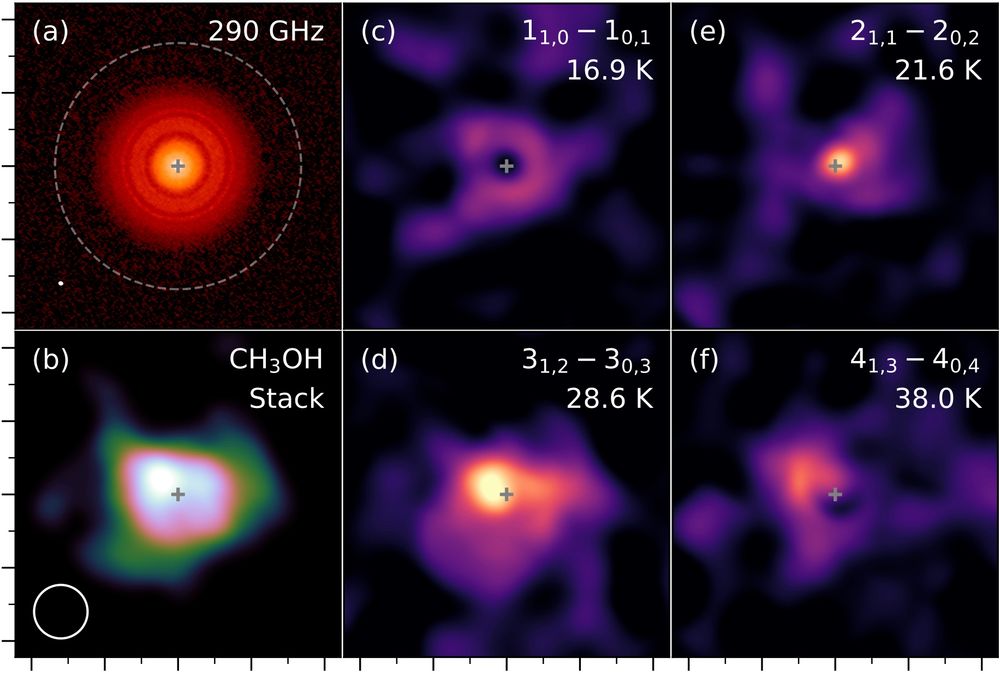
Methanol is the starting point for lots of important prebiotic chemistry. So far it has only been detected in a disk around one solar-type star, TW Hya. We used #ALMA to go back and get some very sensitive, high-resolution observations of multiple transitions for the first time.
October 7, 2025 at 11:11 AM
Methanol is the starting point for lots of important prebiotic chemistry. So far it has only been detected in a disk around one solar-type star, TW Hya. We used #ALMA to go back and get some very sensitive, high-resolution observations of multiple transitions for the first time.
The second surprising result is that, even after throwing the chemical kitchen sink at the model, we could *not* reproduce the column density profile of methanol. We didn’t have enough of it (short by ~1-2 orders of magnitude) and it was all in the wrong place (the outer disk).
October 7, 2025 at 8:59 AM
The second surprising result is that, even after throwing the chemical kitchen sink at the model, we could *not* reproduce the column density profile of methanol. We didn’t have enough of it (short by ~1-2 orders of magnitude) and it was all in the wrong place (the outer disk).
TW Hya is great because it’s so well studied and there is a wealth of information on the disk physical structure. We combined some pretty advanced chemical modelling (Catherine) with a benchmarked model of the disk (Jenny).
October 7, 2025 at 8:59 AM
TW Hya is great because it’s so well studied and there is a wealth of information on the disk physical structure. We combined some pretty advanced chemical modelling (Catherine) with a benchmarked model of the disk (Jenny).
We can look at the relative intensities of each of these transitions to pull out physical information like excitation temperature and column density for the methanol gas, and since the observations were spatially resolved, we can look at how these change radially through the disk.
October 7, 2025 at 8:59 AM
We can look at the relative intensities of each of these transitions to pull out physical information like excitation temperature and column density for the methanol gas, and since the observations were spatially resolved, we can look at how these change radially through the disk.
Methanol is the starting point for lots of important prebiotic chemistry. So far it has only been detected in a disk around one solar-type star, TW Hya. We used #ALMA to go back and get some very sensitive, high-resolution observations of multiple transitions for the first time.
October 7, 2025 at 8:59 AM
Methanol is the starting point for lots of important prebiotic chemistry. So far it has only been detected in a disk around one solar-type star, TW Hya. We used #ALMA to go back and get some very sensitive, high-resolution observations of multiple transitions for the first time.
Sending my apologies to the reviewer for this one… 😬

September 10, 2025 at 8:41 AM
Sending my apologies to the reviewer for this one… 😬
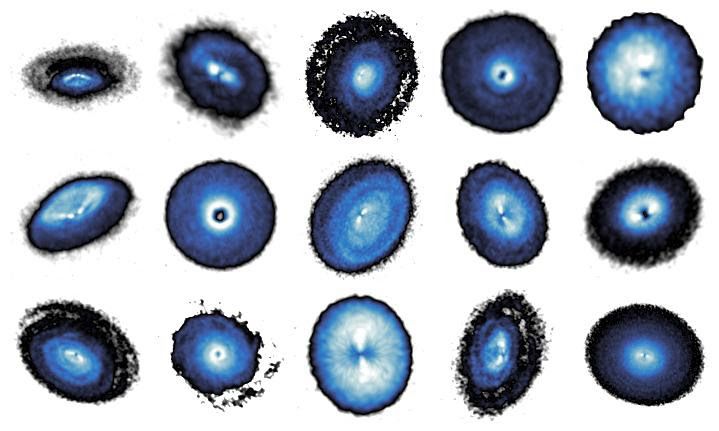
Lots of fun today at John Smeaton Academy talking all about science, art, radio astronomy & building planets onboard the amazing Moon Palace. Thanks for having us and for all the amazing questions!


July 14, 2025 at 6:56 PM
Lots of fun today at John Smeaton Academy talking all about science, art, radio astronomy & building planets onboard the amazing Moon Palace. Thanks for having us and for all the amazing questions!
April 28, 2025 at 4:09 PM

Combining the ALMA & VLA observations revealed where the objects are optically thick at different wavelengths, and where ionised gas emission contaminates dust emission. Understanding this is really key to accurately measuring how much planet forming material is present in these young disks:


January 31, 2025 at 9:09 AM
Combining the ALMA & VLA observations revealed where the objects are optically thick at different wavelengths, and where ionised gas emission contaminates dust emission. Understanding this is really key to accurately measuring how much planet forming material is present in these young disks:
The ALMA observations also showed that B appears to be extremely unsettled (aren’t we all?) with millimetre dust emission originating from very high up in the disk:

January 31, 2025 at 9:09 AM
The ALMA observations also showed that B appears to be extremely unsettled (aren’t we all?) with millimetre dust emission originating from very high up in the disk:
The JWST observations revealed that the parsec-scale outflow in the region appears to originate from one member of the central binary AaAb, and were sensitive enough to pick up a faint outflow (or wind?) from its neighbour B:

January 31, 2025 at 9:09 AM
The JWST observations revealed that the parsec-scale outflow in the region appears to originate from one member of the central binary AaAb, and were sensitive enough to pick up a faint outflow (or wind?) from its neighbour B:
Great to see Isaac Radley’s multi-wavelength study of some of the youngest protostars come out today - arxiv.org/abs/2501.18348
@physicsleedsuni.bsky.social
@physicsleedsuni.bsky.social

January 31, 2025 at 9:09 AM
Great to see Isaac Radley’s multi-wavelength study of some of the youngest protostars come out today - arxiv.org/abs/2501.18348
@physicsleedsuni.bsky.social
@physicsleedsuni.bsky.social
Combining the ALMA & VLA observations revealed where the objects are optically thick at different wavelengths, and where ionised gas emission contaminates dust emission. Understanding this is really key to accurately measuring how much planet forming material is present in these young disks:
January 31, 2025 at 9:09 AM
Combining the ALMA & VLA observations revealed where the objects are optically thick at different wavelengths, and where ionised gas emission contaminates dust emission. Understanding this is really key to accurately measuring how much planet forming material is present in these young disks:
The ALMA observations also showed that B appears to be extremely unsettled (aren’t we all?) with millimetre dust emission originating from very high up in the disk:
January 31, 2025 at 9:09 AM
The ALMA observations also showed that B appears to be extremely unsettled (aren’t we all?) with millimetre dust emission originating from very high up in the disk:
The JWST observations revealed that the parsec-scale outflow in the region appears to originate from one member of the central binary AaAb, and were sensitive enough to pick up a faint outflow (or wind?) from its neighbour B:
January 31, 2025 at 9:09 AM
The JWST observations revealed that the parsec-scale outflow in the region appears to originate from one member of the central binary AaAb, and were sensitive enough to pick up a faint outflow (or wind?) from its neighbour B:
Very nice to pop back to @cambridgeastro.bsky.social after far too long…

January 22, 2025 at 6:33 PM
Very nice to pop back to @cambridgeastro.bsky.social after far too long…