




John Ilee
@johnilee.bsky.social
Assembled in Yorkshire. STFC Ernest Rutherford Fellow & Associate Professor in Astrophysics at the University of Leeds.
Reposted by John Ilee

We can see Io rotate slightly over the hour-long timelapse, tracking volcanoes on its surface!
And check out the Conversation piece for a cool slider showing how NGC 1068 lines up perfectly with previous data from LBTI.
And check out the Conversation piece for a cool slider showing how NGC 1068 lines up perfectly with previous data from LBTI.
October 14, 2025 at 3:35 AM
We can see Io rotate slightly over the hour-long timelapse, tracking volcanoes on its surface!
And check out the Conversation piece for a cool slider showing how NGC 1068 lines up perfectly with previous data from LBTI.
And check out the Conversation piece for a cool slider showing how NGC 1068 lines up perfectly with previous data from LBTI.
So, the main takeaway: you need to correctly account for dust evolution and ice chemistry when trying to understand complex molecules in planet forming disks!
October 7, 2025 at 11:11 AM
So, the main takeaway: you need to correctly account for dust evolution and ice chemistry when trying to understand complex molecules in planet forming disks!
Unfortunately including this is time consuming and computationally difficult, but ultimately we think this is going to be the only way to reconcile the models with the observations in the future.
October 7, 2025 at 11:11 AM
Unfortunately including this is time consuming and computationally difficult, but ultimately we think this is going to be the only way to reconcile the models with the observations in the future.
So what is this telling us? A big limitation of the modelling here is that it is static, but we know dust grains move radially and vertically in disks and can redistribute molecules when they do so.
October 7, 2025 at 11:11 AM
So what is this telling us? A big limitation of the modelling here is that it is static, but we know dust grains move radially and vertically in disks and can redistribute molecules when they do so.
The second surprising result is that even after throwing the chemical kitchen sink at the model (honestly, see Table 2) we could *not* reproduce the column density profile of methanol. We didn't have enough of it (short by ~1-2 orders of magnitude) and it was all in the wrong place (the outer disk).

October 7, 2025 at 11:11 AM
The second surprising result is that even after throwing the chemical kitchen sink at the model (honestly, see Table 2) we could *not* reproduce the column density profile of methanol. We didn't have enough of it (short by ~1-2 orders of magnitude) and it was all in the wrong place (the outer disk).
TW Hya is great because it's so well studied and there is a wealth of information on the disk physical structure. We combined some pretty advanced chemical modelling (thanks to Catherine) with a really well benchmarked model of the disk (thanks to Jenny).

October 7, 2025 at 11:11 AM
TW Hya is great because it's so well studied and there is a wealth of information on the disk physical structure. We combined some pretty advanced chemical modelling (thanks to Catherine) with a really well benchmarked model of the disk (thanks to Jenny).
Our first surprising result was than the methanol was cold (~35K) suggesting it wasn't coming from thermal desorption of ices on dust grains, but instead by non-thermal processes. This led us to start looking more into how it could be formed chemically…
October 7, 2025 at 11:11 AM
Our first surprising result was than the methanol was cold (~35K) suggesting it wasn't coming from thermal desorption of ices on dust grains, but instead by non-thermal processes. This led us to start looking more into how it could be formed chemically…
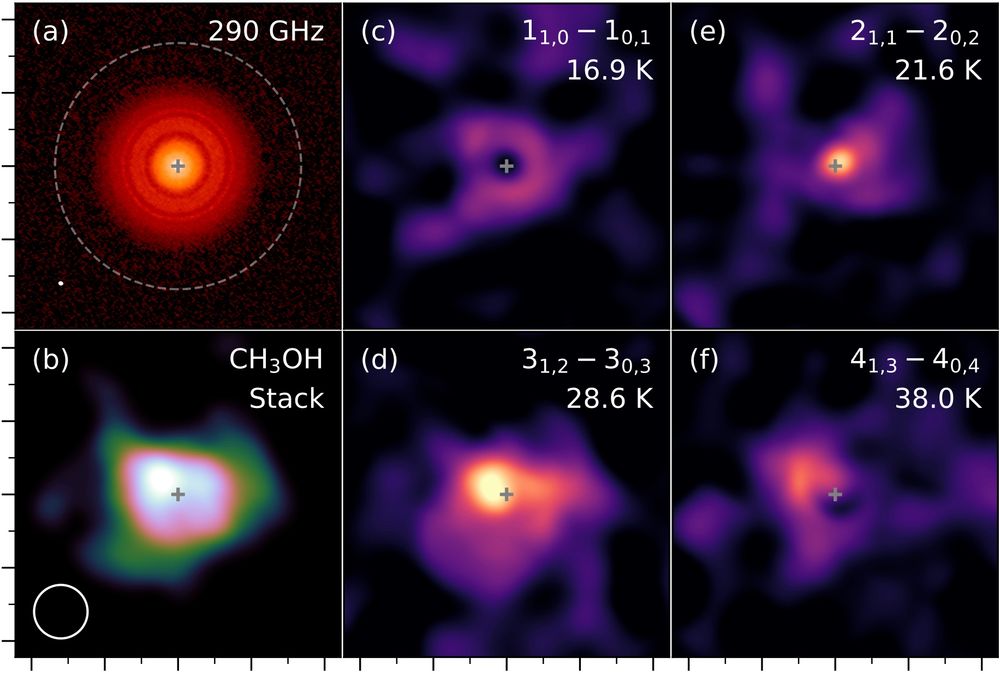
We can look at the relative intensities of each of these transitions to pull out physical information like excitation temperature and column density for the methanol gas, and since the observations were spatially resolved, we see how these change radially through the disk.

October 7, 2025 at 11:11 AM
We can look at the relative intensities of each of these transitions to pull out physical information like excitation temperature and column density for the methanol gas, and since the observations were spatially resolved, we see how these change radially through the disk.
Methanol is the starting point for lots of important prebiotic chemistry. So far it has only been detected in a disk around one solar-type star, TW Hya. We used #ALMA to go back and get some very sensitive, high-resolution observations of multiple transitions for the first time.
October 7, 2025 at 11:11 AM
Methanol is the starting point for lots of important prebiotic chemistry. So far it has only been detected in a disk around one solar-type star, TW Hya. We used #ALMA to go back and get some very sensitive, high-resolution observations of multiple transitions for the first time.
Ultimately, we think including these types of processes is going to be the only way to reconcile the models with the observations. But the main takeaway is that the distribution of important prebiotic molecules in disks is likely highly dependent on treating dust (and ice) evolution correctly!
October 7, 2025 at 8:59 AM
Ultimately, we think including these types of processes is going to be the only way to reconcile the models with the observations. But the main takeaway is that the distribution of important prebiotic molecules in disks is likely highly dependent on treating dust (and ice) evolution correctly!
So what is this telling us? A big limitation of the modelling here is that it is static, but we know dust grains move radially and vertically in disks and can redistribute molecules when they do so.
October 7, 2025 at 8:59 AM
So what is this telling us? A big limitation of the modelling here is that it is static, but we know dust grains move radially and vertically in disks and can redistribute molecules when they do so.
The second surprising result is that, even after throwing the chemical kitchen sink at the model, we could *not* reproduce the column density profile of methanol. We didn’t have enough of it (short by ~1-2 orders of magnitude) and it was all in the wrong place (the outer disk).
October 7, 2025 at 8:59 AM
The second surprising result is that, even after throwing the chemical kitchen sink at the model, we could *not* reproduce the column density profile of methanol. We didn’t have enough of it (short by ~1-2 orders of magnitude) and it was all in the wrong place (the outer disk).
TW Hya is great because it’s so well studied and there is a wealth of information on the disk physical structure. We combined some pretty advanced chemical modelling (Catherine) with a benchmarked model of the disk (Jenny).
October 7, 2025 at 8:59 AM
TW Hya is great because it’s so well studied and there is a wealth of information on the disk physical structure. We combined some pretty advanced chemical modelling (Catherine) with a benchmarked model of the disk (Jenny).
Our first surprising result was than the methanol was cold (~35K) suggesting it wasn’t coming from thermal desorption of ices on dust grains, but instead by non-thermal processes. This led us to start looking more into how it could be formed chemically.
October 7, 2025 at 8:59 AM
Our first surprising result was than the methanol was cold (~35K) suggesting it wasn’t coming from thermal desorption of ices on dust grains, but instead by non-thermal processes. This led us to start looking more into how it could be formed chemically.
We can look at the relative intensities of each of these transitions to pull out physical information like excitation temperature and column density for the methanol gas, and since the observations were spatially resolved, we can look at how these change radially through the disk.
October 7, 2025 at 8:59 AM
We can look at the relative intensities of each of these transitions to pull out physical information like excitation temperature and column density for the methanol gas, and since the observations were spatially resolved, we can look at how these change radially through the disk.
Methanol is the starting point for lots of important prebiotic chemistry. So far it has only been detected in a disk around one solar-type star, TW Hya. We used #ALMA to go back and get some very sensitive, high-resolution observations of multiple transitions for the first time.
October 7, 2025 at 8:59 AM
Methanol is the starting point for lots of important prebiotic chemistry. So far it has only been detected in a disk around one solar-type star, TW Hya. We used #ALMA to go back and get some very sensitive, high-resolution observations of multiple transitions for the first time.
Such a shame. He gave a really encouraging speech at our graduation (and I also had the honour of being tapped on the head with a pair of very old trousers by him!). RIP.
September 26, 2025 at 6:40 PM
Such a shame. He gave a really encouraging speech at our graduation (and I also had the honour of being tapped on the head with a pair of very old trousers by him!). RIP.