



Jonathan Karin
@jonathankarin.bsky.social
9/9 Our generative model discovered the "Kite" configuration that breaks the established trade-off and maximizes the number of surviving agents.

December 8, 2025 at 9:04 AM
9/9 Our generative model discovered the "Kite" configuration that breaks the established trade-off and maximizes the number of surviving agents.
8/9
To solve this, we designed SwaGen: A GNN-based generative model that optimizes agents positions using a multi objective loss function that minimizes both DOD and Diffusion simultaneously.
To solve this, we designed SwaGen: A GNN-based generative model that optimizes agents positions using a multi objective loss function that minimizes both DOD and Diffusion simultaneously.

December 8, 2025 at 8:58 AM
8/9
To solve this, we designed SwaGen: A GNN-based generative model that optimizes agents positions using a multi objective loss function that minimizes both DOD and Diffusion simultaneously.
To solve this, we designed SwaGen: A GNN-based generative model that optimizes agents positions using a multi objective loss function that minimizes both DOD and Diffusion simultaneously.
7/9
Simulations validated this trade-off where the V-formation was frequently detected (58%) but rarely went extinct (5.6%). Conversely, the compact Rectangle was harder to detect (32.4%) but suffered a significantly higher extinction rate (32.0%).
Simulations validated this trade-off where the V-formation was frequently detected (58%) but rarely went extinct (5.6%). Conversely, the compact Rectangle was harder to detect (32.4%) but suffered a significantly higher extinction rate (32.0%).

December 8, 2025 at 8:58 AM
7/9
Simulations validated this trade-off where the V-formation was frequently detected (58%) but rarely went extinct (5.6%). Conversely, the compact Rectangle was harder to detect (32.4%) but suffered a significantly higher extinction rate (32.0%).
Simulations validated this trade-off where the V-formation was frequently detected (58%) but rarely went extinct (5.6%). Conversely, the compact Rectangle was harder to detect (32.4%) but suffered a significantly higher extinction rate (32.0%).
6/9
For example:
V-Formation: High DOD (easy to detect), but low diffusion (hard to extinct).
Rectangle: Low DOD (hard to detect), but high diffusion (easy to extinct).
For example:
V-Formation: High DOD (easy to detect), but low diffusion (hard to extinct).
Rectangle: Low DOD (hard to detect), but high diffusion (easy to extinct).
December 8, 2025 at 8:58 AM
6/9
For example:
V-Formation: High DOD (easy to detect), but low diffusion (hard to extinct).
Rectangle: Low DOD (hard to detect), but high diffusion (easy to extinct).
For example:
V-Formation: High DOD (easy to detect), but low diffusion (hard to extinct).
Rectangle: Low DOD (hard to detect), but high diffusion (easy to extinct).
5/9
Diffusion: How fast the predator diffuses on the swarm’s graph. Compact swarms are easy to diffuse (bad for surviving).
Diffusion: How fast the predator diffuses on the swarm’s graph. Compact swarms are easy to diffuse (bad for surviving).

December 8, 2025 at 8:58 AM
5/9
Diffusion: How fast the predator diffuses on the swarm’s graph. Compact swarms are easy to diffuse (bad for surviving).
Diffusion: How fast the predator diffuses on the swarm’s graph. Compact swarms are easy to diffuse (bad for surviving).
4/9
Those risks can be quantified :
Domain of Danger (DOD): The area where the predator can detect the prey. Compact swarms have low DOD (good for hiding).
Those risks can be quantified :
Domain of Danger (DOD): The area where the predator can detect the prey. Compact swarms have low DOD (good for hiding).

December 8, 2025 at 8:58 AM
4/9
Those risks can be quantified :
Domain of Danger (DOD): The area where the predator can detect the prey. Compact swarms have low DOD (good for hiding).
Those risks can be quantified :
Domain of Danger (DOD): The area where the predator can detect the prey. Compact swarms have low DOD (good for hiding).
3/9 We model this problem as a graph problem, where each agent in the warm is a node, and the predator is a signal diffusing through the graph.

December 8, 2025 at 8:58 AM
3/9 We model this problem as a graph problem, where each agent in the warm is a node, and the predator is a signal diffusing through the graph.
2/9 It turns out there is a fundamental mathematical tension between "hiding" and "surviving."
Swarms face two risks:
Detection: Being spotted by a predator.
Extinction: Being wiped out once spotted.
Swarms face two risks:
Detection: Being spotted by a predator.
Extinction: Being wiped out once spotted.
December 8, 2025 at 8:58 AM
2/9 It turns out there is a fundamental mathematical tension between "hiding" and "surviving."
Swarms face two risks:
Detection: Being spotted by a predator.
Extinction: Being wiped out once spotted.
Swarms face two risks:
Detection: Being spotted by a predator.
Extinction: Being wiped out once spotted.
3/3 For a tutorial please explore our GitHub repository:
github.com/nitzanlab/An...
github.com/nitzanlab/An...

GitHub - nitzanlab/Annotatability: Annotatability, a method to identify meaningful patterns in single-cell genomics data through annotation-trainability analysis, which estimates annotation congruence...
Annotatability, a method to identify meaningful patterns in single-cell genomics data through annotation-trainability analysis, which estimates annotation congruence using a rich but often overlook...
github.com
December 8, 2024 at 2:05 PM
3/3 For a tutorial please explore our GitHub repository:
github.com/nitzanlab/An...
github.com/nitzanlab/An...
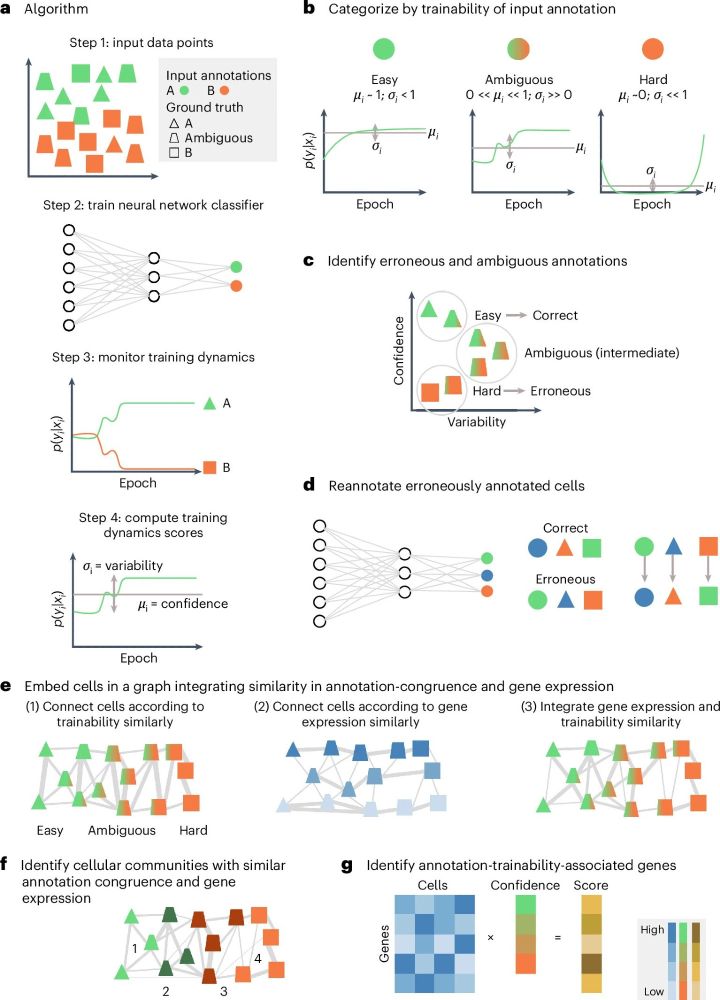
2/3 Explore how deep learning training dynamics reveal insights into single-cell and spatial omics data—It can identify erroneous annotations, ambiguous cell states, infer continuous trajectories from binary labels.
December 8, 2024 at 2:05 PM
2/3 Explore how deep learning training dynamics reveal insights into single-cell and spatial omics data—It can identify erroneous annotations, ambiguous cell states, infer continuous trajectories from binary labels.
For tutorial please explore our GitHub repository:
github.com/nitzanlab/An...
github.com/nitzanlab/An...

GitHub - nitzanlab/Annotatability: Annotatability, a method to identify meaningful patterns in single-cell genomics data through annotation-trainability analysis, which estimates annotation congruence...
Annotatability, a method to identify meaningful patterns in single-cell genomics data through annotation-trainability analysis, which estimates annotation congruence using a rich but often overlook...
github.com
December 5, 2024 at 6:43 PM
For tutorial please explore our GitHub repository:
github.com/nitzanlab/An...
github.com/nitzanlab/An...
2/3 Explore how deep learning training dynamics reveal insights into single-cell and spatial omics data—It can identify erroneous annotations, ambiguous cell states states, infer continuous trajectories from binary labels.

December 5, 2024 at 6:43 PM
2/3 Explore how deep learning training dynamics reveal insights into single-cell and spatial omics data—It can identify erroneous annotations, ambiguous cell states states, infer continuous trajectories from binary labels.