



Jon Daniels
@jsdaniel02.bsky.social
Scientific instrument developer, focused on #lightsheet and other #microscopy 🔬 at ASI
Do you know to what extent other objective lenses are intrinsically telecentric?
Particularly comparable ones like Nikon 40x/0.8, Olympus 20x/1.0 W, Nikon 25x/1.1 W (which isn't plan-corrected but still widely used in light sheet).
Particularly comparable ones like Nikon 40x/0.8, Olympus 20x/1.0 W, Nikon 25x/1.1 W (which isn't plan-corrected but still widely used in light sheet).
December 19, 2025 at 2:49 PM
Do you know to what extent other objective lenses are intrinsically telecentric?
Particularly comparable ones like Nikon 40x/0.8, Olympus 20x/1.0 W, Nikon 25x/1.1 W (which isn't plan-corrected but still widely used in light sheet).
Particularly comparable ones like Nikon 40x/0.8, Olympus 20x/1.0 W, Nikon 25x/1.1 W (which isn't plan-corrected but still widely used in light sheet).
Related, I'm curious to what extent other objective lenses are intrinsically telecentric.
Particularly comparable ones like Olympus 20x/1.0 W, Nikon 25x/1.1 W (which isn't plan-corrected but still widely used in light sheet), and Nikon 40x/0.8 W.
Particularly comparable ones like Olympus 20x/1.0 W, Nikon 25x/1.1 W (which isn't plan-corrected but still widely used in light sheet), and Nikon 40x/0.8 W.
December 19, 2025 at 12:44 AM
Related, I'm curious to what extent other objective lenses are intrinsically telecentric.
Particularly comparable ones like Olympus 20x/1.0 W, Nikon 25x/1.1 W (which isn't plan-corrected but still widely used in light sheet), and Nikon 40x/0.8 W.
Particularly comparable ones like Olympus 20x/1.0 W, Nikon 25x/1.1 W (which isn't plan-corrected but still widely used in light sheet), and Nikon 40x/0.8 W.
Designing the whole optic train together makes sense for OPM or similar applications. It can be done with the BB model (which we will give out).
Primary use as detection lens with expanded samples for light sheet with separate illumination path, or for epi-fluorescence including confocal.
Primary use as detection lens with expanded samples for light sheet with separate illumination path, or for epi-fluorescence including confocal.
December 19, 2025 at 12:39 AM
Designing the whole optic train together makes sense for OPM or similar applications. It can be done with the BB model (which we will give out).
Primary use as detection lens with expanded samples for light sheet with separate illumination path, or for epi-fluorescence including confocal.
Primary use as detection lens with expanded samples for light sheet with separate illumination path, or for epi-fluorescence including confocal.
Thank you, good point. If the objective is not intrinsically telecentric, can you still make a combined telecentric system with it, e.g. adjusting the axial position of the galvo so that the scanning is self-parallel?
December 19, 2025 at 12:12 AM
Thank you, good point. If the objective is not intrinsically telecentric, can you still make a combined telecentric system with it, e.g. adjusting the axial position of the galvo so that the scanning is self-parallel?
Smaller fan angles were better for our application. Because Laserline only had 1° and 5°, we had a special 2° one made (which we can sell if it's helpful to others).
I suggest using a slit for only modest adjustments in NA because of light efficiency.
I suggest using a slit for only modest adjustments in NA because of light efficiency.
November 5, 2025 at 11:26 PM
Smaller fan angles were better for our application. Because Laserline only had 1° and 5°, we had a special 2° one made (which we can sell if it's helpful to others).
I suggest using a slit for only modest adjustments in NA because of light efficiency.
I suggest using a slit for only modest adjustments in NA because of light efficiency.
BTW these objectives generally work for water/ExM though not specifically optimized for it. For instance the 54-12-8 -- NA 0.64 in water -- was used as the illumination objective for ASLM imaging of pan-ExM samples in www.biorxiv.org/content/10.1...

Pan-ASLM: a high-resolution and large field-of-view light sheet microscope for Expansion Microscopy
Expansion microscopy, a super-resolution fluorescence microscopy technique in which samples are expanded up to ∼8,000 times (after 20-fold expansion) their original volume, places high demands on the ...
www.biorxiv.org
September 30, 2025 at 11:25 AM
BTW these objectives generally work for water/ExM though not specifically optimized for it. For instance the 54-12-8 -- NA 0.64 in water -- was used as the illumination objective for ASLM imaging of pan-ExM samples in www.biorxiv.org/content/10.1...
In the past this (and the glycerol one) was available for purchase only with Olympus/Evident confocal systems, not to homebuilders. Not sure if they have changed their policy.
September 30, 2025 at 12:30 AM
In the past this (and the glycerol one) was available for purchase only with Olympus/Evident confocal systems, not to homebuilders. Not sure if they have changed their policy.
for cleared tissue see these four objectives with different NA/WD/FOV tradeoffs: asiimaging.com/docs/multi-i...
multi-immersion_objectives [Applied Scientific Instrumentation]
asiimaging.com
September 30, 2025 at 12:26 AM
for cleared tissue see these four objectives with different NA/WD/FOV tradeoffs: asiimaging.com/docs/multi-i...
Note this would be a dipping objective and basically a regular microscope objective lens, compared to the specialized ExaSPIM lenses which are awesome but unconventional optically.
September 30, 2025 at 12:21 AM
Note this would be a dipping objective and basically a regular microscope objective lens, compared to the specialized ExaSPIM lenses which are awesome but unconventional optically.
I have some thoughts in this direction... I'm thinking NA 0.75 or NA 0.8 with >10mm WD.
I'm hoping to talk with researchers at Seeing Is Believing and SfN (or by email/DM) and then start the detailed design.
Please reach out to me [email protected].
I'm hoping to talk with researchers at Seeing Is Believing and SfN (or by email/DM) and then start the detailed design.
Please reach out to me [email protected].
September 30, 2025 at 12:20 AM
I have some thoughts in this direction... I'm thinking NA 0.75 or NA 0.8 with >10mm WD.
I'm hoping to talk with researchers at Seeing Is Believing and SfN (or by email/DM) and then start the detailed design.
Please reach out to me [email protected].
I'm hoping to talk with researchers at Seeing Is Believing and SfN (or by email/DM) and then start the detailed design.
Please reach out to me [email protected].
Here is what it will look like:

September 19, 2025 at 4:44 PM
Here is what it will look like:
OK not sure why it's not posting as either png or jpg...
September 18, 2025 at 10:44 PM
OK not sure why it's not posting as either png or jpg...

I like Empress but I don't want to be the arbiter of nicknames.
Official PN is 57-14-7 and it will be colloquially "AMS-AGY v3" on our website.
It's 10mm shorter than v2. OD is flared near the threads: 30mm OD for most and 37mm OD near the threads, whereas v2 was 35mm OD all the way.
Official PN is 57-14-7 and it will be colloquially "AMS-AGY v3" on our website.
It's 10mm shorter than v2. OD is flared near the threads: 30mm OD for most and 37mm OD near the threads, whereas v2 was 35mm OD all the way.
September 18, 2025 at 10:37 PM
I like Empress but I don't want to be the arbiter of nicknames.
Official PN is 57-14-7 and it will be colloquially "AMS-AGY v3" on our website.
It's 10mm shorter than v2. OD is flared near the threads: 30mm OD for most and 37mm OD near the threads, whereas v2 was 35mm OD all the way.
Official PN is 57-14-7 and it will be colloquially "AMS-AGY v3" on our website.
It's 10mm shorter than v2. OD is flared near the threads: 30mm OD for most and 37mm OD near the threads, whereas v2 was 35mm OD all the way.
Details here: bsky.app/profile/jsda...
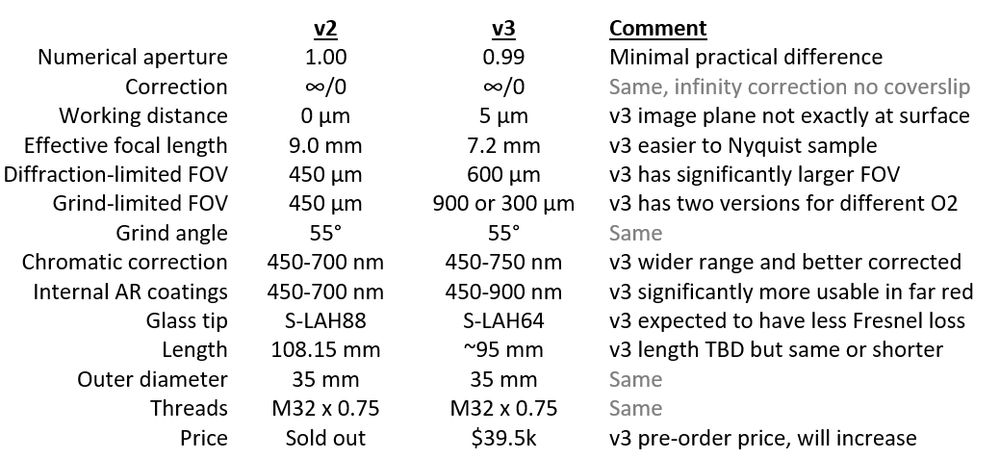
Production has started for a new #Snoutscope objective, AMS-AGY v3. It has significantly larger FOV and some other tweaks from v1 and v2. Currently accepting pre-orders. The price will need to increase modestly after deliveries start late October.
July 9, 2025 at 9:32 PM
Details here: bsky.app/profile/jsda...
Tagging @amsikking.bsky.social @andrewgyork.bsky.social @tanner-fadero.bsky.social @retof.bsky.social @loicaroyer.bsky.social and I'm sure I'm missing more but hopefully this will make the rounds...
July 9, 2025 at 8:02 PM
Tagging @amsikking.bsky.social @andrewgyork.bsky.social @tanner-fadero.bsky.social @retof.bsky.social @loicaroyer.bsky.social and I'm sure I'm missing more but hopefully this will make the rounds...
High-res cellular imaging uses O1 > 1.0 with O2 being 40x/0.95 02. Short O2 WD means the grind has to sacrifice FOV in the depth axis, but FOV in the other direction (parallel the coverslip) is still 600um.
For larger samples e.g. zebrafish the grind position is wider to capture the entire FOV.
For larger samples e.g. zebrafish the grind position is wider to capture the entire FOV.
July 9, 2025 at 8:00 PM
High-res cellular imaging uses O1 > 1.0 with O2 being 40x/0.95 02. Short O2 WD means the grind has to sacrifice FOV in the depth axis, but FOV in the other direction (parallel the coverslip) is still 600um.
For larger samples e.g. zebrafish the grind position is wider to capture the entire FOV.
For larger samples e.g. zebrafish the grind position is wider to capture the entire FOV.
4. 55° grind so compatible with any-immersion concept.
5. Two different options for grind position: one for situations where O2 is NA ~0.95 and another for NA ~0.8. This one requires a bit more explanation.
5. Two different options for grind position: one for situations where O2 is NA ~0.95 and another for NA ~0.8. This one requires a bit more explanation.
July 9, 2025 at 8:00 PM
4. 55° grind so compatible with any-immersion concept.
5. Two different options for grind position: one for situations where O2 is NA ~0.95 and another for NA ~0.8. This one requires a bit more explanation.
5. Two different options for grind position: one for situations where O2 is NA ~0.95 and another for NA ~0.8. This one requires a bit more explanation.
A few nerdy details:
1. Generally better imaging quality especially for those pushing the FOV. I can send plots to those interested.
2. The image plane is a few microns off the glass tip to mitigate problem with dust.
3. Improved capture of high-angle rays despite slightly reduced NA of 0.99.
1. Generally better imaging quality especially for those pushing the FOV. I can send plots to those interested.
2. The image plane is a few microns off the glass tip to mitigate problem with dust.
3. Improved capture of high-angle rays despite slightly reduced NA of 0.99.
July 9, 2025 at 8:00 PM
A few nerdy details:
1. Generally better imaging quality especially for those pushing the FOV. I can send plots to those interested.
2. The image plane is a few microns off the glass tip to mitigate problem with dust.
3. Improved capture of high-angle rays despite slightly reduced NA of 0.99.
1. Generally better imaging quality especially for those pushing the FOV. I can send plots to those interested.
2. The image plane is a few microns off the glass tip to mitigate problem with dust.
3. Improved capture of high-angle rays despite slightly reduced NA of 0.99.