




Ilkka Rauvola
@jukka235.bsky.social
Covid-19. In God we trust, all others must bring data.
X: @jukka235 or https://x.com/jukka235
X: @jukka235 or https://x.com/jukka235
How privacy is defended (part 2): privacy survives through a patchwork of legal frameworks, technical safeguards, market pressures, cultural norms, civil-society activism, and even strategic calculations by companies.
11/x
11/x


December 7, 2025 at 6:14 PM
How privacy is defended (part 2): privacy survives through a patchwork of legal frameworks, technical safeguards, market pressures, cultural norms, civil-society activism, and even strategic calculations by companies.
11/x
11/x
How privacy is defended (part 1): not by a single factor or mechanism. An uneasy balance of forces pushing back against the erosion of privacy.
10/x
10/x


December 7, 2025 at 6:12 PM
How privacy is defended (part 1): not by a single factor or mechanism. An uneasy balance of forces pushing back against the erosion of privacy.
10/x
10/x
The democratic system is a loser in the long term. No chance.
Democracy cannot exist without privacy:
- anonymity in thought
- freedom in communication
- safety in dissent
- equality of information
- the inability of any one actor to know everything
9/x
Democracy cannot exist without privacy:
- anonymity in thought
- freedom in communication
- safety in dissent
- equality of information
- the inability of any one actor to know everything
9/x


December 7, 2025 at 5:45 PM
The democratic system is a loser in the long term. No chance.
Democracy cannot exist without privacy:
- anonymity in thought
- freedom in communication
- safety in dissent
- equality of information
- the inability of any one actor to know everything
9/x
Democracy cannot exist without privacy:
- anonymity in thought
- freedom in communication
- safety in dissent
- equality of information
- the inability of any one actor to know everything
9/x
Winners and losers from eroding privacy:
- winners:
governments, large corporations, law enforcement, censorship, cybercriminals
- losers:
ordinary citizens
democratic institutions
market competition
future generations: children
8/x
- winners:
governments, large corporations, law enforcement, censorship, cybercriminals
- losers:
ordinary citizens
democratic institutions
market competition
future generations: children
8/x


December 7, 2025 at 5:25 PM
Winners and losers from eroding privacy:
- winners:
governments, large corporations, law enforcement, censorship, cybercriminals
- losers:
ordinary citizens
democratic institutions
market competition
future generations: children
8/x
- winners:
governments, large corporations, law enforcement, censorship, cybercriminals
- losers:
ordinary citizens
democratic institutions
market competition
future generations: children
8/x
There are powerful forces working against privacy.
- they operate at multiple layers: technological, economic, political, social, and even psychological
- understanding who benefits and who loses reveals why privacy erodes even when societies claim to value it.
7/x
- they operate at multiple layers: technological, economic, political, social, and even psychological
- understanding who benefits and who loses reveals why privacy erodes even when societies claim to value it.
7/x


December 7, 2025 at 5:16 PM
There are powerful forces working against privacy.
- they operate at multiple layers: technological, economic, political, social, and even psychological
- understanding who benefits and who loses reveals why privacy erodes even when societies claim to value it.
7/x
- they operate at multiple layers: technological, economic, political, social, and even psychological
- understanding who benefits and who loses reveals why privacy erodes even when societies claim to value it.
7/x
Privacy is one of 25 foundational forces. Privacy provides conditions for a cohesive society. Privacy, with the other foundational forces, shape whether societies stay cohesive, fragment, stagnate, or transform. These are underlying dynamics that run through every human civilization.
6/x
6/x


December 7, 2025 at 5:09 PM
Privacy is one of 25 foundational forces. Privacy provides conditions for a cohesive society. Privacy, with the other foundational forces, shape whether societies stay cohesive, fragment, stagnate, or transform. These are underlying dynamics that run through every human civilization.
6/x
6/x
Privacy, according to AI, belongs to the next set of "Foundational Social Forces" that hold societies together.
Foundational social forces are deep structural conditions that shape whether societies stay cohesive, fragment, stagnate, or transform.
5/x
Foundational social forces are deep structural conditions that shape whether societies stay cohesive, fragment, stagnate, or transform.
5/x


December 7, 2025 at 4:56 PM
Privacy, according to AI, belongs to the next set of "Foundational Social Forces" that hold societies together.
Foundational social forces are deep structural conditions that shape whether societies stay cohesive, fragment, stagnate, or transform.
5/x
Foundational social forces are deep structural conditions that shape whether societies stay cohesive, fragment, stagnate, or transform.
5/x
According to AI, there are 9 forces ("binding forces", set 1) that actively hold societies together right now. They capture the mechanisms that directly maintain social order. They are the ropes, cables and pylons that keep "the bridge of society" standing day to day.
4/x
4/x


December 7, 2025 at 4:51 PM
According to AI, there are 9 forces ("binding forces", set 1) that actively hold societies together right now. They capture the mechanisms that directly maintain social order. They are the ropes, cables and pylons that keep "the bridge of society" standing day to day.
4/x
4/x

December 7, 2025 at 4:34 PM
I asked AI what would become of society if privacy goes. The answer is unbelievably black. Privacy is one of the key forces holding societies together. Yet it is weakly defended. Democracy is gone when privacy is gone.
1/x
1/x


December 7, 2025 at 4:29 PM
I asked AI what would become of society if privacy goes. The answer is unbelievably black. Privacy is one of the key forces holding societies together. Yet it is weakly defended. Democracy is gone when privacy is gone.
1/x
1/x
They used to vaccinate everyone against influenza.

December 4, 2025 at 7:25 AM
They used to vaccinate everyone against influenza.
Kidneys and urinary system (Q60-Q64):
- <1 year olds: average growth roughly 20% (10x in 12.4 years) (2019-2025e)
- 1-6 year olds: average growth 16.3% (10x in 15.2 years)
- number 1: congenital obstructive defects of renal pelvis and congenital malformation of ureter (Q62)
16/x
- <1 year olds: average growth roughly 20% (10x in 12.4 years) (2019-2025e)
- 1-6 year olds: average growth 16.3% (10x in 15.2 years)
- number 1: congenital obstructive defects of renal pelvis and congenital malformation of ureter (Q62)
16/x


December 4, 2025 at 6:48 AM
Kidneys and urinary system (Q60-Q64):
- <1 year olds: average growth roughly 20% (10x in 12.4 years) (2019-2025e)
- 1-6 year olds: average growth 16.3% (10x in 15.2 years)
- number 1: congenital obstructive defects of renal pelvis and congenital malformation of ureter (Q62)
16/x
- <1 year olds: average growth roughly 20% (10x in 12.4 years) (2019-2025e)
- 1-6 year olds: average growth 16.3% (10x in 15.2 years)
- number 1: congenital obstructive defects of renal pelvis and congenital malformation of ureter (Q62)
16/x
POTS and Long C0v1d.
5/x
5/x


December 4, 2025 at 6:28 AM
POTS and Long C0v1d.
5/x
5/x
Summary of POTS (Postural Orthostatic Tachycardia Syndrome) (G90) (part 1)
4/x
4/x


December 4, 2025 at 6:21 AM
Summary of POTS (Postural Orthostatic Tachycardia Syndrome) (G90) (part 1)
4/x
4/x
Genital organs (Q50-Q56): among <1 year olds,
- average y/y growth is 24.2% per year (10x in 10.6 years)
- 97% of patients are boys. Total incidence among boys today is roughly 0.5023*0.97*2 = 0.97% (and 10 times that in 10.6 years from now at current growth)
15/x
- average y/y growth is 24.2% per year (10x in 10.6 years)
- 97% of patients are boys. Total incidence among boys today is roughly 0.5023*0.97*2 = 0.97% (and 10 times that in 10.6 years from now at current growth)
15/x


December 4, 2025 at 6:08 AM
Genital organs (Q50-Q56): among <1 year olds,
- average y/y growth is 24.2% per year (10x in 10.6 years)
- 97% of patients are boys. Total incidence among boys today is roughly 0.5023*0.97*2 = 0.97% (and 10 times that in 10.6 years from now at current growth)
15/x
- average y/y growth is 24.2% per year (10x in 10.6 years)
- 97% of patients are boys. Total incidence among boys today is roughly 0.5023*0.97*2 = 0.97% (and 10 times that in 10.6 years from now at current growth)
15/x
This is what exponential growth looks like: a straight line on a log scale chart. (This is the same chart as above, but on a log scale.)
Fastest growth is among 15-24 year olds (128% per year, or 10x in 2.8 years, 100x in 5.6 years, ...) (2023-2025e).
3/x
Fastest growth is among 15-24 year olds (128% per year, or 10x in 2.8 years, 100x in 5.6 years, ...) (2023-2025e).
3/x

December 3, 2025 at 10:07 PM
This is what exponential growth looks like: a straight line on a log scale chart. (This is the same chart as above, but on a log scale.)
Fastest growth is among 15-24 year olds (128% per year, or 10x in 2.8 years, 100x in 5.6 years, ...) (2023-2025e).
3/x
Fastest growth is among 15-24 year olds (128% per year, or 10x in 2.8 years, 100x in 5.6 years, ...) (2023-2025e).
3/x

December 3, 2025 at 10:00 PM
With an average patient growth rate (2022-2025e) of 75% per year (10x in 4.1 years, 100x in 8.2 years, ...), POTS (Postural Orthostatic Tachycardia Syndrome) (G90) is among the diseases/conditions showing fastest growth in Finland. Public outpatient HC.
1/x
1/x

December 3, 2025 at 9:53 PM
With an average patient growth rate (2022-2025e) of 75% per year (10x in 4.1 years, 100x in 8.2 years, ...), POTS (Postural Orthostatic Tachycardia Syndrome) (G90) is among the diseases/conditions showing fastest growth in Finland. Public outpatient HC.
1/x
1/x
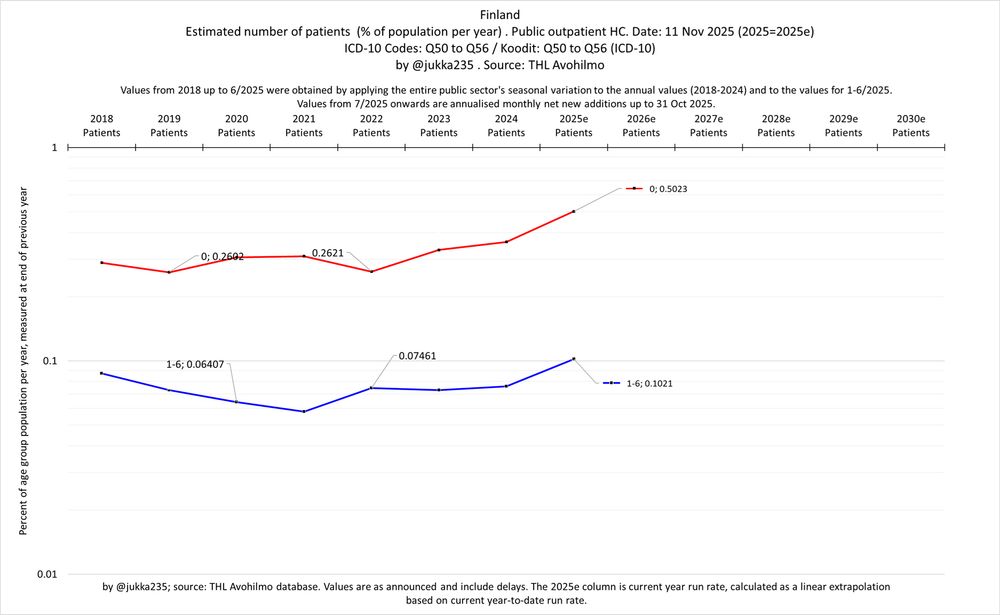
Genital organs (Q50-Q56): currently 0.5 percent of <1 year olds are diagnosed with a congenital malformation or deformation in genital organs. The patient count has been growing at an average rate of 24.2% per year (10x in 10.6 years) (2022-2025e).
14/x
14/x
December 3, 2025 at 8:26 PM
Genital organs (Q50-Q56): currently 0.5 percent of <1 year olds are diagnosed with a congenital malformation or deformation in genital organs. The patient count has been growing at an average rate of 24.2% per year (10x in 10.6 years) (2022-2025e).
14/x
14/x
Digestive system (Q39-Q45): among <1 year olds, estimated average growth rate (2021-2025e) at 33% per year (10x in 8.1 years).
13/x
13/x

December 3, 2025 at 8:12 PM
Digestive system (Q39-Q45): among <1 year olds, estimated average growth rate (2021-2025e) at 33% per year (10x in 8.1 years).
13/x
13/x
Breathing (Q31-Q34) related congenital malformations and deformations:
- the leading condition is congenital malformations of larynx (Q31)
12/x
- the leading condition is congenital malformations of larynx (Q31)
12/x


December 3, 2025 at 7:48 PM
Breathing (Q31-Q34) related congenital malformations and deformations:
- the leading condition is congenital malformations of larynx (Q31)
12/x
- the leading condition is congenital malformations of larynx (Q31)
12/x
Breathing (Q31-Q34) related congenital malformations and deformations:
- <1 year olds: 23.6% growth (10x in 11 years) (2022-2025e)
- 1-6 year olds: 56% average growth (10x in 5.2 years) (2022-2025e)
11/x
- <1 year olds: 23.6% growth (10x in 11 years) (2022-2025e)
- 1-6 year olds: 56% average growth (10x in 5.2 years) (2022-2025e)
11/x

December 3, 2025 at 7:27 PM
Breathing (Q31-Q34) related congenital malformations and deformations:
- <1 year olds: 23.6% growth (10x in 11 years) (2022-2025e)
- 1-6 year olds: 56% average growth (10x in 5.2 years) (2022-2025e)
11/x
- <1 year olds: 23.6% growth (10x in 11 years) (2022-2025e)
- 1-6 year olds: 56% average growth (10x in 5.2 years) (2022-2025e)
11/x
Description of nonrheumatic aortic valve disorders (I35):
4/x
4/x

December 3, 2025 at 9:02 AM
Description of nonrheumatic aortic valve disorders (I35):
4/x
4/x
Here's another graph (same data, linear scale).
2/x
2/x

December 3, 2025 at 9:00 AM
Here's another graph (same data, linear scale).
2/x
2/x
In Finland, among 15-24 year olds, the patient count for aortic valve disorders (ICD-10 code I35) up 21.3% per year (10x in 12 years) (2022-2025e). Public outpatient healthcare.
1/x
1/x

December 3, 2025 at 9:00 AM
In Finland, among 15-24 year olds, the patient count for aortic valve disorders (ICD-10 code I35) up 21.3% per year (10x in 12 years) (2022-2025e). Public outpatient healthcare.
1/x
1/x