


Kari Hoffman
@karihoffman.bsky.social
neuroscientist @vanderbilt studying neural circuit+population rules for creating and deploying knowledge. computational neuroethology.
#1 The Discussions! Best explained by founding member Jim McGaugh.
OK, what did I miss?
parkcitywinterconf.org/register/
6/6
OK, what did I miss?
parkcitywinterconf.org/register/
6/6

December 11, 2025 at 5:07 PM
#1 The Discussions! Best explained by founding member Jim McGaugh.
OK, what did I miss?
parkcitywinterconf.org/register/
6/6
OK, what did I miss?
parkcitywinterconf.org/register/
6/6
#2 Latest, sometimes controversial, findings. Hear unpublished results, hot takes that speakers haven’t yet disclosed to the big crowds. Every year, I hear it here first. During the meeting or after, at the Hotel Bar. 👇
5/6
5/6

December 11, 2025 at 5:07 PM
#2 Latest, sometimes controversial, findings. Hear unpublished results, hot takes that speakers haven’t yet disclosed to the big crowds. Every year, I hear it here first. During the meeting or after, at the Hotel Bar. 👇
5/6
5/6
#5 Activities – and not just skiing. Snowshoeing, hiking, fat tire biking, bougie spas, excursions to the main drag, High West Distillery. Touch gra- well, snow. 👇
2/6
2/6

December 11, 2025 at 5:07 PM
#5 Activities – and not just skiing. Snowshoeing, hiking, fat tire biking, bougie spas, excursions to the main drag, High West Distillery. Touch gra- well, snow. 👇
2/6
2/6
📣Register now for the 50th Anniversary Park City Winter Conference on the Neurobiology of Learning and Memory parkcitywinterconf.org/register/
Deadline tomorrow, Friday, the 12th! Spread the word. 🧠🔬👩🔬
➡️Top 5 reasons to attend:
1/6
Deadline tomorrow, Friday, the 12th! Spread the word. 🧠🔬👩🔬
➡️Top 5 reasons to attend:
1/6

December 11, 2025 at 5:07 PM
📣Register now for the 50th Anniversary Park City Winter Conference on the Neurobiology of Learning and Memory parkcitywinterconf.org/register/
Deadline tomorrow, Friday, the 12th! Spread the word. 🧠🔬👩🔬
➡️Top 5 reasons to attend:
1/6
Deadline tomorrow, Friday, the 12th! Spread the word. 🧠🔬👩🔬
➡️Top 5 reasons to attend:
1/6
Happening now ss3 ss4 dentate spikes, beta, category learning in freely moving 🐒

November 17, 2025 at 4:43 PM
Happening now ss3 ss4 dentate spikes, beta, category learning in freely moving 🐒

November 14, 2025 at 8:45 PM
We agree. KenjiLee your data. @sabbaspoor.bsky.social's version uncovered surprisingly specific spike-field motifs and short latency spike timing interactions in macaque CA1: doi.org/10.1016/j.ce...

May 21, 2025 at 12:26 AM
We agree. KenjiLee your data. @sabbaspoor.bsky.social's version uncovered surprisingly specific spike-field motifs and short latency spike timing interactions in macaque CA1: doi.org/10.1016/j.ce...
Another one in the Krakauer et al., 2017 Neuron perspective: www.cell.com/neuron/fullt...


April 25, 2025 at 11:33 AM
Another one in the Krakauer et al., 2017 Neuron perspective: www.cell.com/neuron/fullt...
Finally, assemblies can flexibly team up (co-activate) during the task and in later sleep, but this propensity depends on pairing with/among OLD (and RECENT) assemblies. This property could allow for selective generalization while preserving constituent representations.

April 15, 2025 at 5:10 PM
Finally, assemblies can flexibly team up (co-activate) during the task and in later sleep, but this propensity depends on pairing with/among OLD (and RECENT) assemblies. This property could allow for selective generalization while preserving constituent representations.
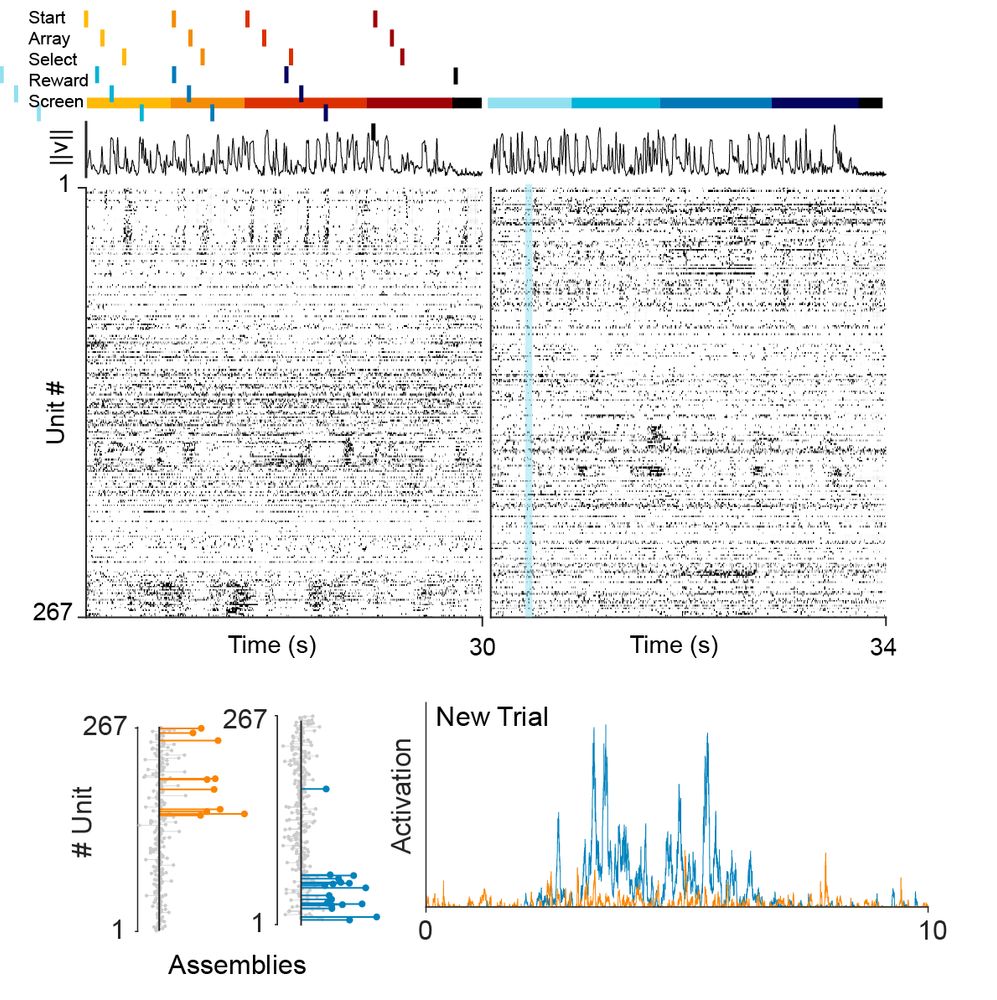
After careful curation of single units from CA1 and connected structures, we identified cell assemblies - repeated patterns of synchronous firing (typically N~100, some approaching 300). Some assemblies were more active in NEW trials, others OLD. But did either or both groups reactivate in sleep?
April 15, 2025 at 5:05 PM
After careful curation of single units from CA1 and connected structures, we identified cell assemblies - repeated patterns of synchronous firing (typically N~100, some approaching 300). Some assemblies were more active in NEW trials, others OLD. But did either or both groups reactivate in sleep?
We recorded wirelessly from high-density probes in freely-moving macaques as they learned item-context sequences. In the same session, they had to remember an OLD sequence, learned weeks earlier, and a NEW sequence learned that day. We came back the next day, too, calling the NEW sequence RECENT).

April 15, 2025 at 5:04 PM
We recorded wirelessly from high-density probes in freely-moving macaques as they learned item-context sequences. In the same session, they had to remember an OLD sequence, learned weeks earlier, and a NEW sequence learned that day. We came back the next day, too, calling the NEW sequence RECENT).
🎉Ach, calretinin+, and more (-) expression in Rh🐒means we can start to connect functional cell groups like here doi.org/10.1016/j.ce... to “omics” cell types, and selectively manipulate circuits! It’s a big deal for understanding population dynamics. Thanks to authors and funders: Brain Initiative!

November 24, 2024 at 3:58 PM
🎉Ach, calretinin+, and more (-) expression in Rh🐒means we can start to connect functional cell groups like here doi.org/10.1016/j.ce... to “omics” cell types, and selectively manipulate circuits! It’s a big deal for understanding population dynamics. Thanks to authors and funders: Brain Initiative!