



Kelly Donegan
@kellydonegan.bsky.social
Cognitive & Mental Health Researcher 🧠
Post-doc @ University of York | PhD @ Trinity College Dublin
➡️ https://sites.google.com/view/kellyrdonegan
Post-doc @ University of York | PhD @ Trinity College Dublin
➡️ https://sites.google.com/view/kellyrdonegan
Reposted by Kelly Donegan

This article is now published in @plosone.org. journals.plos.org/plosone/arti... New analysis added: seemingly habitual responses are explained because contingency deg didn't work for some participants (in line with recent outcome dev results in our lab and in @clairegillan.bsky.social lab)
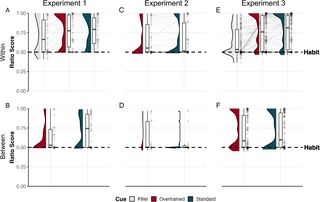
The degraded contingency test fails to detect habit induction in humans
In experimental psychology and behavioral neuroscience, habits are considered stimulus-response (S-R) associations formed through extended reward training. Accordingly, habits are assessed using one o...
journals.plos.org
October 16, 2025 at 7:31 AM
This article is now published in @plosone.org. journals.plos.org/plosone/arti... New analysis added: seemingly habitual responses are explained because contingency deg didn't work for some participants (in line with recent outcome dev results in our lab and in @clairegillan.bsky.social lab)
Reposted by Kelly Donegan

Taken together, our results advance our understanding of the dynamics of fun in realistic environments. They also emphasize the importance of using realistic, game-like environments together with highly-controlled experiments to advance our theories of human motivation & learning.
4/4
4/4
October 2, 2025 at 9:32 AM
Taken together, our results advance our understanding of the dynamics of fun in realistic environments. They also emphasize the importance of using realistic, game-like environments together with highly-controlled experiments to advance our theories of human motivation & learning.
4/4
4/4
Congrats Ondrej & failte to Eire ☘️
September 24, 2025 at 7:08 PM
Congrats Ondrej & failte to Eire ☘️
Finally, a big shoutout to @adrianhaith.bsky.social, @yuedu.bsky.social, Robert Hardwick & co for inspiring this work & the game! 🌟
Happy reading! 🤓☕
Happy reading! 🤓☕
July 28, 2025 at 1:53 PM
Finally, a big shoutout to @adrianhaith.bsky.social, @yuedu.bsky.social, Robert Hardwick & co for inspiring this work & the game! 🌟
Happy reading! 🤓☕
Happy reading! 🤓☕
The good news? If there’s more than one mechanism driving compulsive behaviour, there’s likely more than one way to intervene! We talk about this in our @cp-trendscognsci.bsky.social review @eikekofi.bsky.social @parnianrafei.bsky.social
www.cell.com/trends/cogni...
www.cell.com/trends/cogni...
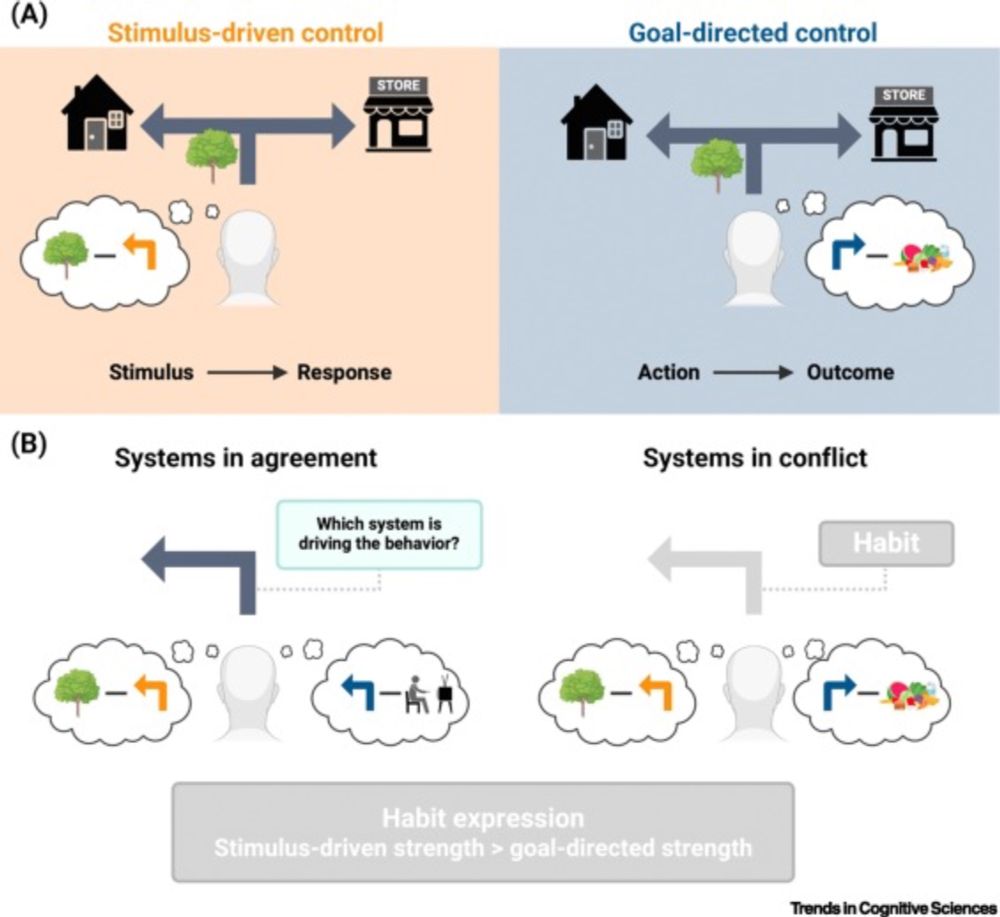
Leveraging cognitive neuroscience for making and breaking real-world habits
Habits are the behavioral output of two brain systems. A stimulus–response (S–R) system
that encourages us to efficiently repeat well-practiced actions in familiar settings,
and a goal-directed system...
www.cell.com
July 28, 2025 at 1:53 PM
The good news? If there’s more than one mechanism driving compulsive behaviour, there’s likely more than one way to intervene! We talk about this in our @cp-trendscognsci.bsky.social review @eikekofi.bsky.social @parnianrafei.bsky.social
www.cell.com/trends/cogni...
www.cell.com/trends/cogni...
People higher in compulsivity made the most habit errors - suggesting stronger habit formation 🏋️♀️
… but so did younger adults, men & those with more education! Because habits aren’t 'bad'. They’re efficient ✅. Until they're not 🚧.
… but so did younger adults, men & those with more education! Because habits aren’t 'bad'. They’re efficient ✅. Until they're not 🚧.

July 28, 2025 at 1:53 PM
People higher in compulsivity made the most habit errors - suggesting stronger habit formation 🏋️♀️
… but so did younger adults, men & those with more education! Because habits aren’t 'bad'. They’re efficient ✅. Until they're not 🚧.
… but so did younger adults, men & those with more education! Because habits aren’t 'bad'. They’re efficient ✅. Until they're not 🚧.
Similar to the lab-based version, we found more habits following extended training. And this effect was time-dependent ⏱️, with habits being revealed when you have to act fast
www.nature.com/articles/s41...
www.nature.com/articles/s41...

Time-dependent competition between goal-directed and habitual response preparation - Nature Human Behaviour
Hardwick et al. show that habits in human behaviour consist of automatic preparation of an action in response to a trigger. Even though we can learn to control habits to perform different action respo...
www.nature.com
July 28, 2025 at 1:53 PM
Similar to the lab-based version, we found more habits following extended training. And this effect was time-dependent ⏱️, with habits being revealed when you have to act fast
www.nature.com/articles/s41...
www.nature.com/articles/s41...
Introducing ... 🥁🥁🥁... COGQUEST
July 28, 2025 at 1:53 PM
Introducing ... 🥁🥁🥁... COGQUEST
Training habits = lots of trials + multiple in-lab visits. Burdensome & inaccessible 🥱🚫 That’s why we gamified a habit task via @clairegillan.bsky.social's Neureka app
1000 people trained habits over a week, while also reporting on their mental health. All without stepping foot inside the lab!
1000 people trained habits over a week, while also reporting on their mental health. All without stepping foot inside the lab!

July 28, 2025 at 1:53 PM
Training habits = lots of trials + multiple in-lab visits. Burdensome & inaccessible 🥱🚫 That’s why we gamified a habit task via @clairegillan.bsky.social's Neureka app
1000 people trained habits over a week, while also reporting on their mental health. All without stepping foot inside the lab!
1000 people trained habits over a week, while also reporting on their mental health. All without stepping foot inside the lab!