



Kyle Meng
@kylemeng.com
Professor at UCSB Bren School and Econ Dept. Climate and Energy Director at emLab. Former White House CEA Senior Climate Economist. Associate at @nber.org @csis.org. Board member @ucsusa.bsky.social. Personal views. www.kylemeng.com
Governor Newsom just reauthorized California’s centerpiece climate policy - cap and invest - for the next two decades, reducing pollution and electricity prices in the world’s 4th biggest economy. This is now the US’ most important climate policy.


September 19, 2025 at 6:16 PM
Governor Newsom just reauthorized California’s centerpiece climate policy - cap and invest - for the next two decades, reducing pollution and electricity prices in the world’s 4th biggest economy. This is now the US’ most important climate policy.
#2: Extends C&T to 2045.
Previous bills sets 10 year periods. And every 10 years the carbon price crashes because of reauthorization uncertainty (as happening now).
Decarbonization investments are made over longer horizons and need more durable policy.
AB 1207 extends C&T from 2030-2045. 4/
Previous bills sets 10 year periods. And every 10 years the carbon price crashes because of reauthorization uncertainty (as happening now).
Decarbonization investments are made over longer horizons and need more durable policy.
AB 1207 extends C&T from 2030-2045. 4/

August 22, 2025 at 7:14 PM
#2: Extends C&T to 2045.
Previous bills sets 10 year periods. And every 10 years the carbon price crashes because of reauthorization uncertainty (as happening now).
Decarbonization investments are made over longer horizons and need more durable policy.
AB 1207 extends C&T from 2030-2045. 4/
Previous bills sets 10 year periods. And every 10 years the carbon price crashes because of reauthorization uncertainty (as happening now).
Decarbonization investments are made over longer horizons and need more durable policy.
AB 1207 extends C&T from 2030-2045. 4/
And it has worked to far.
GHGs, air pollution & their disparities have fallen because of C&T, as my research shows.
Moving forward, it is crucial to reaffirm C&T's foundational elements that ensure affordable GHG reductions and environmental integrity.
This bill reauthorizes those pieces. 3/
GHGs, air pollution & their disparities have fallen because of C&T, as my research shows.
Moving forward, it is crucial to reaffirm C&T's foundational elements that ensure affordable GHG reductions and environmental integrity.
This bill reauthorizes those pieces. 3/

August 22, 2025 at 7:14 PM
And it has worked to far.
GHGs, air pollution & their disparities have fallen because of C&T, as my research shows.
Moving forward, it is crucial to reaffirm C&T's foundational elements that ensure affordable GHG reductions and environmental integrity.
This bill reauthorizes those pieces. 3/
GHGs, air pollution & their disparities have fallen because of C&T, as my research shows.
Moving forward, it is crucial to reaffirm C&T's foundational elements that ensure affordable GHG reductions and environmental integrity.
This bill reauthorizes those pieces. 3/
What about US govt revenue?
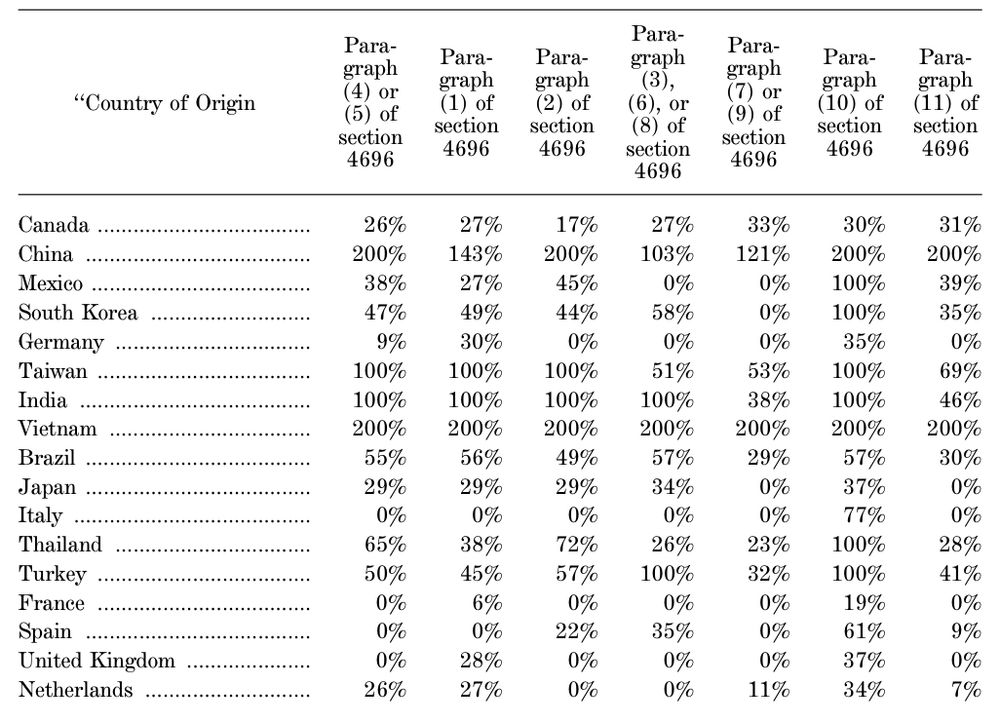
Authors' cite their calculation that FPFA raises $198B over 5 years.
But their accounting exercise makes a crucial assumption: trade volumes don't change under carbon tariffs.
FPFA increase tariffs on some goods by 100%!
Will imports really not fall? 4/
Authors' cite their calculation that FPFA raises $198B over 5 years.
But their accounting exercise makes a crucial assumption: trade volumes don't change under carbon tariffs.
FPFA increase tariffs on some goods by 100%!
Will imports really not fall? 4/
June 24, 2025 at 7:15 AM
What about US govt revenue?
Authors' cite their calculation that FPFA raises $198B over 5 years.
But their accounting exercise makes a crucial assumption: trade volumes don't change under carbon tariffs.
FPFA increase tariffs on some goods by 100%!
Will imports really not fall? 4/
Authors' cite their calculation that FPFA raises $198B over 5 years.
But their accounting exercise makes a crucial assumption: trade volumes don't change under carbon tariffs.
FPFA increase tariffs on some goods by 100%!
Will imports really not fall? 4/
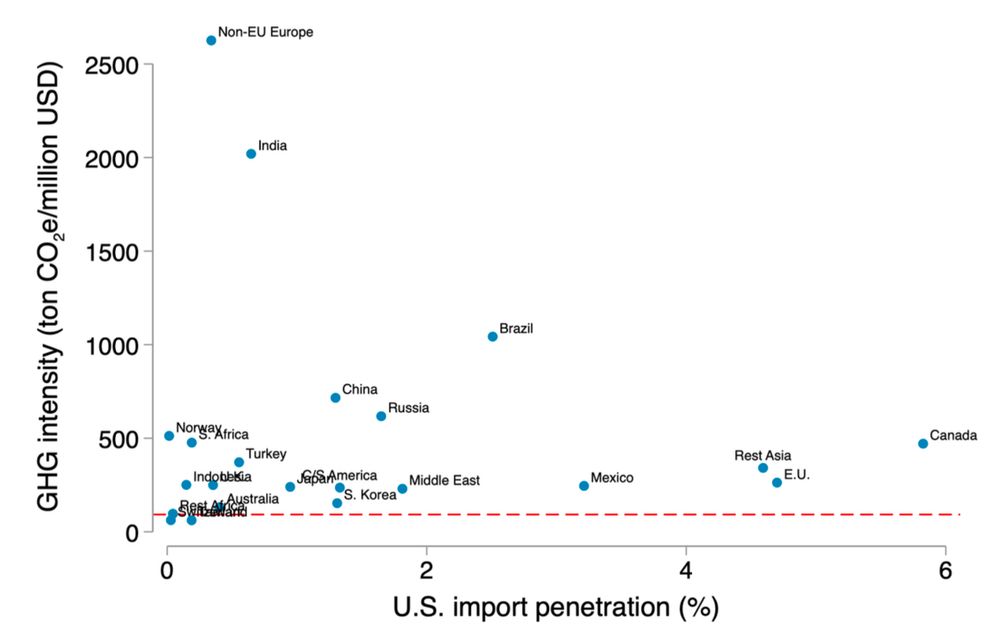
Look at iron/steel. This scatter from my upcoming paper plots country GHG intensities vs U.S. import penetration for iron/steel.
PRC imports serves <2% of U.S. consumption. And PRC consumes 94% of own iron/steel.
So trade too little for U.S. carbon tariffs to have much leverage. 3/
PRC imports serves <2% of U.S. consumption. And PRC consumes 94% of own iron/steel.
So trade too little for U.S. carbon tariffs to have much leverage. 3/
June 24, 2025 at 7:15 AM
Look at iron/steel. This scatter from my upcoming paper plots country GHG intensities vs U.S. import penetration for iron/steel.
PRC imports serves <2% of U.S. consumption. And PRC consumes 94% of own iron/steel.
So trade too little for U.S. carbon tariffs to have much leverage. 3/
PRC imports serves <2% of U.S. consumption. And PRC consumes 94% of own iron/steel.
So trade too little for U.S. carbon tariffs to have much leverage. 3/
June 7, 2025 at 5:19 AM
California electricity prices are too high, even accounting for GHG and air pollution damages from the power sector. Comparison from latest IEMAC report below.
Climate policy costs itself plays a small role. Much of increased prices are from higher distribution costs, such as from wildfires. 2/
Climate policy costs itself plays a small role. Much of increased prices are from higher distribution costs, such as from wildfires. 2/

June 6, 2025 at 10:14 PM
California electricity prices are too high, even accounting for GHG and air pollution damages from the power sector. Comparison from latest IEMAC report below.
Climate policy costs itself plays a small role. Much of increased prices are from higher distribution costs, such as from wildfires. 2/
Climate policy costs itself plays a small role. Much of increased prices are from higher distribution costs, such as from wildfires. 2/
These price reductions would be larger with more
funding, either from additional C&T permit revenue or
other state funds.
Figure shows reductions for any funding amount.
Subsidies can also target
different populations and times of year. 5/
funding, either from additional C&T permit revenue or
other state funds.
Figure shows reductions for any funding amount.
Subsidies can also target
different populations and times of year. 5/

May 19, 2025 at 8:35 PM
These price reductions would be larger with more
funding, either from additional C&T permit revenue or
other state funds.
Figure shows reductions for any funding amount.
Subsidies can also target
different populations and times of year. 5/
funding, either from additional C&T permit revenue or
other state funds.
Figure shows reductions for any funding amount.
Subsidies can also target
different populations and times of year. 5/
California electricity prices are too high, even taking into account climate and pollution damages. This makes it harder for folks to afford their energy bills & discourage the switch to cleaner electric options like electric cars, heat pumps, and other appliances (Fig from latest IEMAC report). 2/

May 19, 2025 at 8:35 PM
California electricity prices are too high, even taking into account climate and pollution damages. This makes it harder for folks to afford their energy bills & discourage the switch to cleaner electric options like electric cars, heat pumps, and other appliances (Fig from latest IEMAC report). 2/
85% of countries experience lower GHGs as a result of this feedback.
For a sense of magnitude, adaptation-induced GHG cuts lower what these countries must do to meet Paris GHG commitments by 20%.
This "free" abatement suggests Paris commitments need to be more stringent. 4/
For a sense of magnitude, adaptation-induced GHG cuts lower what these countries must do to meet Paris GHG commitments by 20%.
This "free" abatement suggests Paris commitments need to be more stringent. 4/

May 2, 2025 at 7:12 AM
85% of countries experience lower GHGs as a result of this feedback.
For a sense of magnitude, adaptation-induced GHG cuts lower what these countries must do to meet Paris GHG commitments by 20%.
This "free" abatement suggests Paris commitments need to be more stringent. 4/
For a sense of magnitude, adaptation-induced GHG cuts lower what these countries must do to meet Paris GHG commitments by 20%.
This "free" abatement suggests Paris commitments need to be more stringent. 4/
How could this be? Climate change increases summer demand for cooling & lowers winter demand for heating.
Depending on a place's energy mix, GHGs can go up or down.
After summing local impacts across the planet using high resolution data, we find total energy-based adaptation lowers GHGs. 3/
Depending on a place's energy mix, GHGs can go up or down.
After summing local impacts across the planet using high resolution data, we find total energy-based adaptation lowers GHGs. 3/

May 2, 2025 at 7:12 AM
How could this be? Climate change increases summer demand for cooling & lowers winter demand for heating.
Depending on a place's energy mix, GHGs can go up or down.
After summing local impacts across the planet using high resolution data, we find total energy-based adaptation lowers GHGs. 3/
Depending on a place's energy mix, GHGs can go up or down.
After summing local impacts across the planet using high resolution data, we find total energy-based adaptation lowers GHGs. 3/
The answer? This feedback is actually negative.
Energy-based adaptation around the planet lowers global temperatures by 0.07 to 0.12C in 2099.
This adaptation-induced cooling avoids $0.6 to $1.8 trillion in damages between 2020-2099. 2/
Energy-based adaptation around the planet lowers global temperatures by 0.07 to 0.12C in 2099.
This adaptation-induced cooling avoids $0.6 to $1.8 trillion in damages between 2020-2099. 2/

May 2, 2025 at 7:12 AM
The answer? This feedback is actually negative.
Energy-based adaptation around the planet lowers global temperatures by 0.07 to 0.12C in 2099.
This adaptation-induced cooling avoids $0.6 to $1.8 trillion in damages between 2020-2099. 2/
Energy-based adaptation around the planet lowers global temperatures by 0.07 to 0.12C in 2099.
This adaptation-induced cooling avoids $0.6 to $1.8 trillion in damages between 2020-2099. 2/
Aggregate US prices rise by 5%. Sectors with >8% US price increase are metals, clothing, electronics, food, chemicals, and other industrial products. /n

April 10, 2025 at 4:53 PM
Aggregate US prices rise by 5%. Sectors with >8% US price increase are metals, clothing, electronics, food, chemicals, and other industrial products. /n
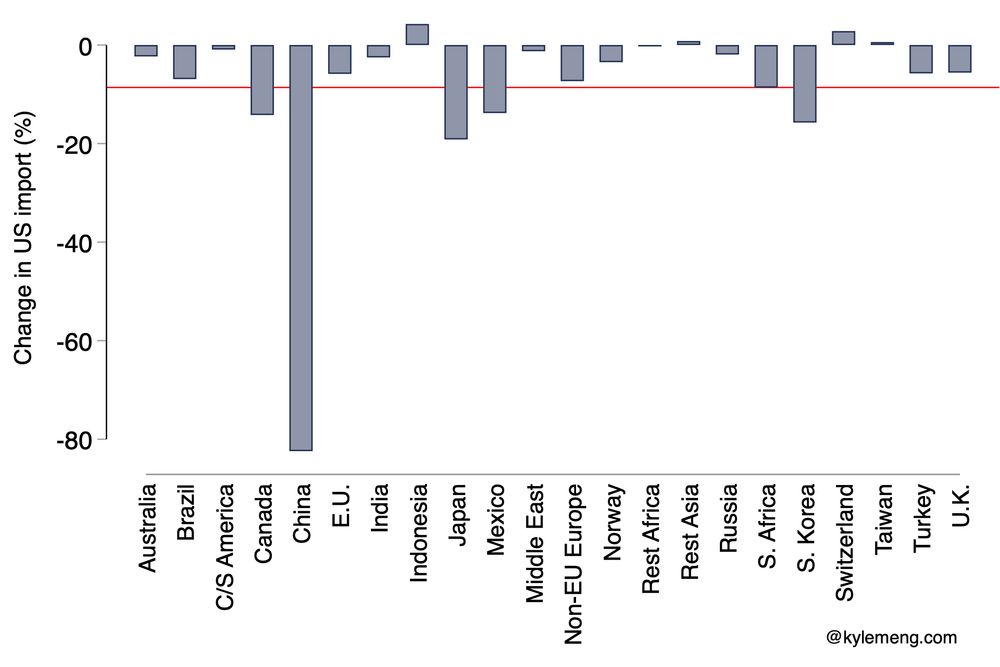
US imports from PRC fall by 82%, but still >10% drop from Canada, Mexico, Japan, and S. Korea because of 10% universal + 25% sectoral tariffs.
US and Mexico GDP fall by 0.8%, followed by drop of 0.5% in Canada and 0.3% in PRC. 2/
US and Mexico GDP fall by 0.8%, followed by drop of 0.5% in Canada and 0.3% in PRC. 2/

April 10, 2025 at 4:53 PM
US imports from PRC fall by 82%, but still >10% drop from Canada, Mexico, Japan, and S. Korea because of 10% universal + 25% sectoral tariffs.
US and Mexico GDP fall by 0.8%, followed by drop of 0.5% in Canada and 0.3% in PRC. 2/
US and Mexico GDP fall by 0.8%, followed by drop of 0.5% in Canada and 0.3% in PRC. 2/
Latest rapid GE trade modeling run: 145% PRC tariffs, 10% universal tariffs, 25% steel/alum/cars tariffs, 84% PRC retaliation
Headline: US GDP falls 0.8%, US prices rise 5%, $220B revenue
How are other countries affected? Which sectors see highest US price increases? 🧵 1/
#econsky
Headline: US GDP falls 0.8%, US prices rise 5%, $220B revenue
How are other countries affected? Which sectors see highest US price increases? 🧵 1/
#econsky

April 10, 2025 at 4:53 PM
Latest rapid GE trade modeling run: 145% PRC tariffs, 10% universal tariffs, 25% steel/alum/cars tariffs, 84% PRC retaliation
Headline: US GDP falls 0.8%, US prices rise 5%, $220B revenue
How are other countries affected? Which sectors see highest US price increases? 🧵 1/
#econsky
Headline: US GDP falls 0.8%, US prices rise 5%, $220B revenue
How are other countries affected? Which sectors see highest US price increases? 🧵 1/
#econsky
(4) Let's dive deeper into price increases in the US.
Left fig. shows distribution of US price increases by sector. Right fig. shows sectors with the highest increases. Note lots of intermediate goods which will translate onto higher final good prices (we don't model input-output linkages).
Left fig. shows distribution of US price increases by sector. Right fig. shows sectors with the highest increases. Note lots of intermediate goods which will translate onto higher final good prices (we don't model input-output linkages).


April 3, 2025 at 7:50 PM
(4) Let's dive deeper into price increases in the US.
Left fig. shows distribution of US price increases by sector. Right fig. shows sectors with the highest increases. Note lots of intermediate goods which will translate onto higher final good prices (we don't model input-output linkages).
Left fig. shows distribution of US price increases by sector. Right fig. shows sectors with the highest increases. Note lots of intermediate goods which will translate onto higher final good prices (we don't model input-output linkages).
(3) What about country prices and GDP?
Prices fall everywhere except for the US, where the average price increase is 9.6%.
GDP falls in most places with US GDP decreasing by 1%.
Prices fall everywhere except for the US, where the average price increase is 9.6%.
GDP falls in most places with US GDP decreasing by 1%.


April 3, 2025 at 7:50 PM
(3) What about country prices and GDP?
Prices fall everywhere except for the US, where the average price increase is 9.6%.
GDP falls in most places with US GDP decreasing by 1%.
Prices fall everywhere except for the US, where the average price increase is 9.6%.
GDP falls in most places with US GDP decreasing by 1%.
(2) What happens to US imports?
Country-level change in US imports correlated with tariff. We see large 20-40% drops. But some countries/regions with low or zero tariffs (e.g., Russia) will import more to the US.
Country-level change in US imports correlated with tariff. We see large 20-40% drops. But some countries/regions with low or zero tariffs (e.g., Russia) will import more to the US.


April 3, 2025 at 7:50 PM
(2) What happens to US imports?
Country-level change in US imports correlated with tariff. We see large 20-40% drops. But some countries/regions with low or zero tariffs (e.g., Russia) will import more to the US.
Country-level change in US imports correlated with tariff. We see large 20-40% drops. But some countries/regions with low or zero tariffs (e.g., Russia) will import more to the US.
(1) Rapid GE trade modeling returns for April 2nd tariffs.
We model: April 2nd tariffs + 25% on CAN/MEX imports + 20% on PRC imports + 25% on iron/steel/alum/cars.
Fig. shows total tariff by country. Avg. is 20.4%, about 10X pre-Trump rates.
What are US and foreign country impacts?
We model: April 2nd tariffs + 25% on CAN/MEX imports + 20% on PRC imports + 25% on iron/steel/alum/cars.
Fig. shows total tariff by country. Avg. is 20.4%, about 10X pre-Trump rates.
What are US and foreign country impacts?

April 3, 2025 at 7:50 PM
(1) Rapid GE trade modeling returns for April 2nd tariffs.
We model: April 2nd tariffs + 25% on CAN/MEX imports + 20% on PRC imports + 25% on iron/steel/alum/cars.
Fig. shows total tariff by country. Avg. is 20.4%, about 10X pre-Trump rates.
What are US and foreign country impacts?
We model: April 2nd tariffs + 25% on CAN/MEX imports + 20% on PRC imports + 25% on iron/steel/alum/cars.
Fig. shows total tariff by country. Avg. is 20.4%, about 10X pre-Trump rates.
What are US and foreign country impacts?
Here is actual recent ad-valorem tariffs on US exports by partner country from WITS (2.4=2.4%). Shown are simple averages across sectors for AHS and MFN rates.
Actual rates are an order of magnitude smaller than Trump claims. Adding other trade barriers and manipulation won't increase much. 2/
Actual rates are an order of magnitude smaller than Trump claims. Adding other trade barriers and manipulation won't increase much. 2/

April 2, 2025 at 11:28 PM
Here is actual recent ad-valorem tariffs on US exports by partner country from WITS (2.4=2.4%). Shown are simple averages across sectors for AHS and MFN rates.
Actual rates are an order of magnitude smaller than Trump claims. Adding other trade barriers and manipulation won't increase much. 2/
Actual rates are an order of magnitude smaller than Trump claims. Adding other trade barriers and manipulation won't increase much. 2/
Puzzled by where Trump's numbers on tariffs charged on US exports come from?
Do they seem oddly high? Especially given all this talk about how trade is too liberalized?
What are actual tariffs charged on US exports? 1/
@econsky
Do they seem oddly high? Especially given all this talk about how trade is too liberalized?
What are actual tariffs charged on US exports? 1/
@econsky

April 2, 2025 at 11:28 PM
Puzzled by where Trump's numbers on tariffs charged on US exports come from?
Do they seem oddly high? Especially given all this talk about how trade is too liberalized?
What are actual tariffs charged on US exports? 1/
@econsky
Do they seem oddly high? Especially given all this talk about how trade is too liberalized?
What are actual tariffs charged on US exports? 1/
@econsky

Seen alongside Las Vegas highway. A message from Canada. Is this service trade itself tariffed?

March 25, 2025 at 7:33 PM
Seen alongside Las Vegas highway. A message from Canada. Is this service trade itself tariffed?
But CT also did something very smart during the drought.
It introduced income-varying fixed charges!
Fixed charges, which economists have long argued for efficiency reasons, led to more equal cost sharing after the drought. 9/
It introduced income-varying fixed charges!
Fixed charges, which economists have long argued for efficiency reasons, led to more equal cost sharing after the drought. 9/

February 18, 2025 at 5:55 PM
But CT also did something very smart during the drought.
It introduced income-varying fixed charges!
Fixed charges, which economists have long argued for efficiency reasons, led to more equal cost sharing after the drought. 9/
It introduced income-varying fixed charges!
Fixed charges, which economists have long argued for efficiency reasons, led to more equal cost sharing after the drought. 9/
Exhibit 4: Groundwater depths
We also see groundwater tables falling much faster during the drought in richer neighborhoods.
This drop of about 1 meter/year in groundwater levels rivals that of some of the fastest depleting aquifers in the world. 8/
We also see groundwater tables falling much faster during the drought in richer neighborhoods.
This drop of about 1 meter/year in groundwater levels rivals that of some of the fastest depleting aquifers in the world. 8/

February 18, 2025 at 5:55 PM
Exhibit 4: Groundwater depths
We also see groundwater tables falling much faster during the drought in richer neighborhoods.
This drop of about 1 meter/year in groundwater levels rivals that of some of the fastest depleting aquifers in the world. 8/
We also see groundwater tables falling much faster during the drought in richer neighborhoods.
This drop of about 1 meter/year in groundwater levels rivals that of some of the fastest depleting aquifers in the world. 8/