




Mapologies
@mapologies.bsky.social
Maps and mops are my obsession.
Share & comment to improve our blog:
www.mapologies.com
Support us:
http://ko-fi.com/mapologies
#language 📞 #tvseries 📺 #etymology 🐣 #geography 🌐 #maps 🗺 #history ⏰️ #cartoo
Share & comment to improve our blog:
www.mapologies.com
Support us:
http://ko-fi.com/mapologies
#language 📞 #tvseries 📺 #etymology 🐣 #geography 🌐 #maps 🗺 #history ⏰️ #cartoo
“Cat” is a word with a uniform spread: Ukrainian kit (кіт) or Estonian kass trace back to the same root as English, possibly of Afro-Asiatic origin. Exceptions: In the Balkans, from maca, likely onomatopoetic, and in West Asia, where there is a Turkic root.
mapologies.com/animals/
mapologies.com/animals/

December 7, 2025 at 5:37 PM
“Cat” is a word with a uniform spread: Ukrainian kit (кіт) or Estonian kass trace back to the same root as English, possibly of Afro-Asiatic origin. Exceptions: In the Balkans, from maca, likely onomatopoetic, and in West Asia, where there is a Turkic root.
mapologies.com/animals/
mapologies.com/animals/
Don’t you think it’s time for a cinnamon latte? Interestingly, the word cinnamon comes from Latin, which took it from the Greek κίνναμον (kínnamon), a name that’s been around since antiquity.
mapologies.com/spices
mapologies.com/spices

December 2, 2025 at 11:36 AM
Don’t you think it’s time for a cinnamon latte? Interestingly, the word cinnamon comes from Latin, which took it from the Greek κίνναμον (kínnamon), a name that’s been around since antiquity.
mapologies.com/spices
mapologies.com/spices
Only a few languages do not know him as Donald Duck: Italian “Paolino” is translated as Paul; Danish “Anders” is Andrew; in Swedish “Kalle” is Carl, in Finnish “Aku” is Augustin; “Paško” is Pascal, and in Slovenian “Jaka” is Jacob or James.
mapologies.com/cartoons/
mapologies.com/cartoons/

November 24, 2025 at 8:05 PM
Only a few languages do not know him as Donald Duck: Italian “Paolino” is translated as Paul; Danish “Anders” is Andrew; in Swedish “Kalle” is Carl, in Finnish “Aku” is Augustin; “Paško” is Pascal, and in Slovenian “Jaka” is Jacob or James.
mapologies.com/cartoons/
mapologies.com/cartoons/
"What am I seeing here? is it a boat or a duck?"
This situation must have been fairly common in the past, since the etymological origin of the French word for “duck” (canard or cane) comes from a Proto-Germanic term meaning boat or vessel.
mapologies.com/animals/
This situation must have been fairly common in the past, since the etymological origin of the French word for “duck” (canard or cane) comes from a Proto-Germanic term meaning boat or vessel.
mapologies.com/animals/

November 21, 2025 at 10:54 AM
"What am I seeing here? is it a boat or a duck?"
This situation must have been fairly common in the past, since the etymological origin of the French word for “duck” (canard or cane) comes from a Proto-Germanic term meaning boat or vessel.
mapologies.com/animals/
This situation must have been fairly common in the past, since the etymological origin of the French word for “duck” (canard or cane) comes from a Proto-Germanic term meaning boat or vessel.
mapologies.com/animals/
Second part of beer's three ingredients: Hops
mapologies.com/flowers/
mapologies.com/flowers/

November 15, 2025 at 5:16 PM
Second part of beer's three ingredients: Hops
mapologies.com/flowers/
mapologies.com/flowers/
One of the beer's three ingredients
mapologies.com/cereals/
mapologies.com/cereals/

November 8, 2025 at 9:36 AM
One of the beer's three ingredients
mapologies.com/cereals/
mapologies.com/cereals/
During the era when Arabs were in the Iberian Peninsula, many words and cultural elements were introduced into the Spanish language: “calabaza” is one of those examples, from Arabic قَرْعَة يَابِسَة (qarʕa yābisa) “dry gourd”, from Persian خربزه (xarboza, xarboze) “melon”.
mapologies.com/el-atlas/#Pu...
mapologies.com/el-atlas/#Pu...

November 5, 2025 at 9:10 AM
During the era when Arabs were in the Iberian Peninsula, many words and cultural elements were introduced into the Spanish language: “calabaza” is one of those examples, from Arabic قَرْعَة يَابِسَة (qarʕa yābisa) “dry gourd”, from Persian خربزه (xarboza, xarboze) “melon”.
mapologies.com/el-atlas/#Pu...
mapologies.com/el-atlas/#Pu...

October 31, 2025 at 2:46 PM
#Halloween's vegetable #pumpkin originates from French pompon, Latin pepo, from the Greek pepon (πέπων), meaning “ripe.” This shared etymology connects the word pumpkin to terms for “melon” in several Balkan languages: Bulgarian пъпеш (păpeš) or Romanian pepene.
mapologies.com/fruits/
mapologies.com/fruits/

October 29, 2025 at 11:31 AM
#Halloween's vegetable #pumpkin originates from French pompon, Latin pepo, from the Greek pepon (πέπων), meaning “ripe.” This shared etymology connects the word pumpkin to terms for “melon” in several Balkan languages: Bulgarian пъпеш (păpeš) or Romanian pepene.
mapologies.com/fruits/
mapologies.com/fruits/
Mustard is a Latin word present in many languages, for example, Portuguese mostarda, Hungarian mustár, or Greek μουστάρδα (moustárda). Romans used a condiment called mustum ardens “burning must”, made by grinding the seeds and mixing them with must, unfermented grape juice.
mapologies.com/spices/
mapologies.com/spices/

October 27, 2025 at 11:49 AM
Mustard is a Latin word present in many languages, for example, Portuguese mostarda, Hungarian mustár, or Greek μουστάρδα (moustárda). Romans used a condiment called mustum ardens “burning must”, made by grinding the seeds and mixing them with must, unfermented grape juice.
mapologies.com/spices/
mapologies.com/spices/
Lilac originated from the Persian word lilak, which spread to Europe during the Arab expansion. Also known as Syringa vulgaris, whih has a different origin: it derives from the Ancient Greek σῦριγξ (sûrinx), meaning “pipe” or “flute".
mapologies.com/flowers
mapologies.com/flowers

October 24, 2025 at 10:16 AM
Lilac originated from the Persian word lilak, which spread to Europe during the Arab expansion. Also known as Syringa vulgaris, whih has a different origin: it derives from the Ancient Greek σῦριγξ (sûrinx), meaning “pipe” or “flute".
mapologies.com/flowers
mapologies.com/flowers
The nuts of oak are called agern in Danish, & as English acorn, comes from Proto-Germanic akraną. This is not universal among Germanic languages: For example, German prefers Eichel, a diminutive derived from Eiche “oak,” & Norwegian uses eikenøtt, literally “oak-nut.”
mapologies.com/nuts
mapologies.com/nuts

October 19, 2025 at 6:56 AM
The nuts of oak are called agern in Danish, & as English acorn, comes from Proto-Germanic akraną. This is not universal among Germanic languages: For example, German prefers Eichel, a diminutive derived from Eiche “oak,” & Norwegian uses eikenøtt, literally “oak-nut.”
mapologies.com/nuts
mapologies.com/nuts
This season can be called autumn, fall or harverst. The first is connected to other Romance languages: Italian “autunno,” French “automne,” and Spanish “otoño.” These words all trace back to the Latin “auctumnus.”
mapologies.com/time/
mapologies.com/time/

October 12, 2025 at 8:36 AM
This season can be called autumn, fall or harverst. The first is connected to other Romance languages: Italian “autunno,” French “automne,” and Spanish “otoño.” These words all trace back to the Latin “auctumnus.”
mapologies.com/time/
mapologies.com/time/
In Spanish, the hummingbird is commonly referred to as “colibrí,” yet diverse regions offer alternative names. In Mexico, it’s known as “chuparrosa” and “chupamiel”. In the South America, it is called “picaflor,” while in the northern areas, “chupaflor” is more common.
mapologies.com/el-atlas
mapologies.com/el-atlas

September 29, 2025 at 5:53 AM
In Spanish, the hummingbird is commonly referred to as “colibrí,” yet diverse regions offer alternative names. In Mexico, it’s known as “chuparrosa” and “chupamiel”. In the South America, it is called “picaflor,” while in the northern areas, “chupaflor” is more common.
mapologies.com/el-atlas
mapologies.com/el-atlas
I really feel my oats after posting this map #mapologies #map #etymology #etymologymap #languagemap #cereals #languages #mapping #oats
www.maplogies.com/cereals
www.maplogies.com/cereals

September 11, 2025 at 8:06 PM
I really feel my oats after posting this map #mapologies #map #etymology #etymologymap #languagemap #cereals #languages #mapping #oats
www.maplogies.com/cereals
www.maplogies.com/cereals
pig, swine, pork... are some of the words used to name "pigs". Which one do you use in your language?
mapologies.com/animals/
#animal #etymology #etymologymap #languages
mapologies.com/animals/
#animal #etymology #etymologymap #languages

September 4, 2025 at 2:34 PM
pig, swine, pork... are some of the words used to name "pigs". Which one do you use in your language?
mapologies.com/animals/
#animal #etymology #etymologymap #languages
mapologies.com/animals/
#animal #etymology #etymologymap #languages
Like wheat, millet has a rich variety of etymological roots: In the West, Latin milium. In the North, the Germanic hirsijo —except in English. In the East, there are two main Slavic roots: proso and pьšeno. Further east, the Turkic tarig and Proto-Semitic root tahan.
mapologies.com/cereals/
mapologies.com/cereals/

August 30, 2025 at 6:35 AM
Like wheat, millet has a rich variety of etymological roots: In the West, Latin milium. In the North, the Germanic hirsijo —except in English. In the East, there are two main Slavic roots: proso and pьšeno. Further east, the Turkic tarig and Proto-Semitic root tahan.
mapologies.com/cereals/
mapologies.com/cereals/
In English, the term “Guinea“ was commonly used to describe exotic places. Another possibility is that it is a corruption of “Guiana”, a region in South America. Interestingly, some languages associate the animal with India: in French, cochon d’Inde “pig of India”
mapologies.com/animals/
mapologies.com/animals/

August 26, 2025 at 7:29 PM
In English, the term “Guinea“ was commonly used to describe exotic places. Another possibility is that it is a corruption of “Guiana”, a region in South America. Interestingly, some languages associate the animal with India: in French, cochon d’Inde “pig of India”
mapologies.com/animals/
mapologies.com/animals/
Tea takes on various forms in different languages, yet all trace back to Chinese 茶. In the West from Dutch “thee", from Hokkien 茶 (tê). Similarly, the Portuguese word “cha” has connections through Cantonese 茶 (caa). Both come from Proto-Sino-Tibetan *s-la.
mapologies.com/herbs
mapologies.com/herbs

August 22, 2025 at 8:42 AM
Tea takes on various forms in different languages, yet all trace back to Chinese 茶. In the West from Dutch “thee", from Hokkien 茶 (tê). Similarly, the Portuguese word “cha” has connections through Cantonese 茶 (caa). Both come from Proto-Sino-Tibetan *s-la.
mapologies.com/herbs
mapologies.com/herbs
In most languages it is referred to as a “cabbage flower.” English cauliflower developed from Middle English cole-florye “cole-flower”. German presents an interesting case, as it has two common terms: Blumenkohl (Literally “flower-cabbage”), and Karfiol, an Italian borrowing.
mapologies.com/flowers/
mapologies.com/flowers/

August 18, 2025 at 10:48 AM
In most languages it is referred to as a “cabbage flower.” English cauliflower developed from Middle English cole-florye “cole-flower”. German presents an interesting case, as it has two common terms: Blumenkohl (Literally “flower-cabbage”), and Karfiol, an Italian borrowing.
mapologies.com/flowers/
mapologies.com/flowers/
Armadillos are a group of mammals in the order Cingulata. What are they called in different Spanish countries?
mapologies.com/el-atlas
#map #mapologies #armadillo #tatu #armour #armed #animal #etymology #animal #mamal #spanish #languages
mapologies.com/el-atlas
#map #mapologies #armadillo #tatu #armour #armed #animal #etymology #animal #mamal #spanish #languages

August 14, 2025 at 8:42 AM
Armadillos are a group of mammals in the order Cingulata. What are they called in different Spanish countries?
mapologies.com/el-atlas
#map #mapologies #armadillo #tatu #armour #armed #animal #etymology #animal #mamal #spanish #languages
mapologies.com/el-atlas
#map #mapologies #armadillo #tatu #armour #armed #animal #etymology #animal #mamal #spanish #languages
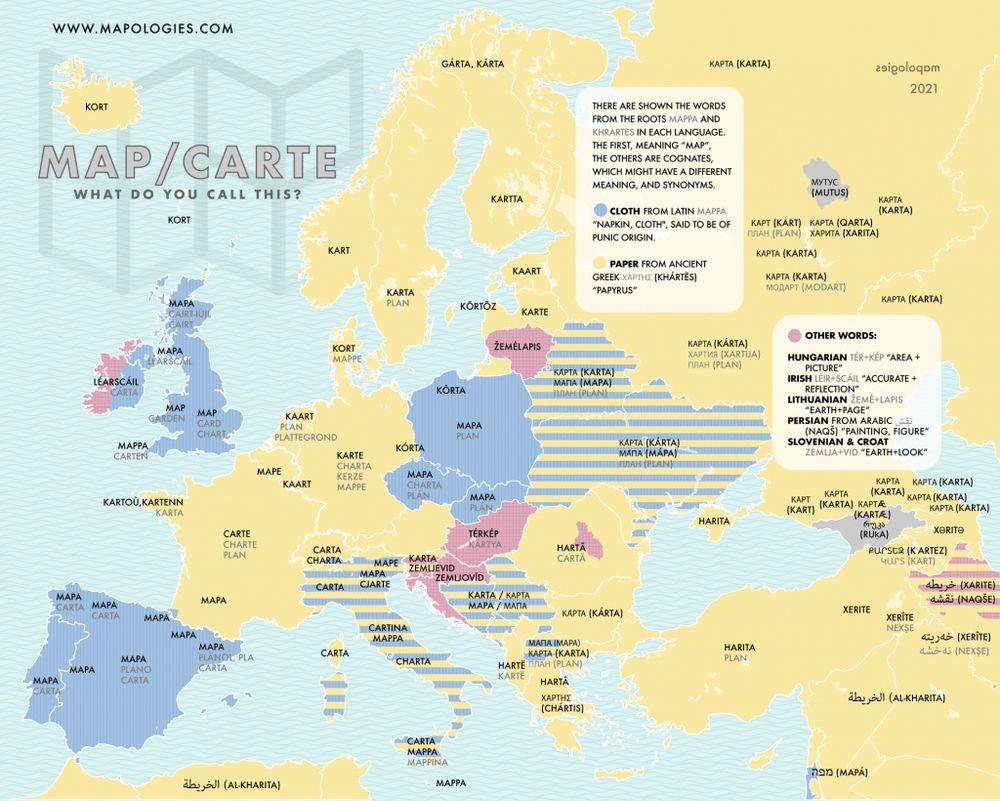
The first root comes from the Latin mappa, meaning “cloth” or “napkin.” This word might have been of Punic origin originally.
The second root comes from the Greek khartes (χάρτης), meaning “papyrus”. This root is found in English words like chart or card.
mapologies.com/map-carte/
The second root comes from the Greek khartes (χάρτης), meaning “papyrus”. This root is found in English words like chart or card.
mapologies.com/map-carte/
August 9, 2025 at 7:33 AM
The first root comes from the Latin mappa, meaning “cloth” or “napkin.” This word might have been of Punic origin originally.
The second root comes from the Greek khartes (χάρτης), meaning “papyrus”. This root is found in English words like chart or card.
mapologies.com/map-carte/
The second root comes from the Greek khartes (χάρτης), meaning “papyrus”. This root is found in English words like chart or card.
mapologies.com/map-carte/
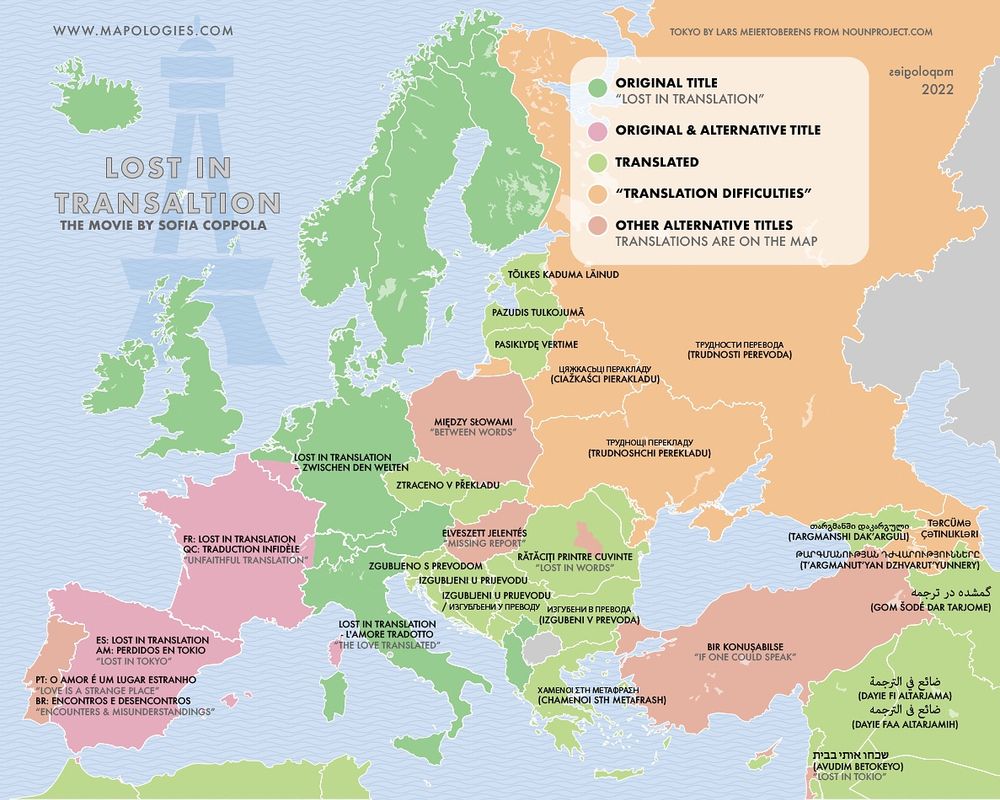
In the summer of 2003 the movie “Lost in transalation was released. Don't be misled by the title.
mapologies.com/film/
mapologies.com/film/
August 3, 2025 at 12:15 PM
In the summer of 2003 the movie “Lost in transalation was released. Don't be misled by the title.
mapologies.com/film/
mapologies.com/film/
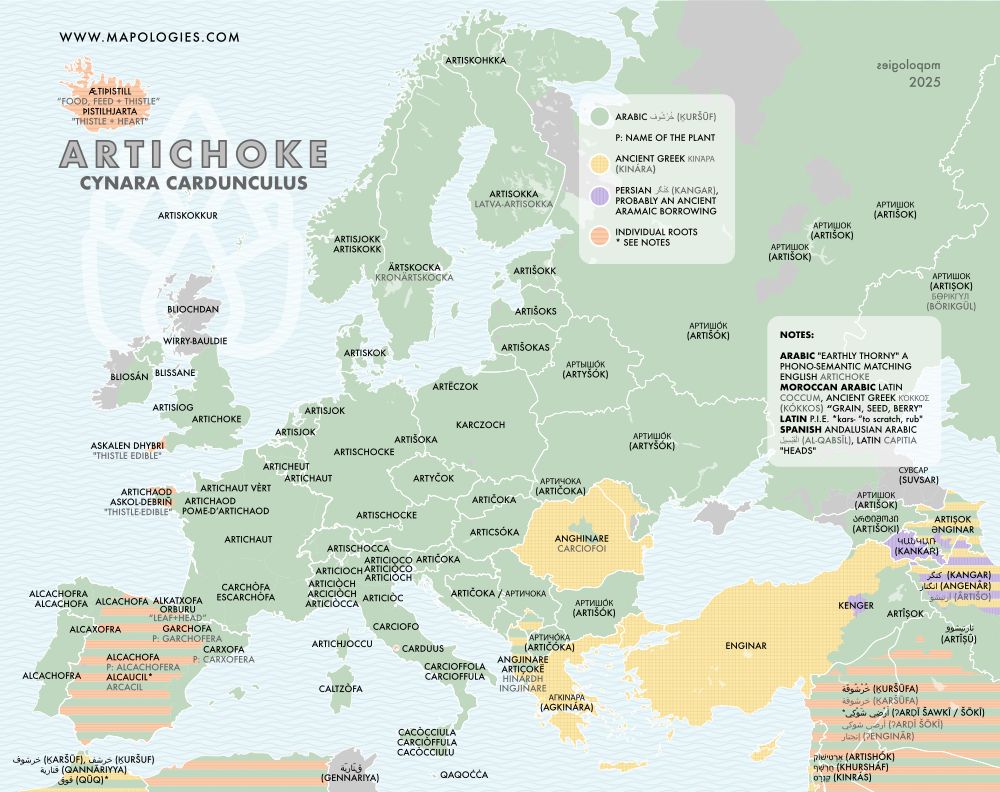
The word artichoke is a true linguistic traveler: The English likely derives from artichaut or articiocco, from Old Spanish alcarchofa, which was borrowed from the Arabic al-ḥaršūfa.
More maps:
mapologies.com/flowers/
More maps:
mapologies.com/flowers/
July 31, 2025 at 5:29 PM
The word artichoke is a true linguistic traveler: The English likely derives from artichaut or articiocco, from Old Spanish alcarchofa, which was borrowed from the Arabic al-ḥaršūfa.
More maps:
mapologies.com/flowers/
More maps:
mapologies.com/flowers/
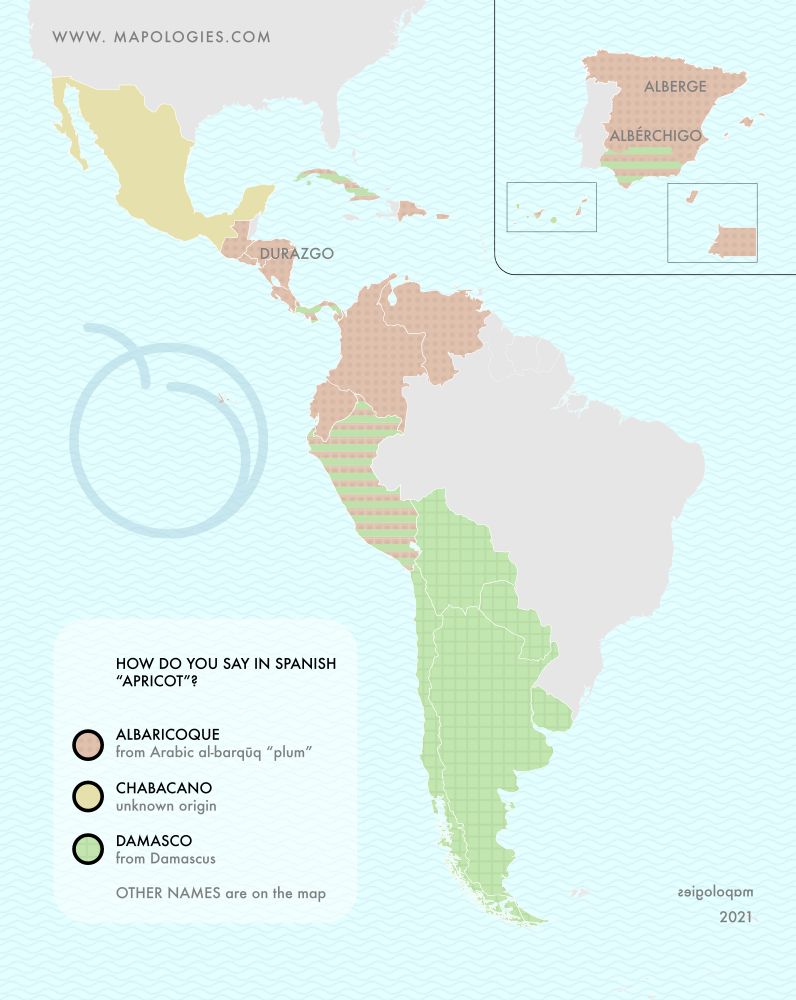
The arrival of Muslims in medieval Spain was not merely a propagation of a new religion; it also introduced a new fruit known as “al-barqūq” (الْبَرْقُوق), which translates to plum. Arabs adopted the term from Greek, and Greeks borrowed it from Latin.
mapologies.com/el-atlas/
mapologies.com/el-atlas/
July 28, 2025 at 5:01 AM
The arrival of Muslims in medieval Spain was not merely a propagation of a new religion; it also introduced a new fruit known as “al-barqūq” (الْبَرْقُوق), which translates to plum. Arabs adopted the term from Greek, and Greeks borrowed it from Latin.
mapologies.com/el-atlas/
mapologies.com/el-atlas/