



Matt Delventhal
@mattd-econ.bsky.social
Quantitative researcher with a background in Economics
Icelandair carried us to BCN when I started my masters degree in 2012. We had a nice flight & a long layover in Reykjavik which we used to explore the city.
But I can imagine-every thing is great until it goes wrong, and what happens then makes the difference between real/fake airlines.
But I can imagine-every thing is great until it goes wrong, and what happens then makes the difference between real/fake airlines.
January 6, 2025 at 12:36 AM
Icelandair carried us to BCN when I started my masters degree in 2012. We had a nice flight & a long layover in Reykjavik which we used to explore the city.
But I can imagine-every thing is great until it goes wrong, and what happens then makes the difference between real/fake airlines.
But I can imagine-every thing is great until it goes wrong, and what happens then makes the difference between real/fake airlines.
Judging from the quality of some obviously AI-generated problem set answers I had turned in to me this semester, I think it may be a ways off yet.
December 25, 2024 at 7:18 PM
Judging from the quality of some obviously AI-generated problem set answers I had turned in to me this semester, I think it may be a ways off yet.
And thanks to Nezih Guner and Jesús Fernández-Villaverde for being such great co-authors and mentors!
Click here to access an interactive visualization of our dataset:
mattdelventhal.com/project/demo...
Click here to access an interactive visualization of our dataset:
mattdelventhal.com/project/demo...

Visualizing Demographic Transitions | Matt Delventhal
Data and interactive visualizations for *Demographic Transitions Across Time and Space* (Delventhal, Fernández-Villaverde & Guner, 2021).
mattdelventhal.com
December 20, 2024 at 6:44 AM
And thanks to Nezih Guner and Jesús Fernández-Villaverde for being such great co-authors and mentors!
Click here to access an interactive visualization of our dataset:
mattdelventhal.com/project/demo...
Click here to access an interactive visualization of our dataset:
mattdelventhal.com/project/demo...
If something here interests you, we hope you'll check out the paper! We'd love to hear what you think.
You can also try out this interactive visualization of part of our results: mattdelventhal.com/project/tele...
Thanks for reading!
8//fin
You can also try out this interactive visualization of part of our results: mattdelventhal.com/project/tele...
Thanks for reading!
8//fin

Visualizing the Future of Remote Work | Matt Delventhal
Data and interactive visualizations for *Spatial Implications of Telecommuting* (Delventhal & Parkhomenko 2022).
mattdelventhal.com
December 16, 2024 at 3:56 AM
If something here interests you, we hope you'll check out the paper! We'd love to hear what you think.
You can also try out this interactive visualization of part of our results: mattdelventhal.com/project/tele...
Thanks for reading!
8//fin
You can also try out this interactive visualization of part of our results: mattdelventhal.com/project/tele...
Thanks for reading!
8//fin
This is in addition to updated results on what we're calling the "Great Reconvergence." Our model predicts a re-distribution of high-earners & college educated back OUT of big coastal city centers. According to latest data it's *already happening*. 7/

December 16, 2024 at 3:56 AM
This is in addition to updated results on what we're calling the "Great Reconvergence." Our model predicts a re-distribution of high-earners & college educated back OUT of big coastal city centers. According to latest data it's *already happening*. 7/
Remote workers either want to ski, or go to the opera, or at least have a big house! In low- (Jackson Hole) & high- (Manhattan) -density locations, they seek high amenities in spite of prices. In medium density locations, they just look for lower prices. 6/

December 16, 2024 at 3:56 AM
Remote workers either want to ski, or go to the opera, or at least have a big house! In low- (Jackson Hole) & high- (Manhattan) -density locations, they seek high amenities in spite of prices. In medium density locations, they just look for lower prices. 6/
NON-remote workers move for job access (CMA)=*shorter commutes*. Controlling for density, they seek out low prices & stay away from high amenities, but always move towards high CMA.
Departure of telecommuters lowers cost of short-commute locations, so non-remotes substitute. 5/
Departure of telecommuters lowers cost of short-commute locations, so non-remotes substitute. 5/

December 16, 2024 at 3:56 AM
NON-remote workers move for job access (CMA)=*shorter commutes*. Controlling for density, they seek out low prices & stay away from high amenities, but always move towards high CMA.
Departure of telecommuters lowers cost of short-commute locations, so non-remotes substitute. 5/
Departure of telecommuters lowers cost of short-commute locations, so non-remotes substitute. 5/
NEW draft analyzes motives for moving. 4 main ones--house price, non-tradable goods price, amenities, & job access (CMA), are all correlated w/density. So we 1st calc. overall corrlations (shown below), then control for density by calculating corr. for ventiles (vent = 20). 4/

December 16, 2024 at 3:56 AM
NEW draft analyzes motives for moving. 4 main ones--house price, non-tradable goods price, amenities, & job access (CMA), are all correlated w/density. So we 1st calc. overall corrlations (shown below), then control for density by calculating corr. for ventiles (vent = 20). 4/
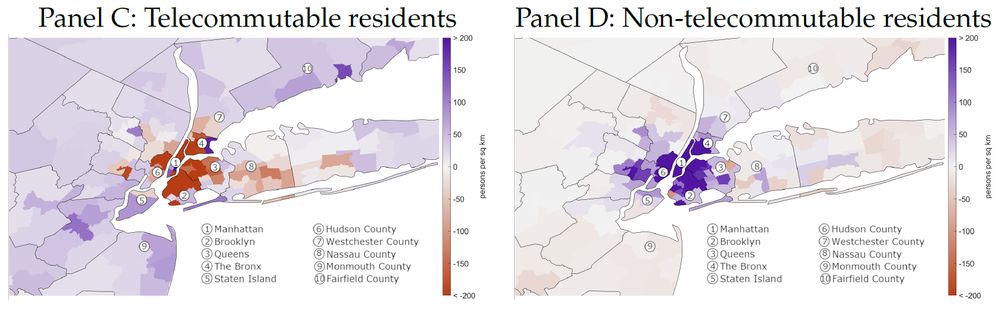
A key prediction is that remote-capable workers will move out of city centers to suburbs and smaller cities; while non-remote-capable move towards city centers in response. This visualization shows the NY metro, but the trend is very general. 3/
December 16, 2024 at 3:56 AM
A key prediction is that remote-capable workers will move out of city centers to suburbs and smaller cities; while non-remote-capable move towards city centers in response. This visualization shows the NY metro, but the trend is very general. 3/
Main motivation of the paper is to understand how and why the US urban landscape will be reshaped by the post-Covid shift towards remote & hybrid work. As we can see in this graph (data credit WFH Research), it is 3-5X higher than pre-Covid and shows few signs of fading away: 2/

December 16, 2024 at 3:56 AM
Main motivation of the paper is to understand how and why the US urban landscape will be reshaped by the post-Covid shift towards remote & hybrid work. As we can see in this graph (data credit WFH Research), it is 3-5X higher than pre-Covid and shows few signs of fading away: 2/