



GAMA Miguel Angel
@miangoar.bsky.social
Biologist that navigate in the oceans of diversity through space-time
Protein evolution, metagenomics, AI/ML/DL
Website https://miangoaren.github.io/
Protein evolution, metagenomics, AI/ML/DL
Website https://miangoaren.github.io/
I’ve recorded ~8h explaining the architectures of AlphaFold, AF2 & AF3, as well as the context needed to understand their development, applications and limitations :)
youtu.be/_jDRr5BcTaY
Slides
drive.google.com/file/d/1i4QE...
English is available only via auto-translated subtitles
youtu.be/_jDRr5BcTaY
Slides
drive.google.com/file/d/1i4QE...
English is available only via auto-translated subtitles

February 2, 2026 at 9:23 PM
I’ve recorded ~8h explaining the architectures of AlphaFold, AF2 & AF3, as well as the context needed to understand their development, applications and limitations :)
youtu.be/_jDRr5BcTaY
Slides
drive.google.com/file/d/1i4QE...
English is available only via auto-translated subtitles
youtu.be/_jDRr5BcTaY
Slides
drive.google.com/file/d/1i4QE...
English is available only via auto-translated subtitles
The 7th lecture is available on YouTube :) We will review how proteins emerge and diversify throughout evolution, considering mutations and molecular interactions
youtu.be/qaypRS8SX5M
Slides
drive.google.com/file/d/1BfQd...
English is available only via auto-translated subtitles
youtu.be/qaypRS8SX5M
Slides
drive.google.com/file/d/1BfQd...
English is available only via auto-translated subtitles

February 1, 2026 at 5:57 PM
The 7th lecture is available on YouTube :) We will review how proteins emerge and diversify throughout evolution, considering mutations and molecular interactions
youtu.be/qaypRS8SX5M
Slides
drive.google.com/file/d/1BfQd...
English is available only via auto-translated subtitles
youtu.be/qaypRS8SX5M
Slides
drive.google.com/file/d/1BfQd...
English is available only via auto-translated subtitles
The 6th lecture is now available on YouTube :) We’ll review how proteins adopt their 3D shape, how they perform their functions and how their activity is regulated
youtu.be/cZs8XtVYa5A
Slides
drive.google.com/file/d/1TpPj...
English is available only via auto-translated subtitles
youtu.be/cZs8XtVYa5A
Slides
drive.google.com/file/d/1TpPj...
English is available only via auto-translated subtitles

January 31, 2026 at 5:55 PM
The 6th lecture is now available on YouTube :) We’ll review how proteins adopt their 3D shape, how they perform their functions and how their activity is regulated
youtu.be/cZs8XtVYa5A
Slides
drive.google.com/file/d/1TpPj...
English is available only via auto-translated subtitles
youtu.be/cZs8XtVYa5A
Slides
drive.google.com/file/d/1TpPj...
English is available only via auto-translated subtitles
The fifth lecture of the course is now available on YouTube :) We’ll review amino acid chemistry and how we organize and classify proteins
youtu.be/gE6qXwpBP_s
Slides
drive.google.com/file/d/1F99V...
For now, the English version is only available through the automatic translation of the subtitles
youtu.be/gE6qXwpBP_s
Slides
drive.google.com/file/d/1F99V...
For now, the English version is only available through the automatic translation of the subtitles

January 30, 2026 at 6:51 PM
The fifth lecture of the course is now available on YouTube :) We’ll review amino acid chemistry and how we organize and classify proteins
youtu.be/gE6qXwpBP_s
Slides
drive.google.com/file/d/1F99V...
For now, the English version is only available through the automatic translation of the subtitles
youtu.be/gE6qXwpBP_s
Slides
drive.google.com/file/d/1F99V...
For now, the English version is only available through the automatic translation of the subtitles
The fourth lecture of the course is now available on YouTube :) We will review how Transformers and modern LLMs work
youtu.be/vUpb6O6T2yQ
Slides
drive.google.com/file/d/1y2Vj...
For now, the English version is only available through the automatic translation of the subtitles.
youtu.be/vUpb6O6T2yQ
Slides
drive.google.com/file/d/1y2Vj...
For now, the English version is only available through the automatic translation of the subtitles.

January 29, 2026 at 6:03 PM
The fourth lecture of the course is now available on YouTube :) We will review how Transformers and modern LLMs work
youtu.be/vUpb6O6T2yQ
Slides
drive.google.com/file/d/1y2Vj...
For now, the English version is only available through the automatic translation of the subtitles.
youtu.be/vUpb6O6T2yQ
Slides
drive.google.com/file/d/1y2Vj...
For now, the English version is only available through the automatic translation of the subtitles.
The third lecture of the course is now available on YouTube :) We will review how neural networks work.
youtu.be/pAgL7NsCUMU
Slides
drive.google.com/file/d/1cazt...
For now, the English version is only available through the automatic translation of the subtitles.
youtu.be/pAgL7NsCUMU
Slides
drive.google.com/file/d/1cazt...
For now, the English version is only available through the automatic translation of the subtitles.

January 28, 2026 at 6:23 PM
The third lecture of the course is now available on YouTube :) We will review how neural networks work.
youtu.be/pAgL7NsCUMU
Slides
drive.google.com/file/d/1cazt...
For now, the English version is only available through the automatic translation of the subtitles.
youtu.be/pAgL7NsCUMU
Slides
drive.google.com/file/d/1cazt...
For now, the English version is only available through the automatic translation of the subtitles.
The second lecture of the course is now available on YouTube :) We will review what AI is, its subfields and how to train a model.
youtu.be/Xx80O85-5rI
Slides
drive.google.com/file/d/1i-Jo...
For now, the English version is only available through the automatic translation of the subtitles.
youtu.be/Xx80O85-5rI
Slides
drive.google.com/file/d/1i-Jo...
For now, the English version is only available through the automatic translation of the subtitles.

January 27, 2026 at 5:03 PM
The second lecture of the course is now available on YouTube :) We will review what AI is, its subfields and how to train a model.
youtu.be/Xx80O85-5rI
Slides
drive.google.com/file/d/1i-Jo...
For now, the English version is only available through the automatic translation of the subtitles.
youtu.be/Xx80O85-5rI
Slides
drive.google.com/file/d/1i-Jo...
For now, the English version is only available through the automatic translation of the subtitles.
The first lecture of the course is now available on YouTube :)
youtu.be/uMkZzKbnoJI
Slides
drive.google.com/file/d/1uDwe...
For now, the English version is only available through the automatic translation of the subtitles.
youtu.be/uMkZzKbnoJI
Slides
drive.google.com/file/d/1uDwe...
For now, the English version is only available through the automatic translation of the subtitles.

January 27, 2026 at 4:20 AM
The first lecture of the course is now available on YouTube :)
youtu.be/uMkZzKbnoJI
Slides
drive.google.com/file/d/1uDwe...
For now, the English version is only available through the automatic translation of the subtitles.
youtu.be/uMkZzKbnoJI
Slides
drive.google.com/file/d/1uDwe...
For now, the English version is only available through the automatic translation of the subtitles.
2/3 The course includes +800 freely available slides, and starting next monday, I will publish one video per day. For example, the AlphaFold lecture is ~7.4 hours long and includes 148 slides, in which I cover the architectures of AF1, AF2 and AF3 as well as their applications.

January 22, 2026 at 9:16 PM
2/3 The course includes +800 freely available slides, and starting next monday, I will publish one video per day. For example, the AlphaFold lecture is ~7.4 hours long and includes 148 slides, in which I cover the architectures of AF1, AF2 and AF3 as well as their applications.
🧵1/3 I created this free 37-hour course, distributed across 10 lectures, to introduce AI-based protein design. For more information about the course and its specific topics, please visit the official course page:

January 22, 2026 at 9:16 PM
🧵1/3 I created this free 37-hour course, distributed across 10 lectures, to introduce AI-based protein design. For more information about the course and its specific topics, please visit the official course page:
Even the five most abundant folds account for ~31% of all domains in the PDB. For more information on these superfolds check out
Protein superfamilies and domain superfolds
pubmed.ncbi.nlm.nih.gov/7990952/
Protein superfamilies and domain superfolds
pubmed.ncbi.nlm.nih.gov/7990952/

January 16, 2026 at 6:35 PM
Even the five most abundant folds account for ~31% of all domains in the PDB. For more information on these superfolds check out
Protein superfamilies and domain superfolds
pubmed.ncbi.nlm.nih.gov/7990952/
Protein superfamilies and domain superfolds
pubmed.ncbi.nlm.nih.gov/7990952/
1/2 If you think that the Protein Data Bank is a representative DB, it is not. The data is highly biased. The CATH suggests that there are 1,472 protein folds, yet among the ~600k domains present in the PDB, ~39% are represented by the 10 most abundant folds (AKA superfolds).

January 16, 2026 at 6:35 PM
1/2 If you think that the Protein Data Bank is a representative DB, it is not. The data is highly biased. The CATH suggests that there are 1,472 protein folds, yet among the ~600k domains present in the PDB, ~39% are represented by the 10 most abundant folds (AKA superfolds).
I strongly recommend making cat-based diagrams to illustrate complex topics in protein science: "Figure 4 considers [...] invariance and equivariance with respect to translations and rotations in 3D. For illustration purposes, the figure includes a series of cat cartoons in 2D."

October 24, 2025 at 5:47 AM
I strongly recommend making cat-based diagrams to illustrate complex topics in protein science: "Figure 4 considers [...] invariance and equivariance with respect to translations and rotations in 3D. For illustration purposes, the figure includes a series of cat cartoons in 2D."
I just want to create hype and say that I made a 10-class course to introduce people to AI-driven protein design. It’s around 750 slides and will be freely available for anyone who wants to use them and, most importantly, improve them. Stay tuned :)

October 9, 2025 at 5:59 PM
I just want to create hype and say that I made a 10-class course to introduce people to AI-driven protein design. It’s around 750 slides and will be freely available for anyone who wants to use them and, most importantly, improve them. Stay tuned :)
This is a breakthrough for protein science🔥AFAIK this is the largest protein DB, with >100B seqs (3B clustered at 50%). New biology will come from LOGAN: new folds, topologies, etc. You can also improve your AlphaFold models by building better MSAs. Future AI models will also use LOGAN for training

September 5, 2025 at 4:51 PM
This is a breakthrough for protein science🔥AFAIK this is the largest protein DB, with >100B seqs (3B clustered at 50%). New biology will come from LOGAN: new folds, topologies, etc. You can also improve your AlphaFold models by building better MSAs. Future AI models will also use LOGAN for training
12/13 Bindcraft started as a binder design tutorial for the Boston Protein Design and Modeling Club, and it evolved into one of the most promising tools in AI-based protein design. And Importantly, it is open-source!🤗
Congrats to all the authors!
Congrats to all the authors!
August 27, 2025 at 7:54 PM
12/13 Bindcraft started as a binder design tutorial for the Boston Protein Design and Modeling Club, and it evolved into one of the most promising tools in AI-based protein design. And Importantly, it is open-source!🤗
Congrats to all the authors!
Congrats to all the authors!
11/13 The authors have gone a step further and are currently developing BoltzDesign1, which instead of designing binders, focuses on biomolecular interactions between proteins and small molecules. However, one of the main limitations of both AIs is their high computational cost.

August 27, 2025 at 7:54 PM
11/13 The authors have gone a step further and are currently developing BoltzDesign1, which instead of designing binders, focuses on biomolecular interactions between proteins and small molecules. However, one of the main limitations of both AIs is their high computational cost.
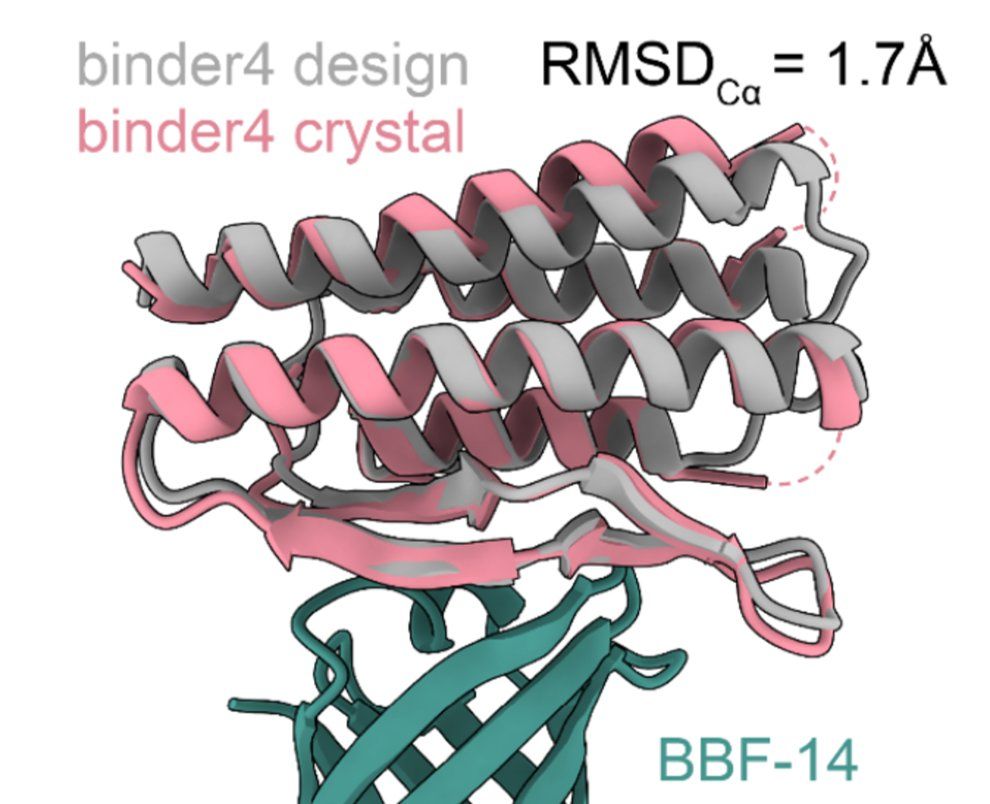
9/13 the most important results IMO was the determination of atomic structures of four binders, where in all cases, the computational designs were highly consistent with the experimentally determined ones.
August 27, 2025 at 7:54 PM
9/13 the most important results IMO was the determination of atomic structures of four binders, where in all cases, the computational designs were highly consistent with the experimentally determined ones.
8/13 They designed binders targeting:
*proteins with no known binding sites
*membrane proteins , which are much harder than intra/extra-cellular proteins
*proteins lacking evolutionary information
*proteins that interact with DNA/RNA
*medically relevant proteins such as those causing allergies
*proteins with no known binding sites
*membrane proteins , which are much harder than intra/extra-cellular proteins
*proteins lacking evolutionary information
*proteins that interact with DNA/RNA
*medically relevant proteins such as those causing allergies

August 27, 2025 at 7:54 PM
8/13 They designed binders targeting:
*proteins with no known binding sites
*membrane proteins , which are much harder than intra/extra-cellular proteins
*proteins lacking evolutionary information
*proteins that interact with DNA/RNA
*medically relevant proteins such as those causing allergies
*proteins with no known binding sites
*membrane proteins , which are much harder than intra/extra-cellular proteins
*proteins lacking evolutionary information
*proteins that interact with DNA/RNA
*medically relevant proteins such as those causing allergies
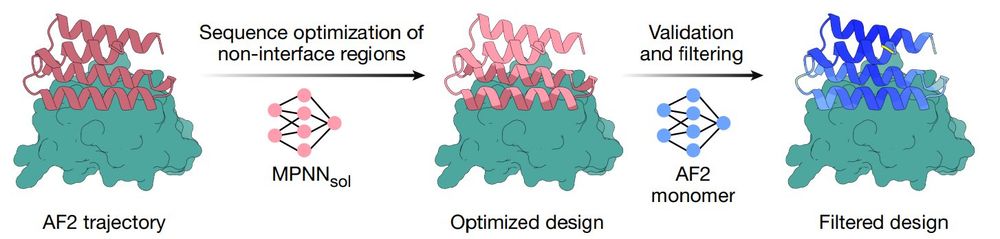
7/13 Then it uses ProteinMPNN to optimize for solubility, increasing the chances of experimental success. Finally, uses AF2 to predict the structure. To demonstrate Bindcraft’s utility, the authors carried out many wet-lab experiments, something not as common as I would like.
August 27, 2025 at 7:54 PM
7/13 Then it uses ProteinMPNN to optimize for solubility, increasing the chances of experimental success. Finally, uses AF2 to predict the structure. To demonstrate Bindcraft’s utility, the authors carried out many wet-lab experiments, something not as common as I would like.
6/13 Bindcraft takes advantage of this by first proposing a random seq and predicting its structure to assess how well it interacts with the target protein. It then uses info from each interaction, successful or not, to optimize the seqs until it arrives at a credible interaction

August 27, 2025 at 7:54 PM
6/13 Bindcraft takes advantage of this by first proposing a random seq and predicting its structure to assess how well it interacts with the target protein. It then uses info from each interaction, successful or not, to optimize the seqs until it arrives at a credible interaction
5/13 Bindcraft is an improved version of AlphaFold2, specifically AF-Multimer, which predicts the structure of protein complexes. Having been trained on thousands of structures, AF-Multimer learned to identify which sites are most likely to form protein–protein interactions.

August 27, 2025 at 7:54 PM
5/13 Bindcraft is an improved version of AlphaFold2, specifically AF-Multimer, which predicts the structure of protein complexes. Having been trained on thousands of structures, AF-Multimer learned to identify which sites are most likely to form protein–protein interactions.
4/13 Bindcraft designs both the sequence and structure of binders, achieving a success rate between 10-100%, since designing large or complex binders is more challenging. This is enormous, considering that our previous best physics/biochemistry-based methods reached a 0.1%.

August 27, 2025 at 7:54 PM
4/13 Bindcraft designs both the sequence and structure of binders, achieving a success rate between 10-100%, since designing large or complex binders is more challenging. This is enormous, considering that our previous best physics/biochemistry-based methods reached a 0.1%.
3/13 We have learned how to design PPI so that one protein, called a binder, can bind to another and regulate it. e.g., cancer drugs are binders. However, designing binders requires yrs of research and detailed biomolecular knowledge. So, what if we teach an AI to design binders?

August 27, 2025 at 7:54 PM
3/13 We have learned how to design PPI so that one protein, called a binder, can bind to another and regulate it. e.g., cancer drugs are binders. However, designing binders requires yrs of research and detailed biomolecular knowledge. So, what if we teach an AI to design binders?
2/13 Proteins carry out many functions on their own, but when they interact with each other, they generate a diversity of mechanisms that expand and regulate those functions. PPI arose over millions of years of evolution, giving rise to processes as complex as metabolism.

August 27, 2025 at 7:54 PM
2/13 Proteins carry out many functions on their own, but when they interact with each other, they generate a diversity of mechanisms that expand and regulate those functions. PPI arose over millions of years of evolution, giving rise to processes as complex as metabolism.