



Mir Lab
@mirlab.bsky.social
Lab run by Mustafa Mir studying transcription and nuclear organization using live imaging at University of Pennsylvania, Children's Hospital of Philadelphia, and Howard Hughes Medical Institute. mir-lab.com
Unless I misunderstood and you are asking about spatially proximal genes in general. In which case it could either, i.e. regulated (for example same TAD) or incidental.
January 16, 2026 at 8:21 PM
Unless I misunderstood and you are asking about spatially proximal genes in general. In which case it could either, i.e. regulated (for example same TAD) or incidental.
These are sister chromatids (copies of the same chromosome after replication). They are held together by cohesin and other proteins complexes so the proximity is not accidental. if you image with enough temporal and spatial resolution you can incidentally see them separate some times.
January 16, 2026 at 8:18 PM
These are sister chromatids (copies of the same chromosome after replication). They are held together by cohesin and other proteins complexes so the proximity is not accidental. if you image with enough temporal and spatial resolution you can incidentally see them separate some times.
One big take away (that took some while for us to reconcile here) is to not assume when you see a bright focus in a cell that a non-stochiometric phenomenon is occurring.
January 16, 2026 at 2:12 PM
One big take away (that took some while for us to reconcile here) is to not assume when you see a bright focus in a cell that a non-stochiometric phenomenon is occurring.
4) It is possible that the clusters we observe contain multiple genes that are firing in sync, but our simulations suggest that this is likely rare and the fact that we don’t see thousands of “clusters” is due to differences in Pol II occupancy at genes and technological limitations.
January 16, 2026 at 2:12 PM
4) It is possible that the clusters we observe contain multiple genes that are firing in sync, but our simulations suggest that this is likely rare and the fact that we don’t see thousands of “clusters” is due to differences in Pol II occupancy at genes and technological limitations.
3) One observation that was quite convincing to us, is that when we look at the same locus firing on sister chromatids, when they transiently separate, we clearly see two Pol II clusters. By cross linking capture methods these would show a high contact frequency, and by static FISH high overlap.

January 16, 2026 at 2:12 PM
3) One observation that was quite convincing to us, is that when we look at the same locus firing on sister chromatids, when they transiently separate, we clearly see two Pol II clusters. By cross linking capture methods these would show a high contact frequency, and by static FISH high overlap.
2) When looking at fixed cell images with diffraction limited resolution, there might be multiple clusters at each FISH spot which are not resolvable.
January 16, 2026 at 2:12 PM
2) When looking at fixed cell images with diffraction limited resolution, there might be multiple clusters at each FISH spot which are not resolvable.
A few points: 1) When interpreting evidence from chromatin conformation methods it is important to keep in mind that live imaging work has now shown that these contacts tend to be quite transient and infrequent in live cells.
January 16, 2026 at 2:12 PM
A few points: 1) When interpreting evidence from chromatin conformation methods it is important to keep in mind that live imaging work has now shown that these contacts tend to be quite transient and infrequent in live cells.
Reposted by Mir Lab

Huge props to our grad student @manyakapoor.bsky.social for developing the simulations and the new MS2 analysis amongst other things! We also thank the transcription community for their invaluable feedback and always welcome further discussion😊
September 18, 2025 at 3:24 PM
Huge props to our grad student @manyakapoor.bsky.social for developing the simulations and the new MS2 analysis amongst other things! We also thank the transcription community for their invaluable feedback and always welcome further discussion😊
5/n: Please reach out directly to me if you are interested. This is a unique opportunity at a time where increased centralized resources are critical to maintain and accelerate the pace of scientific discovery.
April 11, 2025 at 10:48 AM
5/n: Please reach out directly to me if you are interested. This is a unique opportunity at a time where increased centralized resources are critical to maintain and accelerate the pace of scientific discovery.
4/n We are seeking a microscope specialist/engineer. The role will include developing and implementing new microscope hardware, control software, customized analysis pipelines as well as collaborating with core users.
April 11, 2025 at 10:48 AM
4/n We are seeking a microscope specialist/engineer. The role will include developing and implementing new microscope hardware, control software, customized analysis pipelines as well as collaborating with core users.
3/n We will provide custom built ad hoc optical microscopy solutions, advanced image analysis, and consultation services to researchers across campus and beyond. We will implement technology in response to experimental needs instead of working within the bounds of commercially available technology.
Advanced Core for Microscope Engineering (ACME) | Advanced Core for Microscope Engineering | Perelman School of Medicine at the University of Pennsylvania
www.med.upenn.edu
April 11, 2025 at 10:48 AM
3/n We will provide custom built ad hoc optical microscopy solutions, advanced image analysis, and consultation services to researchers across campus and beyond. We will implement technology in response to experimental needs instead of working within the bounds of commercially available technology.
2/n: ACME is co-directed by myself (Mustafa Mir), Melike Lakadamyali @melikel.bsky.social (www.lakadamyali-lab.com), Yihui Shen (www.imaging-systems-metabolism-lab.com), and Andrea Stout @aleestoutphd.bsky.social (www.med.upenn.edu/cdbmicroscopycore)
April 11, 2025 at 10:48 AM
2/n: ACME is co-directed by myself (Mustafa Mir), Melike Lakadamyali @melikel.bsky.social (www.lakadamyali-lab.com), Yihui Shen (www.imaging-systems-metabolism-lab.com), and Andrea Stout @aleestoutphd.bsky.social (www.med.upenn.edu/cdbmicroscopycore)
9/ We welcome feedback, questions, and critical discussion from the community. Huge thanks to all our amazing co-authors for their insight, support, and collaboration throughout this work.
April 9, 2025 at 2:31 PM
9/ We welcome feedback, questions, and critical discussion from the community. Huge thanks to all our amazing co-authors for their insight, support, and collaboration throughout this work.
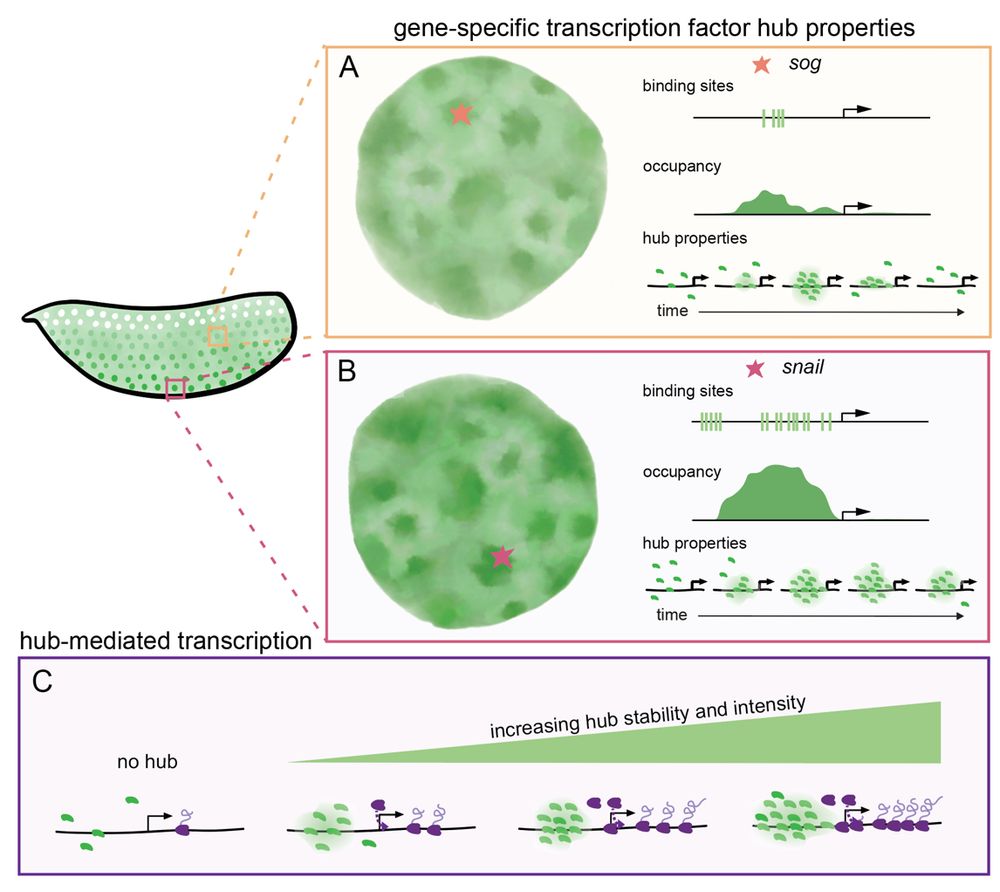
8/n: We suggest that enhancers encode the biophysical properties of transcription factor hubs (intensity and stability) through binding affinities and cofactors. Hub properties dictate gene occupancy and transcriptional kinetics, suggesting hubs are active executors of enhancer-encoded regulation.

April 9, 2025 at 2:31 PM
8/n: We suggest that enhancers encode the biophysical properties of transcription factor hubs (intensity and stability) through binding affinities and cofactors. Hub properties dictate gene occupancy and transcriptional kinetics, suggesting hubs are active executors of enhancer-encoded regulation.
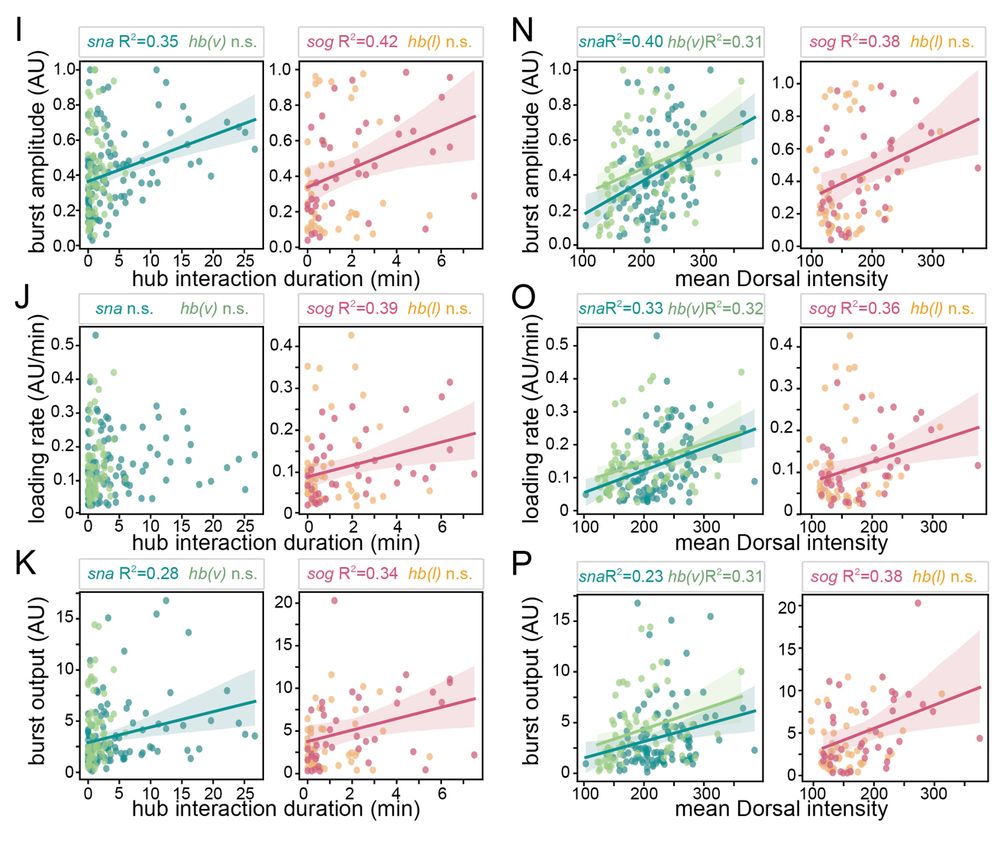
7/n: Hub intensity and duration correlate with burst amplitude, loading rate, and output suggesting that persistently interacting hubs with more molecules tune gene expression. Consistent with the idea that hubs facilitate transcription factor binding and promote expression.
April 9, 2025 at 2:31 PM
7/n: Hub intensity and duration correlate with burst amplitude, loading rate, and output suggesting that persistently interacting hubs with more molecules tune gene expression. Consistent with the idea that hubs facilitate transcription factor binding and promote expression.
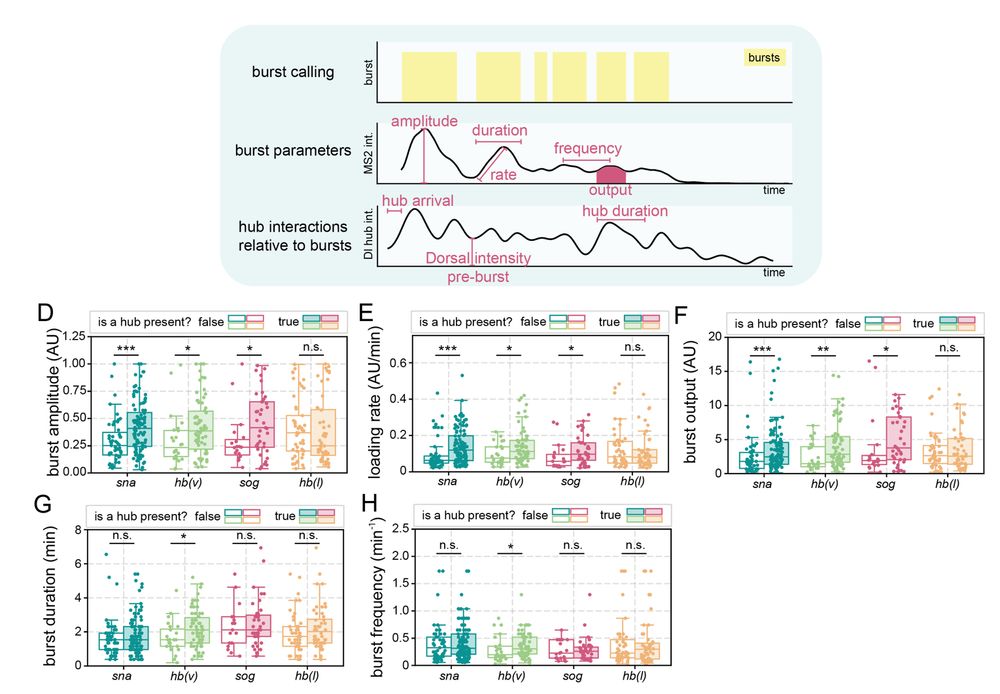
6/n: Hub presence at a gene is correlated with increased transcription burst amplitude, Pol II loading rate, and total output. Surprisingly, transient interactions between Dorsal hubs and hunchback (lacking Dorsal binding) boosts transcription in ventral nuclei where Dorsal concentration is highest
April 9, 2025 at 2:31 PM
6/n: Hub presence at a gene is correlated with increased transcription burst amplitude, Pol II loading rate, and total output. Surprisingly, transient interactions between Dorsal hubs and hunchback (lacking Dorsal binding) boosts transcription in ventral nuclei where Dorsal concentration is highest
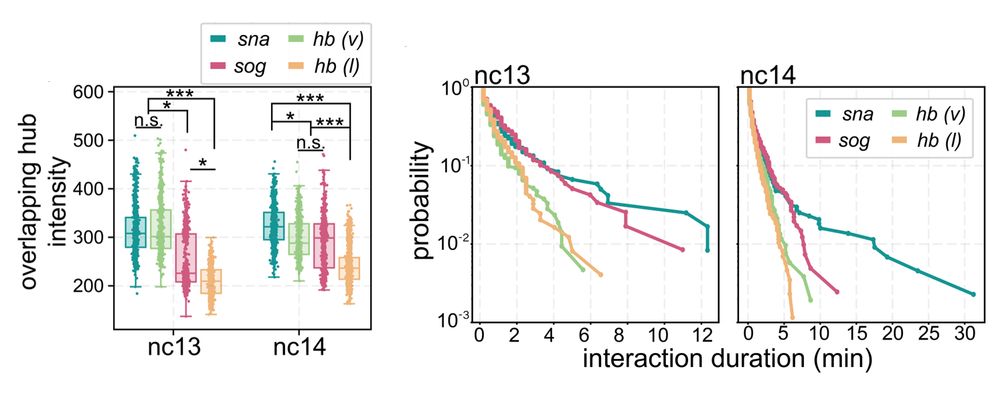
5/n: We found:
• snail has persistent hub interactions with high-intensity hubs
• sog: has slightly less persistent hub interactions with lower-intensity hubs
• hunchback (negative control): transient interactions without stable hub formation
• snail has persistent hub interactions with high-intensity hubs
• sog: has slightly less persistent hub interactions with lower-intensity hubs
• hunchback (negative control): transient interactions without stable hub formation
April 9, 2025 at 2:31 PM
5/n: We found:
• snail has persistent hub interactions with high-intensity hubs
• sog: has slightly less persistent hub interactions with lower-intensity hubs
• hunchback (negative control): transient interactions without stable hub formation
• snail has persistent hub interactions with high-intensity hubs
• sog: has slightly less persistent hub interactions with lower-intensity hubs
• hunchback (negative control): transient interactions without stable hub formation
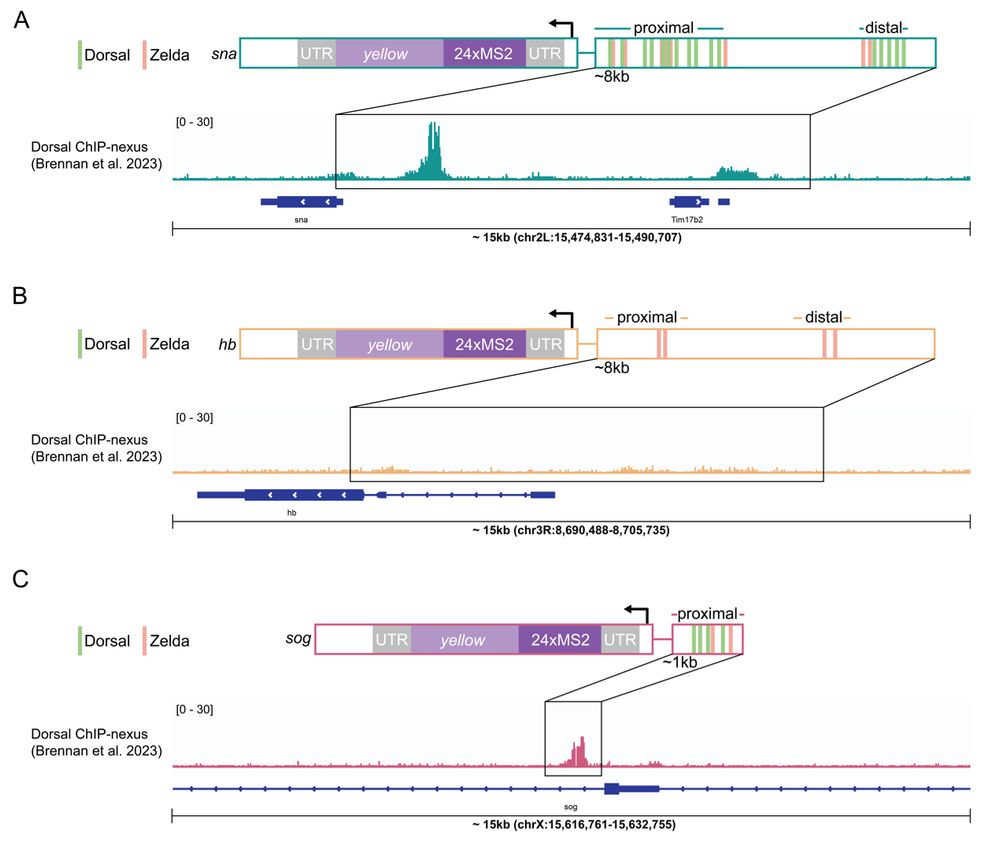
4/n: Next we examined Dorsal hub interactions at two target genes with distinct Dorsal occupancy and enhancer grammars, snai and sog, and as a negative control examined hunchback which has no dorsal sites.
April 9, 2025 at 2:31 PM
4/n: Next we examined Dorsal hub interactions at two target genes with distinct Dorsal occupancy and enhancer grammars, snai and sog, and as a negative control examined hunchback which has no dorsal sites.
3/n: First, we find that hubs form rapidly after mitosis and last through interphase. Nuclear hub density doesn't depend on nuclear concentration but hub intensity does, suggesting that hub formation may be independent of concentration, but hubs accumulate more protein with increased concentrations.
April 9, 2025 at 2:31 PM
3/n: First, we find that hubs form rapidly after mitosis and last through interphase. Nuclear hub density doesn't depend on nuclear concentration but hub intensity does, suggesting that hub formation may be independent of concentration, but hubs accumulate more protein with increased concentrations.
2/n: Transcription factor hubs (dense local accumulations) regulate gene expression by promoting the frequency of binding. They are often discussed as having uniform properties based on protein sequence and concentration. We wondered if their biophysical properties vary in a gene dependent manner.
April 9, 2025 at 2:31 PM
2/n: Transcription factor hubs (dense local accumulations) regulate gene expression by promoting the frequency of binding. They are often discussed as having uniform properties based on protein sequence and concentration. We wondered if their biophysical properties vary in a gene dependent manner.