



Nick Ridpath
@nickridpath.bsky.social
Research Economist at the IFS
This is important as last month's OBR forecast (no monthly breakdown of this yet) expects a big increase in receipts by 2029/30 from higher inflation, boosting the public finances.
That may materialise, but it’s concerning that it hasn’t yet - one watch out for in the new year
That may materialise, but it’s concerning that it hasn’t yet - one watch out for in the new year
December 19, 2025 at 2:39 PM
This is important as last month's OBR forecast (no monthly breakdown of this yet) expects a big increase in receipts by 2029/30 from higher inflation, boosting the public finances.
That may materialise, but it’s concerning that it hasn’t yet - one watch out for in the new year
That may materialise, but it’s concerning that it hasn’t yet - one watch out for in the new year
We’ve written about this in more detail in our chapter of the IFS Green Budget on the public finances which came out today. You can read it here: ifs.org.uk/publications...

Risks and challenges for the public finances | Institute for Fiscal Studies
We set out the challenges facing the Chancellor from a changing economic and policy outlook, and explore options to stabilise policy going forwards.
ifs.org.uk
October 16, 2025 at 6:57 AM
We’ve written about this in more detail in our chapter of the IFS Green Budget on the public finances which came out today. You can read it here: ifs.org.uk/publications...
Frequent policy changes lead to overly frequent and overly rushed policy adjustments. Other measures like a range could help, but if the Chancellor wants to stave off the speculation and uncertainty like we’ve seen recently for more than a few months, more headroom is likely to be needed.
October 16, 2025 at 6:57 AM
Frequent policy changes lead to overly frequent and overly rushed policy adjustments. Other measures like a range could help, but if the Chancellor wants to stave off the speculation and uncertainty like we’ve seen recently for more than a few months, more headroom is likely to be needed.
The government has a second fiscal rule, the debt rule, which is more volatile, with no plans for a range. Here, the chances of surviving are even slimmer – the £15bn the government had in Spring would be v unlikely to survive for three years.

October 16, 2025 at 6:56 AM
The government has a second fiscal rule, the debt rule, which is more volatile, with no plans for a range. Here, the chances of surviving are even slimmer – the £15bn the government had in Spring would be v unlikely to survive for three years.
To hold up over a longer timeframe, such as 3 years, the Chancellor would need far more headroom: £9.9bn would only give a 1 in 4 chance of avoiding further changes. To get above 50%, she’d need around £50bn, around the levels maintained in 2013 & 2014.

October 16, 2025 at 6:56 AM
To hold up over a longer timeframe, such as 3 years, the Chancellor would need far more headroom: £9.9bn would only give a 1 in 4 chance of avoiding further changes. To get above 50%, she’d need around £50bn, around the levels maintained in 2013 & 2014.
Now, from 2027, there will be a range of 0.5% of GDP on the borrowing rule in the Spring, so it binds less tightly. If this were brought forward, it would improve the Chancellor’s chances of not needing further changes to over 80%. But we might want to avoid volatility for longer than six months…

October 16, 2025 at 6:55 AM
Now, from 2027, there will be a range of 0.5% of GDP on the borrowing rule in the Spring, so it binds less tightly. If this were brought forward, it would improve the Chancellor’s chances of not needing further changes to over 80%. But we might want to avoid volatility for longer than six months…
We looked at past revisions to the OBR forecast, and what proportion of them the Chancellor would survive without being bounced into further changes – we find that to withstand 80% of past shocks, she would need around £26 billion of headroom.

October 16, 2025 at 6:54 AM
We looked at past revisions to the OBR forecast, and what proportion of them the Chancellor would survive without being bounced into further changes – we find that to withstand 80% of past shocks, she would need around £26 billion of headroom.
Reposted by Nick Ridpath

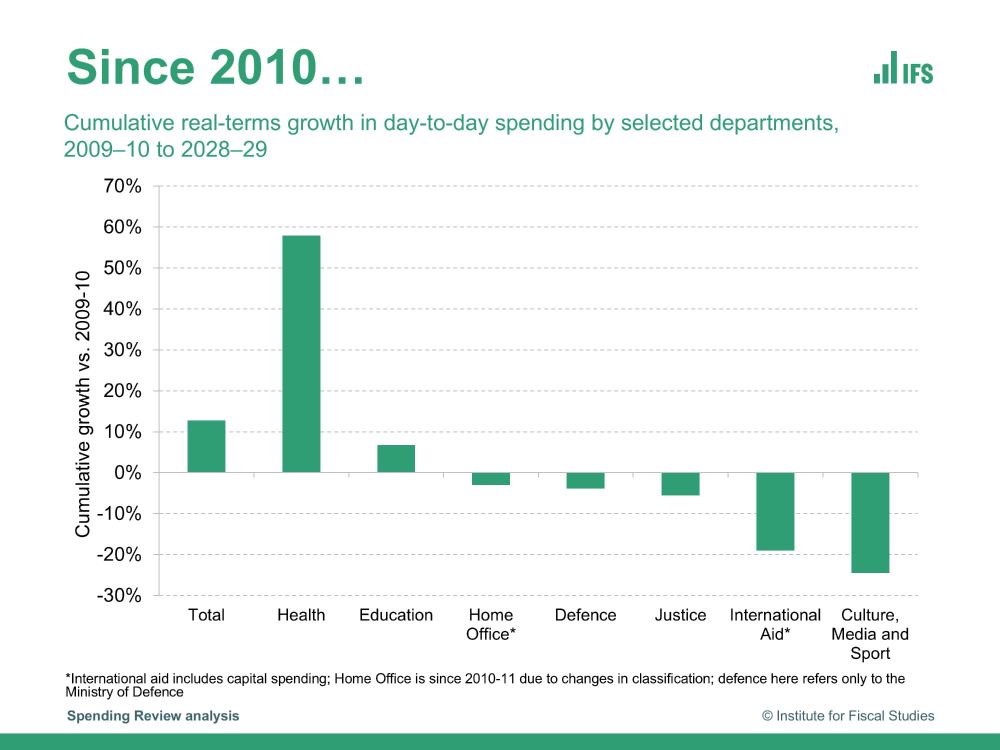
At the end of parliament, health funding will be more than 50% higher than in 2010.
Spending on justice, in contrast, will be lower in 2028–29 than two decades earlier despite recent increases. Spending on overseas aid and culture, media & sport will also be lower than in 2010.
Spending on justice, in contrast, will be lower in 2028–29 than two decades earlier despite recent increases. Spending on overseas aid and culture, media & sport will also be lower than in 2010.
June 12, 2025 at 9:55 AM
At the end of parliament, health funding will be more than 50% higher than in 2010.
Spending on justice, in contrast, will be lower in 2028–29 than two decades earlier despite recent increases. Spending on overseas aid and culture, media & sport will also be lower than in 2010.
Spending on justice, in contrast, will be lower in 2028–29 than two decades earlier despite recent increases. Spending on overseas aid and culture, media & sport will also be lower than in 2010.
Reposted by Nick Ridpath
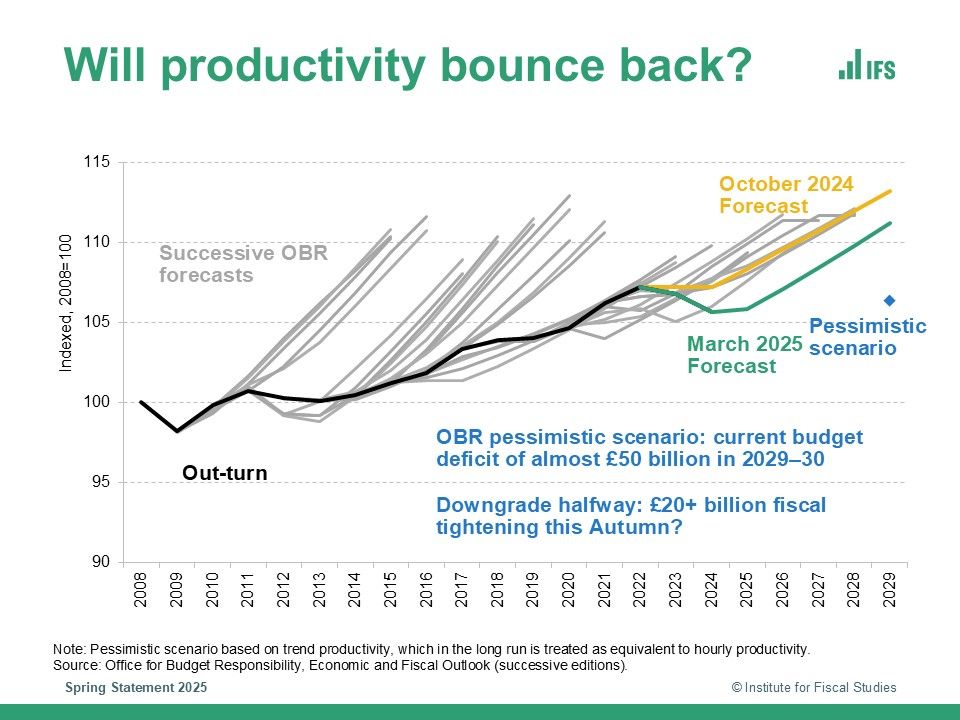
OBR productivity growth forecasts have historically been over-optimistic.
They remain above the productivity growth rates seen since 2008 – a downgrade to the OBR's forecast could cause a real fiscal headache for the Chancellor.
They remain above the productivity growth rates seen since 2008 – a downgrade to the OBR's forecast could cause a real fiscal headache for the Chancellor.
March 27, 2025 at 11:00 AM
OBR productivity growth forecasts have historically been over-optimistic.
They remain above the productivity growth rates seen since 2008 – a downgrade to the OBR's forecast could cause a real fiscal headache for the Chancellor.
They remain above the productivity growth rates seen since 2008 – a downgrade to the OBR's forecast could cause a real fiscal headache for the Chancellor.