



Niranjan Nagarajan
@niranjantw.bsky.social
Computational Biologist and Microbiome Scientist at the National University of Singapore
Say hello to Heliusvirales, Astravirales and Suryavirales! 👋These are the first TEM images of members of these highly prevalent gut phage clades. Genomic characterization identified many interesting features (particularly DGRs) that could explain their ability to infect diverse hosts. [5/5]


January 30, 2026 at 10:26 AM
Say hello to Heliusvirales, Astravirales and Suryavirales! 👋These are the first TEM images of members of these highly prevalent gut phage clades. Genomic characterization identified many interesting features (particularly DGRs) that could explain their ability to infect diverse hosts. [5/5]
Interestingly, many of the highly prevalent phage families have diverse Firmicutes hosts. They seem to frequently have temperate lifestyles, but are also spontaneously induced from their hosts! [4/5]


January 30, 2026 at 10:21 AM
Interestingly, many of the highly prevalent phage families have diverse Firmicutes hosts. They seem to frequently have temperate lifestyles, but are also spontaneously induced from their hosts! [4/5]
Using these genomes to identify viral families, we noted that 11 out of the 12 most prevalent families in our cohort have never been described before. Even more strikingly, 6 of them are globally among the most prevalent based on analysis of >3000 gut metagenomes! [3/5]


January 30, 2026 at 10:19 AM
Using these genomes to identify viral families, we noted that 11 out of the 12 most prevalent families in our cohort have never been described before. Even more strikingly, 6 of them are globally among the most prevalent based on analysis of >3000 gut metagenomes! [3/5]
It turns out that short-read assemblies might be consistently fragmenting viral genomes and thus affecting viral family-level clustering workflows. Long read assemblies allowed us to discover nearly 20,000 novel viruses from just a 100 odd samples! [2/5]

January 30, 2026 at 10:17 AM
It turns out that short-read assemblies might be consistently fragmenting viral genomes and thus affecting viral family-level clustering workflows. Long read assemblies allowed us to discover nearly 20,000 novel viruses from just a 100 odd samples! [2/5]
Thank you - bluesky feels like a mirror world :)
April 30, 2025 at 12:26 AM
Thank you - bluesky feels like a mirror world :)
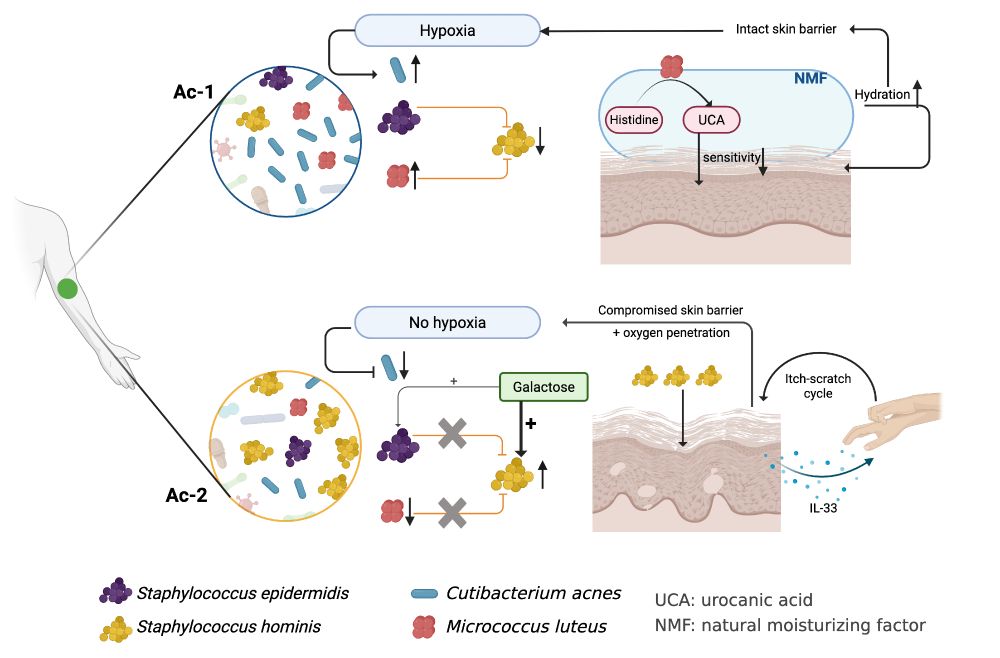
5. Exciting days ahead as we try to decipher the contributions of diverse factors that shape skin microbiome dermotypes, and in turn their influence on skin health! @cherrychengchenli.bsky.social
April 28, 2025 at 4:58 AM
5. Exciting days ahead as we try to decipher the contributions of diverse factors that shape skin microbiome dermotypes, and in turn their influence on skin health! @cherrychengchenli.bsky.social
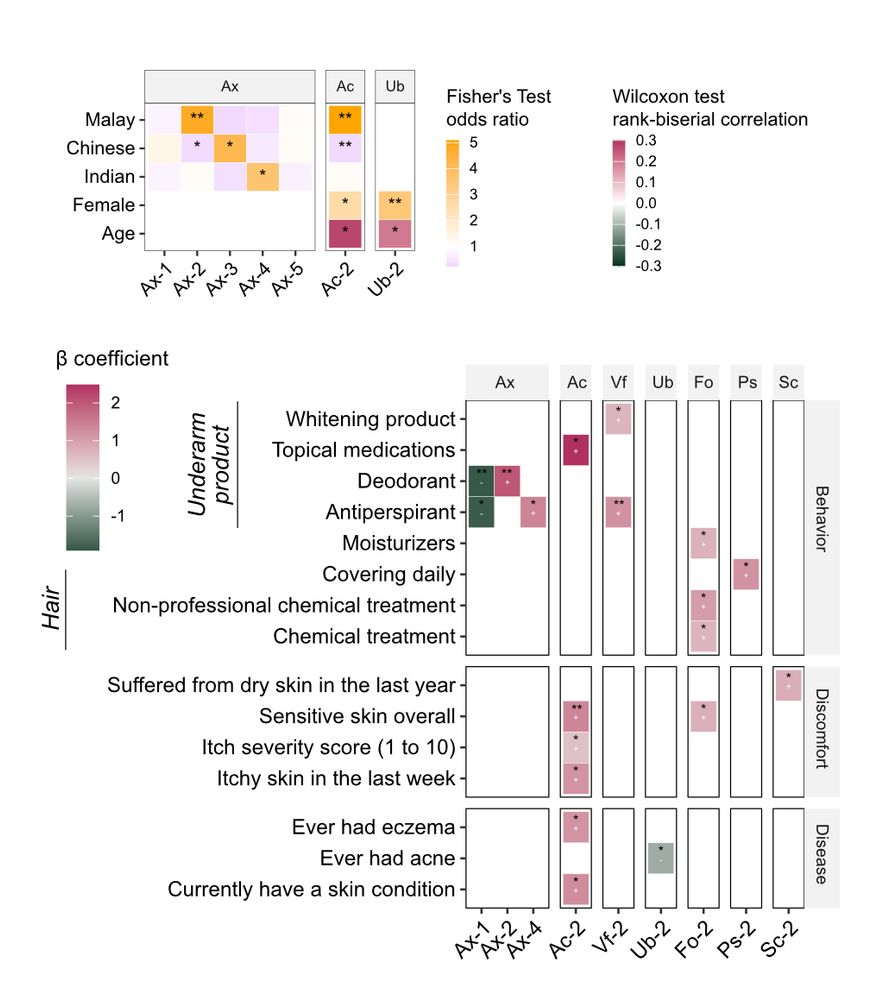
4. Dermotypes exhibit distinct associations w/ host, where ethnicity and gender play a role in some cases, while others are linked to skincare behaviors. Skin sensitivity, itch and eczema may be affected by dermotype function, highlighting utility for patient stratification & therapeutics
April 28, 2025 at 4:57 AM
4. Dermotypes exhibit distinct associations w/ host, where ethnicity and gender play a role in some cases, while others are linked to skincare behaviors. Skin sensitivity, itch and eczema may be affected by dermotype function, highlighting utility for patient stratification & therapeutics
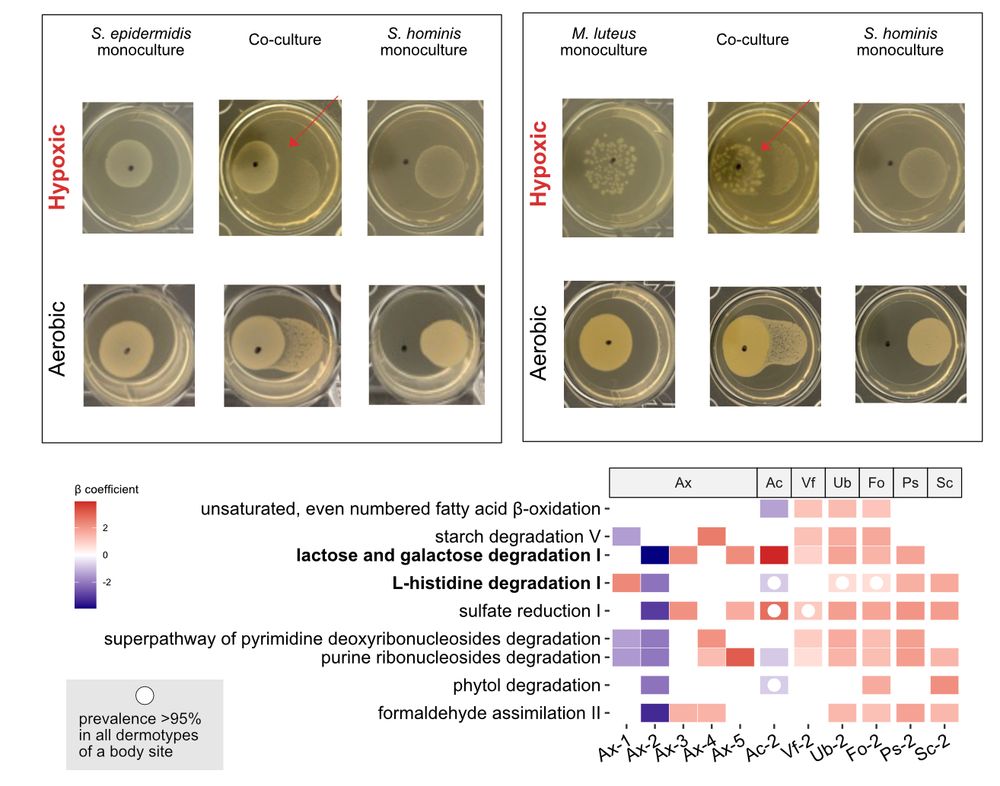
3. Microbes behave very differently across dermotypes in terms of who they co-occur with! We can confirm this with culture-based experiments that show that oxygen gradients and nutrient availability likely shape why we see distinct dermotypes in various individuals.
@atVidu
@atVidu
April 28, 2025 at 4:56 AM
3. Microbes behave very differently across dermotypes in terms of who they co-occur with! We can confirm this with culture-based experiments that show that oxygen gradients and nutrient availability likely shape why we see distinct dermotypes in various individuals.
@atVidu
@atVidu
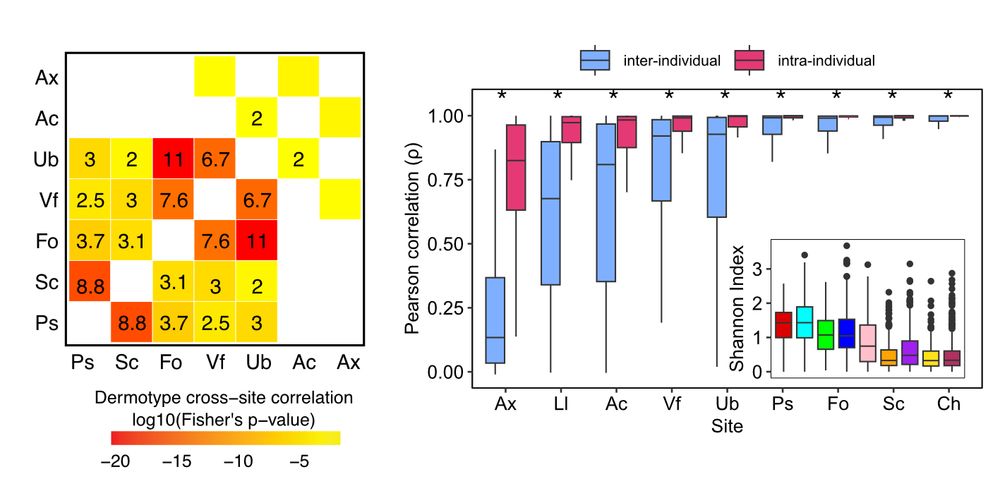
2. Dermotypes are highly coordinated across sites. For some sites, we can predict the dermotype just by knowing dermotype of another site. Left and right sides of the body are also highly correlated, suggesting that individual intrinsic factors strongly shape the skin microbiome.
April 28, 2025 at 4:56 AM
2. Dermotypes are highly coordinated across sites. For some sites, we can predict the dermotype just by knowing dermotype of another site. Left and right sides of the body are also highly correlated, suggesting that individual intrinsic factors strongly shape the skin microbiome.
Many exciting results to follow-up on!
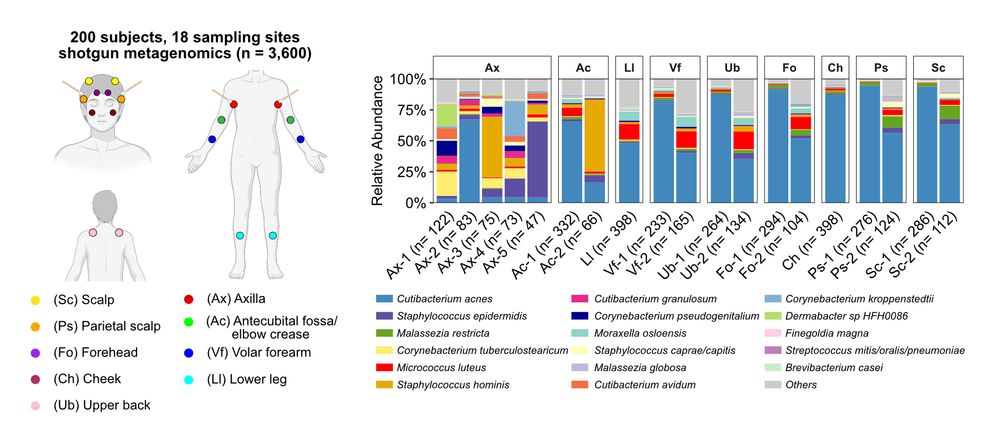
1. The skin microbiome has unique “types” in every site - we call them dermotypes. The underarm has as many as 5 distinct ones defined by diverse microbes. We built ML classifiers to predict them w/ near-perfect accuracy with 5 species!
1. The skin microbiome has unique “types” in every site - we call them dermotypes. The underarm has as many as 5 distinct ones defined by diverse microbes. We built ML classifiers to predict them w/ near-perfect accuracy with 5 species!
April 28, 2025 at 4:54 AM
Many exciting results to follow-up on!
1. The skin microbiome has unique “types” in every site - we call them dermotypes. The underarm has as many as 5 distinct ones defined by diverse microbes. We built ML classifiers to predict them w/ near-perfect accuracy with 5 species!
1. The skin microbiome has unique “types” in every site - we call them dermotypes. The underarm has as many as 5 distinct ones defined by diverse microbes. We built ML classifiers to predict them w/ near-perfect accuracy with 5 species!