


Dr Stephan Lautenschlager
@palaeostephan.bsky.social
Associate Professor in Palaeobiology @ University of Birmingham,
Research Lead @ Lapworth Museum of Geology,
vertebrate palaeontologist, dinosaurs, digital visualisation, biomechanics & functional morphology
🦕🐶🌱🇪🇺
Research Lead @ Lapworth Museum of Geology,
vertebrate palaeontologist, dinosaurs, digital visualisation, biomechanics & functional morphology
🦕🐶🌱🇪🇺
Importantly, this study was done with the contribution of several undergraduate students who helped my collect the data as part of a year 1 course I am teaching (if you are interested in more detail see here: link.springer.com/article/10.1...)
5/5
5/5

Participatory science and course-based undergraduate research experience to improve research-informed teaching of evolution and palaeontology - Evolution: Education and Outreach
This study introduces a participatory science-inspired approach to teaching and curriculum design, involving undergraduate students directly in active research. Using a case study on dinosaur eye size...
link.springer.com
December 1, 2025 at 2:41 PM
Importantly, this study was done with the contribution of several undergraduate students who helped my collect the data as part of a year 1 course I am teaching (if you are interested in more detail see here: link.springer.com/article/10.1...)
5/5
5/5
Turns out, dinosaur skulls are neither optimised for minimising stress nor maximising bite efficiency. However, this makes snout shape and length highly adaptable, enabling them to occupy a variety of dietary niches!
4/5
4/5

December 1, 2025 at 2:41 PM
Turns out, dinosaur skulls are neither optimised for minimising stress nor maximising bite efficiency. However, this makes snout shape and length highly adaptable, enabling them to occupy a variety of dietary niches!
4/5
4/5
To investigate the effect of skull proportions we tested different hypothetical models with varying proportions using biomechanical simulations.
3/5
3/5
December 1, 2025 at 2:41 PM
To investigate the effect of skull proportions we tested different hypothetical models with varying proportions using biomechanical simulations.
3/5
3/5
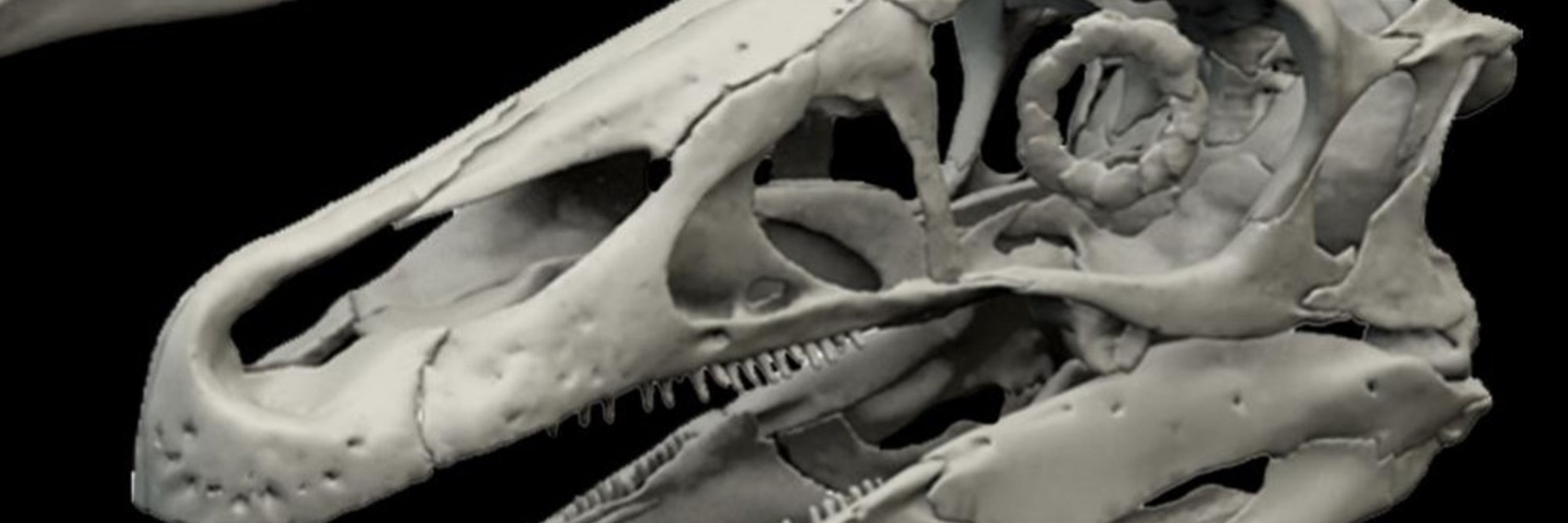
Our results show that the main variability in dinosaur skulls is found in the length of the snout (or rostrum). In contrast, the orbital and braincase regions maintained their relative size fairly consistently.
2/5
2/5

December 1, 2025 at 2:41 PM
Our results show that the main variability in dinosaur skulls is found in the length of the snout (or rostrum). In contrast, the orbital and braincase regions maintained their relative size fairly consistently.
2/5
2/5
This study demonstrates that sabre-tooth canine shape is exceptionally diverse. A functional analysis of theoretical and actual tooth shapes shows that these canines represent a compromise between sharpness, curvature, and length vs. robustness and material investment.
October 9, 2025 at 6:19 PM
This study demonstrates that sabre-tooth canine shape is exceptionally diverse. A functional analysis of theoretical and actual tooth shapes shows that these canines represent a compromise between sharpness, curvature, and length vs. robustness and material investment.
The second paper (based on the 3rd-year project of former student Caitlin Shelbourne) explores the shape diversity of the eponymous canine teeth across different sabre-tooth groups.
anatomypubs.onlinelibrary.wiley.com/doi/10.1002/...
anatomypubs.onlinelibrary.wiley.com/doi/10.1002/...
October 9, 2025 at 6:19 PM
The second paper (based on the 3rd-year project of former student Caitlin Shelbourne) explores the shape diversity of the eponymous canine teeth across different sabre-tooth groups.
anatomypubs.onlinelibrary.wiley.com/doi/10.1002/...
anatomypubs.onlinelibrary.wiley.com/doi/10.1002/...
Our results show that Barbourofelis was a force to be reckoned with and that its skull could withstand higher stresses than that of Smilodon hinting at a more generalist behaviour to subdue prey.
October 9, 2025 at 6:19 PM
Our results show that Barbourofelis was a force to be reckoned with and that its skull could withstand higher stresses than that of Smilodon hinting at a more generalist behaviour to subdue prey.
The first paper (with co-authors @bortxaf.bsky.social and Shane West) investigates the feeding biomechanics of the “false sabre-tooth cat” Barbourofelis and how it compares to the iconic Smilodon:
anatomypubs.onlinelibrary.wiley.com/doi/10.1002/...
anatomypubs.onlinelibrary.wiley.com/doi/10.1002/...
October 9, 2025 at 6:19 PM
The first paper (with co-authors @bortxaf.bsky.social and Shane West) investigates the feeding biomechanics of the “false sabre-tooth cat” Barbourofelis and how it compares to the iconic Smilodon:
anatomypubs.onlinelibrary.wiley.com/doi/10.1002/...
anatomypubs.onlinelibrary.wiley.com/doi/10.1002/...
Reposted by Dr Stephan Lautenschlager

As we see so often in research, bullies and abusers do terrible things while everyone who could stop them wrings their hands and gives free speech platitudes just so they don't have to act with unity and strength.
This is just another example of academic inequalities and harms writ large. Appalling
This is just another example of academic inequalities and harms writ large. Appalling
October 1, 2025 at 5:12 PM
As we see so often in research, bullies and abusers do terrible things while everyone who could stop them wrings their hands and gives free speech platitudes just so they don't have to act with unity and strength.
This is just another example of academic inequalities and harms writ large. Appalling
This is just another example of academic inequalities and harms writ large. Appalling