




Protea Glycosciences
@proteaglyco.bsky.social
Accelerating Glycoscience Research
https://proteaglyco.com/
https://proteaglyco.com/
Finally, we leveraged all of this to see if O-acetylation was present on human N-glycans from serum. Specifically, we had O-acetylation on NeuGc in mice, and on NeuAc in rats, so the combined approach should uncover if it is present in humans
Short answer: trace amounts in human at best.
#glycotime
Short answer: trace amounts in human at best.
#glycotime

October 20, 2025 at 2:50 AM
Finally, we leveraged all of this to see if O-acetylation was present on human N-glycans from serum. Specifically, we had O-acetylation on NeuGc in mice, and on NeuAc in rats, so the combined approach should uncover if it is present in humans
Short answer: trace amounts in human at best.
#glycotime
Short answer: trace amounts in human at best.
#glycotime
We then developed a quality control workflow, using as much information as possible to confirm O-acetylation.
Using MS1, MS2, and LC, we reduced the number of putative identifications by 95%, ensuring the quality of these annotations.
Using MS1, MS2, and LC, we reduced the number of putative identifications by 95%, ensuring the quality of these annotations.

October 20, 2025 at 2:47 AM
We then developed a quality control workflow, using as much information as possible to confirm O-acetylation.
Using MS1, MS2, and LC, we reduced the number of putative identifications by 95%, ensuring the quality of these annotations.
Using MS1, MS2, and LC, we reduced the number of putative identifications by 95%, ensuring the quality of these annotations.
Second level, liquid chromatography:
- O-acetylated structures elute later
- Their peak shape is broader
We're not quite sure why we have broader peak shapes, but it was universal. Further work is ongoing to resolve this, but it could be caused by multiple acetylation positions (more structures!).
- O-acetylated structures elute later
- Their peak shape is broader
We're not quite sure why we have broader peak shapes, but it was universal. Further work is ongoing to resolve this, but it could be caused by multiple acetylation positions (more structures!).

October 20, 2025 at 2:45 AM
Second level, liquid chromatography:
- O-acetylated structures elute later
- Their peak shape is broader
We're not quite sure why we have broader peak shapes, but it was universal. Further work is ongoing to resolve this, but it could be caused by multiple acetylation positions (more structures!).
- O-acetylated structures elute later
- Their peak shape is broader
We're not quite sure why we have broader peak shapes, but it was universal. Further work is ongoing to resolve this, but it could be caused by multiple acetylation positions (more structures!).
Now we're seeing these structures, we want to characterise them for community use, specifically, by LC-MS/MS.
First fragmentation:
- Beam-type (HCD) CID is best, as it generates universally useful fragments for all acetylated structures
- Energy profiles show the expected ratios of these fragments
First fragmentation:
- Beam-type (HCD) CID is best, as it generates universally useful fragments for all acetylated structures
- Energy profiles show the expected ratios of these fragments

October 20, 2025 at 2:27 AM
Now we're seeing these structures, we want to characterise them for community use, specifically, by LC-MS/MS.
First fragmentation:
- Beam-type (HCD) CID is best, as it generates universally useful fragments for all acetylated structures
- Energy profiles show the expected ratios of these fragments
First fragmentation:
- Beam-type (HCD) CID is best, as it generates universally useful fragments for all acetylated structures
- Energy profiles show the expected ratios of these fragments
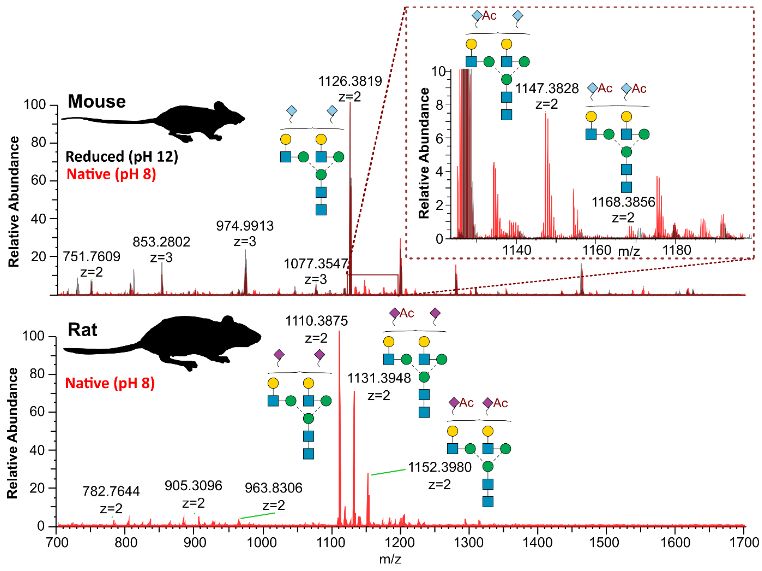
Traditionally, reduction or permethylation has been optimal to measure glycan structures, but we've previously reported a way to avoid this (link: www.biorxiv.org/content/10.1...).
By performing native glycan analysis, we are suddenly seeing 2x the structures previously observed in rats and mice.
By performing native glycan analysis, we are suddenly seeing 2x the structures previously observed in rats and mice.
October 20, 2025 at 2:22 AM
Traditionally, reduction or permethylation has been optimal to measure glycan structures, but we've previously reported a way to avoid this (link: www.biorxiv.org/content/10.1...).
By performing native glycan analysis, we are suddenly seeing 2x the structures previously observed in rats and mice.
By performing native glycan analysis, we are suddenly seeing 2x the structures previously observed in rats and mice.