



Seva Viliuga
@proteinator.bsky.social
PhD candidate in bioinformatics
Protein structure prediction / Protein design
Protein structure prediction / Protein design
Reposted by Seva Viliuga

All data are available on Zenodo and we'd love to see what you can do with it! Cydney also made a nice notebook to run the predictive model (including DMS scan) in Colab!
Preprint: biorxiv.org/content/10.1...
Colab: colab.research.google.com/drive/1KNWvG...
Data: docs.google.com/forms/d/e/1F...
Preprint: biorxiv.org/content/10.1...
Colab: colab.research.google.com/drive/1KNWvG...
Data: docs.google.com/forms/d/e/1F...

Global Analysis of Aggregation Determinants in Small Protein Domains
Protein aggregation is an obstacle for engineering effective recombinant proteins for biotechnology and therapeutic applications. Predicting protein aggregation propensity remains challenging due to t...
biorxiv.org
November 19, 2025 at 9:16 PM
All data are available on Zenodo and we'd love to see what you can do with it! Cydney also made a nice notebook to run the predictive model (including DMS scan) in Colab!
Preprint: biorxiv.org/content/10.1...
Colab: colab.research.google.com/drive/1KNWvG...
Data: docs.google.com/forms/d/e/1F...
Preprint: biorxiv.org/content/10.1...
Colab: colab.research.google.com/drive/1KNWvG...
Data: docs.google.com/forms/d/e/1F...
Exchanging for an authentic Wienerschnitzel 🤠
January 1, 2026 at 12:12 PM
Exchanging for an authentic Wienerschnitzel 🤠
Folding models learn protein stability only implicitly. Without access to negative data, one can in principle make use of the folding free energy (dG) and the change in the free energy upon mutation (ddG). I believe simple aux losses could help for cases where a mutation is clearly disruptive.
December 18, 2025 at 2:47 PM
Folding models learn protein stability only implicitly. Without access to negative data, one can in principle make use of the folding free energy (dG) and the change in the free energy upon mutation (ddG). I believe simple aux losses could help for cases where a mutation is clearly disruptive.
Hi Thomas, that's indeed the case! However, this would also mean that one can reliably refold and score redesigned sequences only of those proteins whose structures were deposited post AF2 training cutoff date. This is a big limitation in our opinion!
December 17, 2025 at 10:08 PM
Hi Thomas, that's indeed the case! However, this would also mean that one can reliably refold and score redesigned sequences only of those proteins whose structures were deposited post AF2 training cutoff date. This is a big limitation in our opinion!
Good luck and enjoy, Seb!
August 27, 2025 at 8:45 AM
Good luck and enjoy, Seb!
6/6 Amazing team work with great co-authors
@leif-seute.bsky.social, Nicolas Wolf, Simon Wagner, @bioinfo.se, Jan Stühmer and @graeterlab.bsky.social
Try out FliPS and BackFlip yourself, code and Google Colab tutorials are available on GitHub!
@leif-seute.bsky.social, Nicolas Wolf, Simon Wagner, @bioinfo.se, Jan Stühmer and @graeterlab.bsky.social
Try out FliPS and BackFlip yourself, code and Google Colab tutorials are available on GitHub!
July 17, 2025 at 4:27 AM
6/6 Amazing team work with great co-authors
@leif-seute.bsky.social, Nicolas Wolf, Simon Wagner, @bioinfo.se, Jan Stühmer and @graeterlab.bsky.social
Try out FliPS and BackFlip yourself, code and Google Colab tutorials are available on GitHub!
@leif-seute.bsky.social, Nicolas Wolf, Simon Wagner, @bioinfo.se, Jan Stühmer and @graeterlab.bsky.social
Try out FliPS and BackFlip yourself, code and Google Colab tutorials are available on GitHub!
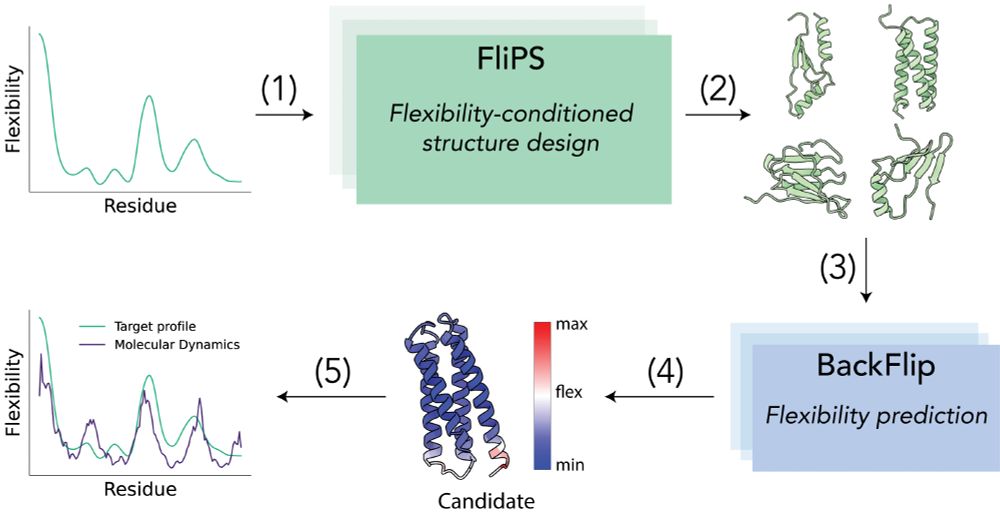
5/6 We introduce a framework in which we generate candidate protein structures conditioned on flexibility with FliPS and use BackFlip to select the candidates whose predicted flexibility profile best matches the target before running expensive MD simulations.
July 17, 2025 at 4:21 AM
5/6 We introduce a framework in which we generate candidate protein structures conditioned on flexibility with FliPS and use BackFlip to select the candidates whose predicted flexibility profile best matches the target before running expensive MD simulations.
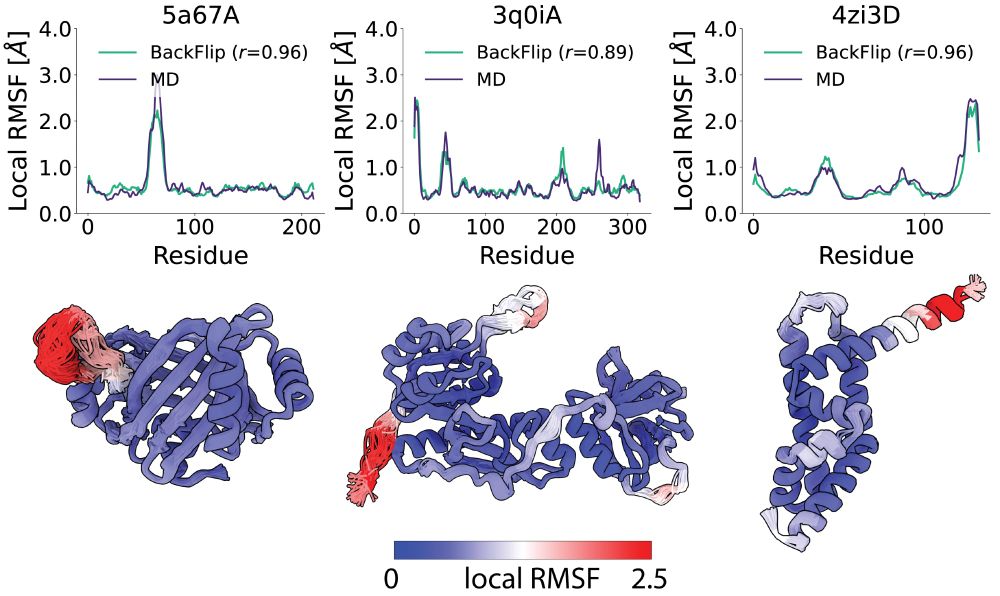
4/6 We also introduce BackFlip - an equivariant network that can accurately predict backbone flexibility as derived from MD simulations. Crucially, BackFlip infers flexibility solely from the backbone geometry without requiring evolutionary information, making it useful for de novo protein design.
July 17, 2025 at 4:21 AM
4/6 We also introduce BackFlip - an equivariant network that can accurately predict backbone flexibility as derived from MD simulations. Crucially, BackFlip infers flexibility solely from the backbone geometry without requiring evolutionary information, making it useful for de novo protein design.
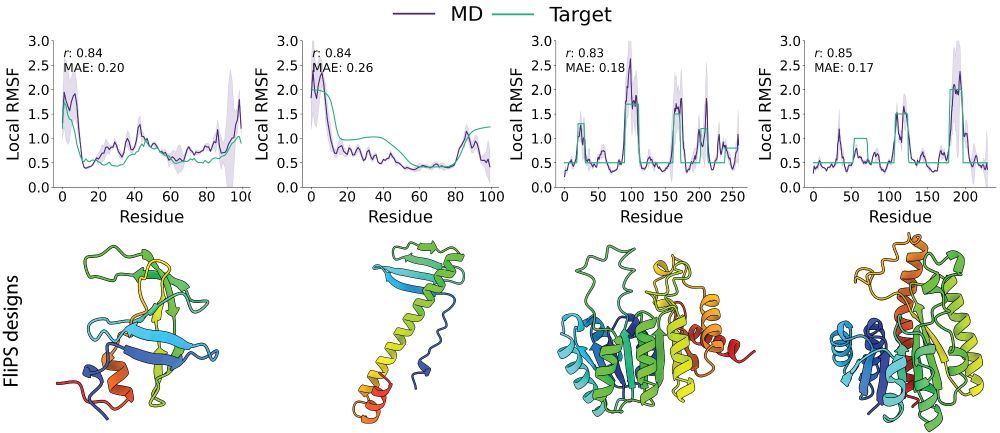
3/6 In a series of experiments, we demonstrate that FliPS samples novel, realistic proteins with diverse secondary structure composition and a remarkable resemblance to custom target flexibility profiles, as verified in 300ns Molecular Dynamics (MD) simulations of the designed samples.
July 17, 2025 at 4:20 AM
3/6 In a series of experiments, we demonstrate that FliPS samples novel, realistic proteins with diverse secondary structure composition and a remarkable resemblance to custom target flexibility profiles, as verified in 300ns Molecular Dynamics (MD) simulations of the designed samples.
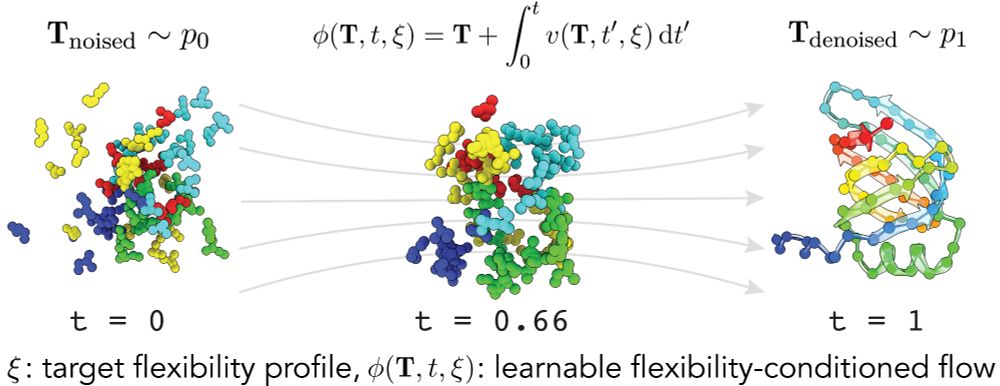
2/6 Our model FliPS is a conditional flow matching model for protein structure generation. FliPS receives a flexibility profile as conditional input feature and learns how to generate realistic protein structures while respecting target flexibilities.
July 17, 2025 at 4:19 AM
2/6 Our model FliPS is a conditional flow matching model for protein structure generation. FliPS receives a flexibility profile as conditional input feature and learns how to generate realistic protein structures while respecting target flexibilities.
Hahaha this is hilarious!! I’m now totally convinced I should play with it as well 🤣
July 13, 2025 at 4:52 AM
Hahaha this is hilarious!! I’m now totally convinced I should play with it as well 🤣