


Seth Blackshaw
@sethblackshaw.bsky.social
Professor of Neuroscience. Studying neural development, regeneration, and control of innate behaviors at Johns Hopkins.
I'd like to close by thanking lead author Nicole Pannullo, who recently defended her thesis, who with Debarpita Datta, @claytonsantiago.bsky.social, Jared Hangman, Lizhi Jiang, and Leighton Duncan -- and support from NIH -- made this possible./end
January 16, 2026 at 9:06 PM
I'd like to close by thanking lead author Nicole Pannullo, who recently defended her thesis, who with Debarpita Datta, @claytonsantiago.bsky.social, Jared Hangman, Lizhi Jiang, and Leighton Duncan -- and support from NIH -- made this possible./end
One reason why the Sox8/9 mutant phenotype is so much less dramatic than that of Nfia/b/x mutants may be persistent compensatory expression of other Sox family members, most notably Sox2, which might compensate for the loss of Sox8/9./11

January 16, 2026 at 9:03 PM
One reason why the Sox8/9 mutant phenotype is so much less dramatic than that of Nfia/b/x mutants may be persistent compensatory expression of other Sox family members, most notably Sox2, which might compensate for the loss of Sox8/9./11
So what's going on here? While Sox8/9 suppress early-born cell type generation when misexpressed, and directly regulate transcription of NFI family genes, they are not required for maintaining late-stage temporal identity, being required for glial differentiation rather than specification./10
January 16, 2026 at 8:58 PM
So what's going on here? While Sox8/9 suppress early-born cell type generation when misexpressed, and directly regulate transcription of NFI family genes, they are not required for maintaining late-stage temporal identity, being required for glial differentiation rather than specification./10
What about Sox8/9 function in mature Muller glia, where we previously showed that Nfia/b/x actively suppress neurogenic competence? As with Nfia/b/x mutants, we observe a modest induction of injury-induced proliferation, but no glial-derived neurogenesis or induction of Ascl1./9

January 16, 2026 at 8:52 PM
What about Sox8/9 function in mature Muller glia, where we previously showed that Nfia/b/x actively suppress neurogenic competence? As with Nfia/b/x mutants, we observe a modest induction of injury-induced proliferation, but no glial-derived neurogenesis or induction of Ascl1./9
scATAC-Seq and CUT&TAG data show that Sox8/9 predominantly function as transcriptional activators, in combination with other late-stage progenitor-specific factors such as NFIs. However, Sox8/9 mutants show no change in retinal cell fate specification or clear disruptions of temporal identity./8

January 16, 2026 at 8:48 PM
scATAC-Seq and CUT&TAG data show that Sox8/9 predominantly function as transcriptional activators, in combination with other late-stage progenitor-specific factors such as NFIs. However, Sox8/9 mutants show no change in retinal cell fate specification or clear disruptions of temporal identity./8
Single-cell multiomic analysis of Sox8/9 double mutant glia show reduced Notch signaling and altered expression of many genes known to regulate cell adhesion and migration, as well as mature glial markers./7

January 16, 2026 at 8:43 PM
Single-cell multiomic analysis of Sox8/9 double mutant glia show reduced Notch signaling and altered expression of many genes known to regulate cell adhesion and migration, as well as mature glial markers./7
Both Sox8 and Sox9 mutants resulted in progressive radial displacement of Muller glial cell nuclei towards the photoreceptor layer. This was enhanced in Sox8/9 double mutants./6

January 16, 2026 at 8:38 PM
Both Sox8 and Sox9 mutants resulted in progressive radial displacement of Muller glial cell nuclei towards the photoreceptor layer. This was enhanced in Sox8/9 double mutants./6
Early retinal progenitor-specific loss of function of Sox9 did not affect neurogenesis or cell fate specification, and despite much effort, we were unable to generate early progenitor-specific Sox8 or Sox8/9 double mutants. We shifted instead to selectively deleting these genes in neonates./5
January 16, 2026 at 8:36 PM
Early retinal progenitor-specific loss of function of Sox9 did not affect neurogenesis or cell fate specification, and despite much effort, we were unable to generate early progenitor-specific Sox8 or Sox8/9 double mutants. We shifted instead to selectively deleting these genes in neonates./5
When over expressed in early-stage E14 progenitors, both Sox8 and Sox9 repress generation of early-born retinal ganglion and amacrine cells and promote formation of later-born photoreceptors. This matches what we previously observed with NFI factors./4

January 16, 2026 at 8:30 PM
When over expressed in early-stage E14 progenitors, both Sox8 and Sox9 repress generation of early-born retinal ganglion and amacrine cells and promote formation of later-born photoreceptors. This matches what we previously observed with NFI factors./4
Overexpression, conditional loss of function, and biochemical analysis all confirmed that this was the case for Nfia/b/x in retina. We asked if this was also the case for Sox8/9./3
www.sciencedirect.com/science/arti...
www.sciencedirect.com/science/arti...

Gene regulatory networks controlling temporal patterning, neurogenesis, and cell-fate specification in mammalian retina
Gene regulatory networks (GRNs), consisting of transcription factors and their target sites, control neurogenesis and cell-fate specification in the d…
www.sciencedirect.com
January 16, 2026 at 8:26 PM
Overexpression, conditional loss of function, and biochemical analysis all confirmed that this was the case for Nfia/b/x in retina. We asked if this was also the case for Sox8/9./3
www.sciencedirect.com/science/arti...
www.sciencedirect.com/science/arti...
Sox8/9 play an important role in regulating brain and spinal cord astrocyte and oligodendrocyte differentiation, often acting cooperatively with Nfia. Our multiomic analysis of retinal progenitors identified NFI and SoxE factor as more broadly promoting late-stage temporal identity, however./2

January 16, 2026 at 8:23 PM
Sox8/9 play an important role in regulating brain and spinal cord astrocyte and oligodendrocyte differentiation, often acting cooperatively with Nfia. Our multiomic analysis of retinal progenitors identified NFI and SoxE factor as more broadly promoting late-stage temporal identity, however./2
Congratulation!
January 8, 2026 at 11:21 PM
Congratulation!
I want to give my deepest thanks to Tomomi Shimogori -- with whom this all started nearly 20 years ago -- and more recently Marysia and Elsie. It has been an honor and privilege to work with you all.
December 22, 2025 at 5:23 PM
I want to give my deepest thanks to Tomomi Shimogori -- with whom this all started nearly 20 years ago -- and more recently Marysia and Elsie. It has been an honor and privilege to work with you all.
I have no illusions that this will stop the ongoing trickle of prosomere-promoting single-color in situ hybridization studies in one Frontiers journal or another. I hope this will lead the Allen Brain Atlas to finally revise their developmental mouse reference atlas, however.
December 22, 2025 at 5:21 PM
I have no illusions that this will stop the ongoing trickle of prosomere-promoting single-color in situ hybridization studies in one Frontiers journal or another. I hope this will lead the Allen Brain Atlas to finally revise their developmental mouse reference atlas, however.
And finally combining multiomic-based gene regulatory network and genetic analysis in mouse earlier this year:
www.cell.com/cell-reports...
www.cell.com/cell-reports...
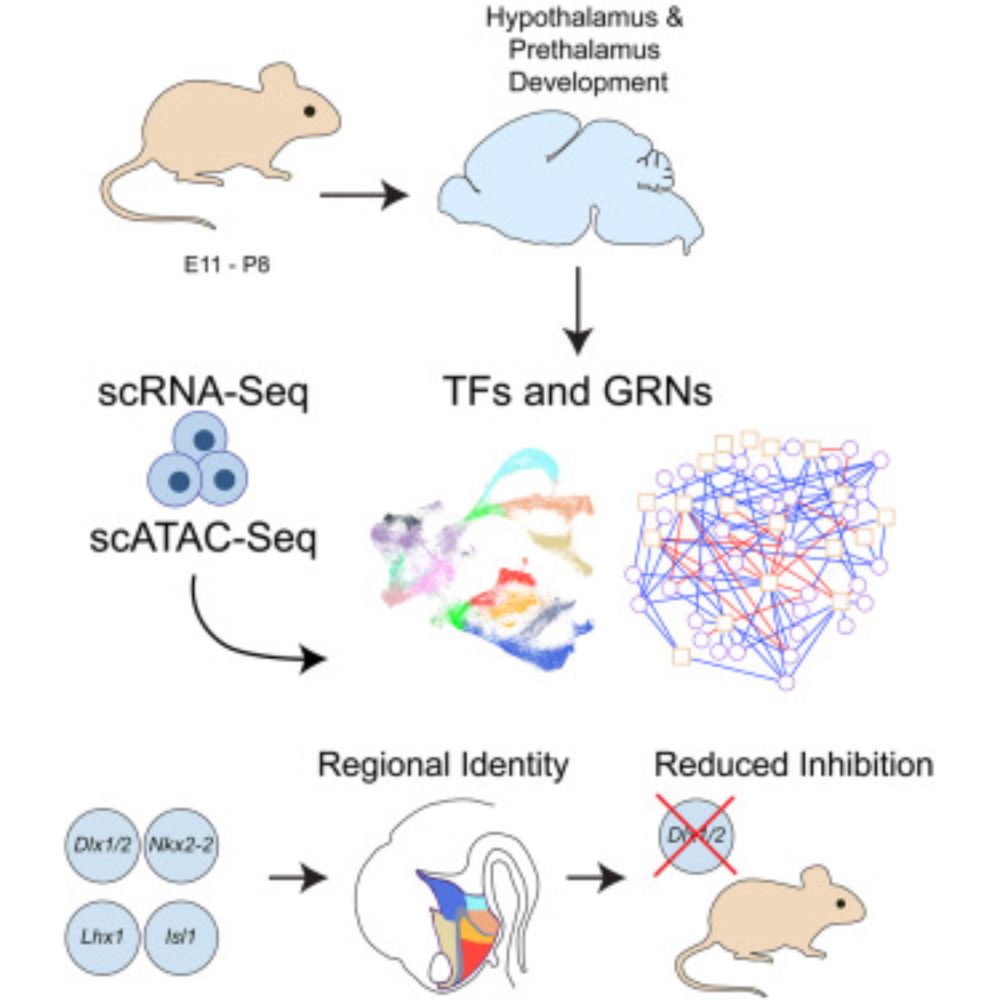
Decoding gene networks controlling hypothalamic and prethalamic neuron development
Kim et al. map gene regulatory networks of the developing mouse hypothalamus and prethalamus
using single-cell multiomics, identifying regulators of regionalization and neurogenesis.
They further show...
www.cell.com
December 22, 2025 at 5:19 PM
And finally combining multiomic-based gene regulatory network and genetic analysis in mouse earlier this year:
www.cell.com/cell-reports...
www.cell.com/cell-reports...