


Sepideh Mamooler@ACL🇦🇹
@smamooler.bsky.social
PhD Candidate at @icepfl.bsky.social | Ex Research Intern@Google DeepMind
👩🏻💻 Working on multi-modal AI reasoning models in scientific domains
https://smamooler.github.io/
👩🏻💻 Working on multi-modal AI reasoning models in scientific domains
https://smamooler.github.io/
🙏 Amazing collaboration with my co-authors and advisors
@smontariol.bsky.social, @abosselut.bsky.social,
@trackingskills.bsky.social
@smontariol.bsky.social, @abosselut.bsky.social,
@trackingskills.bsky.social
December 17, 2024 at 2:51 PM
🙏 Amazing collaboration with my co-authors and advisors
@smontariol.bsky.social, @abosselut.bsky.social,
@trackingskills.bsky.social
@smontariol.bsky.social, @abosselut.bsky.social,
@trackingskills.bsky.social
📖 Check out the full paper here: arxiv.org/pdf/2412.11923
arxiv.org
December 17, 2024 at 2:51 PM
📖 Check out the full paper here: arxiv.org/pdf/2412.11923
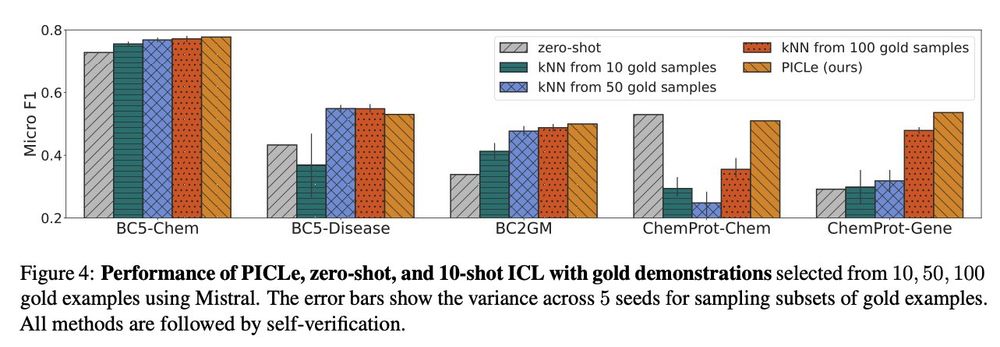
📊 We evaluate PICLe on 5 biomedical NED datasets and find:
✨ With zero human annotations, PICLe outperforms ICL in low-resource settings, where limited gold examples can be used as in-context demonstrations!
✨ With zero human annotations, PICLe outperforms ICL in low-resource settings, where limited gold examples can be used as in-context demonstrations!
December 17, 2024 at 2:51 PM
📊 We evaluate PICLe on 5 biomedical NED datasets and find:
✨ With zero human annotations, PICLe outperforms ICL in low-resource settings, where limited gold examples can be used as in-context demonstrations!
✨ With zero human annotations, PICLe outperforms ICL in low-resource settings, where limited gold examples can be used as in-context demonstrations!
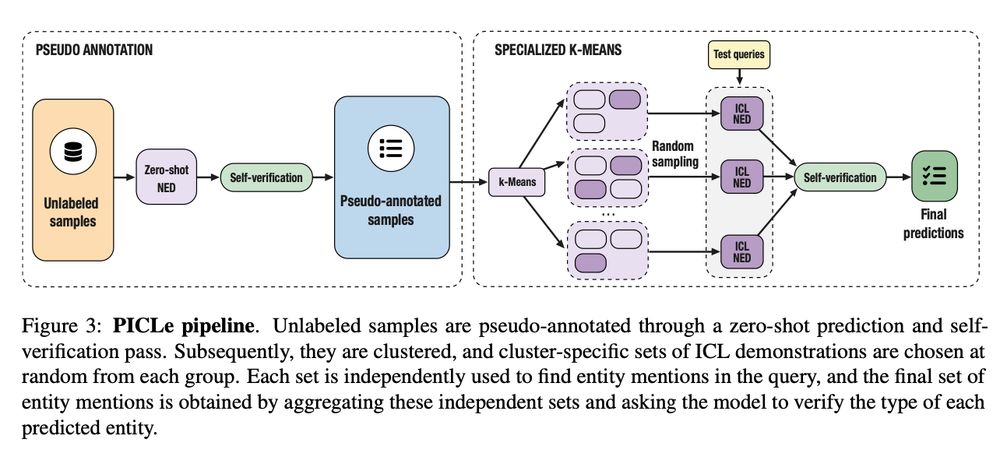
⚙️ How does PICLe work?
1️⃣ LLMs annotate demonstrations in a zero-shot first pass.
2️⃣ Synthetic demos are clustered, and in-context sets are sampled.
3️⃣ Entity mentions are predicted using each set independently.
4️⃣ Self-verification selects the final predictions.
1️⃣ LLMs annotate demonstrations in a zero-shot first pass.
2️⃣ Synthetic demos are clustered, and in-context sets are sampled.
3️⃣ Entity mentions are predicted using each set independently.
4️⃣ Self-verification selects the final predictions.
December 17, 2024 at 2:51 PM
⚙️ How does PICLe work?
1️⃣ LLMs annotate demonstrations in a zero-shot first pass.
2️⃣ Synthetic demos are clustered, and in-context sets are sampled.
3️⃣ Entity mentions are predicted using each set independently.
4️⃣ Self-verification selects the final predictions.
1️⃣ LLMs annotate demonstrations in a zero-shot first pass.
2️⃣ Synthetic demos are clustered, and in-context sets are sampled.
3️⃣ Entity mentions are predicted using each set independently.
4️⃣ Self-verification selects the final predictions.
💡 Building on our findings, we introduce PICLe: a framework for in-context learning powered by noisy, pseudo-annotated demonstrations. 🛠️ No human labels, no problem! 🚀
December 17, 2024 at 2:51 PM
💡 Building on our findings, we introduce PICLe: a framework for in-context learning powered by noisy, pseudo-annotated demonstrations. 🛠️ No human labels, no problem! 🚀
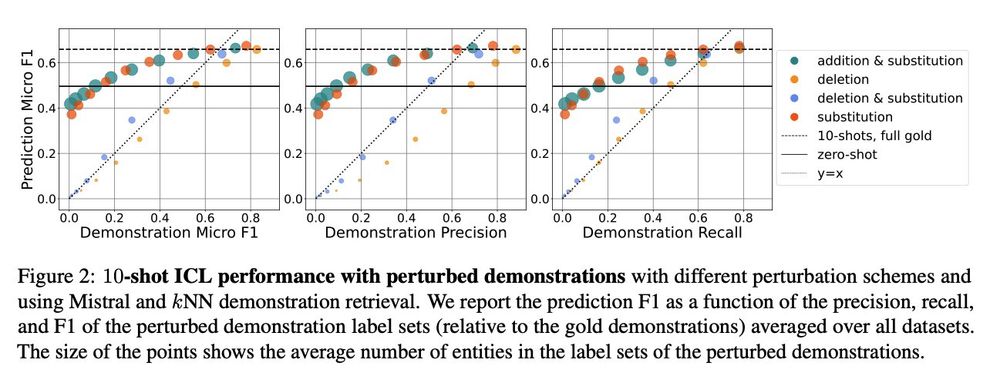
📊 Key finding: A semantic mapping between demonstration context and label is essential for in-context task transfer. BUT even weak semantic mappings can provide enough signal for effective adaptation in NED!
December 17, 2024 at 2:51 PM
📊 Key finding: A semantic mapping between demonstration context and label is essential for in-context task transfer. BUT even weak semantic mappings can provide enough signal for effective adaptation in NED!
🔍 It’s unclear which demonstration attributes enable in-context learning in tasks that require structured, open-ended predictions (such as NED).
We use perturbation schemes that create demonstrations with varying correctness levels to analyze key demonstration attributes.
We use perturbation schemes that create demonstrations with varying correctness levels to analyze key demonstration attributes.
December 17, 2024 at 2:51 PM
🔍 It’s unclear which demonstration attributes enable in-context learning in tasks that require structured, open-ended predictions (such as NED).
We use perturbation schemes that create demonstrations with varying correctness levels to analyze key demonstration attributes.
We use perturbation schemes that create demonstrations with varying correctness levels to analyze key demonstration attributes.