



Jonathan Clapsaddle
@tclap.bsky.social
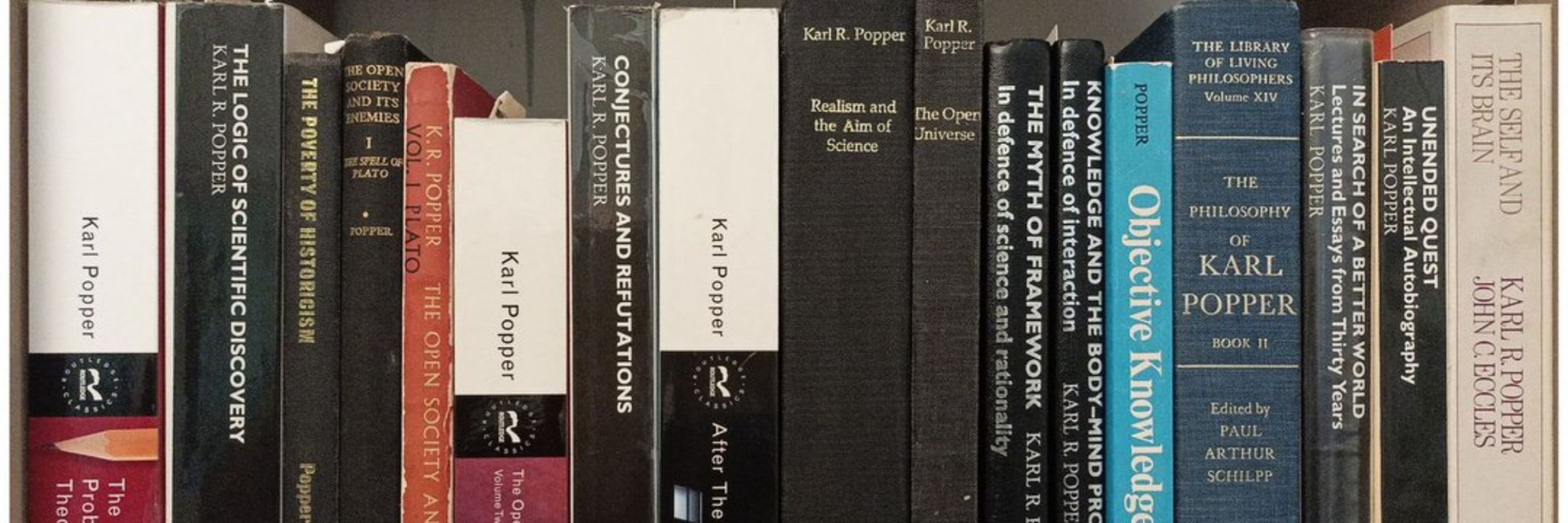
Karl Popper. Also philosophy more generally (esp. epistemology, ethics), economics, history of ideas, theories of distributive justice.
Completely agreed. For the sake of historical accuracy, though - bsky.app/profile/tcla....
Popper fan here 👋🏼
This quote regularly pops up as Popper's, but that's spurious. Its from a 1995 NYT obituary written by Ryszard Kapuscinski.
www.nytimes.com/1995/01/01/m...
This quote regularly pops up as Popper's, but that's spurious. Its from a 1995 NYT obituary written by Ryszard Kapuscinski.
www.nytimes.com/1995/01/01/m...

LIVES WELL LIVED: KARL POPPER;
The Philosopher As Giant-Slayer (Published 1995)
1902-1994 Born in Vienna to a prominent Jewish family, Sir Karl Popper was known as Communism's most formidable opponent. But his influence extended far beyond politics. A postwar emigre, Popper was a...
www.nytimes.com
March 2, 2025 at 5:36 PM
Completely agreed. For the sake of historical accuracy, though - bsky.app/profile/tcla....
Popper aficionado 👋🏼
Popper's point in the paradox of tolerance concerns the limits to allowing political actors who are hostile to certain principles of a broadly liberal form of governance, to act without contraint. Free speech comes into it only secondarily to this point, and subject to it.
Popper's point in the paradox of tolerance concerns the limits to allowing political actors who are hostile to certain principles of a broadly liberal form of governance, to act without contraint. Free speech comes into it only secondarily to this point, and subject to it.

February 26, 2025 at 2:56 PM
Popper aficionado 👋🏼
Popper's point in the paradox of tolerance concerns the limits to allowing political actors who are hostile to certain principles of a broadly liberal form of governance, to act without contraint. Free speech comes into it only secondarily to this point, and subject to it.
Popper's point in the paradox of tolerance concerns the limits to allowing political actors who are hostile to certain principles of a broadly liberal form of governance, to act without contraint. Free speech comes into it only secondarily to this point, and subject to it.
Sure. And, well, Popper's such a good thinker that he gets (mis)used by people on all sides of an issue! 🤭
February 23, 2025 at 5:44 AM
Sure. And, well, Popper's such a good thinker that he gets (mis)used by people on all sides of an issue! 🤭
Popper fan here 👋🏼
This quote regularly pops up as Popper's, but that's spurious. Its from a 1995 NYT obituary written by Ryszard Kapuscinski.
www.nytimes.com/1995/01/01/m...
This quote regularly pops up as Popper's, but that's spurious. Its from a 1995 NYT obituary written by Ryszard Kapuscinski.
www.nytimes.com/1995/01/01/m...
LIVES WELL LIVED: KARL POPPER;
The Philosopher As Giant-Slayer (Published 1995)
1902-1994 Born in Vienna to a prominent Jewish family, Sir Karl Popper was known as Communism's most formidable opponent. But his influence extended far beyond politics. A postwar emigre, Popper was a...
www.nytimes.com
February 22, 2025 at 9:42 PM
Popper aficionado here.
The paradox Popper refers to - at several points in his writing, not just the OSE footnote - isn't a general, "apriori" one, but rather one he claims is inherent *in an assumption, (absolute) value(ing) or argument*, according to which tolerance must be granted absolutely.
The paradox Popper refers to - at several points in his writing, not just the OSE footnote - isn't a general, "apriori" one, but rather one he claims is inherent *in an assumption, (absolute) value(ing) or argument*, according to which tolerance must be granted absolutely.
February 21, 2025 at 10:03 AM
Popper aficionado here.
The paradox Popper refers to - at several points in his writing, not just the OSE footnote - isn't a general, "apriori" one, but rather one he claims is inherent *in an assumption, (absolute) value(ing) or argument*, according to which tolerance must be granted absolutely.
The paradox Popper refers to - at several points in his writing, not just the OSE footnote - isn't a general, "apriori" one, but rather one he claims is inherent *in an assumption, (absolute) value(ing) or argument*, according to which tolerance must be granted absolutely.
Popper afficionado here.
The paradox of intolerance has to do with threats to concrete liberal rule - politically, who's in power and what the actual power relations are - not the limits of acceptable social practice (except to say that the latter requires the former in place to be relevant).
The paradox of intolerance has to do with threats to concrete liberal rule - politically, who's in power and what the actual power relations are - not the limits of acceptable social practice (except to say that the latter requires the former in place to be relevant).
February 18, 2025 at 11:34 AM
Popper afficionado here.
The paradox of intolerance has to do with threats to concrete liberal rule - politically, who's in power and what the actual power relations are - not the limits of acceptable social practice (except to say that the latter requires the former in place to be relevant).
The paradox of intolerance has to do with threats to concrete liberal rule - politically, who's in power and what the actual power relations are - not the limits of acceptable social practice (except to say that the latter requires the former in place to be relevant).
Popper didn't claim scientific hypotheses "should be rejected as soon as... empirical evidence reveals one instance incompatible with it". Accepted contradicting evidence needed to corroborate a falsifying (and itself testable) theory, and repeated that theories shouldn't be abandoned too hastily.


February 14, 2025 at 3:33 PM
Popper didn't claim scientific hypotheses "should be rejected as soon as... empirical evidence reveals one instance incompatible with it". Accepted contradicting evidence needed to corroborate a falsifying (and itself testable) theory, and repeated that theories shouldn't be abandoned too hastily.
February 13, 2025 at 8:06 PM
Popper didn't claim scientific hypotheses "should be rejected as soon as... empirical evidence reveals one instance incompatible with it". Accepted contradicting evidence needed to corroborate a falsifying (and itself testable) theory, and repeated that theories shouldn't be abandoned too hastily.
My (2') referred to Hooker's comment just before it - ie concerning Popper, not the argument that preceded it.
February 13, 2025 at 7:32 PM
My (2') referred to Hooker's comment just before it - ie concerning Popper, not the argument that preceded it.
Popper aficionado here:
Both this (2) and the previous (1) posts don't quite get P right.
(1') the "one counterexample" had to do with the *logical* status of theories - the data here isn't a theory - not necessarily in practice.
(2') P always acknowledged probabilistic statements within science.
Both this (2) and the previous (1) posts don't quite get P right.
(1') the "one counterexample" had to do with the *logical* status of theories - the data here isn't a theory - not necessarily in practice.
(2') P always acknowledged probabilistic statements within science.

February 13, 2025 at 5:06 PM
Popper aficionado here:
Both this (2) and the previous (1) posts don't quite get P right.
(1') the "one counterexample" had to do with the *logical* status of theories - the data here isn't a theory - not necessarily in practice.
(2') P always acknowledged probabilistic statements within science.
Both this (2) and the previous (1) posts don't quite get P right.
(1') the "one counterexample" had to do with the *logical* status of theories - the data here isn't a theory - not necessarily in practice.
(2') P always acknowledged probabilistic statements within science.
Thanks. On Lakatos - criminally abbreviated - nearly all of his supposed critique of Popper is already in Popper - including the notion of research programs (that Lakatos saw in P's manuscripts).
Marxism: Popper sympathised with Marx's concerns; the critiques mostly aimed at "scientific" Marxism.
Marxism: Popper sympathised with Marx's concerns; the critiques mostly aimed at "scientific" Marxism.

February 10, 2025 at 3:48 PM
Thanks. On Lakatos - criminally abbreviated - nearly all of his supposed critique of Popper is already in Popper - including the notion of research programs (that Lakatos saw in P's manuscripts).
Marxism: Popper sympathised with Marx's concerns; the critiques mostly aimed at "scientific" Marxism.
Marxism: Popper sympathised with Marx's concerns; the critiques mostly aimed at "scientific" Marxism.
Fair enough. 👍🏼
February 10, 2025 at 11:21 AM
Fair enough. 👍🏼
What constitutes a "need" for some philosopher('s ideas) within philosophy is tricky; a thinker who no longer bears on any philosophical problem might, arguably, be a candidate.
But then given that induction in some form or other is still widely endorsed, that alone would mean we still need Popper.
But then given that induction in some form or other is still widely endorsed, that alone would mean we still need Popper.
February 10, 2025 at 9:24 AM
What constitutes a "need" for some philosopher('s ideas) within philosophy is tricky; a thinker who no longer bears on any philosophical problem might, arguably, be a candidate.
But then given that induction in some form or other is still widely endorsed, that alone would mean we still need Popper.
But then given that induction in some form or other is still widely endorsed, that alone would mean we still need Popper.
Popper afficionado here 👋🏼
What does being continental have to do with "screw (anyone)"? And is there something specific to Popper that made him the target of that exclamation?
What does being continental have to do with "screw (anyone)"? And is there something specific to Popper that made him the target of that exclamation?
February 10, 2025 at 9:14 AM
Popper afficionado here 👋🏼
What does being continental have to do with "screw (anyone)"? And is there something specific to Popper that made him the target of that exclamation?
What does being continental have to do with "screw (anyone)"? And is there something specific to Popper that made him the target of that exclamation?
(Popper afficionado here.)
Popper's falsification criterion wasn't meant to explain as much as it was a proposal in light of philosophical problems, given accepted aims.
He later (pre-Kuhn) acknowledged the role in science of theories that don't meet it, and stressed their criticizability as key.
Popper's falsification criterion wasn't meant to explain as much as it was a proposal in light of philosophical problems, given accepted aims.
He later (pre-Kuhn) acknowledged the role in science of theories that don't meet it, and stressed their criticizability as key.

February 10, 2025 at 9:05 AM
(Popper afficionado here.)
Popper's falsification criterion wasn't meant to explain as much as it was a proposal in light of philosophical problems, given accepted aims.
He later (pre-Kuhn) acknowledged the role in science of theories that don't meet it, and stressed their criticizability as key.
Popper's falsification criterion wasn't meant to explain as much as it was a proposal in light of philosophical problems, given accepted aims.
He later (pre-Kuhn) acknowledged the role in science of theories that don't meet it, and stressed their criticizability as key.
Not an actual Popper quote.
bsky.app/profile/tcla...
bsky.app/profile/tcla...
Popper fan here 👋🏼
This quote regularly pops up as Popper's, but that's spurious. Its from a 1995 NYT obituary written by Ryszard Kapuscinski.
www.nytimes.com/1995/01/01/m...
This quote regularly pops up as Popper's, but that's spurious. Its from a 1995 NYT obituary written by Ryszard Kapuscinski.
www.nytimes.com/1995/01/01/m...
LIVES WELL LIVED: KARL POPPER;
The Philosopher As Giant-Slayer (Published 1995)
1902-1994 Born in Vienna to a prominent Jewish family, Sir Karl Popper was known as Communism's most formidable opponent. But his influence extended far beyond politics. A postwar emigre, Popper was a...
www.nytimes.com
January 25, 2025 at 10:02 PM
Not an actual Popper quote.
bsky.app/profile/tcla...
bsky.app/profile/tcla...
I think you would be right on that. Popper's core insight was the importance of effective criticism, not only the producing of theories. Though he wouldn't quite put it this way, the "point" of multiple contradictory theories would be as grist for a critical pruning process - *in pursuit of truth.*
January 18, 2025 at 10:08 AM
I think you would be right on that. Popper's core insight was the importance of effective criticism, not only the producing of theories. Though he wouldn't quite put it this way, the "point" of multiple contradictory theories would be as grist for a critical pruning process - *in pursuit of truth.*
Re Popper - yes, but.
He indeed enrolled in more Schlick courses than any other lecturer but Buhler. However, he was quickly disillusioned, and the sharp criticism of Schlick's theory of knowledge in Popper's dissertation carried into his first book. He was first and foremost Buhler's student.
He indeed enrolled in more Schlick courses than any other lecturer but Buhler. However, he was quickly disillusioned, and the sharp criticism of Schlick's theory of knowledge in Popper's dissertation carried into his first book. He was first and foremost Buhler's student.
January 18, 2025 at 10:03 AM
Re Popper - yes, but.
He indeed enrolled in more Schlick courses than any other lecturer but Buhler. However, he was quickly disillusioned, and the sharp criticism of Schlick's theory of knowledge in Popper's dissertation carried into his first book. He was first and foremost Buhler's student.
He indeed enrolled in more Schlick courses than any other lecturer but Buhler. However, he was quickly disillusioned, and the sharp criticism of Schlick's theory of knowledge in Popper's dissertation carried into his first book. He was first and foremost Buhler's student.
Popper afficionado here 👋🏼
P was not particularly a proponent of there being "different kinds of truth and reality". Can you give a direction of what you had in mind here?
P was not particularly a proponent of there being "different kinds of truth and reality". Can you give a direction of what you had in mind here?
December 28, 2024 at 11:02 PM
Popper afficionado here 👋🏼
P was not particularly a proponent of there being "different kinds of truth and reality". Can you give a direction of what you had in mind here?
P was not particularly a proponent of there being "different kinds of truth and reality". Can you give a direction of what you had in mind here?
A spirited response, no doubt - but you haven't answered the question.
December 15, 2024 at 12:31 PM
A spirited response, no doubt - but you haven't answered the question.
Points for enthusiasm, but you haven't answered the question.
December 15, 2024 at 12:30 PM
Points for enthusiasm, but you haven't answered the question.
The benefits to Islamists right on Israel's borders having advanced weaponry are - what, exactly? (See Hamas and Hezbollah for reference.)
December 15, 2024 at 12:06 PM
The benefits to Islamists right on Israel's borders having advanced weaponry are - what, exactly? (See Hamas and Hezbollah for reference.)