



Tom Fay
@tompfay.bsky.social
Theoretical chemist by day. Vegan by night. (Also vegan by day too.) Assistant professor at UCLA. Views are my own. Group site: https://faygroupucla.github.io Orcid: https://orcid.org/0000-0003-0625-731X
This strong charge transfer coupling calculation uses a theory I developed not too long ago called Optimal Golden Rule theory. This generalises Fermi's Golden Rule non-adiabatic rates (and Marcus theory) in the inverted regime to strong electronic couplings doi.org/10.1063/5.02...

Extending non-adiabatic rate theory to strong electronic couplings in the Marcus inverted regime
Electron transfer reactions play an essential role in many chemical and biological processes. Fermi’s golden rule (GR), which assumes that the coupling between
doi.org
January 8, 2026 at 5:34 PM
This strong charge transfer coupling calculation uses a theory I developed not too long ago called Optimal Golden Rule theory. This generalises Fermi's Golden Rule non-adiabatic rates (and Marcus theory) in the inverted regime to strong electronic couplings doi.org/10.1063/5.02...
I think one of the most remarkable things to come out of this is that in one system studied, BODIPY-PTH, very strong charge transfer coupling actually slows down reverse electron transfer by 3 orders of magnitude. Without this, BODIPY-PTH wouldn't be a viable photosensitiser.
January 8, 2026 at 5:34 PM
I think one of the most remarkable things to come out of this is that in one system studied, BODIPY-PTH, very strong charge transfer coupling actually slows down reverse electron transfer by 3 orders of magnitude. Without this, BODIPY-PTH wouldn't be a viable photosensitiser.
This opens the door to studying more complex processes like charge transfer and non-adiabatic dynamics in the condensed phase. The methods are implemented in the OpenESPF code available here: github.com/tomfay/opene... It combines PySCF for QM calculations and OpenMM for GPU accelerated MM.

GitHub - tomfay/openespf: A python toolkit for performing polarizable QM/MM simulations.
A python toolkit for performing polarizable QM/MM simulations. - tomfay/openespf
github.com
September 12, 2025 at 12:11 PM
This opens the door to studying more complex processes like charge transfer and non-adiabatic dynamics in the condensed phase. The methods are implemented in the OpenESPF code available here: github.com/tomfay/opene... It combines PySCF for QM calculations and OpenMM for GPU accelerated MM.
We've also developed the machinery to treat periodic boundary conditions and calculate forces for ground and excited states. In the paper we demonstrate that we can calculate fluorescence spectra with tens of nanoseconds of excited state QM/MM molecular dynamics with state-specific MM polarisation.
September 12, 2025 at 12:11 PM
We've also developed the machinery to treat periodic boundary conditions and calculate forces for ground and excited states. In the paper we demonstrate that we can calculate fluorescence spectra with tens of nanoseconds of excited state QM/MM molecular dynamics with state-specific MM polarisation.
I'm also going to take this opportunity to advertise again that I'm recruiting postdocs to work in my group. If you have an interest in quantum dynamics, excited states, electron/energy transfers, or other things my group does (see here faygroupucla.github.io) please do get in touch.
September 8, 2025 at 5:06 PM
I'm also going to take this opportunity to advertise again that I'm recruiting postdocs to work in my group. If you have an interest in quantum dynamics, excited states, electron/energy transfers, or other things my group does (see here faygroupucla.github.io) please do get in touch.
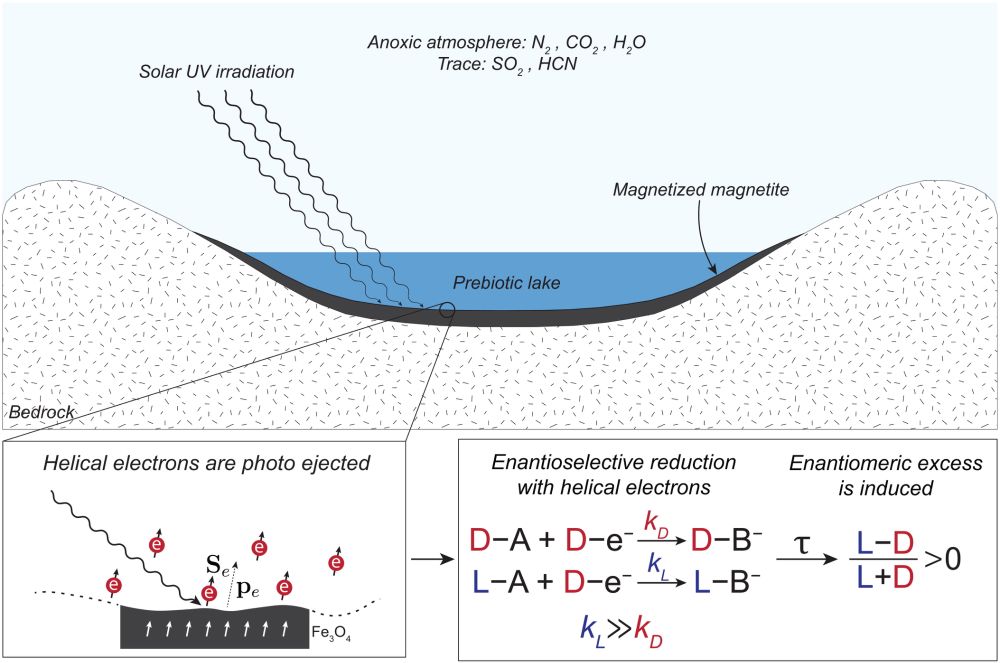
This work describes a new mechanism by which reactions of spin-polarised radicals, high energy intermediates encountered in lots of chemistry, can selectively react to form different chiral products. This could implications for the chemistry of the origin of life.
September 8, 2025 at 5:06 PM
This work describes a new mechanism by which reactions of spin-polarised radicals, high energy intermediates encountered in lots of chemistry, can selectively react to form different chiral products. This could implications for the chemistry of the origin of life.
This idea may have implications for why all of life's molecules have a particular chirality over another. This work was inspired by work from Ozturk and Sasselov which I'd thoroughly recommend. doi.org/10.1073/pnas...
On the origins of life’s homochirality: Inducing enantiomeric excess with spin-polarized electrons | PNAS
Life as we know it is homochiral, but the origins of biological homochirality on early
Earth remain elusive. Shallow closed-basin lakes are a plaus...
doi.org
July 18, 2025 at 5:29 AM
This idea may have implications for why all of life's molecules have a particular chirality over another. This work was inspired by work from Ozturk and Sasselov which I'd thoroughly recommend. doi.org/10.1073/pnas...
All of this is implemented in the freely available OpenESPF code: github.com/tomfay/opene... . This interfaces PySCF for QM calculations and OpenMM for polarisable MM calculations (with GPU acceleration). Lots of examples are included in the git repo!

GitHub - tomfay/openespf: A python toolkit for performing polarizable QM/MM simulations.
A python toolkit for performing polarizable QM/MM simulations. - tomfay/openespf
github.com
June 2, 2025 at 8:18 AM
All of this is implemented in the freely available OpenESPF code: github.com/tomfay/opene... . This interfaces PySCF for QM calculations and OpenMM for polarisable MM calculations (with GPU acceleration). Lots of examples are included in the git repo!
With this we've been able to run 10s of picoseconds of excited state, polarisable QM/MM molecular dynamics, with rigorously treated periodic boundary conditions. We can also run calculations with well over 100,000 polarisable MM atoms.
June 2, 2025 at 8:18 AM
With this we've been able to run 10s of picoseconds of excited state, polarisable QM/MM molecular dynamics, with rigorously treated periodic boundary conditions. We can also run calculations with well over 100,000 polarisable MM atoms.