




Jonathan Tsay
@tsay.bsky.social
Assistant Professor of Psychology at Carnegie Mellon University | Studying how we acquire, adapt, and retain skilled movements | Physical Intelligence Lab: www.tsaylab.com
New preprint with @mwarb.bsky.social!
We outline 10 principles for conducting rigorous online behavioral experiments, offering a practical framework for researchers.
osf.io/preprints/ps...
We outline 10 principles for conducting rigorous online behavioral experiments, offering a practical framework for researchers.
osf.io/preprints/ps...

January 20, 2026 at 1:01 PM
New preprint with @mwarb.bsky.social!
We outline 10 principles for conducting rigorous online behavioral experiments, offering a practical framework for researchers.
osf.io/preprints/ps...
We outline 10 principles for conducting rigorous online behavioral experiments, offering a practical framework for researchers.
osf.io/preprints/ps...
On the individual level, the efficiency–flexibility trade-off reflects a continuous shift in the mixture of strategies each learner deploys.
To uncover this, Wei Ding and Anjuli developed a suite of analyses that we hope will be useful to anyone studying learning and exploratory behavior!
To uncover this, Wei Ding and Anjuli developed a suite of analyses that we hope will be useful to anyone studying learning and exploratory behavior!

December 3, 2025 at 12:50 PM
On the individual level, the efficiency–flexibility trade-off reflects a continuous shift in the mixture of strategies each learner deploys.
To uncover this, Wei Ding and Anjuli developed a suite of analyses that we hope will be useful to anyone studying learning and exploratory behavior!
To uncover this, Wei Ding and Anjuli developed a suite of analyses that we hope will be useful to anyone studying learning and exploratory behavior!
...when the hypothesis space is constrained, learners acquire strategies more slowly but generalize well to novel targets. When it is unconstrained, learners can quickly latch onto an expedient hypothesis—yet these strategies often fail to generalize.

December 3, 2025 at 12:50 PM
...when the hypothesis space is constrained, learners acquire strategies more slowly but generalize well to novel targets. When it is unconstrained, learners can quickly latch onto an expedient hypothesis—yet these strategies often fail to generalize.
To stress-test this idea, our two experiments also evaluated and revealed pattern of behavior uniquely predicted by the hypothesis testing framework: an efficiency–flexibility trade-off.
Specifically, ...
Specifically, ...

December 3, 2025 at 12:50 PM
To stress-test this idea, our two experiments also evaluated and revealed pattern of behavior uniquely predicted by the hypothesis testing framework: an efficiency–flexibility trade-off.
Specifically, ...
Specifically, ...
However, across our two large-scale online experiments (N = 560), our data tell a very different story!
Individual learners engage in rich, exploratory behavior that is anything but gradual—and show variability that is anything but minimal.
Individual learners engage in rich, exploratory behavior that is anything but gradual—and show variability that is anything but minimal.

December 3, 2025 at 12:50 PM
However, across our two large-scale online experiments (N = 560), our data tell a very different story!
Individual learners engage in rich, exploratory behavior that is anything but gradual—and show variability that is anything but minimal.
Individual learners engage in rich, exploratory behavior that is anything but gradual—and show variability that is anything but minimal.
For decades, the dominant view has been that strategic adaptation follows a gradual process of error reduction.
Group-averaged data appear to support this, showing learners slowly adjusting to a changed visuomotor mapping (e.g., a rotation between hand movement and cursor position).
Group-averaged data appear to support this, showing learners slowly adjusting to a changed visuomotor mapping (e.g., a rotation between hand movement and cursor position).

December 3, 2025 at 12:50 PM
For decades, the dominant view has been that strategic adaptation follows a gradual process of error reduction.
Group-averaged data appear to support this, showing learners slowly adjusting to a changed visuomotor mapping (e.g., a rotation between hand movement and cursor position).
Group-averaged data appear to support this, showing learners slowly adjusting to a changed visuomotor mapping (e.g., a rotation between hand movement and cursor position).
We just launched Fast Fingers 👌🏼—a quick 3 min tapping game that uses your phone/laptop camera to measure hand dexterity.
I got 54 taps in 10s. Can you beat me? 😏
Game link: actioncensus.org
#Sensorimotor #PsychSciSky #Neuroscience #Psychology
I got 54 taps in 10s. Can you beat me? 😏
Game link: actioncensus.org
#Sensorimotor #PsychSciSky #Neuroscience #Psychology

November 19, 2025 at 3:43 PM
We just launched Fast Fingers 👌🏼—a quick 3 min tapping game that uses your phone/laptop camera to measure hand dexterity.
I got 54 taps in 10s. Can you beat me? 😏
Game link: actioncensus.org
#Sensorimotor #PsychSciSky #Neuroscience #Psychology
I got 54 taps in 10s. Can you beat me? 😏
Game link: actioncensus.org
#Sensorimotor #PsychSciSky #Neuroscience #Psychology
CoRT not only offers an explanation for a wide array of findings, but it points to future tests in controversial domains.
Take language, social cognition, and executive control: fMRI shows cerebellar activation, yet patient data often don’t align.
Take language, social cognition, and executive control: fMRI shows cerebellar activation, yet patient data often don’t align.

September 15, 2025 at 12:19 PM
CoRT not only offers an explanation for a wide array of findings, but it points to future tests in controversial domains.
Take language, social cognition, and executive control: fMRI shows cerebellar activation, yet patient data often don’t align.
Take language, social cognition, and executive control: fMRI shows cerebellar activation, yet patient data often don’t align.
Continuity: The cerebellum shines when transforming continuous representations—rotating a mental image, tracking a moving ball, adding along a mental number line.
But it plays little role in discrete tasks like word retrieval or look-up from a discrete multiplication table.
But it plays little role in discrete tasks like word retrieval or look-up from a discrete multiplication table.

September 15, 2025 at 12:19 PM
Continuity: The cerebellum shines when transforming continuous representations—rotating a mental image, tracking a moving ball, adding along a mental number line.
But it plays little role in discrete tasks like word retrieval or look-up from a discrete multiplication table.
But it plays little role in discrete tasks like word retrieval or look-up from a discrete multiplication table.
Timescale: The cerebellum specializes in predictions at fast, millisecond resolution—like timing an eyeblink to an air puff, or perceiving short temporal intervals (but not perceiving loudness).
But planning dinner tonight? That may be outside the cerebellum's wheelhouse.
But planning dinner tonight? That may be outside the cerebellum's wheelhouse.

September 15, 2025 at 12:19 PM
Timescale: The cerebellum specializes in predictions at fast, millisecond resolution—like timing an eyeblink to an air puff, or perceiving short temporal intervals (but not perceiving loudness).
But planning dinner tonight? That may be outside the cerebellum's wheelhouse.
But planning dinner tonight? That may be outside the cerebellum's wheelhouse.
Prediction: The cerebellum runs feedforward, anticipatory computations—not reactive ones. It helps you plan for the future state, not just react to the present, or retrieve from the past.

September 15, 2025 at 12:19 PM
Prediction: The cerebellum runs feedforward, anticipatory computations—not reactive ones. It helps you plan for the future state, not just react to the present, or retrieve from the past.
New @biorxivpreprint.bsky.social:
People with low vision—uncorrectable visual impairment that causes functional vision loss—can still adapt deliberately to motor errors, even when visual feedback is degraded.
Welcoming any and all feedback!
tinyurl.com/ymbm9352
People with low vision—uncorrectable visual impairment that causes functional vision loss—can still adapt deliberately to motor errors, even when visual feedback is degraded.
Welcoming any and all feedback!
tinyurl.com/ymbm9352

August 2, 2025 at 2:22 PM
New @biorxivpreprint.bsky.social:
People with low vision—uncorrectable visual impairment that causes functional vision loss—can still adapt deliberately to motor errors, even when visual feedback is degraded.
Welcoming any and all feedback!
tinyurl.com/ymbm9352
People with low vision—uncorrectable visual impairment that causes functional vision loss—can still adapt deliberately to motor errors, even when visual feedback is degraded.
Welcoming any and all feedback!
tinyurl.com/ymbm9352
Specifically, when we look at the error distributions, we see greater random exploration (weight on the uniform component) and greater # of peaks.

July 30, 2025 at 11:57 PM
Specifically, when we look at the error distributions, we see greater random exploration (weight on the uniform component) and greater # of peaks.
What happens to motor adaptation—the way we correct errors with feedback—when feedback is indirect, like a number on a screen?
In our new paper in @royalsociety.org, we found that indirect feedback hinders learning compared to sensory feedback.
tinyurl.com/5d32c99e
In our new paper in @royalsociety.org, we found that indirect feedback hinders learning compared to sensory feedback.
tinyurl.com/5d32c99e

July 30, 2025 at 11:33 AM
What happens to motor adaptation—the way we correct errors with feedback—when feedback is indirect, like a number on a screen?
In our new paper in @royalsociety.org, we found that indirect feedback hinders learning compared to sensory feedback.
tinyurl.com/5d32c99e
In our new paper in @royalsociety.org, we found that indirect feedback hinders learning compared to sensory feedback.
tinyurl.com/5d32c99e
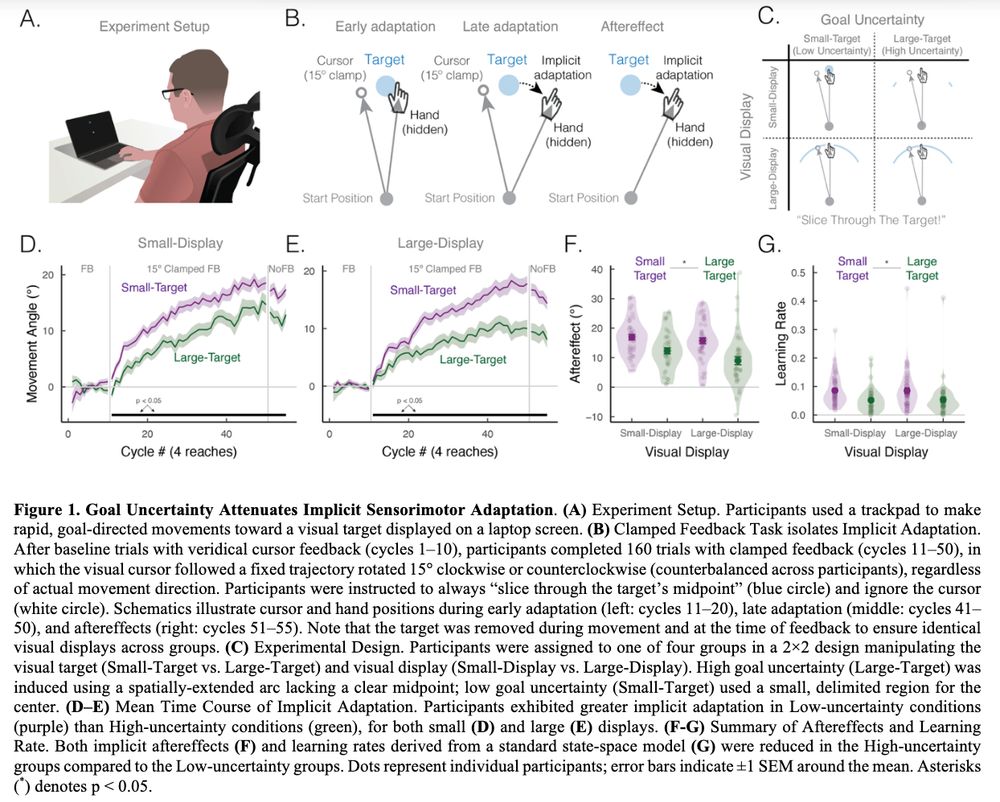
New preprint with Sritej, rezashadmehr.bsky.social, and Roberta Klatzky now on biorxivpreprint.bsky.social!
Motor adaptation—our ability to correct errors using feedback—is attenuated in a Bayes-optimal manner when goals are uncertain.
Welcome any and all feedback!
tinyurl.com/y9kjcfzj
Motor adaptation—our ability to correct errors using feedback—is attenuated in a Bayes-optimal manner when goals are uncertain.
Welcome any and all feedback!
tinyurl.com/y9kjcfzj
July 24, 2025 at 10:40 AM
New preprint with Sritej, rezashadmehr.bsky.social, and Roberta Klatzky now on biorxivpreprint.bsky.social!
Motor adaptation—our ability to correct errors using feedback—is attenuated in a Bayes-optimal manner when goals are uncertain.
Welcome any and all feedback!
tinyurl.com/y9kjcfzj
Motor adaptation—our ability to correct errors using feedback—is attenuated in a Bayes-optimal manner when goals are uncertain.
Welcome any and all feedback!
tinyurl.com/y9kjcfzj
Welcoming any and all feedback on my short summary of Motor Learning for the Open Encyclopedia of Cognitive Science (@oecs-bot.bsky.social)—an amazing resource edited by @mcxfrank.bsky.social. Currently under review.
#Sensorimotor #MotorLearning #Neurosky
tinyurl.com/t2c4vsrf
#Sensorimotor #MotorLearning #Neurosky
tinyurl.com/t2c4vsrf

June 15, 2025 at 1:20 PM
Welcoming any and all feedback on my short summary of Motor Learning for the Open Encyclopedia of Cognitive Science (@oecs-bot.bsky.social)—an amazing resource edited by @mcxfrank.bsky.social. Currently under review.
#Sensorimotor #MotorLearning #Neurosky
tinyurl.com/t2c4vsrf
#Sensorimotor #MotorLearning #Neurosky
tinyurl.com/t2c4vsrf
Sex/gender effects:
Women reacted slower (–8 ms), moved slower (–37 ms), but were more precise (+0.5°)—differences that largely disappeared after accounting for video game use + sleep.
Age effects? Remained robust after accounting for experiential factors.
Women reacted slower (–8 ms), moved slower (–37 ms), but were more precise (+0.5°)—differences that largely disappeared after accounting for video game use + sleep.
Age effects? Remained robust after accounting for experiential factors.

May 8, 2025 at 12:33 AM
Sex/gender effects:
Women reacted slower (–8 ms), moved slower (–37 ms), but were more precise (+0.5°)—differences that largely disappeared after accounting for video game use + sleep.
Age effects? Remained robust after accounting for experiential factors.
Women reacted slower (–8 ms), moved slower (–37 ms), but were more precise (+0.5°)—differences that largely disappeared after accounting for video game use + sleep.
Age effects? Remained robust after accounting for experiential factors.
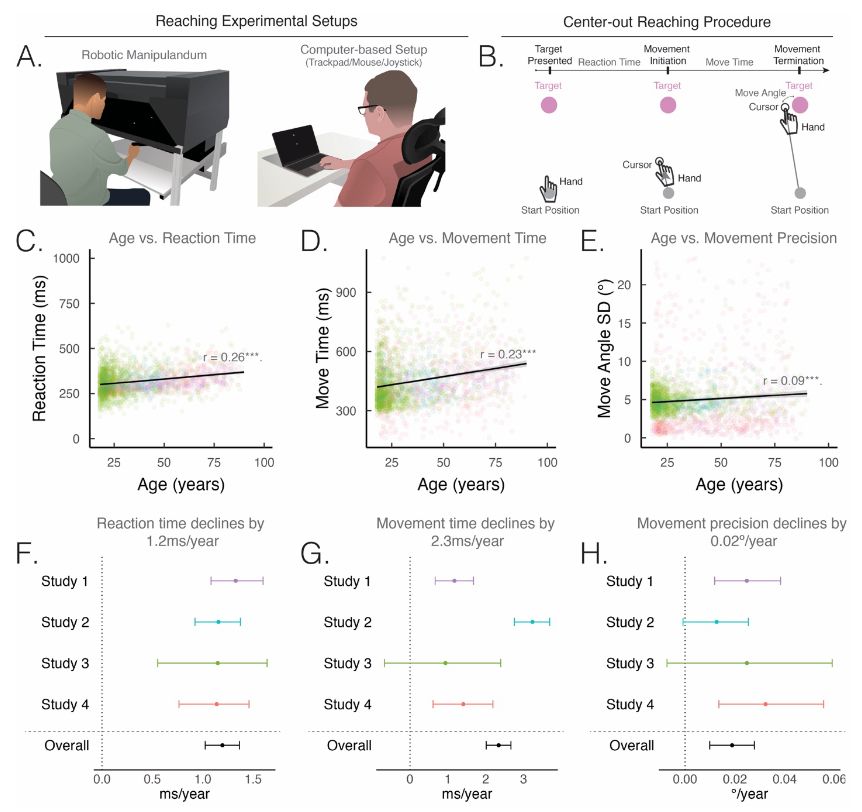
As we age, we move slower and less precisely—but how much, exactly?
We analyzed one of the largest datasets on motor control to date—2,185 adults performing a reaching task.
Findings
• Reaction time: –1.2 ms/year
• Movement time: –2.3 ms/year
• Precision: –0.02°/year
tinyurl.com/f9v66jut
1/2
We analyzed one of the largest datasets on motor control to date—2,185 adults performing a reaching task.
Findings
• Reaction time: –1.2 ms/year
• Movement time: –2.3 ms/year
• Precision: –0.02°/year
tinyurl.com/f9v66jut
1/2
May 8, 2025 at 12:33 AM
As we age, we move slower and less precisely—but how much, exactly?
We analyzed one of the largest datasets on motor control to date—2,185 adults performing a reaching task.
Findings
• Reaction time: –1.2 ms/year
• Movement time: –2.3 ms/year
• Precision: –0.02°/year
tinyurl.com/f9v66jut
1/2
We analyzed one of the largest datasets on motor control to date—2,185 adults performing a reaching task.
Findings
• Reaction time: –1.2 ms/year
• Movement time: –2.3 ms/year
• Precision: –0.02°/year
tinyurl.com/f9v66jut
1/2