


Yi Zhang
@yi-zhang-compbio.bsky.social
Assistant Professor@Duke #compbio #machinelearning #genomics👩🔬 💻 Alumni UIUC/DFCI/Harvard. https://yi-zhang-compbio-lab.github.io/ Recruiting postdoc!
We are recruiting postdocs and students! Interested in computational biology, machine learning, bioinformatics, cancer genomics, single-cell multi-omics, spatial transcriptomics, human genetics, and immunology? - Welcome to join us! yi-zhang-compbio-lab.github.io/join/ 10/
Join
Yi Zhang’s computational biology lab at Duke University (2024)
yi-zhang-compbio-lab.github.io
February 14, 2025 at 9:42 PM
We are recruiting postdocs and students! Interested in computational biology, machine learning, bioinformatics, cancer genomics, single-cell multi-omics, spatial transcriptomics, human genetics, and immunology? - Welcome to join us! yi-zhang-compbio-lab.github.io/join/ 10/
Our first lab preprint is impossible without the collaborative work with our amazing intern student Silas Chuhanwen Sun, and support from our Duke Departments of Neurosurgery and Biostatistics&Bioinformatics, Brain Tumor Center, and Brain Tumor Omics Program. 9/
February 14, 2025 at 9:42 PM
Our first lab preprint is impossible without the collaborative work with our amazing intern student Silas Chuhanwen Sun, and support from our Duke Departments of Neurosurgery and Biostatistics&Bioinformatics, Brain Tumor Center, and Brain Tumor Omics Program. 9/
STHD is scalable to millions of spots now common in high-resolution spatial omics; the algorithm design also works for other high-resolution, high gene-coverage spatial transcriptomics platforms - under development 8/
February 14, 2025 at 9:42 PM
STHD is scalable to millions of spots now common in high-resolution spatial omics; the algorithm design also works for other high-resolution, high gene-coverage spatial transcriptomics platforms - under development 8/
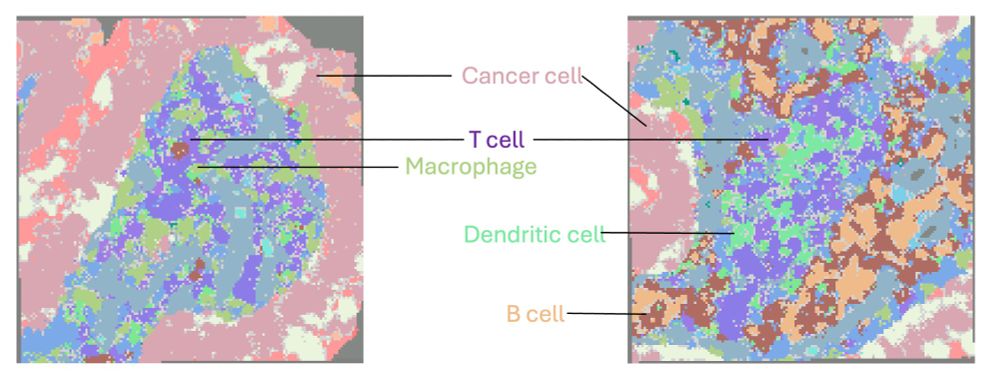
- Locally: identification of multi-cellular neighborhoods and cell-cell interactions, where gene expression mediating cell-cell communications are further revealed. E.g. Various immune hubs enriching different T-myeloid interactions; TLS structure seen in other tumor samples. 7/
February 14, 2025 at 9:42 PM
- Locally: identification of multi-cellular neighborhoods and cell-cell interactions, where gene expression mediating cell-cell communications are further revealed. E.g. Various immune hubs enriching different T-myeloid interactions; TLS structure seen in other tumor samples. 7/
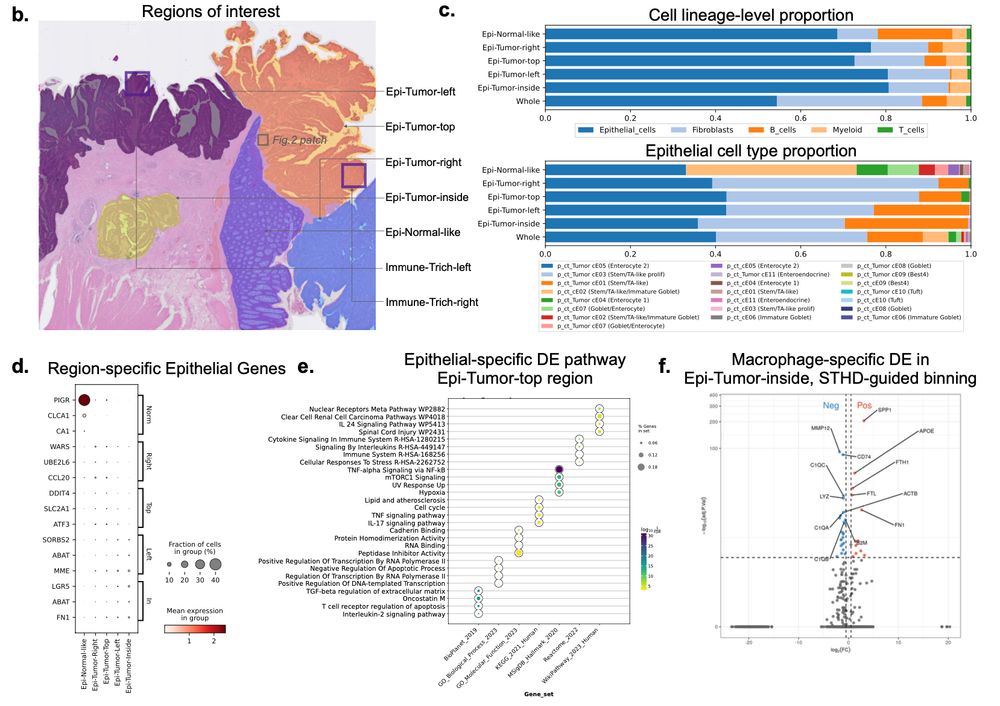
The STHD cell labels enable many analyses- globally: segmentation of tissue structures and detection of cell type-specific differential genes/pathways. e.g. The inside tumor nodule expresses higher epithelial-specific stem genes, and higher macrophage-specific SPP1+ state. 6/
February 14, 2025 at 9:42 PM
The STHD cell labels enable many analyses- globally: segmentation of tissue structures and detection of cell type-specific differential genes/pathways. e.g. The inside tumor nodule expresses higher epithelial-specific stem genes, and higher macrophage-specific SPP1+ state. 6/
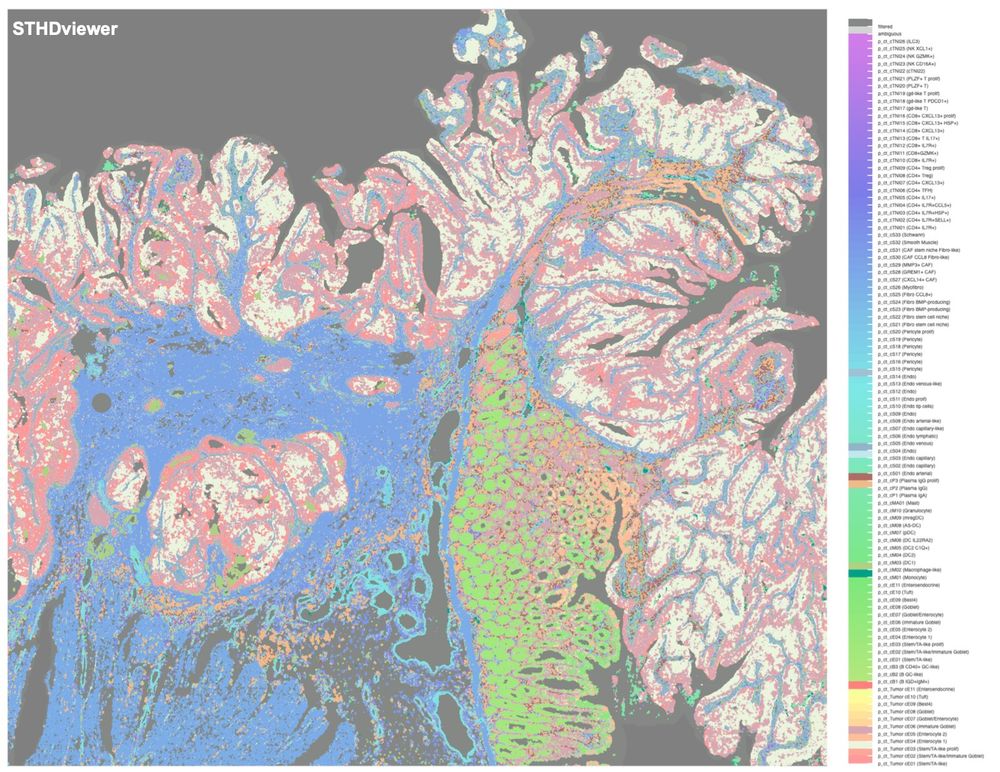
STHD enables scalable spatial inference and interactive exploration of cellular niches and immune hubs, facilitating genome-wide and cell type-specific spatial comparisons. One example full-size colon cancer VisiumHD generated by STHDviewer is at yi-zhang-compbio-lab.github.io/STHDviewer_c.... 5/
February 14, 2025 at 9:42 PM
STHD enables scalable spatial inference and interactive exploration of cellular niches and immune hubs, facilitating genome-wide and cell type-specific spatial comparisons. One example full-size colon cancer VisiumHD generated by STHDviewer is at yi-zhang-compbio-lab.github.io/STHDviewer_c.... 5/
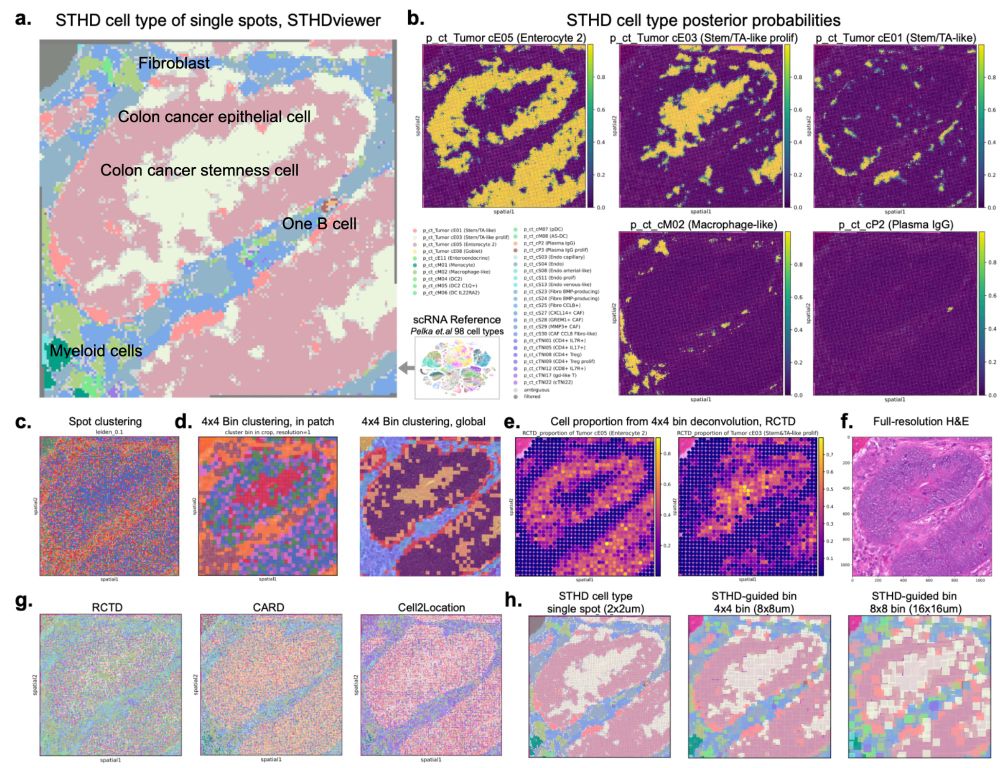
We show that STHD accurately infers cell type identities at subcellular level and guides cell type-specific binning, achieving high performance in benchmarks and preserving cell type-specific expression. Below is a small "tumor bagel" patch (~0.25%) from one colon cancer VisiumHD 4/
February 14, 2025 at 9:42 PM
We show that STHD accurately infers cell type identities at subcellular level and guides cell type-specific binning, achieving high performance in benchmarks and preserving cell type-specific expression. Below is a small "tumor bagel" patch (~0.25%) from one colon cancer VisiumHD 4/
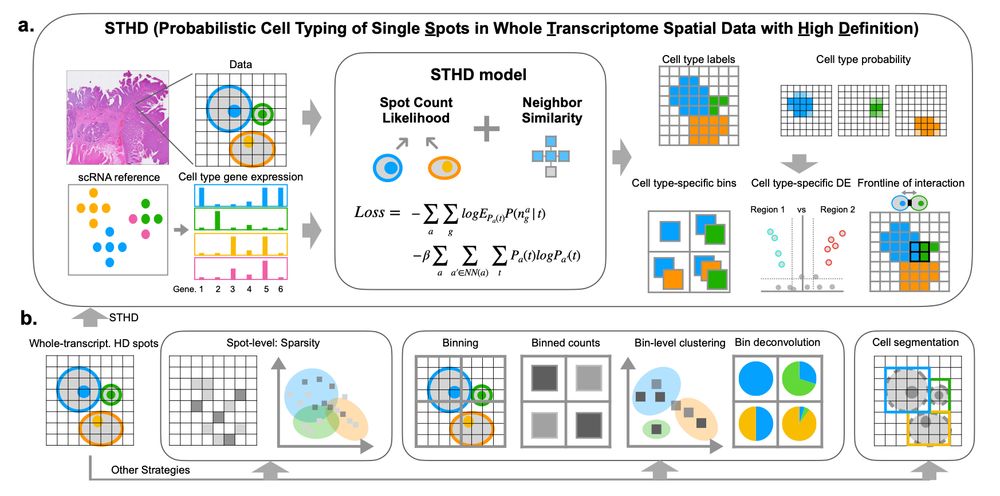
In details, STHD uses machine learning to model high-resolution spots with neighbor regularization, where the loss function addresses sparsity by modeling count statistics, incorporating neighbor similarities, and leveraging reference single-cell RNA-seq data. 3/
February 14, 2025 at 9:42 PM
In details, STHD uses machine learning to model high-resolution spots with neighbor regularization, where the loss function addresses sparsity by modeling count statistics, incorporating neighbor similarities, and leveraging reference single-cell RNA-seq data. 3/
Current binning approaches create cell mixtures that complicate deconvolution. Instead, STHD uses ML/AI to achieve high-resolution cell typing and to discover cell type-specific neighborhoods and differential genes/pathways. STHD pipeline is available at github.com/yi-zhang/STHD/ 2/
GitHub - yi-zhang/STHD: STHD: probabilistic cell typing of Single spots in whole Transcriptome spatial data with High Definition
STHD: probabilistic cell typing of Single spots in whole Transcriptome spatial data with High Definition - yi-zhang/STHD
github.com
February 14, 2025 at 9:42 PM
Current binning approaches create cell mixtures that complicate deconvolution. Instead, STHD uses ML/AI to achieve high-resolution cell typing and to discover cell type-specific neighborhoods and differential genes/pathways. STHD pipeline is available at github.com/yi-zhang/STHD/ 2/
Excited to host Dr. Luca Pinello today at Duke to share insights on computational methods for single-cell genomics and CRISPR genome editing. Duke Single Cell Initiative seminar series: dmpi.duke.edu/duke-single-...
Duke Single Cell Initiative (SCI) | Duke Molecular Physiology Institute | Duke Molecular Physiology Institute
Xenium image of healthy lung tissue, courtesy of Jamie Todd
dmpi.duke.edu
December 18, 2024 at 6:55 PM
Excited to host Dr. Luca Pinello today at Duke to share insights on computational methods for single-cell genomics and CRISPR genome editing. Duke Single Cell Initiative seminar series: dmpi.duke.edu/duke-single-...