



Yi Zhang
@yi-zhang-compbio.bsky.social
Assistant Professor@Duke #compbio #machinelearning #genomics👩🔬 💻 Alumni UIUC/DFCI/Harvard. https://yi-zhang-compbio-lab.github.io/ Recruiting postdoc!
We are recruiting Postdoc at Duke University! Join us to develop computational genomics & machine learning methods: www.linkedin.com/jobs/view/41...
Duke University School of Medicine hiring Computational Genomics Postdoc Positions in Durham, NC | LinkedIn
Posted 7:10:56 PM. Postdoc Position at Duke University on Computational Genomics & Machine LearningDescription: A…See this and similar jobs on LinkedIn.
www.linkedin.com
February 21, 2025 at 7:32 PM
We are recruiting Postdoc at Duke University! Join us to develop computational genomics & machine learning methods: www.linkedin.com/jobs/view/41...
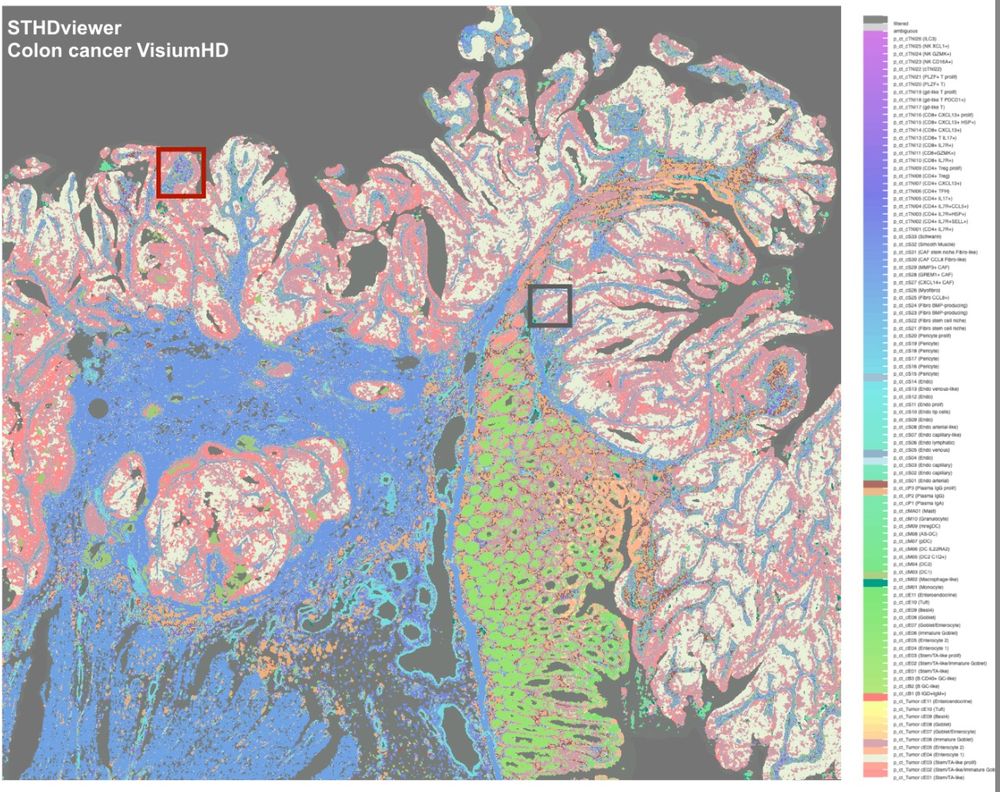
Analyzing high-resolution spatial transcriptomics like VisiumHD? Sharing STHD, a machine learning algorithm for cell type mapping of every high-resolution (2um for VisiumHD) spot by integrating scRNA reference (Updated preprint from Version1 June 2024) : www.biorxiv.org/content/10.1.... 1/
STHD: probabilistic cell typing of single Spots in whole Transcriptome spatial data with High Definition
Recent spatial transcriptomics (ST) technologies have enabled single- and sub-cellular resolution profiling of gene expression across the whole transcriptome. However, the transition to high-definition ST significantly increased data sparsity and dimensionality, posing computational challenges in identifying cell types, deciphering neighborhood structure, and detecting differential expression - all are crucial steps to study normal and disease ST samples. Here we present STHD, a novel machine learning method for probabilistic cell typing of single spots in whole-transcriptome, high-resolution ST data. Unlike the current binning-aggregation-deconvolution strategy, STHD directly models gene expression at single-spot level to infer cell type identities without cell segmentation or spot aggregation. STHD addresses sparsity by modeling count statistics, incorporating neighbor similarities, and leveraging reference single-cell RNA-seq data. We show in VisiumHD data that STHD accurately predicts cell type identities at single-spot level, which achieves precise segmentation of both global tissue architecture and local multicellular neighborhoods. The high-resolution labels facilitate various downstream analyses, including cell type-stratified bin aggregation, spatial compositional comparisons, and cell type-specific differential expression analyses. Moreover, STHD labels further reveal frontlines of inter-cell type interactions at immune hubs in cancer samples. STHD is scalable and generalizable across diverse samples, tissues, and diseases, facilitating genome-wide analyses in various spatial organization contexts. Overall, computational modeling of individual spots with STHD facilitates discoveries in cellular interactions and molecular mechanisms in whole-genome spatial technologies with high resolution. STHD is available at <https://github.com/yi-zhang/STHD>. ### Competing Interest Statement The authors have declared no competing interest.
www.biorxiv.org
February 14, 2025 at 9:42 PM
Analyzing high-resolution spatial transcriptomics like VisiumHD? Sharing STHD, a machine learning algorithm for cell type mapping of every high-resolution (2um for VisiumHD) spot by integrating scRNA reference (Updated preprint from Version1 June 2024) : www.biorxiv.org/content/10.1.... 1/
Reposted by Yi Zhang
High-resolution, noninvasive single-cell lineage tracing in mice and humans based on DNA methylation epimutations
www.nature.com/articles/s41...
www.nature.com/articles/s41...
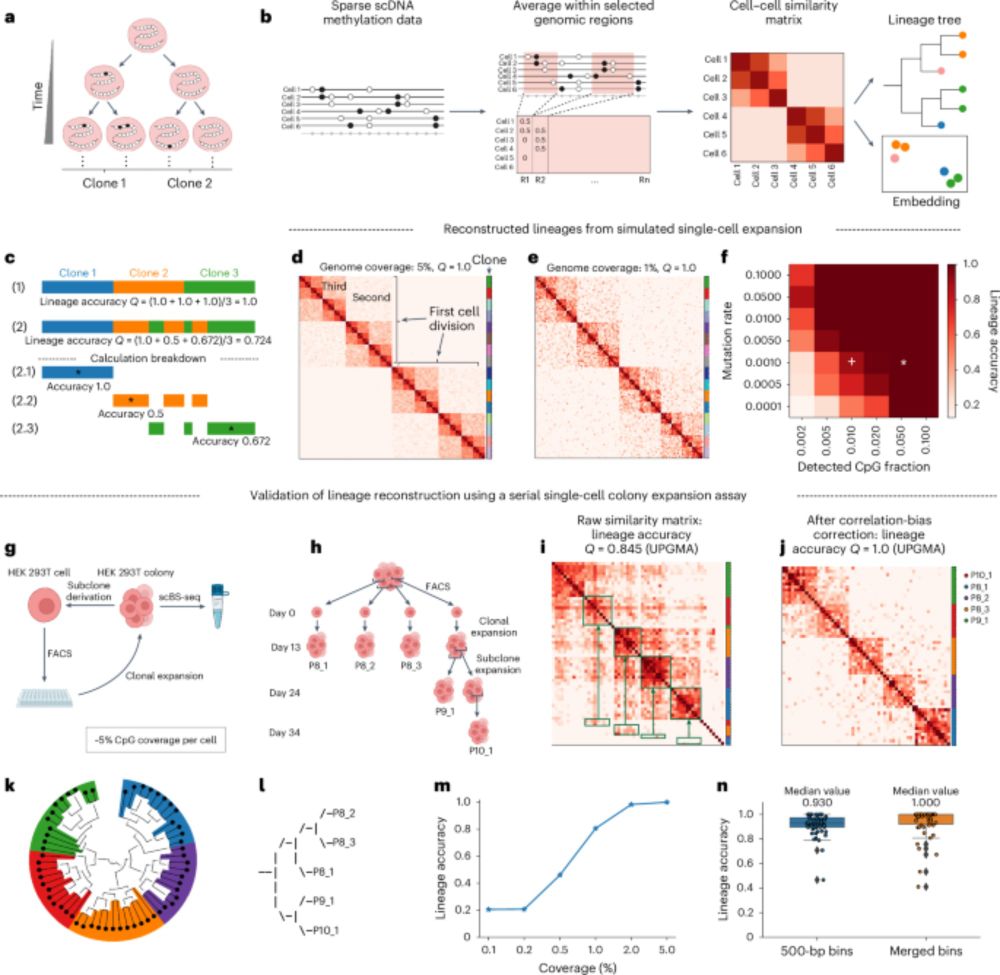
High-resolution, noninvasive single-cell lineage tracing in mice and humans based on DNA methylation epimutations - Nature Methods
This work presents a computational tool MethylTree to infer cell lineages based on epimutations on DNA methylation.
www.nature.com
January 21, 2025 at 8:40 AM
High-resolution, noninvasive single-cell lineage tracing in mice and humans based on DNA methylation epimutations
www.nature.com/articles/s41...
www.nature.com/articles/s41...
Reposted by Yi Zhang

Very excited to announce that the single cell/nuc. RNA/ATAC/multi-ome resource from ENCODE4 is now officially public. This includes raw data, processed data, annotations and pseudobulk products. Covers many human & mouse tissues. 1/
www.encodeproject.org/single-cell/...
www.encodeproject.org/single-cell/...
Single cell – ENCODEHomo sapiens clickable body map
www.encodeproject.org
January 7, 2025 at 9:29 PM
Very excited to announce that the single cell/nuc. RNA/ATAC/multi-ome resource from ENCODE4 is now officially public. This includes raw data, processed data, annotations and pseudobulk products. Covers many human & mouse tissues. 1/
www.encodeproject.org/single-cell/...
www.encodeproject.org/single-cell/...
Reposted by Yi Zhang

Excited to be visiting Duke University to share insights on computational methods for single-cell genomics and CRISPR genome editing! Thank you for hosting me
@yi-zhang-compbio.bsky.social 🙏
@yi-zhang-compbio.bsky.social 🙏
Happening this week with special guest @lucapinello.bsky.social! Check out dmpi.duke.edu/duke-single-... for more information.
We hope to see you all there 🧬
We hope to see you all there 🧬

December 18, 2024 at 1:37 PM
Excited to be visiting Duke University to share insights on computational methods for single-cell genomics and CRISPR genome editing! Thank you for hosting me
@yi-zhang-compbio.bsky.social 🙏
@yi-zhang-compbio.bsky.social 🙏